
How Often Should You Calibrate a Handheld Particle Counter?
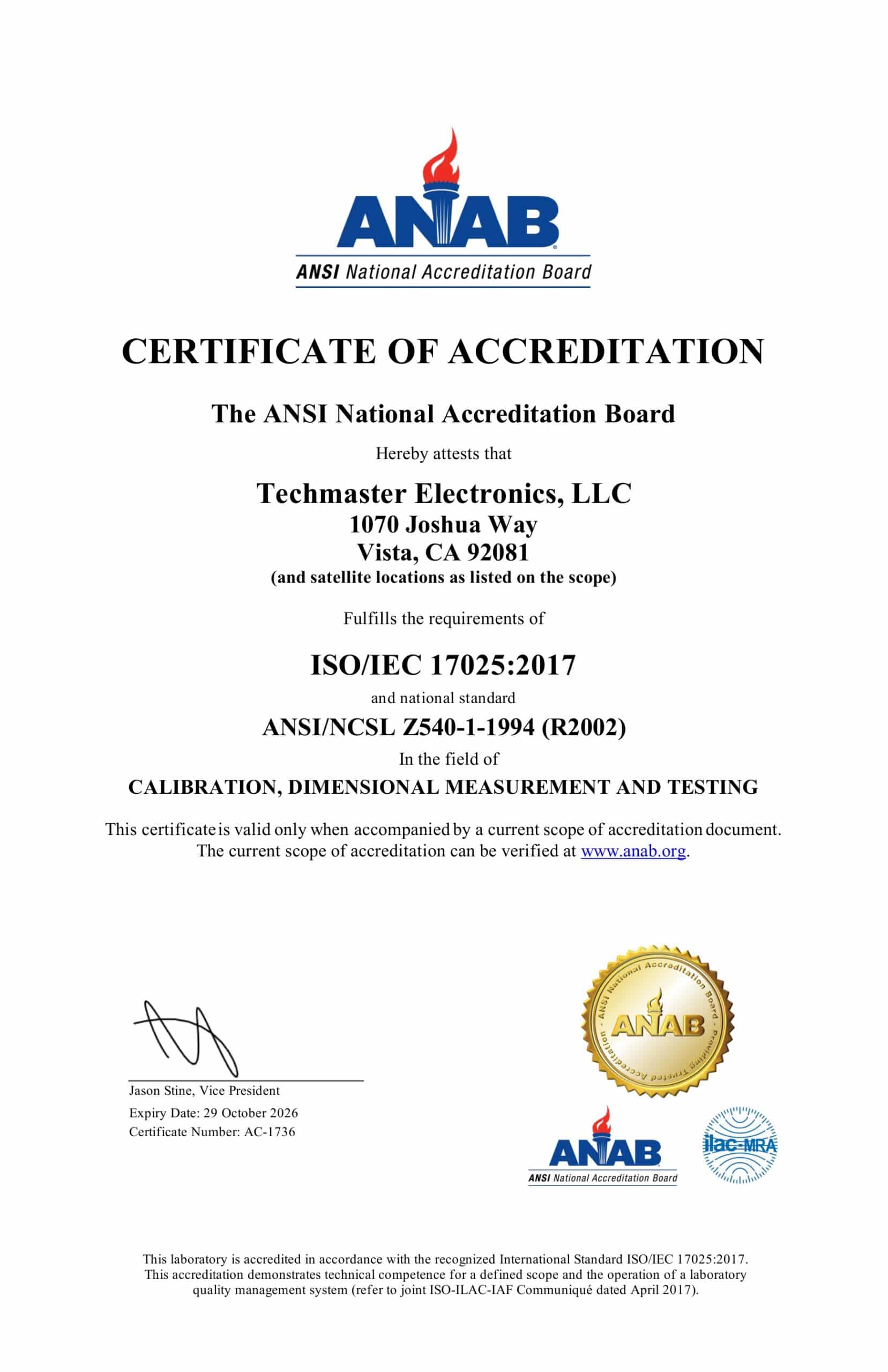
Note on particle counters: This page is for general information only. Techmaster does not calibrate particle counters of any make or model, and particle counters are not on our ANAB ISO/IEC 17025 scope (certificate AC-1736). Techmaster only performs calibration services that are covered by our scope. For particle counter calibration, please contact your instrument’s manufacturer or its authorized service provider, and follow any service requirements they specify. If you prefer, send us your request and, with your permission, we will forward it to the manufacturer. See what is on our accredited scope.
In controlled environments, airborne contamination poses a hidden risk. Consequently, facility managers rely heavily on accurate testing tools. You need precise instruments to protect sensitive products. However, simply owning this equipment does not guarantee ongoing safety. Over time, all measurement devices lose their baseline accuracy. Therefore, quality professionals frequently ask: how often calibrate handheld particle counter units to maintain ISO compliance?
In this complete guide, we will explore the factors that determine your calibration schedule. In addition, we will explain why regular calibration matters. Finally, we will show you what to look for when choosing an accredited calibration laboratory.
1. What Is a Handheld Particle Counter?
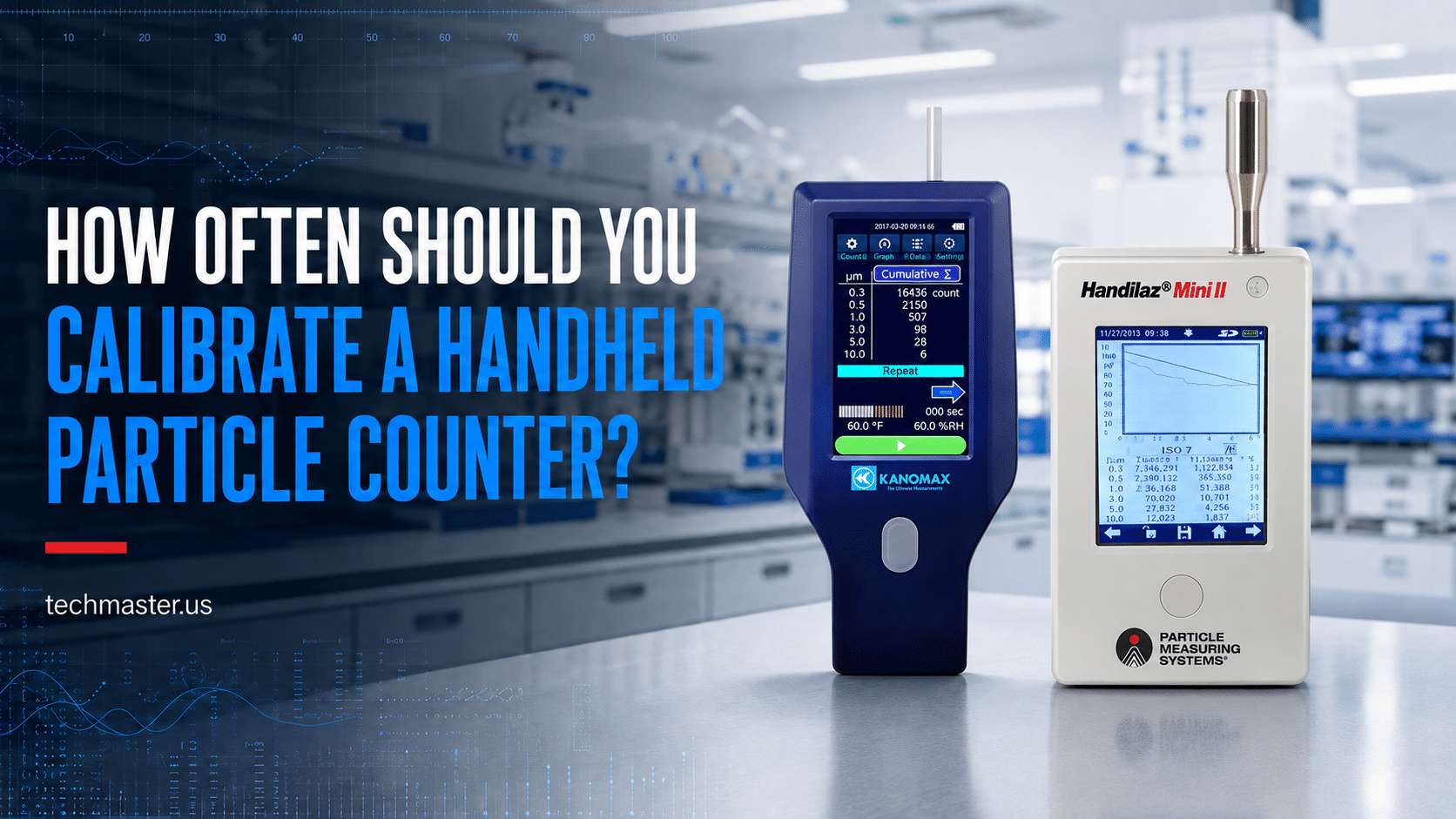
A handheld particle counter is a portable tool. Professionals use it to detect and count airborne particles in a specific area. Specifically, these devices pull air through a small sample chamber. Inside this chamber, a laser beam targets the air stream.
As particles pass through the laser, they scatter light. Then, a photodetector measures this scattered light. In the end, this process determines both the size and the quantity of the particles.
Key Features of Portable Units
These compact devices usually measure particles ranging from 0.3 to 10.0 micrometers. Because they are portable, technicians easily carry them around a facility. For instance, they use them for spot-checking cleanrooms. They also use them to find contamination sources quickly.
2. Why Handheld Particle Counter Calibration Matters
3. Common Applications
Because they offer precise mobile testing, many industries use these devices daily. In fact, you will find them in almost every highly regulated sector.
-
Cleanroom Certification: Technicians spot-check ISO Class 5 through 9 cleanrooms. They ensure the air meets specific purity levels.
-
Pharmaceutical Manufacturing: Quality teams monitor sterile labs. They use these counters to prevent drug contamination.
-
Microelectronics: Semiconductor fabs use them constantly. They must keep microscopic dust off sensitive silicon wafers.
-
Aerospace Assembly: Engineers verify clean zones for satellites. Dust can ruin sensitive optical sensors.
-
Indoor Air Quality (IAQ): Maintenance teams assess HVAC filters. They also test HEPA filters for harmful leaks.
4. Calibration Standards and Traceability
When you test environmental equipment, the testing standard matters greatly. You cannot simply use any basic service. Instead, labs should test particle counters according to ISO 21501-4. This is the global standard for light-scattering airborne particle counters.
Essential Testing Parameters
During a proper ISO 21501-4 particle counter calibration, metrologists test several specific functions. First, they check size calibration. They verify that the device categorizes particle sizes correctly. Second, they measure the flow rate. The internal pump must draw the exact right volume of air.
Third, they perform a zero-count filter test. This confirms the unit reads zero when testing perfectly clean air. Finally, they test counting efficiency against a master reference standard.
Choosing a lab that provides NIST traceable particle counter calibration is crucial. This standard ensures an unbroken chain of documentation. It links your unit directly to national standards.
5. Common Issues Found During Calibration
Routine maintenance often uncovers hidden problems. Even if your device turns on, it might read data incorrectly. Professional Calibration service catches these issues early.
Laser and Optical Degradation
Laser diodes naturally lose intensity as they age. A dim laser fails to scatter enough light. As a result, the device under-counts small particles. In addition, dirty environments contaminate internal mirrors. This causes light scattering errors and false high counts.
Mechanical and Electrical Wear
The internal vacuum pump uses moving parts. Over time, these parts wear out. If the flow rate drops, the device samples less air. Consequently, all volumetric data becomes completely useless. Additionally, portable units face battery issues. Voltage drops can easily cause erratic sensor readings.
6. How Often Should This Equipment Be Calibrated?
How Often Should You Schedule This Vital Service?
Facility managers need clear guidelines. Fortunately, the industry provides a straightforward answer. Evaluate your usage to determine your schedule.
When to Calibrate More Frequently
Specific situations demand a shorter 6-month interval. You must adjust your schedule based on daily usage:
Heavy Daily Use
If technicians run the unit across three shifts, parts wear out much faster.
Harsh Environments
Units working in dirty areas gather dust quickly. They need service sooner than units kept in pristine cleanrooms.
High-Risk Processes
Pharmaceutical compounding often mandates stricter intervals. This mitigates severe safety risks.
Physical Shock (Immediate)
If someone drops the unit, you must recalibrate it immediately. Optical sensors break easily upon impact.
7. What to Look for in a Calibration Provider
You should not trust your critical equipment to just any lab. Instead, you must carefully evaluate your service provider. Look for specific technical qualifications.
Essential Lab Qualifications
First, always demand ISO/IEC 17025 accreditation. This proves the lab has a proven quality system. Second, verify their ISO 21501-4 capability. They must know how to properly test flow rate and counting efficiency.
Third, ask for clear documentation. The lab must provide As-Found and As-Left data. This shows you exactly how the device performed before and after adjustments. Finally, check their turnaround time. You need your equipment back quickly to avoid missing daily checks.
8. Need Equipment Now? Explore Techmaster’s Renting Service
We know that sending equipment away causes problems. Your facility still needs daily monitoring. Quality control does not stop just because a tool is in the lab.
To solve this, Techmaster Electronics offers a convenient renting service. We stock a large inventory of premium handheld particle counters. You can rent a unit while we service yours. Alternatively, you can rent extra units for short-term validation projects. We ship every rental unit fully calibrated. They always arrive with a current NIST-traceable calibration certificate, ready to work immediately.
9. Why Choose Techmaster Electronics?
Techmaster Electronics stands as a premier partner for quality-driven businesses. We help companies that demand complete precision and reliability. With decades of hands-on experience, our metrologists know how to handle sensitive tools.
Our ISO/IEC 17025 accredited laboratories provide rigorous testing for environmental equipment. We proudly serve the aerospace, medical, and electronics industries. In addition, we deliver accurate results with impressive turnaround times.
We perform all tests to the highest industry standards. We also provide clear, audit-ready certificates. As a result, you can face any regulatory audit with total confidence.
10. Conclusion
A handheld particle counter acts as your frontline defense against invisible contamination. However, you must trust the device to trust the data. Calibrating your unit annually remains the best way to prevent drift. It also ensures you meet strict ISO and FDA standards. By partnering with a qualified laboratory, you actively protect your products and your business.
Contact Techmaster Electronics today to discuss your calibration requirements and keep your measurement equipment accurate, reliable, and compliant.
11. FAQ Section
Calibration Expertise & Guidelines
1 What is a handheld particle counter?
2 How often should a handheld particle counter be calibrated?
3 Why is ISO/IEC 17025 calibration important?
4 What happens if equipment is out of tolerance?
5 How do I choose a calibration service provider?
6 What causes a particle counter to lose accuracy?
7 Does Techmaster Electronics provide calibration services for this equipment?
Ready to Ensure Perfect Accuracy?
Don’t risk audit failures or product contamination. Ask your instrument’s manufacturer or its authorized provider for calibration to ISO 21501-4.
Related reading: Cleanroom recovery test under ISO 14644-3: is it required and how is it performed?
References & industry standards
- ISO/IEC 17025 testing & calibration laboratory requirements
- NIST calibration services and measurement traceability
- NIST Time and Frequency Division
- A2LA / ANAB accreditation for calibration laboratories
External standards bodies. Techmaster Electronics is an ISO/IEC 17025-accredited, NIST-traceable calibration laboratory.
Frequently asked questions
What is handheld particle counter calibration?
Handheld Particle Counter Calibration is the documented comparison of a handheld particle counter against NIST-traceable reference standards. It quantifies the handheld particle counter’s error and measurement uncertainty and confirms it performs within tolerance, with as-found and as-left data on the certificate.
How often should a handheld particle counter be calibrated?
Most quality systems calibrate a handheld particle counter every 12 months, or sooner after repair, overload, or before critical measurements. Set your interval from the manufacturer spec and your ISO 9001 / 13485 / AS9100 program and drift history.
Does Techmaster calibrate handheld particle counters?
No. Techmaster Electronics is ISO/IEC 17025:2017 accredited by ANAB (Certificate AC-1736), but particle counters are not on that scope, and Techmaster does not calibrate particle counters of any make or model. For calibration, contact your instrument’s manufacturer or its authorized service provider.
How long does handheld particle counter calibration take?
Turnaround is set by the manufacturer or authorized provider that performs the calibration, so ask them before you ship. Techmaster does not calibrate particle counters.
Where should I send a handheld particle counter for calibration?
To the instrument’s manufacturer or one of its authorized service providers, following any service requirements they specify. Techmaster does not calibrate particle counters; if you send us your request, with your permission we will forward it to the manufacturer.

Khanh Nguyen is the Marketing Manager at Techmaster Electronics, a B2B marketing leader covering the test, measurement, and ISO/IEC 17025 accredited calibration industry across the US and Vietnam markets.