
TL;DR: Torque wrench repair starts with the fault. Some faults are adjustable drift, which calibration fixes. Others are mechanical, a click that no longer breaks cleanly, a spring that has taken a permanent set, a slipping ratchet, and those need repair, then calibration across the range. Storing a wrench at full setting is the single biggest cause of the drift that sends it to a bench in the first place.
When does a torque wrench need repair rather than calibration?
A torque wrench needs repair, not just calibration, when its mechanism is no longer repeatable, when the click will not break cleanly at the set value, the setting will not hold, the ratchet slips, or the spring has taken a permanent set. Calibration measures and, where the design allows, adjusts; it cannot restore a mechanism that has failed mechanically.
Torque tools were one of the larger clusters in the requests reaching our laboratories over the last quarter, including fleets calibrated annually by electrical contractors and single wrenches sent by individual professionals.
Which torque wrench faults need parts?
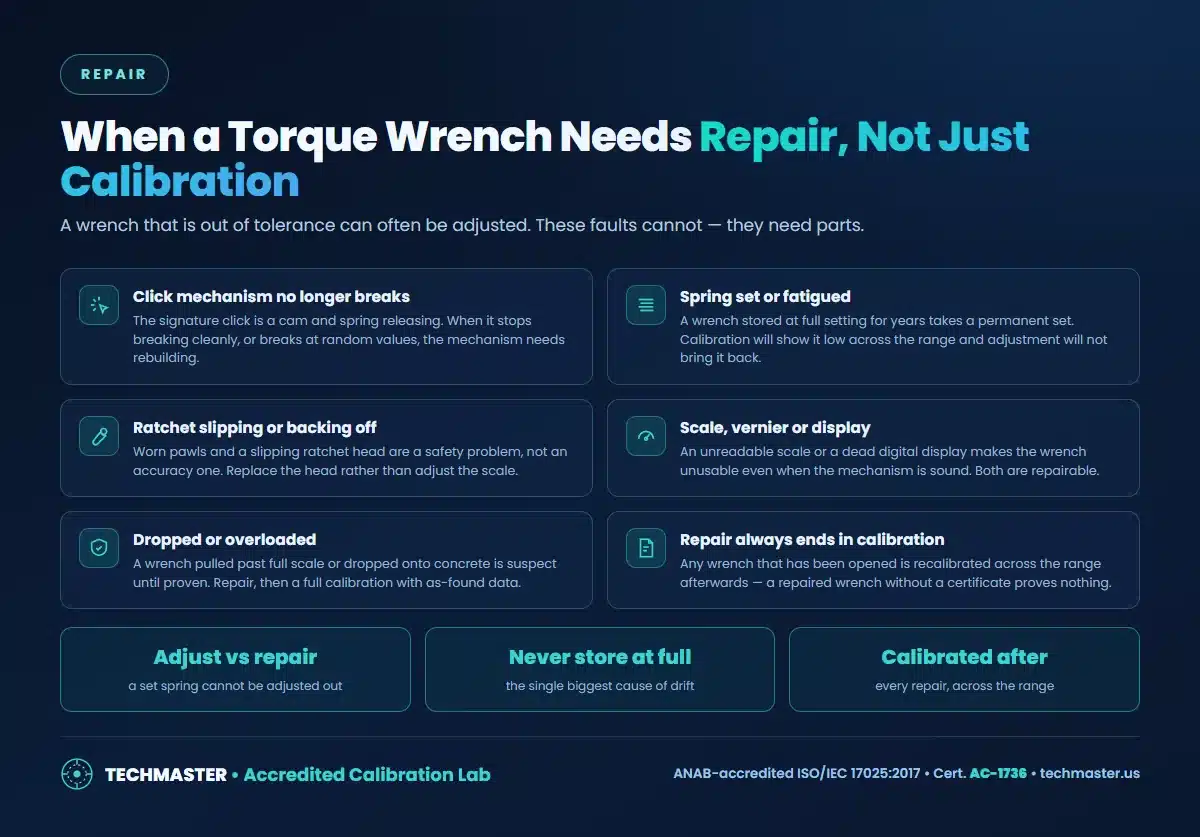
A click mechanism that no longer breaks cleanly, a spring that has taken a permanent set from long storage at full setting, and a slipping or worn ratchet head all need parts. A drifting scale reading, by contrast, is usually corrected by adjustment during calibration.
Adjust, repair, or replace?
| Symptom | Usual answer | Why |
|---|---|---|
| Reads low or high but repeatably | Calibrate and adjust | Drift within the adjustment range |
| Click does not break cleanly | Repair | Cam and spring assembly needs rebuilding |
| Will not hold a setting | Repair | Mechanical fault, not an accuracy offset |
| Ratchet slips under load | Repair | Safety issue; replace the head |
| Reads low across the whole range after long storage | Evaluate | Often a set spring; adjustment will not recover it |
| Dropped or pulled past full scale | Evaluate then calibrate | Suspect until proven, with as-found data |
Why storage is the biggest cause of drift
A setting-type torque wrench stored at or near full scale holds its spring compressed indefinitely, and the spring gradually takes a permanent set, so the wrench reads progressively low. Wind it down to the low end of its range before storage – not to zero, which can unload the mechanism entirely on some designs.
This single habit changes how often a wrench needs work. The interval logic is covered in how often to calibrate a torque wrench.
What happens after the repair?
A calibration across the range, not a single-point check, with as-found and as-left values. The method and tolerances are the same as in routine work, see torque wrench calibration, with related instruments in torque screwdriver calibration and digital torque meter calibration. Torque is on Techmaster’s ANAB ISO/IEC 17025 scope (Cert. AC-1736) at all four accredited laboratories, to 1,000 lbf·ft at the San Antonio laboratory.
Frequently asked questions
Can a torque wrench be repaired, or does it just get replaced?
Most can be repaired. Click mechanisms can be rebuilt, ratchet heads replaced, scales and displays restored. The exception is a wrench whose spring has taken a permanent set, where the mechanism can often still be rebuilt but the economics depend on the wrench. An evaluation quotes the repair against replacement before work begins.
My torque wrench will not hold its setting. Is that a repair?
Yes. A wrench that drifts off its setting, or whose click no longer breaks cleanly at the set value, has a mechanical fault in the cam and spring assembly. Calibration will document the error but cannot correct a mechanism that is no longer repeatable.
Does storing a torque wrench at full setting damage it?
It is the single most common cause of premature drift. The spring is held compressed indefinitely and gradually takes a set, so the wrench reads progressively low. Wind setting-type wrenches down to the low end of their range, not to zero, before storing them.
Is a repaired torque wrench recalibrated?
Always, and across the range rather than at one point. Any wrench that has been opened is calibrated afterwards at multiple points with as-found and as-left data, because the repair changes the mechanism the calibration describes.
The bottom line
If it reads wrong but repeatably, calibrate it. If the mechanism has failed, repair it and then calibrate across the range. And stop storing wrenches at full setting.
Need a quote, a rental, or a repair evaluation?
Techmaster Electronics, ISO/IEC 17025 accredited calibration laboratory, ANAB Cert. AC-1736, founded 1989. Five US labs, 5-day standard turnaround, 1–2 day expedite.
Request a quote →Techmaster Electronics, LLC is an independent ISO/IEC 17025:2017 accredited calibration laboratory. We are not affiliated with, authorized by, or endorsed by any manufacturer named on this page. All product names and model designations are trademarks of their respective owners and are used here only to identify the equipment we calibrate, repair, or rent. Confirm that our accredited scope covers your instrument’s parameters and ranges before shipping, ask us and we will check it against your model list.

Khanh Nguyen is the Marketing Manager at Techmaster Electronics, a B2B marketing leader covering the test, measurement, and ISO/IEC 17025 accredited calibration industry across the US and Vietnam markets.