
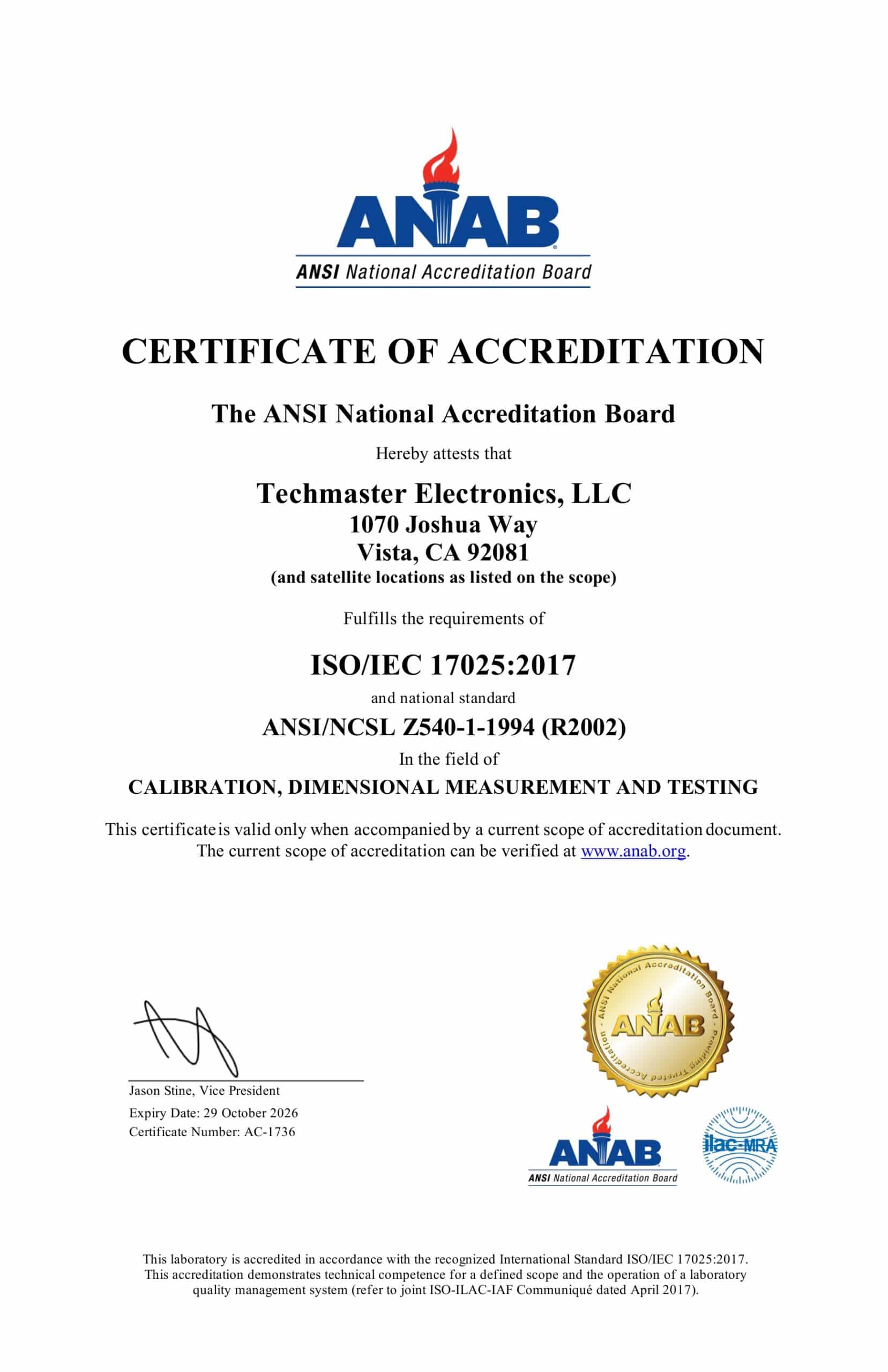
Metrology guide · ISO/IEC 17025 · ANAB-accredited
Capacitance Meter Calibration
Capacitance Meter Calibration verifies a Capacitance Meter against NIST-traceable standards under ISO/IEC 17025. Techmaster performs a documented multi-point check, reports measurement uncertainty, and issues an ANAB-accredited certificate, in-lab or on-site across the USA.
ANAB accredited ISO/IEC 17025 NIST traceable
ISO 17025Accredited method
NISTTraceability
12 moTypical interval
ANABAccreditation
In this guide
Accuracy across the range
Typical as-found results: the indicated error at each test point stays inside the acceptance tolerance band, with measurement uncertainty reported per point.
How Capacitance Meter calibration works
- Intake & visual inspection
- Environmental stabilization
- As-found measurement
- Comparison to NIST-traceable standards
- Adjustment if required
- As-left results & certificate
Your calibration, covered
In-lab calibrationAccredited bench service with pickup
On-site calibrationWe calibrate at your facility
Expedited turnaroundRush options to cut downtime
Accredited certificateANAB ISO 17025 with uncertainty
In-lab vs on-site calibration
In-lab calibration
- Accredited bench with full reference standards
- Best achievable measurement uncertainties
- Pickup & return logistics handled
- Ideal for precision and reference work
On-site calibration
- We calibrate the Capacitance Meter at your facility
- No shipping risk or transit downtime
- As-found data captured before any move
- Ideal for fixed, large or sensitive assets
In-depth guide
The accuracy of electronic components is the “heartbeat” of every modern electrical system. Among these, capacitance plays a key role in noise filtering, energy storage, and signal coordination. But is your device actually reading the true value?
This complete guide dives deep into the Capacitance Meter calibration process, ensuring you maintain peak performance and meet strict industry standards.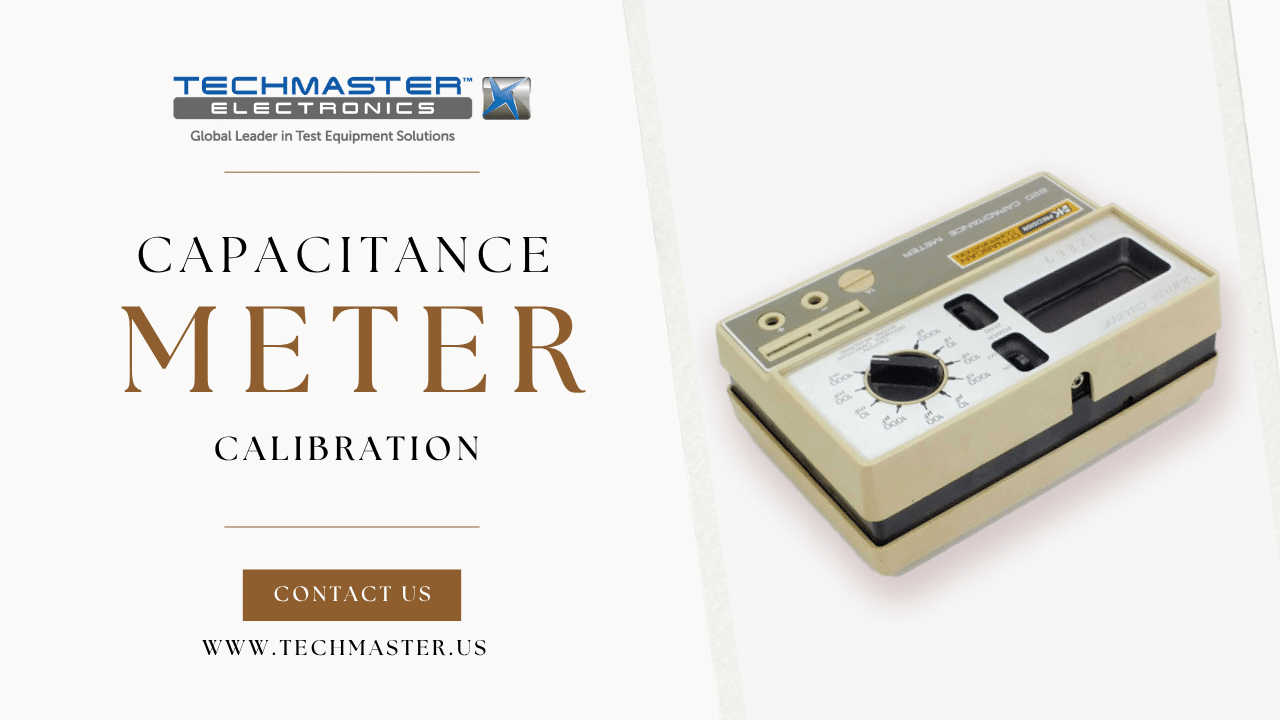
Understanding the Device: What is a Capacitance Meter?
A capacitance meter is a specialized piece of electronic test equipment used to measure the electrical capacitance of discrete capacitors or components. Modern devices range from simple handheld digital multimeters with capacitance functions to high-precision LCR meters (Inductance, Capacitance, and Resistance).Key Applications in Industry
- Quality Control: Verifying that manufactured capacitors meet their labeled tolerance (e.g., ±5% or ±10%).
- Research & Development: Analyzing the frequency response of new dielectric materials.
- Maintenance & Repair: Identifying “leaky” or degraded electrolytic capacitors in power supplies, which are a leading cause of hardware failure.
- Automotive & Aerospace: Ensuring sensors and timing circuits operate within safety-critical margins.
Why is Capacitance Tester Calibration Essential?
In industrial environments, measurement tools are subject to temperature fluctuations, humidity, and the natural aging of internal components. A minor drift in capacitance measurement can lead to catastrophic failures in complex control circuits. Performing regular Capacitance Tester calibration is not just a technical preference; it is a mandatory requirement for quality management systems like ISO 9001. It helps in:- Validating the integrity of measurement data.
- Detecting latent equipment drift before it impacts production.
- Ensuring global traceability and compliance with international standards.
Professional Procedure: Calibrating Capacitor Testers
Calibrating capacitor testers requires careful attention to detail and the use of reference standards with an accuracy ratio of at least 4:1 (the 4:1 Test Uncertainty Ratio rule).Step 1: Environmental Stabilization
Before beginning, the equipment must undergo a “warm-up” period of at least 30 minutes to stabilize internal oscillators. The laboratory environment should ideally be maintained at 23°C ± 2°C with controlled humidity.Step 2: Zero Point Adjustment (The Foundation of Accuracy)
This is the most critical phase of Digital capacitance meter adjustment. Stray capacitance from test leads can add several picofarads (pF) of error.- Open Circuit Calibration: Ensures the meter reads zero when leads are separated.
- Short Circuit Calibration: Compensates for the residual resistance and inductance of the probes.
Step 3: Multi-point Verification & Linearity Check
Measurements must be taken across the device’s full dynamic range using NIST-traceable standard capacitors:- Low Range (pF): Tests sensitivity and signal-to-noise ratio.
- Medium Range (nF/µF): Covers the most common general-purpose applications.
- High Range (mF): Validates the meter’s ability to handle large charging currents without voltage sag.
Advanced Analysis: Dielectric Absorption and Dissipation Factor
To achieve true professional-grade authority in measurement, one must look beyond simple microfarad readings. High-end Digital capacitance meter adjustment often involves evaluating the Dissipation Factor (D) and Equivalent Series Resistance (ESR). A capacitor might show the correct “capacity” but fail in a circuit due to high ESR. During calibration, we analyze the phase angle of the impedance. If the phase shift deviates from the ideal 90 degrees, it indicates energy loss within the dielectric. Professional calibration ensures that your meter correctly distinguishes between a healthy capacitor and one that is physically degrading despite a “good” capacitance reading.The Importance of Traceability and NIST Standards
A professional Capacitance Meter calibration is incomplete without established traceability to national or international standards, such as those maintained by NIST (National Institute of Standards and Technology). Traceability provides an unbroken chain of comparisons, ensuring that a measurement taken in your facility is equivalent to one taken anywhere else in the world. When a laboratory performs Capacitance Tester calibration, they provide a “Calibration Certificate” that includes the uncertainty of measurement. This data is vital for high-stakes industries where even a 1% error margin can lead to safety recalls or system instability. By aligning your equipment with these rigorous standards, you not only improve technical accuracy but also enhance the legal and commercial standing of your quality assurance processes.The Impact of Frequency on Calibration Results
Capacitance is not a static value; it is frequency-dependent. For instance, an electrolytic capacitor measured at 120Hz will yield a different result than at 1kHz. When performing Capacitance Meter calibration, it is vital to match the test frequency to the component’s intended application. High-frequency bypass capacitors should be calibrated at 100kHz, while bulk filter capacitors are typically tested at lower frequencies. Failure to account for the “frequency sweep” characteristics during adjustment can lead to a false sense of security regarding component tolerance.FAQ – Frequently Asked Questions
1. How often should a capacitance meter be calibrated?
The industry standard is every 12 months. However, if the device is used in harsh environments or for high-precision aerospace projects, a 6-month interval is recommended.2. Can I perform calibration in-house?
You can perform a “cross-check” using low-tolerance (1%) reference capacitors. However, for a legally valid Calibration Certificate (ISO/IEC 17025), the device must be processed by an accredited metrology lab.3. What is the difference between “Adjustment” and “Calibration”?
Calibration is the act of comparing a device to a known standard and recording the deviation. Adjustment is the act of modifying the device’s internal settings to bring it back within specifications.Conclusion & Call to Action (CTA)
Maintaining precision through Capacitance Meter calibration is a smart investment in product quality and corporate reputation. Don’t let minor measurement drifts turn into major financial losses. Need professional calibration services or expert technical consultation? Contact our certified metrology team today for a comprehensive quote and ensure your instruments are operating at peak precision!Frequently asked questions
What is Capacitance Meter Calibration?
Capacitance Meter Calibration is the documented comparison of a Capacitance Meter against NIST-traceable reference standards under ISO/IEC 17025, measuring its error and measurement uncertainty and confirming it performs within tolerance.
How often should a Capacitance Meter be calibrated?
Most quality systems calibrate a Capacitance Meter every 12 months, and sooner after repair, overload or heavy use. Follow the manufacturer specification and your ISO 9001/13485/AS9100 program.
What standards apply to Capacitance Meter Calibration?
Calibration is performed under ISO/IEC 17025 with NIST-traceable references and the relevant manufacturer specification. Techmaster is ANAB-accredited.
What is included on the certificate?
An ANAB-accredited ISO/IEC 17025 certificate with as-found and as-left results and the measurement uncertainty for each point.
Can you calibrate the Capacitance Meter on-site?
Yes. Techmaster offers in-lab calibration with pickup and on-site service across the USA to minimize downtime.
Need Capacitance Meter calibration?
ANAB-accredited, NIST-traceable, fast turnaround, in-lab or on-site across the USA.
Contact us for a quoteReferences & industry standards
- ISO/IEC 17025 testing & calibration laboratory requirements
- NIST calibration services and measurement traceability
- A2LA / ANAB accreditation for calibration laboratories
External standards bodies. Techmaster Electronics is an ISO/IEC 17025-accredited, NIST-traceable calibration laboratory.

Khanh Nguyen is the Marketing Manager at Techmaster Electronics, a B2B marketing leader covering the test, measurement, and ISO/IEC 17025 accredited calibration industry across the US and Vietnam markets.