
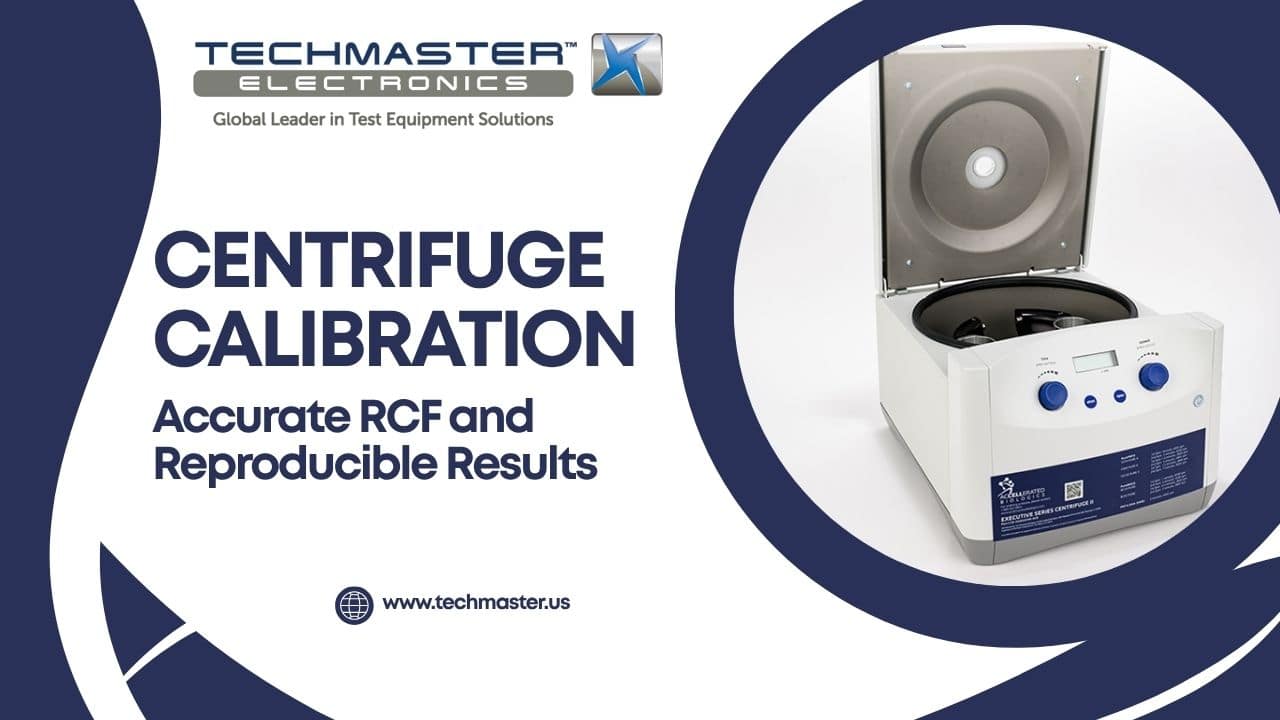
Centrifuge Calibration
Accuracy across the range
How Centrifuge calibration works
- Intake & visual inspection
- Environmental stabilization
- As-found measurement
- Comparison to NIST-traceable standards
- Adjustment if required
- As-left results & certificate
Your calibration, covered
In-lab vs on-site calibration
In-lab calibration
- Accredited bench with full reference standards
- Best achievable measurement uncertainties
- Pickup & return logistics handled
- Ideal for precision and reference work
On-site calibration
- We calibrate the Centrifuge at your facility
- No shipping risk or transit downtime
- As-found data captured before any move
- Ideal for fixed, large or sensitive assets
In-depth guide
Benchtop Centrifuge: The Core Role in Sample Analysis and The Imperative of Calibration
1. Operating Principle and Applications in the Laboratory
The centrifuge generates Relative Centrifugal Force (RCF), which is exerted on the samples. As a result, denser particles move away from the axis of rotation, thereby separating themselves from the lighter components.
Clinical Medicine
Molecular Biology
Quality Control (QC)
1.1. Applications in Clinical Medicine and Diagnostics
- Blood Separation: This is the most common application. The centrifuge separates whole blood into its components: plasma/serum, red blood cells, and platelets. This is necessary for biochemical, hematological, and immunological assays.
- Preparation of Urine/Body Fluid Samples: Centrifugation helps concentrate solid components (cells, crystals, bacteria) in urine or other body fluids for examination and pathological diagnosis.
1.2. Applications in Biotechnology and Molecular Biology
- DNA/RNA/Protein Extraction: Centrifugation is a crucial step for pelleting and isolating biological macromolecules from cells or lysates.
- Harvesting Cells and Microorganisms: Separating microorganisms (bacteria, yeast) or cultured cells from their growth media for research or production.
1.3. Applications in the Pharmaceutical Industry and QC
- Pharmaceutical Quality Control: Centrifugation is used to determine sediment volume, dispersion stability of suspensions, or to check the homogeneity of components in liquid pharmaceutical products.
- Sample Preparation for Testing: Centrifuging samples prior to analysis with more complex instruments (such as chromatography) to remove interfering solid particles.
2. Critical Parameters Requiring Control

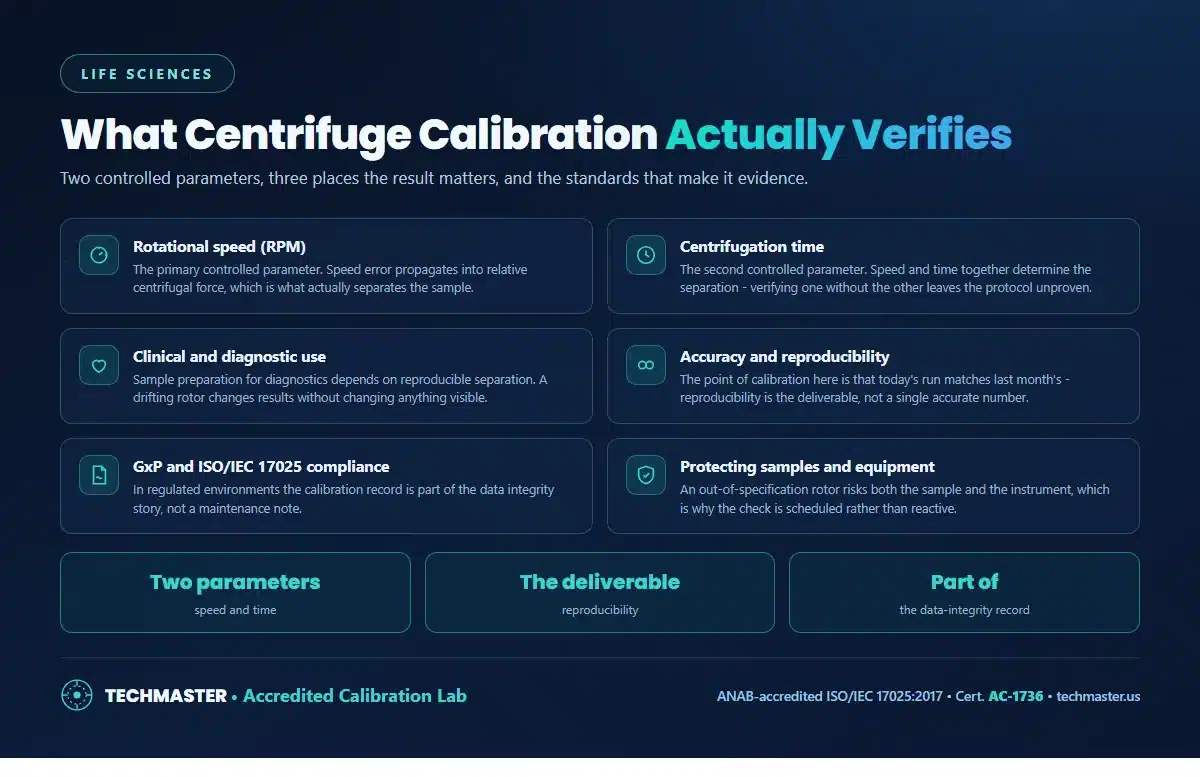
The performance of a centrifuge is determined by two fundamental and closely related parameters. Specifically, these are the rotational speed (RPM) and the centrifugation time, which together define the efficiency and reliability of the separation process.
2.1. Rotational Speed (RPM – Revolutions Per Minute)
- Significance: This is the speed of the rotor. RCF (actual centrifugal force) is directly proportional to the square of the RPM.
- Importance: Inaccurate speed will result in a deviation in RCF. This can lead to incomplete separation or damage to sensitive samples (like cells or proteins).
2.2. Centrifugation Time
- Significance: The time required to achieve the desired separation.
- Importance: Inaccurate timing, especially when caused by a faulty timer, can significantly affect test reliability. As a result, experimental outcomes become non-reproducible between different tests or across various laboratories.
ROTATIONAL SPEED (RPM)
Inaccurate RPM generates incorrect RCF, leading to incomplete separation or damage to sensitive samples (e.g., proteins or cells).

CENTRIFUGATION TIME
A faulty timer makes results non-reproducible and non-compliant with standard operating procedures (SOPs).
35 second deviation: causes over-pelleting and reduces the purity and yield of the supernatant.
3. The Key role of Centrifuge Calibration
Centrifuge Calibration is a mandatory procedure that involves both verification and adjustment of critical technical parameters. In addition, it ensures that the device operates accurately and consistently according to the manufacturer’s specifications or established test protocols. Therefore, regular calibration is essential for maintaining measurement traceability, data reliability, and compliance with quality standards such as GLP and GMP.
3.1. Ensuring Accuracy and Reproducibility
- Speed Verification: During calibration, certified speed measurement devices are used to accurately verify the actual RPM against the value displayed on the machine. Consequently, this process ensures that the Relative Centrifugal Force (RCF) applied to the sample remains exactly as required by the specified protocol.
- Timer Verification: Verifying the accuracy of the timer guarantees that centrifugation time is strictly controlled, thereby maintaining the reproducibility of test results.
3.2. Compliance with GxP and ISO/IEC 17025 Regulations
- GLP (Good Laboratory Practice) and GMP (Good Manufacturing Practice): These regulations require all critical equipment, including centrifuges, to undergo regular performance checks and calibration. Calibration records are indispensable evidence during inspections and audits.
- Preventing Analytical Errors: Accurate centrifugation is the first step in ensuring the reliability of subsequent assays. Calibration minimizes the risk of analytical errors originating from the equipment.
3.3. Protecting Samples and Equipment
- Risk of Imbalance: Inaccurate centrifugation or imbalance can cause severe vibration, damaging samples (e.g., cell lysis) or damaging the rotor and motor itself. Calibration includes checking and adjusting rotor balance.
- Safety: Centrifuges operate at high speeds. Significant errors can lead to catastrophic rotor failure, posing a danger to operators.
Calibration Procedure: Verifying Accuracy
Calibration is the mandatory process of verifying and adjusting technical parameters to ensure the centrifuge operates according to manufacturer standards (GLP/GMP).
4. Importance of the Calibration Service Provider
Choosing a competent calibration provider is a key factor:- Standard Recognition: Ideally, the provider should hold ISO/IEC 17025 accreditation, as this certification clearly demonstrates both technical competence and a robust quality management system. Also, it ensures international recognition by authoritative bodies and regulatory organizations.
- Traceability: All reference standards used for calibration (such as tachometers, timers) must be traceable to national or international measurement standards.
Reproducibility
Ensures consistent test results between different runs and different laboratory sites.
GLP / GMP Compliance
Calibration records are essential legal evidence for all quality audits and inspections.
Sample & Equipment Protection
Prevents rotor imbalance, reduces vibration, protects sensitive samples and extends machine lifespan.
Conclusion
The Benchtop Centrifuge is an irreplaceable diagnostic tool; however, its value is only maintained when operating within verified accuracy. Therefore, routine Centrifuge Calibration is not just an administrative requirement but also a strategic step to safeguard the integrity of research, clinical testing, and the quality of pharmaceutical products. Also, by ensuring that centrifugation speed and time are always precise, laboratories can establish a robust foundation for all scientific and medical decisions.YOUR RELIABLE CALIBRATION PARTNER
Don’t let equipment inaccuracies jeopardize your research and production.
TECHMASTER ELECTRONICS
ISO/IEC 17025 accredited calibration service provider, ensuring traceability to national measurement standards.
Request Calibration Service NowCentrifuge Calibration Certificates, RCF and Standardizing Across Sites
A centrifuge certificate is only useful if it covers the parameters your method depends on. For most benchtop and floor units that means three checks, each at more than one setpoint:
- Rotor speed: measured with a non-contact optical tachometer against reflective tape, compared with the displayed rpm. Our tachometer calibration guide explains how that reference is itself verified.
- Run time: the built-in timer compared with a reference time standard over a full cycle.
- Chamber temperature: for refrigerated models, a calibrated probe in the chamber at the temperature you run.
RCF: why the rotor radius comes first
Protocols specify relative centrifugal force (×g), not rpm, because the same rpm produces different force in different rotors. Before you can establish the RCF of a centrifuge, you need the rotor radius: the distance from the center of rotation to the bottom of the tube, in centimeters. Then:
RCF = 1.118 × 10⁻⁵ × r × rpm²
For example, a 10 cm radius at 3,000 rpm gives about 1,006 ×g. A 1% error in speed becomes roughly a 2% error in force, because speed is squared. That is why speed verification matters more than any other check on the certificate.
Standardizing centrifuges across several lab sites
When the same assay runs in more than one lab, results only match if every site controls the same things. The approach that works:
- Write methods in ×g and minutes, and convert to rpm per rotor at each site.
- Use one written acceptance tolerance for speed, time and temperature at every site.
- Keep the same calibration interval and the same certificate format, so results can be compared side by side.
- Re-verify after any rotor change, repair or relocation, not only on the due date.
Clinical and blood bank centrifuges
Clinical laboratories and blood banks are usually held to accreditation checklists, such as CAP or AABB, that require periodic speed and timer checks with documented results. Serologic centrifuges also go through a functional calibration that sets the optimal spin time for agglutination reactions. That step is run by the laboratory with its own reagents, alongside the instrument calibration.
Techmaster performs centrifuge speed, timer and temperature checks with NIST-traceable reference equipment. Centrifuges are not listed on our ANAB scope, so these certificates are traceable rather than ISO/IEC 17025 accredited. Ask before booking if your auditor requires an accredited certificate.
Frequently asked questions
What is Centrifuge Calibration?
How often should a Centrifuge be calibrated?
What standards apply to Centrifuge Calibration?
What is included on the certificate?
Can you calibrate the Centrifuge on-site?
Need Centrifuge calibration?
ANAB-accredited, NIST-traceable, fast turnaround, in-lab or on-site across the USA.
Contact us for a quoteReferences & industry standards
- ISO/IEC 17025 testing & calibration laboratory requirements
- NIST calibration services and measurement traceability
- A2LA / ANAB accreditation for calibration laboratories
External standards bodies. Techmaster Electronics is an ISO/IEC 17025-accredited, NIST-traceable calibration laboratory.

Khanh Nguyen is the Marketing Manager at Techmaster Electronics, a B2B marketing leader covering the test, measurement, and ISO/IEC 17025 accredited calibration industry across the US and Vietnam markets.