LiDAR & Radar Sensor Calibration for Self-Driving Cars
August 4, 2025
Metrology guide · ISO/IEC 17025 · ANAB-accredited
LiDAR & Radar Sensor Calibration
LiDAR & Radar Sensor Calibration verifies a LiDAR & Radar Sensor against NIST-traceable standards under ISO/IEC 17025. Techmaster performs a documented multi-point check, reports measurement uncertainty, and issues an ANAB-accredited certificate — in-lab or on-site across the USA.
Typical as-found results: the indicated error at each test point stays inside the acceptance tolerance band, with measurement uncertainty reported per point.
How LiDAR & Radar Sensor calibration works
Intake & visual inspection
Environmental stabilization
As-found measurement
Comparison to NIST-traceable standards
Adjustment if required
As-left results & certificate
Your calibration, covered
In-lab calibrationAccredited bench service with pickup
On-site calibrationWe calibrate at your facility
Expedited turnaroundRush options to cut downtime
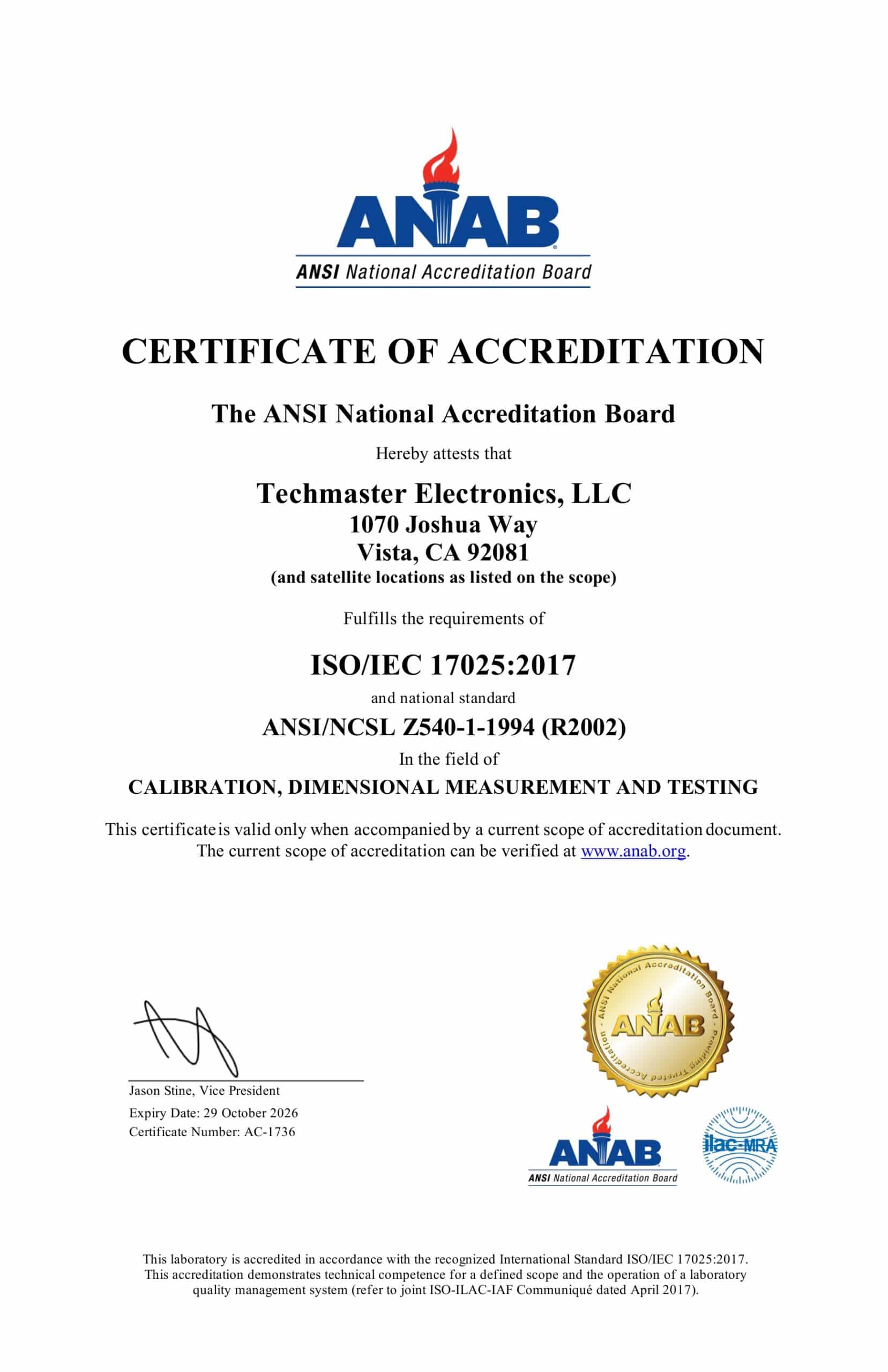
Accredited certificateANAB ISO 17025 with uncertainty
In-lab vs on-site calibration
In-lab calibration
Accredited bench with full reference standards
Best achievable measurement uncertainties
Pickup & return logistics handled
Ideal for precision and reference work
On-site calibration
We calibrate the LiDAR & Radar Sensor at your facility
No shipping risk or transit downtime
As-found data captured before any move
Ideal for fixed, large or sensitive assets
In-depth guide
LiDAR & Radar Sensor Calibration: The Solid Foundation of Traffic Safety
The evolution of automotive technology has entered a new era. The future of transportation is not just about speed but also about the intelligence and safety of our vehicles. Advanced Driver-Assistance Systems (ADAS) and self-driving car technology are becoming increasingly common, changing how we travel. However, behind the convenience and safety these systems provide lies a fundamental element that few people know about: the absolute precision of the vehicle’s “senses”—its sensors. LiDAR and Radar sensors act as the “eyes” of a self-driving car. They scan and build a complete picture of the surrounding environment. But like human eyes, they can become blurry, misaligned, or need adjustment. A minor collision, a bumpy road, or even a windshield replacement can cause a sensor’s position to shift. A slight misalignment in a measurement can have a major consequence. This is why LiDAR & Radar sensor calibration is not just a standard technical service but a vital process that ensures the absolute safety of drivers, passengers, and everyone on the road.
1. The Technologies Behind Autonomous Driving
Modern self-driving technology does not rely on a single type of sensor. Instead, it combines multiple sensor types to create a comprehensive and reliable picture. The two most prominent technologies are Radar and LiDAR.
1.1. Radar – The All-Weather Navigator
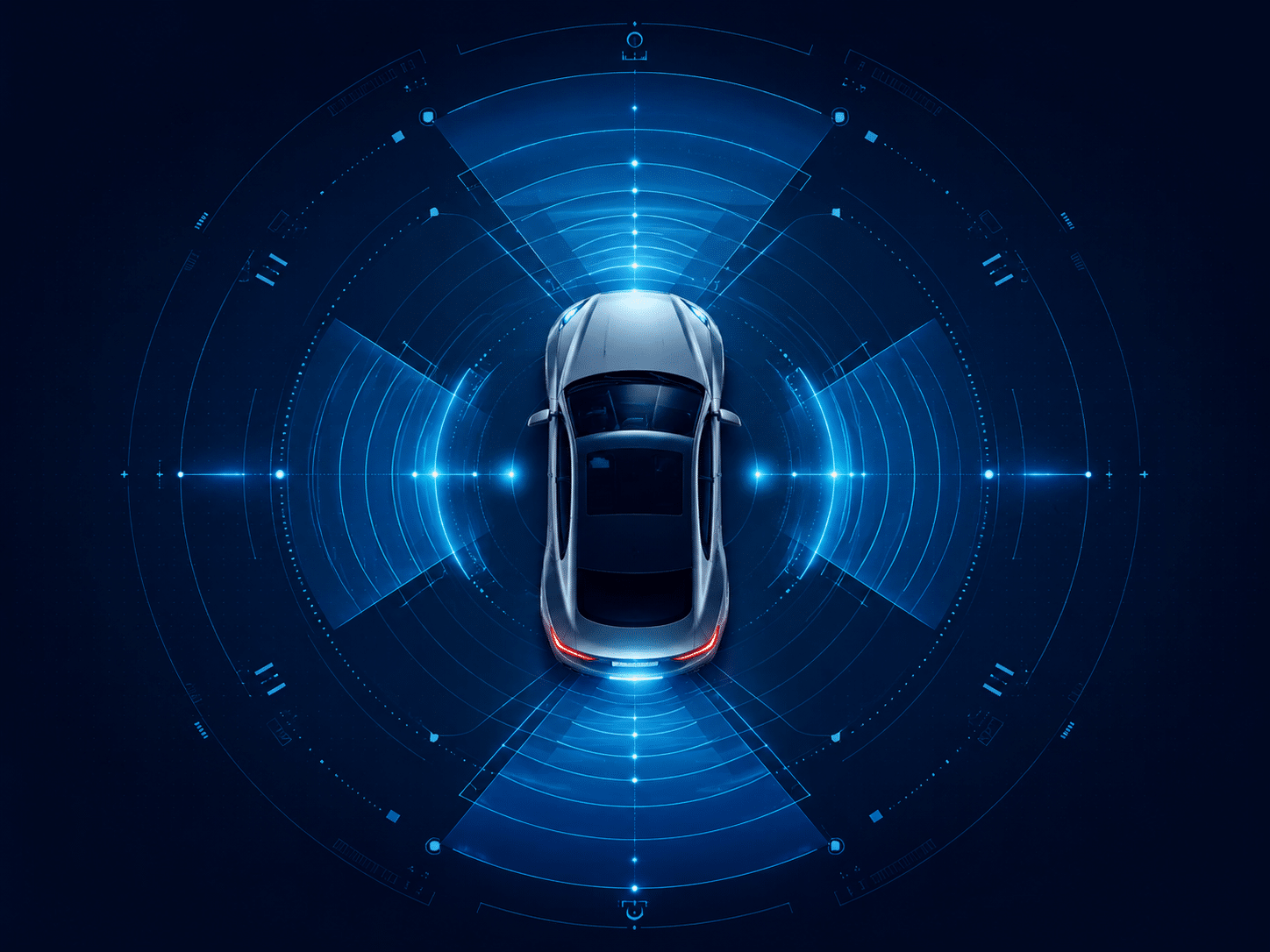
Radar surrounding a car
Principle: Radar (Radio Detection and Ranging) operates on radio waves. The device emits radio waves and measures the time it takes for the waves to bounce back. This data helps calculate the distance, speed, and angle of objects in front of the car.
Advantages: Radar’s biggest advantage is its ability to function well in harsh weather conditions. Heavy rain, fog, snow, or dust do not significantly affect radio waves. This allows the car to “see” even when visibility is limited.
Limitations: However, Radar has a low resolution. It can identify an object, but it struggles to distinguish whether it’s a pedestrian, a bicycle, or a streetlight.
1.2. LiDAR – The Sophisticated 3D Visionary
LiDAR sensor
Principle: LiDAR (Light Detection and Ranging) uses laser pulses to scan the environment. It measures the time for each laser pulse to return, creating a “point cloud” of data that builds a detailed 3D map of the surroundings.
Advantages: LiDAR has extremely high resolution. It not only measures distance but can also recognize the detailed shape and size of objects. This allows the system to differentiate a pedestrian from a motorcycle, or a tree branch from a large obstruction.
Limitations: LiDAR is affected by weather conditions. Heavy rain or dense fog can interfere with the laser beams, reducing the accuracy of its measurements.
1.3. The Synergistic Combination:
Modern self-driving cars use both technologies to compensate for each other’s weaknesses. Radar provides a reliable “view” in all weather conditions, while LiDAR adds high-resolution detail. This combination creates a robust and comprehensive perception system that helps the car make safe and accurate decisions.
2. Why Precise Sensor Adjustment is Critical
Despite their robust design, these sensors can still become misaligned. Their accuracy is not permanent.
2.1. Factors Causing Sensor Misalignment:
Physical Impact: Even a minor collision, driving over potholes, or continuous road vibration can change a sensor’s position. A misalignment can be as small as a fraction of a millimeter, but in a distance measurement, it can create a significant error.
Environmental Factors: Extreme temperatures, high humidity, and the accumulation of dirt or ice on the sensor’s surface can all affect its performance.
Maintenance and Repair: After replacing a windshield, a front bumper, or repairing the car’s body, the position of an integrated sensor may no longer be accurate, requiring recalibration.
2.2. The Dangerous Consequences of Miscalibration:
Faulty ADAS Operation: Misaligned sensors can lead to dangerous errors. For example, a collision warning system might not activate. Conversely, it might trigger an emergency brake unnecessarily, creating a hazard for the car and other vehicles.
Compromised Traffic Safety: A slight error in distance measurement can mean the system fails to recognize an obstacle or a pedestrian in time, leading to a serious collision.
Regulatory Violations: Regulatory bodies like NHTSA (U.S.) and Euro NCAP (Europe) have strict vehicle safety standards. An uncalibrated system can violate these standards, resulting in legal risks and financial losses.
3. The Professional Calibration Procedure
Calibration is a complex technical process. It requires specialized equipment and a team of well-trained technicians.
3.1. More Than a Simple Alignment
Calibration is not merely a physical adjustment of the sensor’s position. It is a scientific process, involves comparing sensor data to precise reference values. It then adjusts both the hardware and software of the sensor to achieve maximum accuracy.
3.2. A Step-by-Step Guide:
Diagnosis: A technician uses a specialized scanner to read the sensor data and check for existing errors.
Calibration Environment Setup: The vehicle is placed in a dedicated area. Standard targets like Radar reflectors or LiDAR calibration boards are positioned at precise distances and angles.
Adjustment and Correction: Specialized software guides the technician to perform the necessary adjustments. This could be a meticulous physical adjustment or a software-based correction.
Post-Calibration Verification: After adjustments, the system is re-tested to verify that the sensor data perfectly matches the reference values.
Documentation: A detailed, traceable calibration report is generated. This report serves as proof that the device has been properly calibrated, ensuring compliance with safety standards.
4. Looking Ahead: Calibration as a Standard
In the near future, as autonomous features become standard on every car, sensor calibration will become an indispensable part of routine vehicle maintenance. It will not be a choice but a mandatory requirement.
In conclusion, LiDAR and Radar technology has ushered in a new era of traffic safety. But it is LiDAR & Radar Sensor Calibration that serves as the critical foundation ensuring that safety. It guarantees that the “eyes” of a self-driving car are always in top condition, able to “see” accurately and “understand” the environment. For every automaker, service center, and consumer, prioritizing professional sensor calibration is the best way to protect themselves and everyone else on the road.
Frequently asked questions
What is LiDAR & Radar Sensor Calibration?
LiDAR & Radar Sensor Calibration is the documented comparison of a LiDAR & Radar Sensor against NIST-traceable reference standards under ISO/IEC 17025, measuring its error and measurement uncertainty and confirming it performs within tolerance.
How often should a LiDAR & Radar Sensor be calibrated?
Most quality systems calibrate a LiDAR & Radar Sensor every 12 months, and sooner after repair, overload or heavy use. Follow the manufacturer specification and your ISO 9001/13485/AS9100 program.
What standards apply to LiDAR & Radar Sensor Calibration?
Calibration is performed under ISO/IEC 17025 with NIST-traceable references and the relevant manufacturer specification. Techmaster is ANAB-accredited.
What is included on the certificate?
An ANAB-accredited ISO/IEC 17025 certificate with as-found and as-left results and the measurement uncertainty for each point.
Can you calibrate the LiDAR & Radar Sensor on-site?
Yes. Techmaster offers in-lab calibration with pickup and on-site service across the USA to minimize downtime.