
Piezoelectric Accelerometer Calibration…
Accuracy across the range
How Piezoelectric Accelerometer calibration works
- Intake & visual inspection
- Environmental stabilization
- As-found measurement
- Comparison to NIST-traceable standards
- Adjustment if required
- As-left results & certificate
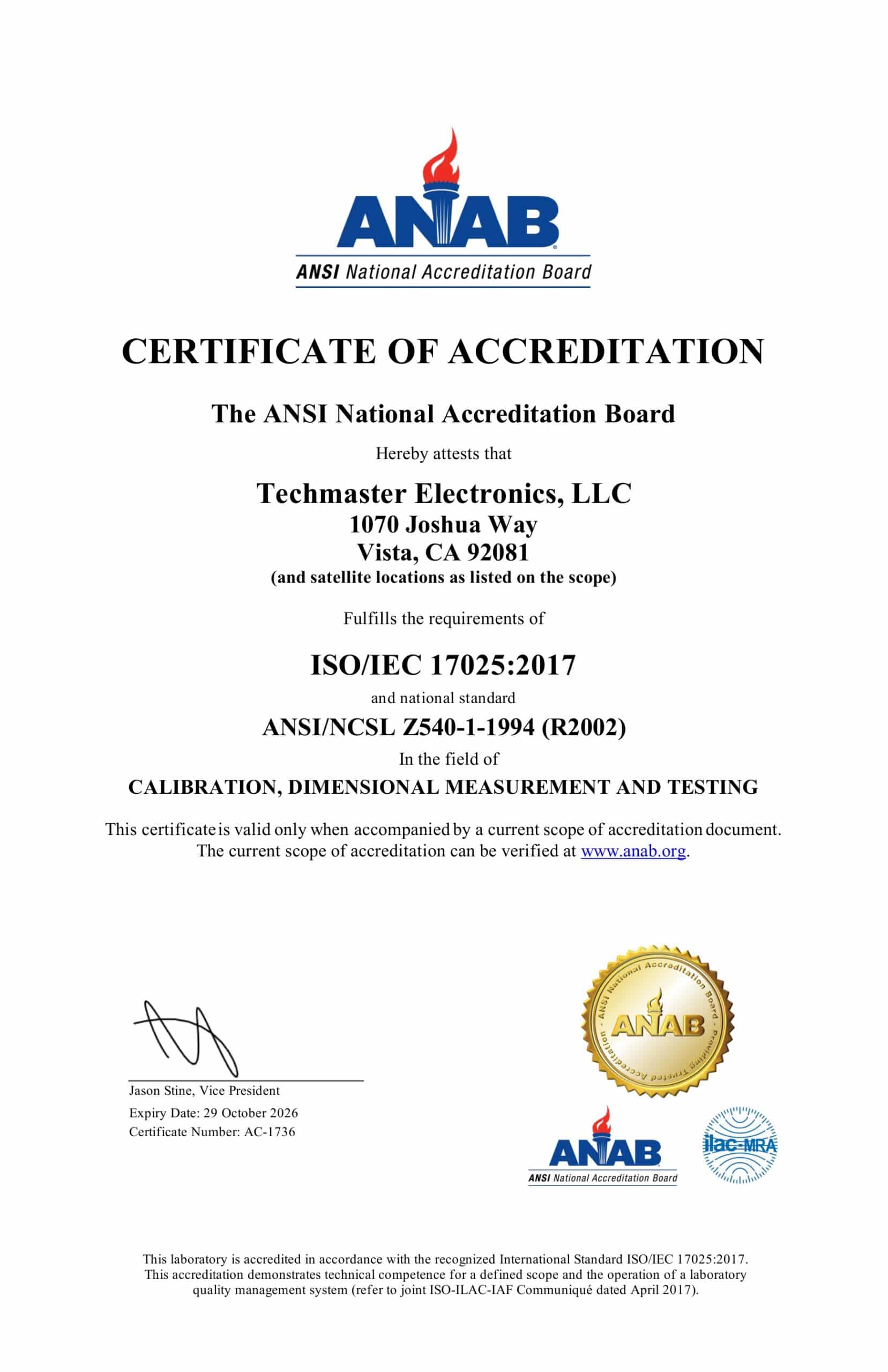
Your calibration, covered
In-lab vs on-site calibration
In-lab calibration
- Accredited bench with full reference standards
- Best achievable measurement uncertainties
- Pickup & return logistics handled
- Ideal for precision and reference work
On-site calibration
- We calibrate the Piezoelectric Accelerometer at your facility
- No shipping risk or transit downtime
- As-found data captured before any move
- Ideal for fixed, large or sensitive assets
In-depth guide
Automation & Collaborative Robotics: The Role of Piezoelectric Accelerometers in Industry 4.0
The world is entering a new era of smart manufacturing. In Industry 4.0, automation and robotics are the driving forces behind productivity, efficiency, and safety. Among them, collaborative robots (cobots) stand out as a game-changing innovation, machines designed to work safely side by side with humans. However, for cobots to be truly intelligent and adaptive, they require sensors that act like a nervous system, allowing them to “feel” and respond to their environment in real time. This is where piezoelectric accelerometers play a central role. Also, regular Piezoelectric Accelerometers calibration ensures that these sensors deliver accurate, reliable data, enabling robots to maintain both precision and safety in demanding industrial environments.
For the main overview, see our guide to accelerometer calibration.
The Piezoelectric Accelerometer: The “Sense” of a Robot
An accelerometer is not just a measuring instrument; in modern automation, it is the core component that enables robots to perceive motion, vibration, and shock. Piezoelectric accelerometers work on the piezoelectric effect: when a crystal material is deformed by acceleration or vibration, it generates an electric charge. This charge is then converted into a voltage signal that reflects the exact motion of the system. When installed on a robot’s joints, motors, or end-of-arm tooling, these accelerometers continuously collect data on movement. Even the slightest change in vibration or force is detected and transmitted to the robot’s controller. The robot can then react instantly, making small adjustments for precision tasks or stopping immediately to avoid collisions. In this sense, the accelerometer acts like a nervous system for cobots, ensuring both accuracy and safety in collaborative environments.Key Advantages of Piezoelectric Accelerometers

1. High Sensitivity and Precision
Piezoelectric accelerometers are known for their exceptional sensitivity, detecting even the slightest changes in vibration or acceleration. This precision is critical in industries such as aerospace, automotive, and manufacturing, where early detection of machine wear or imbalance can prevent costly breakdowns. Their accuracy makes them an essential tool for predictive maintenance and condition monitoring.
2. Durability in Extreme Environments
Built to withstand heat, pressure, humidity, and electromagnetic interference, these sensors perform reliably in the harshest environments. From aerospace testing to heavy industry operations, piezoelectric accelerometers maintain accuracy where other sensors might fail, ensuring engineers and operators can trust the data in mission-critical applications.
3. Long Lifespan and Low Maintenance
With no moving parts, piezoelectric accelerometers offer a long operational life and require minimal maintenance. This reduces downtime and replacement costs, making them a cost-effective solution. Their reliability is especially valuable in structural health monitoring of bridges, dams, and buildings, where continuous long-term data is essential.
4. Wide Frequency Response
These sensors cover a broad frequency range, detecting both low-frequency structural vibrations and high-frequency mechanical events. This versatility enables their use in diverse applications, from automotive crash testing to monitoring wind- or traffic-induced oscillations in civil structures, making them one of the most flexible vibration monitoring solutions available.
Core Role in Industry 4.0
In a smart factory where machines are interconnected, accelerometers act as the sensory “eyes and ears” for motion, enabling systems to:
Detect Motion & Collision
Provide instant data on robot position, speed, and acceleration for precise control and safety.
Measure Vibration
Identify abnormal vibrations to diagnose machine health and prevent failures proactively.
Enable Force Control
Allow robots to perform delicate tasks, like handling fragile items, with high precision.
Major Applications of Piezoelectric Accelerometers
1. Predictive Maintenance
In industrial plants, accelerometers are mounted on rotating equipment such as motors, compressors, and pumps. They continuously monitor vibration patterns to identify early warning signs of wear or imbalance. This approach helps companies prevent unexpected downtime, reduce repair costs, and optimize overall efficiency.
2. Crash Testing in the Automotive Industry
Automakers use piezoelectric accelerometers during crash tests to measure forces and acceleration during impact. This data is critical for evaluating vehicle safety, improving chassis design, and enhancing passenger protection systems.
3. Structural Health Monitoring
These sensors are deployed on bridges, dams, and high-rise buildings to track vibrations and detect structural weaknesses. By analyzing data over time, engineers can predict potential failures, extend the lifespan of infrastructure, and ensure public safety.
4. Research and Development (R&D)
In laboratories, piezoelectric accelerometers are vital tools for studying materials, analyzing product vibration characteristics, and improving designs. They provide researchers with accurate, real-time data that supports innovation across aerospace, defense, consumer electronics, and more.
Applications in Collaborative Robots (Cobots)
Safety & Interaction
Instant collision detection allows cobots to immediately stop or alter their path, ensuring the safety of human workers in a shared workspace.
Precision Control
Sensors enable cobots to apply just the right amount of force for tasks like assembling small components or handling delicate materials.
How Accelerometers Drive Industry 4.0
Predictive Maintenance
Quality Control
Smart Mobility
Workplace Safety
Why Piezoelectric Accelerometers Calibration Is a Must-Have
1. Ensuring Safety
In high-stakes industries like aerospace and automotive, accuracy can be a matter of life and death. For example, a wrong vibration reading could cause engineers to miss a serious issue, like a tired part or a weak structure. In the end, this could lead to a major failure.2. Reducing Financial Risk
Predictive maintenance programs depend on accurate vibration data. As a result, if an accelerometer isn’t calibrated, the data it provides can be wrong. This can lead to two costly problems: either you perform maintenance you don’t need, or worse, you miss a real problem that causes unexpected downtime. In short, both scenarios waste time and money.3. Meeting Standards and Regulations
Many industries, such as those that follow rules from ISO and the FDA, have strict requirements. Therefore, these rules demand that measurement devices be calibrated regularly. This essential step helps ensure your data is trustworthy and that you are legally compliant.Regular Piezoelectric Accelerometers Calibration: Improving Performance and Lifespan
Piezoelectric accelerometers are tough devices. However, their sensitivity can change over time. Things like sudden shocks, big temperature swings, and just getting old can affect them. This is why regular calibration is so important. While the best schedule depends on how the sensor is used, it’s generally a good idea to calibrate it every 12 to 24 months. In the end, regular calibration helps to:- Make Sure It’s Reliable: It confirms that your device is still working within its limits, which stops it from collecting bad data.
- Extend Its Lifespan: It also helps catch small issues as they start, which can prevent them from causing major damage.
Conclusion: Piezoelectric Accelerometers – The Driving Force of Automation’s Future
In the era of Industry 4.0, the piezoelectric accelerometer has transcended its role as a simple sensor. It has become a core component of intelligent robotics, providing the ability to sense and react. From ensuring the safety of collaborative robots to enhancing manufacturing precision and enabling predictive maintenance, the accelerometer has proven its value. It not only helps robots work more efficiently but also makes them work more safely. The accelerometer is playing a key role in shaping a future where automation is smarter, safer, and more productive than ever before. In addition, regular Piezoelectric Accelerometers calibration guarantees accurate and reliable data over time, even in demanding industrial environments. Consequently, as automation continues to advance, these sensors will remain central to creating a smarter, safer, and more efficient future.Frequently asked questions
What is Piezoelectric Accelerometer Calibration?
How often should a Piezoelectric Accelerometer be calibrated?
What standards apply to Piezoelectric Accelerometer Calibration?
What is included on the certificate?
Can you calibrate the Piezoelectric Accelerometer on-site?
Need Piezoelectric Accelerometer calibration?
ANAB-accredited, NIST-traceable, fast turnaround, in-lab or on-site across the USA.
Contact us for a quoteReferences & industry standards
- ISO/IEC 17025 testing & calibration laboratory requirements
- NIST calibration services and measurement traceability
- A2LA / ANAB accreditation for calibration laboratories
External standards bodies. Techmaster Electronics is an ISO/IEC 17025-accredited, NIST-traceable calibration laboratory.

Khanh Nguyen is the Marketing Manager at Techmaster Electronics, a B2B marketing leader covering the test, measurement, and ISO/IEC 17025 accredited calibration industry in the United States.