


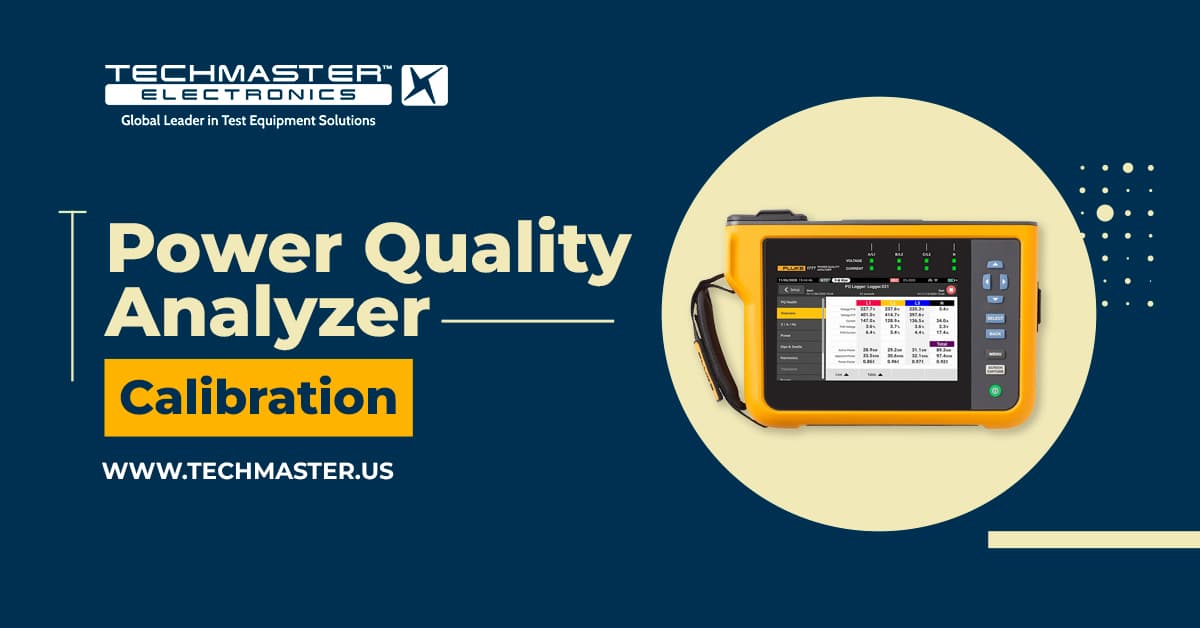
I. Why Power Quality Calibration Matters
In today’s industries, maintaining stable power quality is more critical than ever.
Power Quality Analyzers (PQAs) are the eyes of your electrical system — monitoring harmonics, voltage dips, flicker, and transient disturbances that can affect equipment performance or even cause downtime.
But like any precision instrument, a PQA’s accuracy drifts over time. Even a small deviation can distort how power events are interpreted — leading to poor maintenance decisions or unnecessary shutdowns.
That’s why periodic calibration, aligned with IEC 61000-4-30 Class A accuracy, is essential. It ensures that every waveform, harmonic, and voltage fluctuation your analyzer reports truly reflects reality — not drifted readings.
II. Understanding the Power Quality Analyzer
A Power Quality Analyzer measures parameters that go far beyond simple voltage or current. It evaluates how “quality” the electrical waveform is — identifying harmonic distortion, unbalance, flicker, and transients that could impact sensitive loads like drives or automation systems.
Typical functions include:
-
Measuring RMS voltage, current, active and reactive power
-
Capturing waveform distortion and Total Harmonic Distortion (THD)
-
Logging events such as voltage dips, swells, and interruptions
-
Assessing long-term trends for energy optimization
It’s important to differentiate a PQA from a Universal Power Analyzer (UPA):
-
UPA focuses on efficiency and performance — testing motors, inverters, or power supplies.
-
PQA focuses on stability and quality of supply — tracking grid anomalies and waveform integrity.
Most modern analyzers conform to IEC 61000 family standards:
-
IEC 61000-4-7: defines harmonic measurement methods
-
IEC 61000-4-15: defines flicker evaluation
-
IEC 61000-4-30: specifies how Class A instruments must sample and compute parameters
Together, these ensure consistent measurements regardless of brand or model — and set the foundation for how calibration is performed in an accredited lab.
III. Why Calibration Is Critical
Over time, even precise analyzers lose their alignment between measured and true values.
Temperature variations, long cable runs, or vibration during transport all contribute to drift. When this happens, the analyzer may:
-
Under-report harmonic content, giving a false sense of compliance
-
Over-report transients, leading to unnecessary maintenance
-
Display inconsistent phase angles, affecting power factor calculations
Through ISO/IEC 17025-accredited calibration, Techmaster verifies that every voltage, current, and power reading falls within the instrument’s specification.
Each test is performed using NIST-traceable reference standards, ensuring a continuous chain of measurement reliability.
Without calibration, power quality reports lose their credibility.
For example, when auditors review long-term PQ data for ISO 50001 or GMP compliance, they expect traceable and repeatable measurements — not just readings that “seem close.” Calibration ensures your reports withstand those audits confidently.
IV. Calibration Process
At Techmaster’s accredited lab, each Power Quality Analyzer is calibrated using precision AC sources and harmonic reference generators under tightly controlled conditions.
Step 1. Reference Standards & Environment
-
High-stability AC voltage/current sources traceable to NIST
-
Temperature: 23 ± 2 °C; Humidity: ≤ 50% RH
Step 2. Measurement Points
-
Voltage and current linearity (10 % – 120 %)
-
Power and phase accuracy
-
THD and frequency response
Step 3. Data & Uncertainty Analysis
-
All readings are compared with Class A references per IEC 61000-4-30
-
Measurement uncertainty evaluated and reported in the calibration certificate
This process guarantees that the analyzer performs as intended — meeting the accuracy required for energy audits, ISO compliance, and PQ reporting.
Power Quality Analyzer Calibration Process
Setup & Environment Control
- ▸Maintain 23 ± 2 °C, ≤ 50% RH
- ▸Prepare NIST-traceable AC sources and harmonic generator
Measurement & Verification
- ▸Test voltage/current linearity (10–120%)
- ▸Check THD, power factor, and frequency accuracy
Data Analysis & Uncertainty
- ▸Compare readings with Class A reference limits
- ▸Evaluate total measurement uncertainty
Certification & Reporting
- ▸Generate ISO/IEC 17025 calibration certificate
- ▸Include traceability and test results summary
V. Advanced Calibration Parameters (Case: Fluke 43B)
Modern PQ analyzers must perform accurately not only at fundamental frequencies (50/60 Hz) but also across high-frequency harmonics and fast transients.
Techmaster’s advanced calibration covers:
| Parameter | Typical Range | Why It Matters |
|---|---|---|
| Harmonics (up to 2.5 kHz) | 0.1 – 10 % deviation | Verifies distortion analysis accuracy |
| Flicker (Pst, Plt) | 0.01 – 5 PU | Assesses short/long-term voltage stability |
| Transient Voltage | ≤ 5 µs | Detects surge and switching spikes |
| Phase Angle / Power Factor | ± 0.1° | Ensures real/reactive power correctness |
| Frequency Drift | ± 0.01 Hz | Validates internal clock precision |
Case Study – Fluke 43B
The Fluke 43B handheld analyzer combines oscilloscope-grade waveform capture with PQ and energy functions. During calibration, small deviations were observed at higher harmonic frequencies and phase angle readings.
After adjustment, all test points returned within ± 0.2 % of specification, confirming compliance with IEC Class A criteria.
This example demonstrates that even robust field analyzers benefit from yearly calibration to maintain their diagnostic integrity and support regulatory audits.
Advanced Calibration Parameters – Power Quality Analyzer (Fluke 43B)
Verifying accuracy across advanced PQ parameters – ISO/IEC 17025 traceable
Before Calibration
After Calibration
(up to 2.5 kHz)
(Pst, Plt)
Voltage
Power Factor
Drift
VI. Recommended Calibration Interval
Manufacturers like Fluke generally recommend calibrating Power Quality Analyzers every 12 months.
However, in some situations, it’s better to recalibrate sooner. For example, if the instrument is:
-
Used daily in the field, where conditions can change quickly
-
Exposed to vibration, high humidity, or mechanical shock, which can affect accuracy
-
Showing inconsistent readings during its built-in self-test
In short, while an annual interval works for most cases, frequent use or harsh environments may require earlier recalibration to keep the analyzer reliable.
VII. Common Field Issues & Findings
During PQ testing, the following real-world issues often cause measurement errors:
-
Poor grounding or incorrect voltage lead placement
-
Loose clamp sensors introducing phase shift
-
Shared power supply causing electrical noise
-
Outdated firmware misreporting transient data
Routine calibration helps detect these issues before they affect project results.
VIII. Choosing a Calibration Provider
Not every lab is equipped to perform precise Power Quality Analyzer (PQ) calibration.
When you choose a calibration provider, make sure to review these key points:
-
ISO/IEC 17025 accreditation for electrical measurements
-
Traceability to national standards such as NIST or JCSS
-
Capability to verify Class A analyzers under IEC 61000-4-30
-
Comprehensive reporting that includes uncertainty budgets and before-and-after results
In general, in-lab calibration is the better choice for field instruments like PQAs.
It reduces electrical noise, keeps environmental conditions stable, and allows controlled reference generation. As a result, it delivers lower measurement uncertainty than on-site verification.
IX. Book a Calibration Visit
Keep your Power Quality Analyzer performing at its Class A best.
Ensure every reading you trust meets IEC 61000 accuracy and ISO/IEC 17025 traceability.
Book your calibration today with Techmaster →
