
Handheld Oscilloscope Calibration: ISO/IEC 17025 Step-by-Step Guide
1. Why Handheld Oscilloscope Calibration Matters
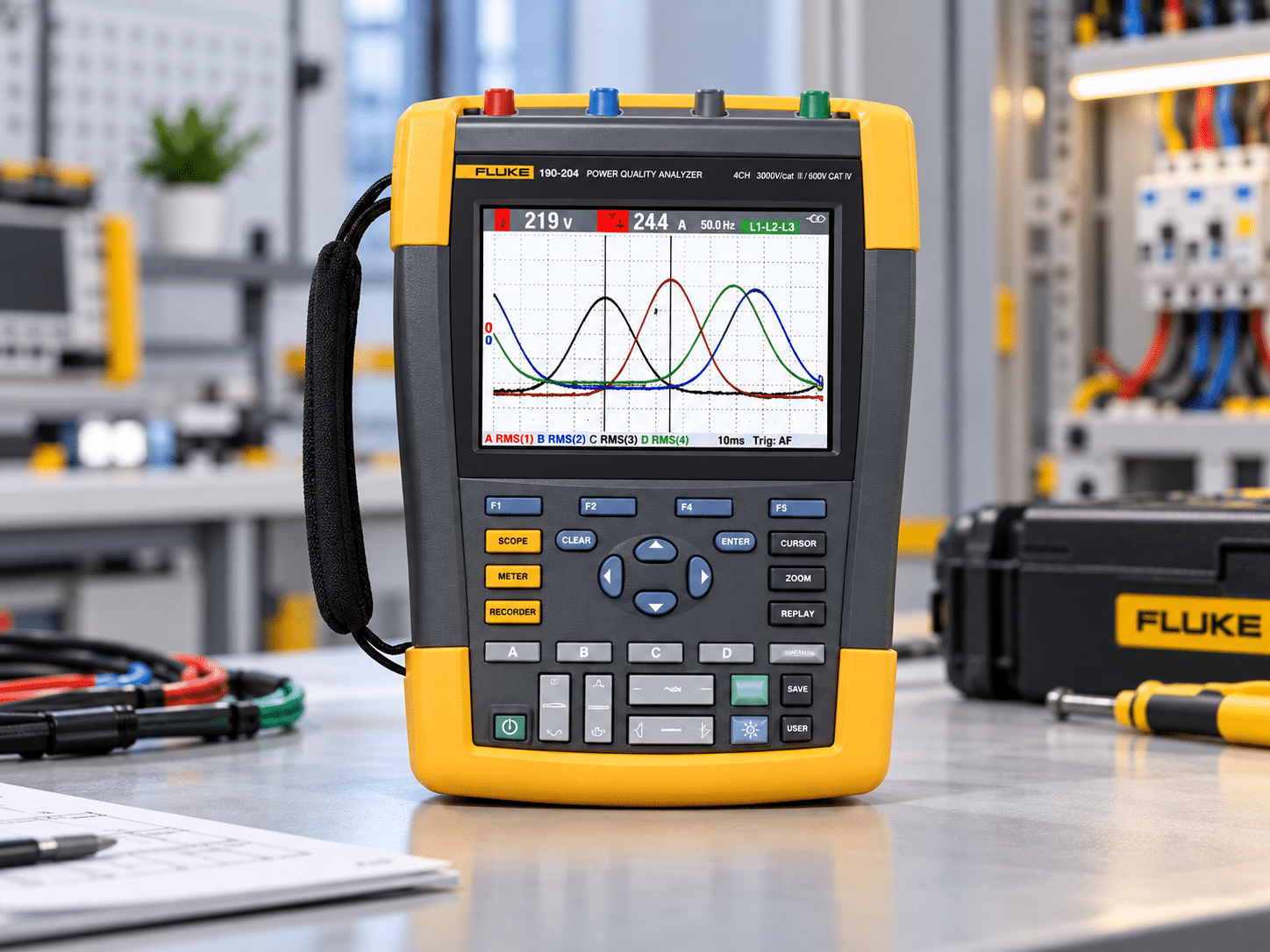
- Component aging: Internal parts may change their values after years of use.
- Temperature changes: Heat and cold can affect the way circuits respond.
- Frequent transport: Field work can place stress on cables, probes, and input ports.
- Heavy use: Long test hours may increase wear on key parts.
- Poor storage: Dust, moisture, and rough handling can affect tool condition.
Why Internal Self-Tests Are Not Enough?
Many handheld oscilloscopes offer built-in self-tests or adjustment tools. First, these features can help users check basic operation. In some models, they also help correct internal offsets. However, internal checks do not replace a full test against suitable external standards. For example, an internal test may show that a channel works. Yet it may not prove that the channel measures voltage within its stated limits. Therefore, teams should use both field checks and formal calibration when their work requires reliable measurement results.2. ISO/IEC 17025 Calibration and Measurement Traceability
ISO/IEC 17025 sets requirements for the skill and quality systems of testing and calibration labs. As a result, accredited labs must show that they can perform the work covered by their accredited scope. During handheld oscilloscope calibration, a lab compares the instrument’s readings with suitable reference standards. The lab then records the results and reviews them against the limits that apply to the device. In addition, the lab must account for measurement uncertainty when required by the test method and reporting rules.What Does NIST Traceability Mean?
Measurement traceability links a result to a recognized reference through a documented chain of calibrations. For example, a lab may use a voltage standard whose calibration links to national standards through other reference tools. However, traceability does not mean that NIST directly calibrated every instrument. Instead, it means the lab can show a valid chain of measurement results and stated uncertainties. Therefore, customers should review the lab’s accredited scope and certificate details when they need proof of traceability.3. Daily Field Checks vs. Accredited Calibration
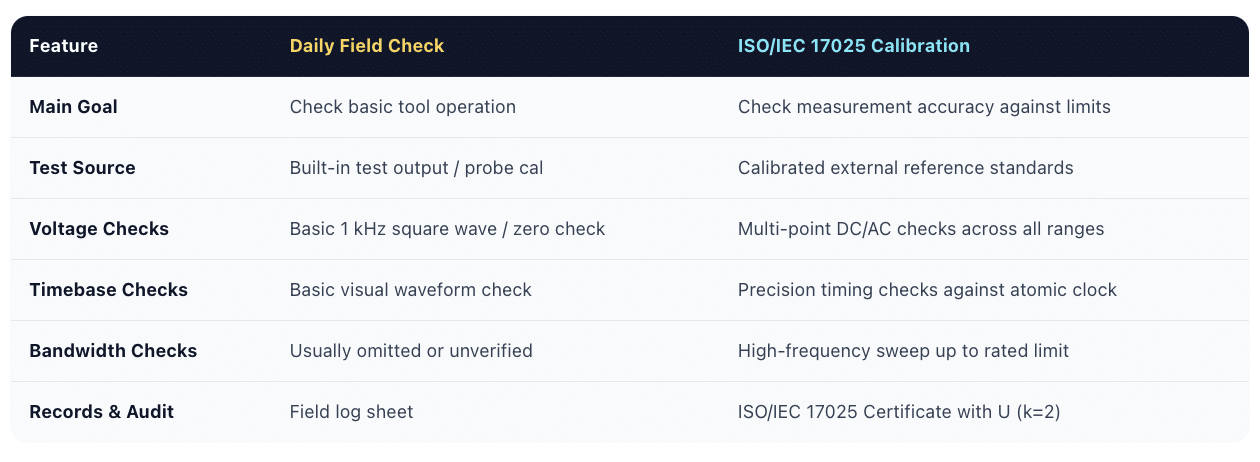
Daily checks and accredited calibration serve different needs. For example, a field check can help a technician find an obvious fault before work starts. However, it cannot replace a full test against external standards.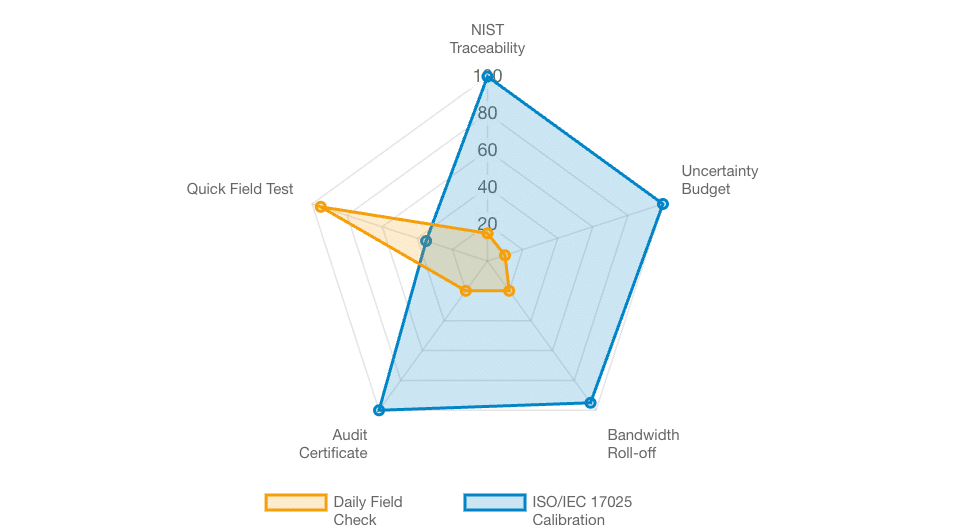
4. Benefits of Regular Handheld Oscilloscope Calibration
Regular calibration supports better test work in several ways. First, it helps teams find measurement errors before they affect key decisions. Next, it gives technicians clear records of instrument performance. In addition, calibration supports equipment control under quality systems such as ISO 9001, AS9100, and IATF 16949 when those systems apply. However, a calibration certificate alone does not prove full compliance with any of these standards. Instead, teams must also follow their own rules for tool use, record control, staff training, and test review. As a result, calibration works best as part of a wider equipment care plan.Techmaster US: Your Accredited Calibration Partner
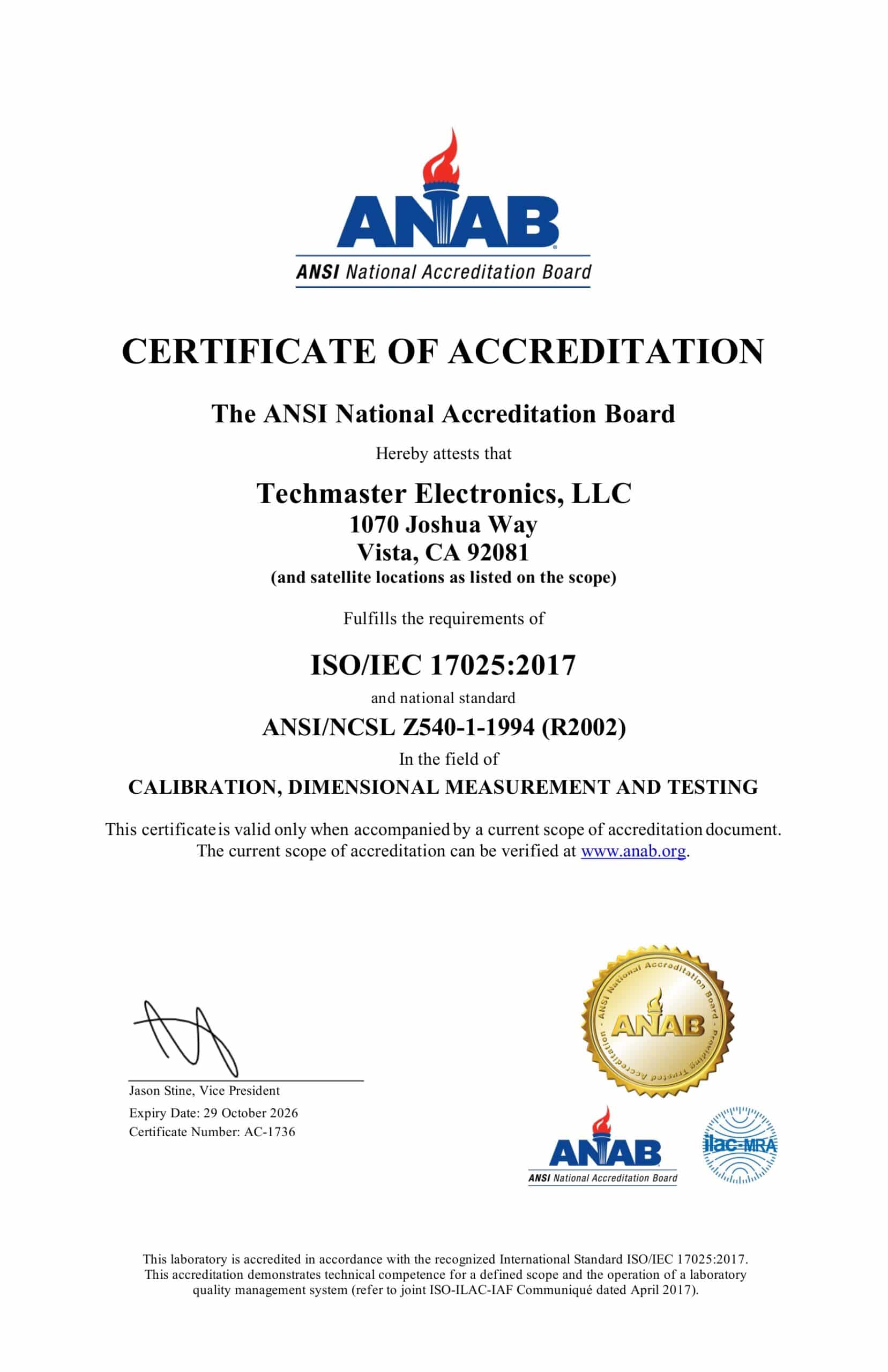
Techmaster Electronics, LLC is an ISO/IEC 17025 accredited calibration laboratory with ANAB certificate AC-1736. Founded in 1989, Techmaster US serves customers through laboratories in Vista, California; Santa Clara, California; Orlando, Florida; San Antonio, Texas; and Holly Springs, North Carolina. In addition, the company has corporate offices in Vista, California, and Henderson, Nevada.Frequently Asked Questions (FAQs)
1. What is handheld oscilloscope calibration and why is it necessary?
Handheld oscilloscope calibration is the metrological verification and adjustment of a portable oscilloscope’s vertical voltage gain, timebase frequency, and input bandwidth against NIST-traceable standards to ensure measurement accuracy under ISO/IEC 17025 guidelines. Regular calibration prevents signal distortion and ensures reliable field diagnostics.
2. How often should a portable oscilloscope be calibrated?
A portable oscilloscope should be calibrated every 12 months under standard operating conditions. Units deployed in extreme field environments, high-temperature industrial settings, or continuous multi-shift testing should be calibrated on a 6-month cycle to account for analog component aging and thermal drift.
3. What causes vertical gain errors in portable oscilloscopes?
Vertical gain errors are primarily caused by thermal aging of input attenuator resistor networks, semiconductor drift in variable gain amplifiers, and changes in high-speed analog-to-digital converter reference thresholds over extended periods of operation.
4. Can internal oscilloscope self-calibration replace accredited laboratory calibration?
No, internal self-calibration routines only compensate for internal DC offsets and baseline adjustments using internal circuit references. They cannot evaluate absolute bandwidth roll-off, timebase frequency accuracy, or input attenuation linearity against external national measurement standards.
5. What parameters are evaluated during accredited oscilloscope calibration?
Accredited calibration evaluates DC and AC voltage measurement linearity across all vertical ranges, input frequency bandwidth flatness up to rated limits, horizontal timebase sweep accuracy, trigger sensitivity, and channel-to-channel isolation.
6. Does Techmaster US offer pickup and delivery services for test equipment calibration?
Yes, Techmaster Electronics provides free local pickup and delivery services for test equipment across Silicon Valley, Southern California, and the Orlando, Florida regions, alongside secure nationwide shipping options for all five accredited laboratory locations.
Handheld Oscilloscope ISO/IEC 17025 Calibration
Maintain field measurement accuracy, prevent costly signal errors, ensure NIST traceability, and master the full 7-step calibration standard for portable oscilloscopes.
CONTACT USFrequently asked questions
What is oscilloscope calibration?
Oscilloscope Calibration is the documented comparison of a oscilloscope against NIST-traceable reference standards under ISO/IEC 17025. It quantifies the oscilloscope’s error and measurement uncertainty and confirms it performs within tolerance, with as-found and as-left data on the certificate.
How often should a oscilloscope be calibrated?
Most quality systems calibrate a oscilloscope every 12 months, or sooner after repair, overload, or before critical measurements. Set your interval from the manufacturer spec and your ISO 9001 / 13485 / AS9100 program and drift history.
Is Techmaster’s oscilloscope calibration ISO 17025 accredited?
Yes. Techmaster Electronics is ISO/IEC 17025:2017 accredited by ANAB (Certificate AC-1736). Every oscilloscope calibration is NIST-traceable and issued with a full measurement-uncertainty budget.
What is the turnaround for oscilloscope calibration?
Standard turnaround is 5 business days, with 1–2 business-day expedite available. On-site calibration removes shipping time entirely for oscilloscopes that can’t leave the floor.
Do you calibrate oscilloscopes on-site or in-lab?
Both. Techmaster runs five US labs (Vista CA, Santa Clara CA, Orlando FL, San Antonio TX, Holly Springs NC) and offers nationwide on-site oscilloscope calibration to minimize downtime.
References & industry standards
- ISO/IEC 17025 testing & calibration laboratory requirements
- NIST calibration services and measurement traceability
- NIST Fundamental Electrical Measurements
- A2LA / ANAB accreditation for calibration laboratories
External standards bodies. Techmaster Electronics is an ISO/IEC 17025-accredited, NIST-traceable calibration laboratory.

Calibration engineer at Techmaster Electronics, ISO/IEC 17025 accredited laboratory with 35+ years of metrology expertise.