
Flow Meter Calibration
Why calibration intervals matter
How Flow Meter calibration works
- Intake & visual inspection
- Environmental stabilization
- As-found measurement
- Comparison to NIST-traceable standards
- Adjustment if required
- As-left results & certificate
Your calibration, covered
In-lab vs on-site calibration
In-lab calibration
- Accredited bench with full reference standards
- Best achievable measurement uncertainties
- Pickup & return logistics handled
- Ideal for precision and reference work
On-site calibration
- We calibrate the Flow Meter at your facility
- No shipping risk or transit downtime
- As-found data captured before any move
- Ideal for fixed, large or sensitive assets
In-depth guide
In the world of industrial processing, precision isn’t just a goal—it’s a regulatory and financial necessity. Whether you are managing chemical dosing, oil custody transfer, or water treatment, the integrity of your data depends on one critical factor: Flow Meter Calibration.
In this guide, we will explore why NIST traceable flow calibration is the gold standard, how on-site flow calibration can save your facility thousands in downtime, and the technical nuances that separate a “functional” meter from an “accurate” one.

1. Calibration vs. Verification: What’s the Difference?
Many plant managers use the terms “calibration” and “verification” interchangeably. In the eyes of an auditor or a metrologist, however, they are worlds apart. Understanding this distinction is the first step toward flow meter accuracy.
-
Flow Verification: This is a functional check. It confirms the meter is operating within a general range and that the electronics are healthy. It is often performed “in-line” using internal diagnostics (Smart Meter Verification).
-
Flow Meter Calibration: This is a formal process where the meter’s performance is compared against a reference standard of much higher accuracy (usually 4:1 ratio). Calibration involves physical testing and results in a certificate that documents the error across multiple flow points.
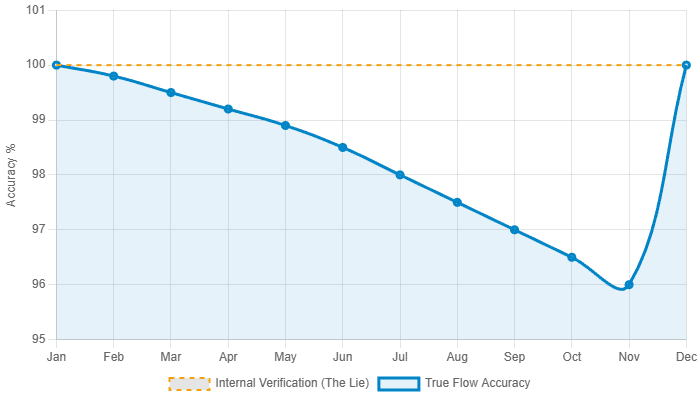
The Risk: Relying solely on verification for high-stakes applications can lead to “measurement drift,” where the device slowly loses accuracy over time, unnoticed by internal sensors.
Verification implies safety while accuracy degrades.
2. Why NIST Traceable Flow Calibration Matters
In the United States, the National Institute of Standards and Technology (NIST) provides the ultimate yardstick for measurement. When you request NIST traceable flow calibration, you are ensuring a “chain of custody” for accuracy.
The Chain of Traceability
Traceability means that your meter was calibrated against a master meter, which was calibrated against a primary standard, which was ultimately verified by NIST.
Regulatory Compliance
For industries governed by the FDA (Food & Drug), EPA (Environmental), or FAA (Aerospace), NIST traceability isn’t optional. It provides the legal and technical defense required during quality audits and safety inspections.
3. Understanding the “As-Found” and “As-Left” Process
A professional calibration report isn’t just a “Pass/Fail” sheet. A high-quality lab will provide two critical sets of data:
-
As-Found Data: This documents the meter’s accuracy before any adjustments were made. This is the most important data for your maintenance records because it tells you if your process was out of spec for the last six months.
-
As-Left Data: After the technician adjusts the meter to minimize error, the “As-Left” data confirms the device is now performing at its peak potential.
Pro Tip: If your “As-Found” data consistently shows significant drift, it’s a sign that your calibration interval is too long and needs to be shortened.
4. The Science of Measurement: Beyond Simple Accuracy
Accuracy isn’t just about the sensor; it’s about the fluid. “Uncertainty” (U) is calculated based on multiple factors.
Thickness of the fluid. Affects flow profiles and Reynolds number.
Mass per volume. Critical for Coriolis and mass flow calculations.
Determines if flow is laminar (smooth) or turbulent (chaotic).
Different meters react differently to environmental stress. This chart visualizes “Robustness” (Higher is better) against key disruptors.
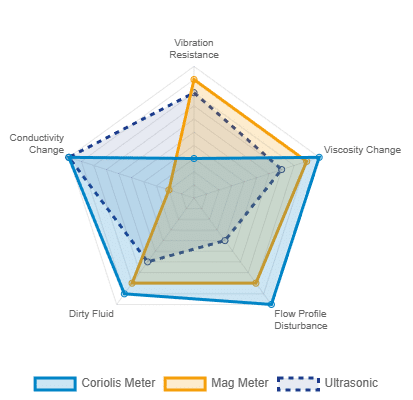
To achieve true flow meter accuracy, we must look at the variables that happen inside the pipe.
The Role of Fluid Properties
Flow meters are sensitive to the physical characteristics of the media. A meter calibrated on water will not perform with the same accuracy on heavy crude oil or pressurized nitrogen. Key factors include:
-
Viscosity: How “thick” the fluid is.
-
Density: How much mass is in a specific volume.
-
Reynolds Number ($Re$): A dimensionless value that determines if a flow is laminar or turbulent.
Calculating Uncertainty
In metrology, “accuracy” is a marketing term. “Uncertainty” is the scientific term. The total uncertainty of a calibration includes the master meter’s error, environmental factors, and even human error. It is usually expressed as:
Where $U$ is the expanded uncertainty and $k$ is the coverage factor (usually 2 for a 95% confidence level).
5. On-Site Flow Calibration vs. Lab Calibration
Should you pull the meter out of the line or have a technician come to you?
On-Site Flow Calibration (In-Situ)
-
Pros: Minimal downtime; no need to ship heavy equipment; accounts for actual piping configurations (bends, valves) which affect flow profiles.
-
Cons: Limited by the accuracy of the portable master meter; environmental conditions (heat, vibration) are harder to control.
Laboratory Calibration
-
Pros: Maximum precision; controlled environment; use of primary standards like gravimetric (weighing) systems.
-
Cons: Requires process shutdown; risk of damage during shipping; does not account for the “install effect” of your specific piping.
6. Common Flow Meter Types and Their Calibration Needs
| Meter Type | Primary Calibration Method | Key Concern |
| Coriolis Meters | Gravimetric / Mass Standard | Zero-point stability and vibration. |
| Magnetic (Mag) Meters | Comparison / Master Meter | Conductivity of the fluid and lining wear. |
| Ultrasonic Meters | Master Meter | Pipe wall thickness and flow profile. |
| Thermal Mass (Airflow) | Wind Tunnel / Controlled Gas | Gas composition and sensor cleanliness. |
7. The Future: Digital Twins and IIoT in Calibration
We are entering the era of Calibration 4.0. Modern flow meters now utilize Industrial Internet of Things (IIoT) sensors to monitor their own health.
-
Smart Meter Verification (SMV): High-end meters from brands like Emerson or Endress+Hauser can now run self-diagnostics that mimic a calibration check without stopping the flow.
-
Digital Twins: By creating a digital model of the flow meter, engineers can predict when a meter is likely to drift based on historical data and fluid friction, moving from preventative to predictive maintenance.
8. Conclusion: Protecting Your Bottom Line
Flow meter calibration is an investment, not an expense. A 1% error in a high-volume custody transfer line can result in hundreds of thousands of dollars in lost revenue per year. By insisting on NIST traceable flow calibration and understanding the nuances of flow meter accuracy, you ensure your facility remains compliant, safe, and profitable.
Frequently asked questions
What is Flow Meter Calibration?
How often should a Flow Meter be calibrated?
What standards apply to Flow Meter Calibration?
What is included on the certificate?
Can you calibrate the Flow Meter on-site?
Need Flow Meter calibration?
ANAB-accredited, NIST-traceable, fast turnaround — in-lab or on-site across the USA.
Contact us for a quoteReferences & industry standards
- ISO/IEC 17025 testing & calibration laboratory requirements
- NIST calibration services and measurement traceability
- NIST Fluid Metrology Group
- A2LA / ANAB accreditation for calibration laboratories
External standards bodies. Techmaster Electronics is an ISO/IEC 17025-accredited, NIST-traceable calibration laboratory.

Khanh Nguyen is the Marketing Manager at Techmaster Electronics, a B2B marketing leader covering the test & measurement and ISO/IEC 17025 accredited calibration industry across the US and Vietnam markets.