
Digital Barometer Calibration
Why calibration intervals matter
How Digital Barometer calibration works
- Intake & visual inspection
- Environmental stabilization
- As-found measurement
- Comparison to NIST-traceable standards
- Adjustment if required
- As-left results & certificate
Your calibration, covered
In-lab vs on-site calibration
In-lab calibration
- Accredited bench with full reference standards
- Best achievable measurement uncertainties
- Pickup & return logistics handled
- Ideal for precision and reference work
On-site calibration
- We calibrate the Digital Barometer at your facility
- No shipping risk or transit downtime
- As-found data captured before any move
- Ideal for fixed, large or sensitive assets
In-depth guide
1. Introduction
Inaccurate atmospheric pressure readings can quietly compromise cleanroom integrity, skew environmental testing, and invalidate critical meteorological data. Over time, physical aging and environmental factors cause inevitable sensor drift, exposing your facility to severe regulatory non-compliance, failed audits, and compromised product quality. Implementing a rigorous schedule of accredited digital barometer calibration provides the definitive defense against drift, establishing verified NIST traceable barometer calibration paths to secure total measurement accuracy.
2. Device Overview and the Key role of Modern Barometers
Digital barometers measure atmospheric pressure with high accuracy for environmental monitoring, aviation, and laboratory compliance. These instruments utilize advanced sensing technologies that convert physical pressure variations into precise electronic signals, which requires structured calibration to maintain. High-performance instruments like the Vaisala PTB330 or Druck DPI740 rely on complex sensing structures to measure ambient atmospheric forces. For instance, these devices use either piezoresistive or capacitive silicon sensors to detect minute physical deflections. However, even premium sensors experience subtle physical changes over time, meaning every facility benefits significantly from routine electronic barometer calibration. In addition, modern laboratories utilize these instruments as reference standards to adjust other sensitive equipment. Therefore, maintaining their accuracy directly impacts the integrity of all dependent measurements. In the end, securing this baseline performance meets the rigorous requirements of ISO 17025 pressure calibration.3. Technical Body
The Technical Reality of Barometric Drift: Why Your Sensor Out-of-Tolerance (OOT) Occurs
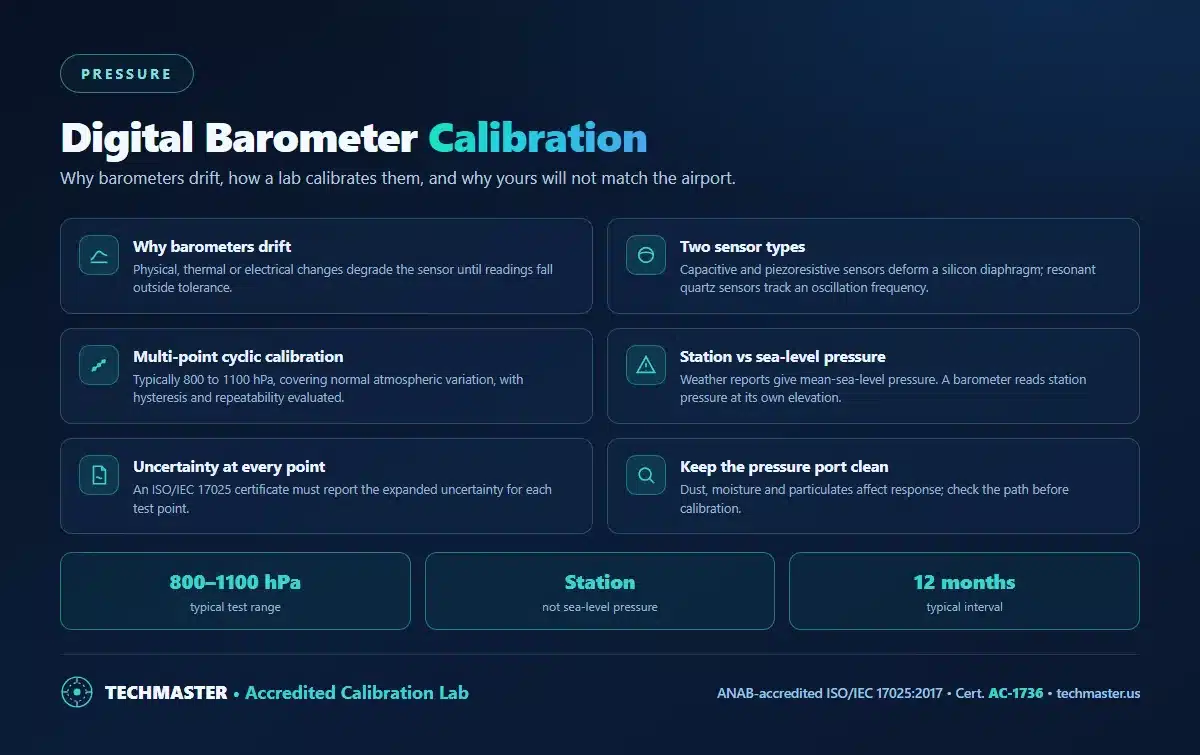
 Sensor drift occurs when physical, thermal, or electrical changes degrade a barometer’s accuracy over time. Consequently, the instrument produces measurements that fall outside its specified tolerance limits, which compromises laboratory data integrity and demands immediate corrective action.
To understand this behavior, we must examine the difference between silicon-capacitive and resonant quartz sensor mechanics. Piezoresistive and capacitive sensors measure pressure through the physical deformation of a silicon diaphragm. In contrast, resonant quartz sensors detect changes in the oscillation frequency of a quartz crystal under stress.
Despite their advanced designs, both sensor types remain vulnerable to environmental and mechanical degradation. Specifically, physical shock, chemical exposure, and aging internal electronics represent the primary contributors to sensor drift. Therefore, undergoing scheduled electronic barometer calibration prevents these minor alterations from escalating into severe out-of-tolerance conditions.
Sensor drift occurs when physical, thermal, or electrical changes degrade a barometer’s accuracy over time. Consequently, the instrument produces measurements that fall outside its specified tolerance limits, which compromises laboratory data integrity and demands immediate corrective action.
To understand this behavior, we must examine the difference between silicon-capacitive and resonant quartz sensor mechanics. Piezoresistive and capacitive sensors measure pressure through the physical deformation of a silicon diaphragm. In contrast, resonant quartz sensors detect changes in the oscillation frequency of a quartz crystal under stress.
Despite their advanced designs, both sensor types remain vulnerable to environmental and mechanical degradation. Specifically, physical shock, chemical exposure, and aging internal electronics represent the primary contributors to sensor drift. Therefore, undergoing scheduled electronic barometer calibration prevents these minor alterations from escalating into severe out-of-tolerance conditions.
NIST Traceability vs. ISO/IEC 17025 Accreditation: What Your Auditor Actually Demands
While basic traceability links your device directly to national measurement standards, accreditation guarantees the technical competence of the laboratory performing the work. Consequently, quality auditors typically require certified calibration certificates to satisfy strict regulatory compliance frameworks. Understanding this distinction is crucial for maintaining compliant facility operations. Choosing a NIST traceable barometer calibration assures you that your measurements trace back to the National Institute of Standards and Technology. However, this trace alone does not verify the operational competence or quality management system of the performing laboratory. Conversely, an accredited ISO 17025 pressure calibration offers independent verification of a laboratory’s technical capability. Specifically, auditors inspect the laboratory’s environmental controls, staff training, and official uncertainty budgets. Therefore, a compliant certificate must document the precise measurement uncertainty, the traceability path, and the environmental conditions.Behind the Scenes: How a Metrology Lab Performs Digital Barometer Calibration
Professional metrology laboratories calibrate digital barometers by subjecting them to highly controlled pressure sequences inside specialized calibration chambers. Technicians compare the instrument’s readings against highly stable reference standards to identify, record, and adjust any measurement discrepancies. Executing professional digital barometer calibration requires extremely precise reference transfer standards. For instance, laboratories frequently utilize Fluke Calibration or Mensor automatic pneumatic controllers to manage pressure levels. These advanced systems deliver ultra-stable, non-reactive gas pressures to the device under test. During the actual procedure, technicians perform a multi-point cyclic pressure calibration process. This sequence usually spans a range from 800 to 1100 hectopascals to cover typical atmospheric variations. In addition, evaluating hysteresis and repeatability during these cycles remains critical to understanding the sensor’s long-term behavior.The Pressure Confusion: Station Pressure vs. Mean Sea Level (MSL) Pressure
Station pressure represents the actual atmospheric pressure measured at the instrument’s exact physical location and elevation. Conversely, mean sea level pressure adjusts this reading mathematically to remove the influence of altitude, which allows for standardized comparison between different geographical locations. This distinction explains why a freshly calibrated barometer might not match local airport reports. Specifically, local weather channels almost always report mean sea level pressure rather than true local pressure. Therefore, technicians must calculate and input elevation offset adjustments into the device configuration after performing the physical calibration. To adjust these values, you must apply the international barometric formula using your exact local elevation. Consequently, neglecting this step can lead to persistent errors in your operational records. Fortunately, modern digital units allow users to store these offsets directly within the instrument software.Industrial Applications Relying on Accredited Barometric Accuracy
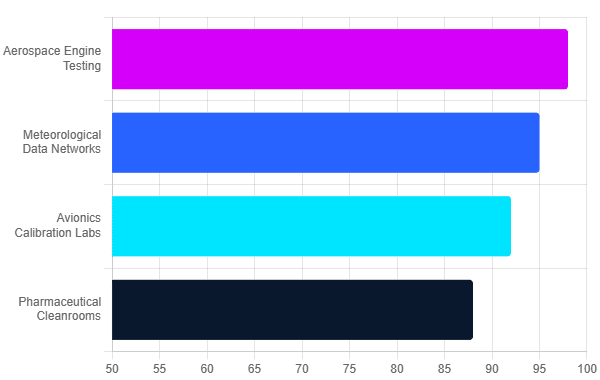 High-precision barometric measurements are vital for critical operations in aerospace engineering, pharmaceutical manufacturing, and advanced meteorological research. Consequently, these sectors depend on verified sensor accuracy to maintain process safety, ensure product quality, and meet strict international regulatory standards.
For example, pharmaceutical cleanrooms rely on precise pressure differentials to prevent hazardous airborne contamination. In addition, aerospace engine testing facilities require highly accurate atmospheric pressure data to calculate engine performance parameters correctly. Therefore, these sectors depend strictly on ISO 17025 pressure calibration to maintain operational safety.
Similarly, global meteorological networks and avionics calibration labs must have absolute confidence in their barometers. Because a tiny error in pressure can translate to significant altitude calculation discrepancies, accuracy is non-negotiable. In the end, reliable measurements preserve both environmental data integrity and passenger flight safety.
High-precision barometric measurements are vital for critical operations in aerospace engineering, pharmaceutical manufacturing, and advanced meteorological research. Consequently, these sectors depend on verified sensor accuracy to maintain process safety, ensure product quality, and meet strict international regulatory standards.
For example, pharmaceutical cleanrooms rely on precise pressure differentials to prevent hazardous airborne contamination. In addition, aerospace engine testing facilities require highly accurate atmospheric pressure data to calculate engine performance parameters correctly. Therefore, these sectors depend strictly on ISO 17025 pressure calibration to maintain operational safety.
Similarly, global meteorological networks and avionics calibration labs must have absolute confidence in their barometers. Because a tiny error in pressure can translate to significant altitude calculation discrepancies, accuracy is non-negotiable. In the end, reliable measurements preserve both environmental data integrity and passenger flight safety.
4. Maintenance and Reliability Protocols
Maintaining barometric reliability requires strict adherence to recommended storage guidelines, careful handling practices, and routine pre-calibration inspections. Consequently, implementing these preventative measures minimizes sensor drift, extends the operational life of your instrument, and ensures consistent performance between scheduled calibrations. Standard maintenance protocols for high-precision models like the Vaisala PTB210 include regular inspection of pressure ports. Specifically, dust, moisture, or particulate contamination can severely affect sensor responsiveness. Therefore, performing simple pre-calibration checks to ensure clean, unobstructed paths is vital for maintaining a NIST traceable barometer calibration status. Additionally, users must maintain optimal storage and environmental conditions for their equipment. Ideally, store your sensitive instruments in environments with controlled temperature and humidity according to international norms. For instance, avoiding sudden thermal shocks protects the delicate internal components from experiencing severe thermal hysteresis before scheduling your regular electronic barometer calibration procedure.5. Digital Barometer Calibration FAQs
Why does my freshly calibrated digital barometer read differently than the local airport?
Your calibrated barometer measures true local station pressure at your exact elevation, whereas local airports report adjusted mean sea level pressure. Consequently, you must apply an elevation offset adjustment to align your device’s readings with standardized regional meteorological data.What is the standard calibration interval for a digital barometric sensor?
Most manufacturers recommend a standard calibration interval of twelve months to guarantee accuracy and trace drift patterns. However, you should shorten this interval if your instrument experiences harsh environmental conditions, physical shocks, or operates within highly critical regulatory environments.Does an ISO 17025 certificate include measurement uncertainty budgets?
Yes, a compliant ISO 17025 pressure calibration certificate must explicitly report the expanded measurement uncertainty for each test point. Conversely, while a NIST traceable barometer calibration provides evidence of a trace path, it may not detail the complete mathematical uncertainty budget.How are digital barometers calibrated across varying temperature ranges?
Metrology laboratories evaluate temperature sensitivity by placing the barometers inside specialized temperature-controlled environmental chambers during the calibration process. This procedure allows technicians to measure and compensate for any thermal drift during the electronic barometer calibration cycle.What reference standards do laboratories use to calibrate high-precision barometers?
Laboratories utilize high-precision resonant quartz pressure standards, automatic pneumatic calibrators, or reference piston gauges to calibrate these instruments. These reference standards provide exceptional stability and accuracy, which allows technicians to verify modern barometers with complete confidence.6. Minimize Your Downtime: Partner with an Accredited Pressure Metrology Lab
Partnering with an accredited pressure metrology laboratory ensures rapid turnaround times, minimized process downtime, and guaranteed compliance. In the end, professional calibration services safeguard your valuable instruments, deliver highly reliable results, and provide the absolute assurance your quality auditors require. Securing high-quality calibration services is the most effective way to protect your physical assets. For this reason, selecting a laboratory that offers secure shipping protocols and onsite service options is highly advantageous. Consequently, your team can maintain continuous operation without worrying about extensive delays or transport damage. Do not let uncalibrated sensors put your cleanroom compliance or product quality at risk. Instead, contact an expert calibration facility today to schedule your next digital barometer calibration. In the end, professional oversight guarantees that your pressure measurements remain accurate, secure, and fully compliant with global metrological standards.Supported Equipment: Industry-Standard Digital Barometers
To safeguard operational integrity, professional pressure metrology laboratories configure calibration parameters directly in alignment with original equipment manufacturer manuals. Because barometric specifications can vary widely based on production batches and optional custom sensor modules, calibration technicians should refer directly to the device’s technical specifications sheets to determine exact testing thresholds and nominal values. The following list highlights the primary industrial manufacturers and high-precision digital barometer models routinely handled in standard metrological workflows:- Vaisala Barometers
- PTB330 series digital barometers (renowned for high-stability capacitive silicon sensors used in meteorological and aviation frameworks).
- PTB210 series transmitters (highly stable instruments frequently configured for cleanroom ambient monitoring).
- Druck (Baker Hughes) Barometers
- DPI740 portable barometers (handheld micro-machined silicon resonant sensors used as secondary standard transfer devices).
- DPI142 barometric indicators (stable reference models designed for high-accuracy benchtop measurements).
- Fluke Calibration
- Fluke Calibration high-precision barometric reference modules (often utilized as high-level transfer reference sensors inside pneumatic pressure calibration systems).
- Traceable (Cole-Parmer)
- Traceable Ambient Digital Barometers (economical units used for non-critical laboratory environment logging and facility storage mapping).
Definition Blocks
Thermal Hysteresis The maximum difference in sensor output at a specific pressure point when approached from opposite temperature directions. This characteristic highlights how temperature changes introduce lag or residual stress inside barometric sensors.
Metrological Traceability The property of a measurement result whereby the result can be related to a reference through a documented unbroken chain of calibrations, each contributing to the measurement uncertainty.
Minimize Your Downtime
Do not let uncalibrated sensors put your cleanroom compliance or product quality at risk. Partnering with an accredited pressure metrology laboratory for your NIST traceable barometer calibration ensures rapid turnaround times, secure handling of high-precision sensors, and guaranteed compliance.
Frequently asked questions
What is Digital Barometer Calibration?
How often should a Digital Barometer be calibrated?
What standards apply to Digital Barometer Calibration?
What is included on the certificate?
Can you calibrate the Digital Barometer on-site?
Need Digital Barometer calibration?
ANAB-accredited, NIST-traceable, fast turnaround, in-lab or on-site across the USA.
Contact us for a quoteReferences & industry standards
- ISO/IEC 17025 testing & calibration laboratory requirements
- NIST calibration services and measurement traceability
- NIST Pressure and Vacuum Group
- A2LA / ANAB accreditation for calibration laboratories
External standards bodies. Techmaster Electronics is an ISO/IEC 17025-accredited, NIST-traceable calibration laboratory.
Related reading: how pressure traceability works: deadweight testers, digital calibrators and the 4:1 rule
Frequently asked questions
What is digital barometer calibration?
Digital Barometer Calibration is the documented comparison of a digital barometer against NIST-traceable reference standards under ISO/IEC 17025. It quantifies the digital barometer’s error and measurement uncertainty and confirms it performs within tolerance, with as-found and as-left data on the certificate.
How often should a digital barometer be calibrated?
Most quality systems calibrate a digital barometer every 12 months, or sooner after repair, overload, or before critical measurements. Set your interval from the manufacturer spec and your ISO 9001 / 13485 / AS9100 program and drift history.
Is Techmaster’s digital barometer calibration ISO 17025 accredited?
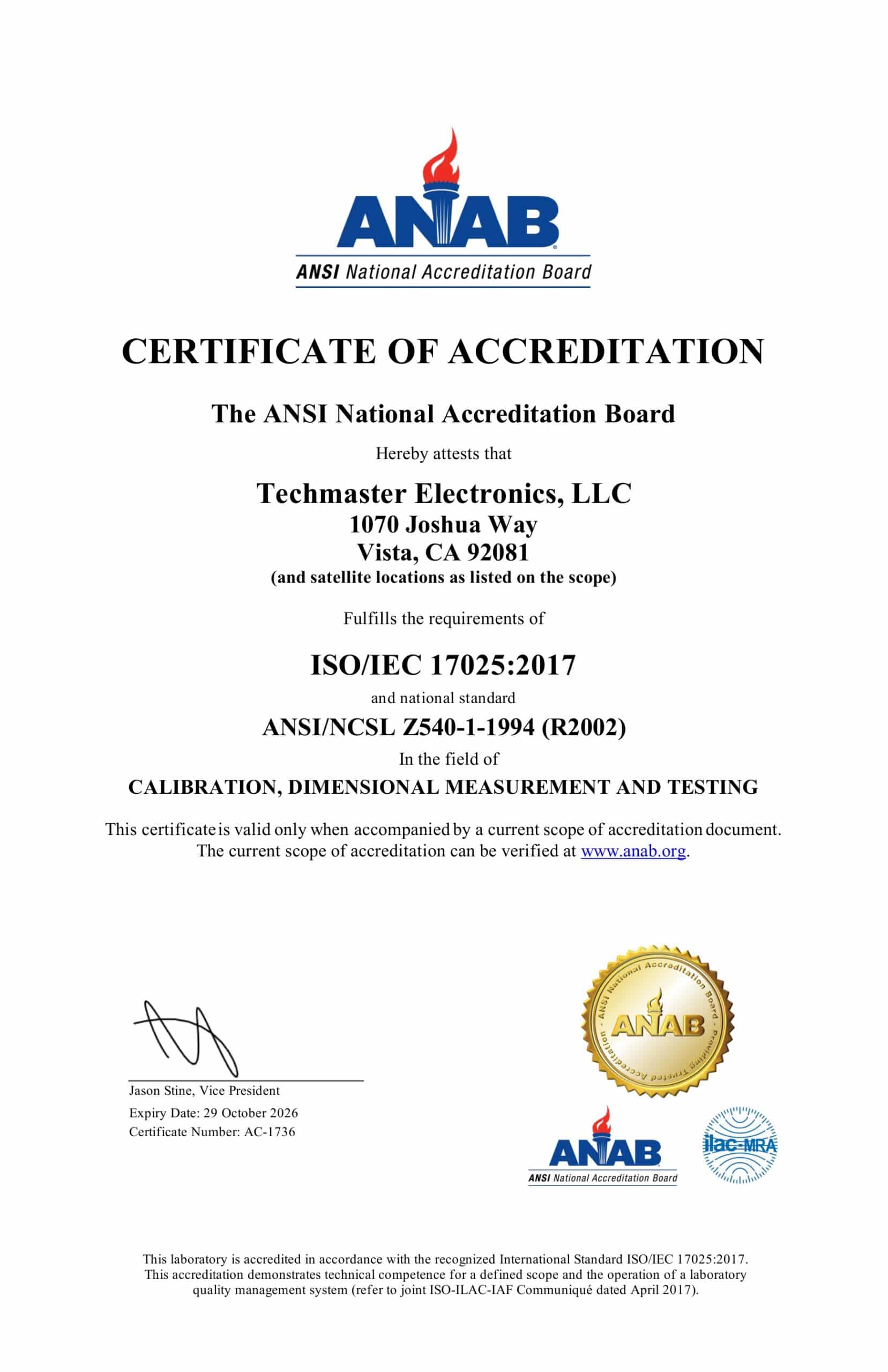
Yes. Techmaster Electronics is ISO/IEC 17025:2017 accredited by ANAB (Certificate AC-1736). Every digital barometer calibration is NIST-traceable and issued with a full measurement-uncertainty budget.
What is the turnaround for digital barometer calibration?
Standard turnaround is 5 business days, with 1–2 business-day expedite available. On-site calibration removes shipping time entirely for digital barometers that can’t leave the floor.
Do you calibrate digital barometers on-site or in-lab?
Both. Techmaster runs five US labs (Vista CA, Santa Clara CA, Orlando FL, San Antonio TX, Holly Springs NC) and offers nationwide on-site digital barometer calibration to minimize downtime.

Khanh Nguyen is the Marketing Manager at Techmaster Electronics, a B2B marketing leader covering the test, measurement, and ISO/IEC 17025 accredited calibration industry in the United States.