
Ionizer Calibration
Why calibration intervals matter
How Ionizer calibration works
- Intake & visual inspection
- Environmental stabilization
- As-found measurement
- Comparison to NIST-traceable standards
- Adjustment if required
- As-left results & certificate
Your calibration, covered
In-lab vs on-site calibration
In-lab calibration
- Accredited bench with full reference standards
- Best achievable measurement uncertainties
- Pickup & return logistics handled
- Ideal for precision and reference work
On-site calibration
- We calibrate the Ionizer at your facility
- No shipping risk or transit downtime
- As-found data captured before any move
- Ideal for fixed, large or sensitive assets
In-depth guide
Ionizer Calibration: Ensuring ESD Control and Static Neutralization Accuracy
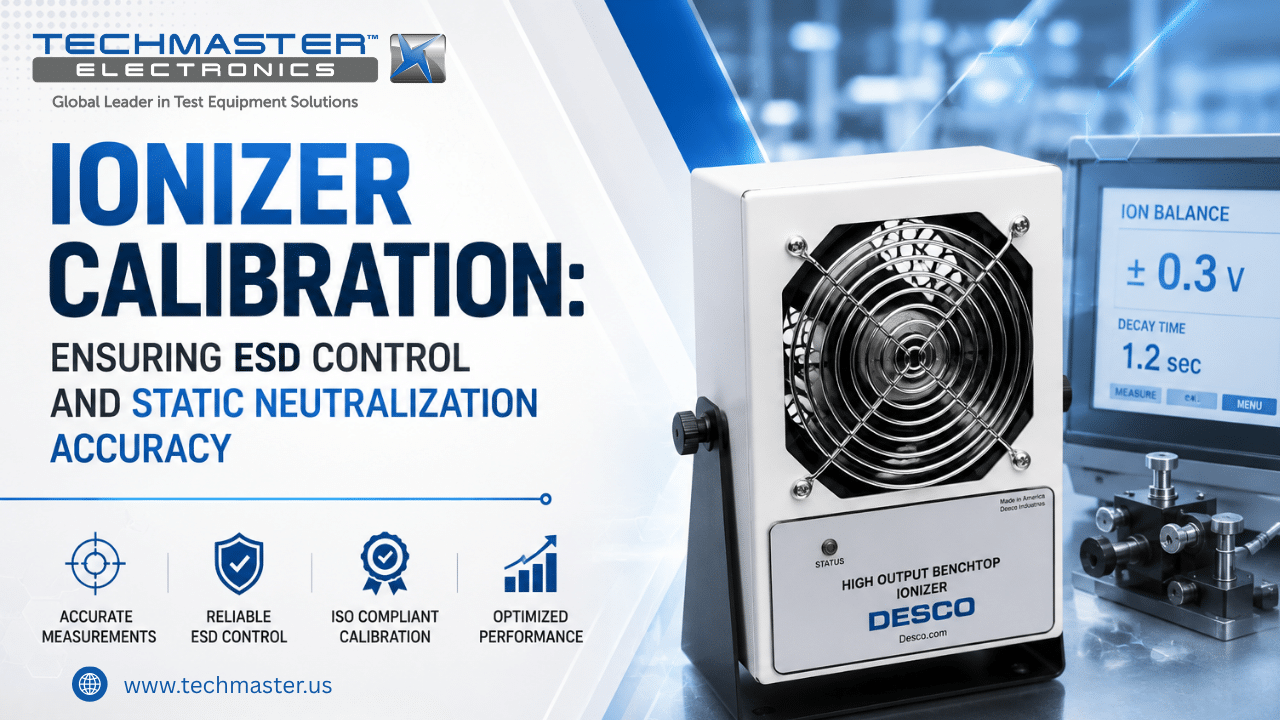
In high-precision electronics manufacturing, semiconductor fabrication, and aerospace assembly, electrostatic discharge (ESD) represents one of the most significant threats to product reliability. Production environments utilize ionization systems to neutralize static charges on non-conductive surfaces and isolated conductors. Preventing latent damage to micro-circuits. These systems, whether benchtop, overhead, or room-level units, depend on sophisticated high-voltage power supplies and emitter needle arrays to generate a balanced flow of positive and negative ions. To ensure these units function as intended. Regular ionizer calibration is mandatory to verify that the balance and decay time remain within strictly defined electrostatic safety limits.
Without consistent calibration, ionization systems are prone to “balance drift.” This phenomenon occurs as emitter needles accumulate oxidation, dust, or chemical residue, causing an uneven output of ions. An unbalanced ionizer may not only fail to neutralize static but can actually induce a charge onto sensitive components, leading to catastrophic ESD events. Consequently, periodic verification against traceable standards is the only way to confirm that an ionization system is actively protecting the manufacturing floor rather than contributing to electrostatic risk.
1. Technical Principles: Ionization Balance and Decay Time Mechanics
1.1. What are the fundamental engineering factors affecting ionizer performance?
Ionizer Calibration is the metrological validation of an ionization system’s ability to neutralize static electricity. This process evaluates the ion balance (offset voltage) and the decay time (time required to reduce a charge from 1000V to 100V) against international electrostatic standards.
2. Industrial Applications: Where Static Neutralization Protects Assets
How does ionizer calibration impact the integrity of the manufacturing workflow?
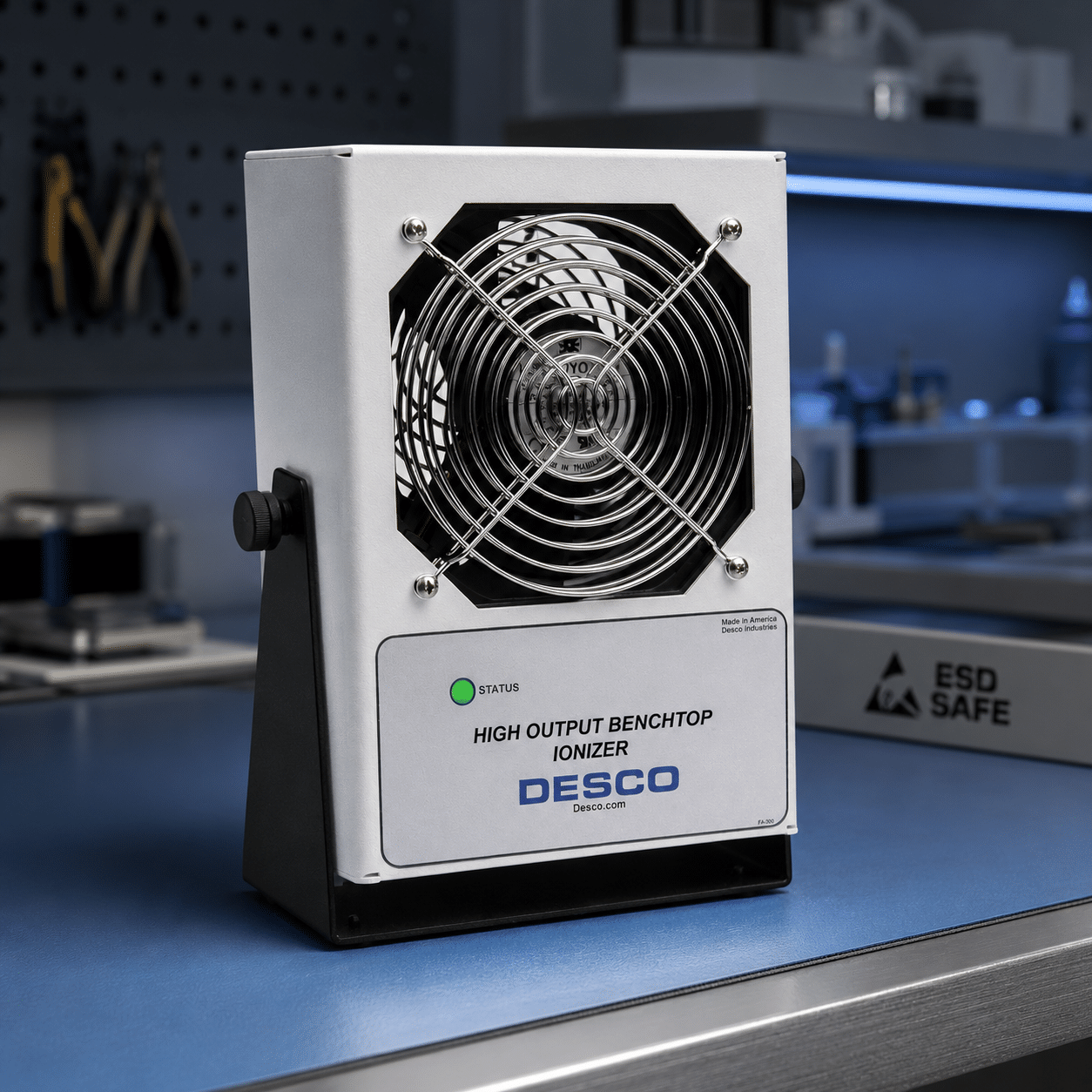
Precise ionizer calibration ensures that static neutralization levels remain within defined safety envelopes, preventing invisible ESD damage and preserving the structural reliability of sensitive micro-components during the assembly process.
-
Semiconductor Fabrication: In wafer handling areas, even a few volts of offset voltage can cause “latch-up” or physical damage to nanoscale transistors. Validated ionizers provide the necessary neutral environment to ensure high-yield production.
-
Medical Device Assembly: High-precision medical sensors and imaging components require pristine manufacturing conditions. Calibrated ionization prevents static-induced particle attraction, ensuring devices are free from contaminants that could cause failure in clinical environments.
-
Automotive Electronics (EVs): With the shift toward high-voltage electric vehicle modules, PCB assembly lines for EV sensors must be rigorously ESD-controlled to prevent intermittent failures that could pose significant safety risks on the road.
3. The Calibration Pillar: Securing Traceability and ISO/IEC 17025 Compliance
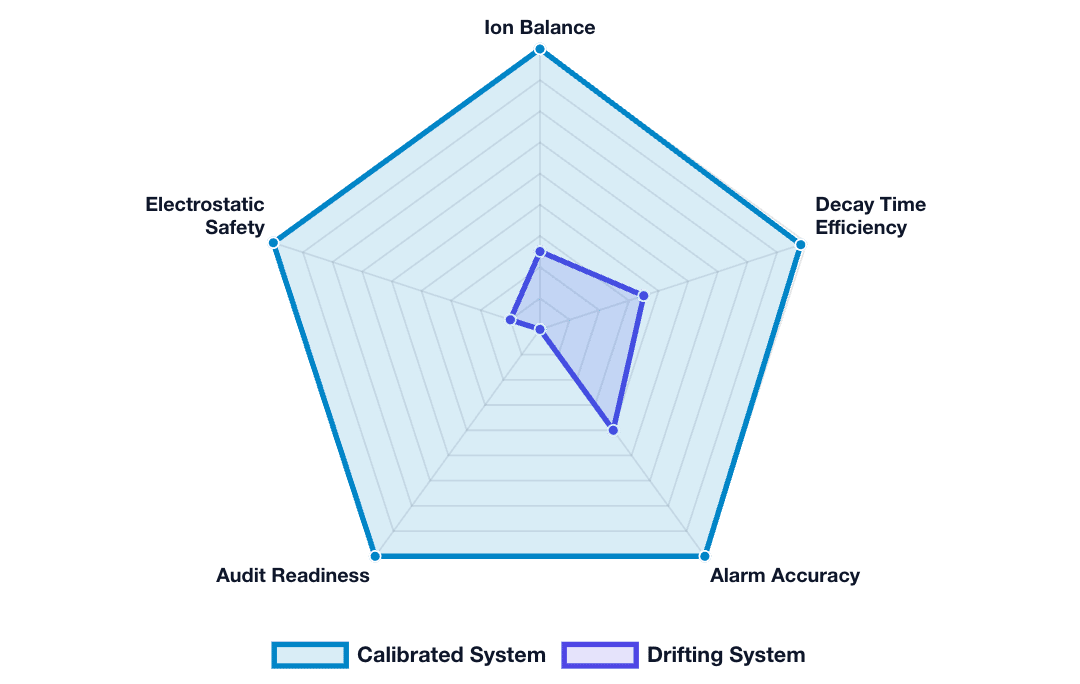
Calibrated vs. Drifting Systems
Uncalibrated systems drift rapidly due to pin erosion and particulate accumulation. Below is a metrological comparison showing the drop in static mitigation when a unit undergoes balance and decay drift.
Calibration Frequency Requirements
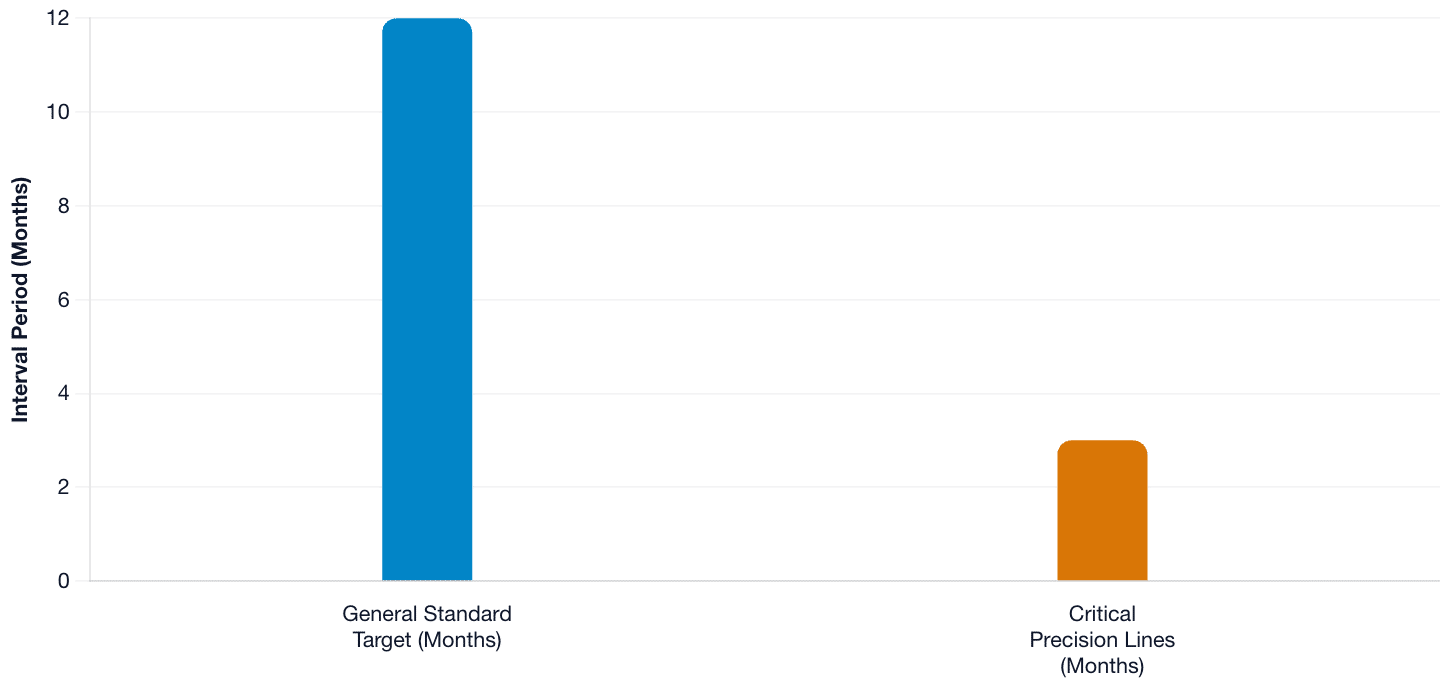
While typical environments might mandate yearly or bi-yearly cycles, high-precision cleanrooms and sensitive semiconductor lines require quarterly check-ups to meet rigorous compliance metrics.
Why is traceable metrological testing mandatory for ESD control equipment?
Accredited ionizer calibration provides a verifiable link between shop-floor ESD protection and recognized international electrostatic standards. This traceability is essential for complying with ANSI/ESD S20.20 and ISO/IEC 17025, ensuring that static control programs withstand rigorous quality audits.
Operating ionization equipment without periodic calibration creates a false sense of security in ESD protection programs. Since static charge accumulation remains invisible to the human eye, an ionizer can drift out of balance and still appear to function normally. As a result, facilities may continue using the equipment for months while it silently damages sensitive electronic components. In many cases, this hidden damage, commonly called “latent failure”, does not appear until the product reaches the end user, ultimately causing reliability issues in the field.
To reduce this risk, companies rely on rigorous, accredited calibration procedures that provide data-driven verification of ionizer performance. During calibration, metrologists use reference electrostatic voltmeters and charged plate monitors calibrated to NIST-traceable standards. With these instruments, they can accurately measure the degree of ionizer drift and precisely adjust the output to restore factory-specified neutralization performance. In addition, the calibration process generates documented records that support auditability and help organizations comply with global quality management system (QMS) requirements.
4. How to Prepare an Ionizer for Calibration
Following these precise steps ensures your ionization systems are optimized for an upcoming field or laboratory calibration session, ensuring efficient verification.
1. Perform Emitter Needle Cleaning
Ensure that all emitter needles are free from accumulated dust, carbon deposits, or flux residue. Use only approved cleaning materials to prevent surface damage that could create sharp edges or improper ionization discharge.
2. Verify Airflow and Filter Status
Check that fans are operating at their specified speeds and that intake filters are free from blockages. Proper airflow is essential for the effective distribution of ions; if the fan is failing, ionizer balance verification will yield poor results.
3. Ensure Environment Stability
Allow the ionizer to operate in its installed location for at least one hour before calibration to ensure thermal and electrical stabilization. Environmental conditions (such as humidity) should be recorded, as they significantly influence ionization efficiency.
4. Provide Operational Baseline Data
Document the desired performance specifications (e.g., target balance voltage and decay time thresholds). Providing this information allows metrologists to verify the system against your specific manufacturing requirements rather than generic factory defaults.
Techmaster US: Your Partner for Certified ESD Equipment Calibration
Why Choose Techmaster US for Certified Equipment Calibration?
-
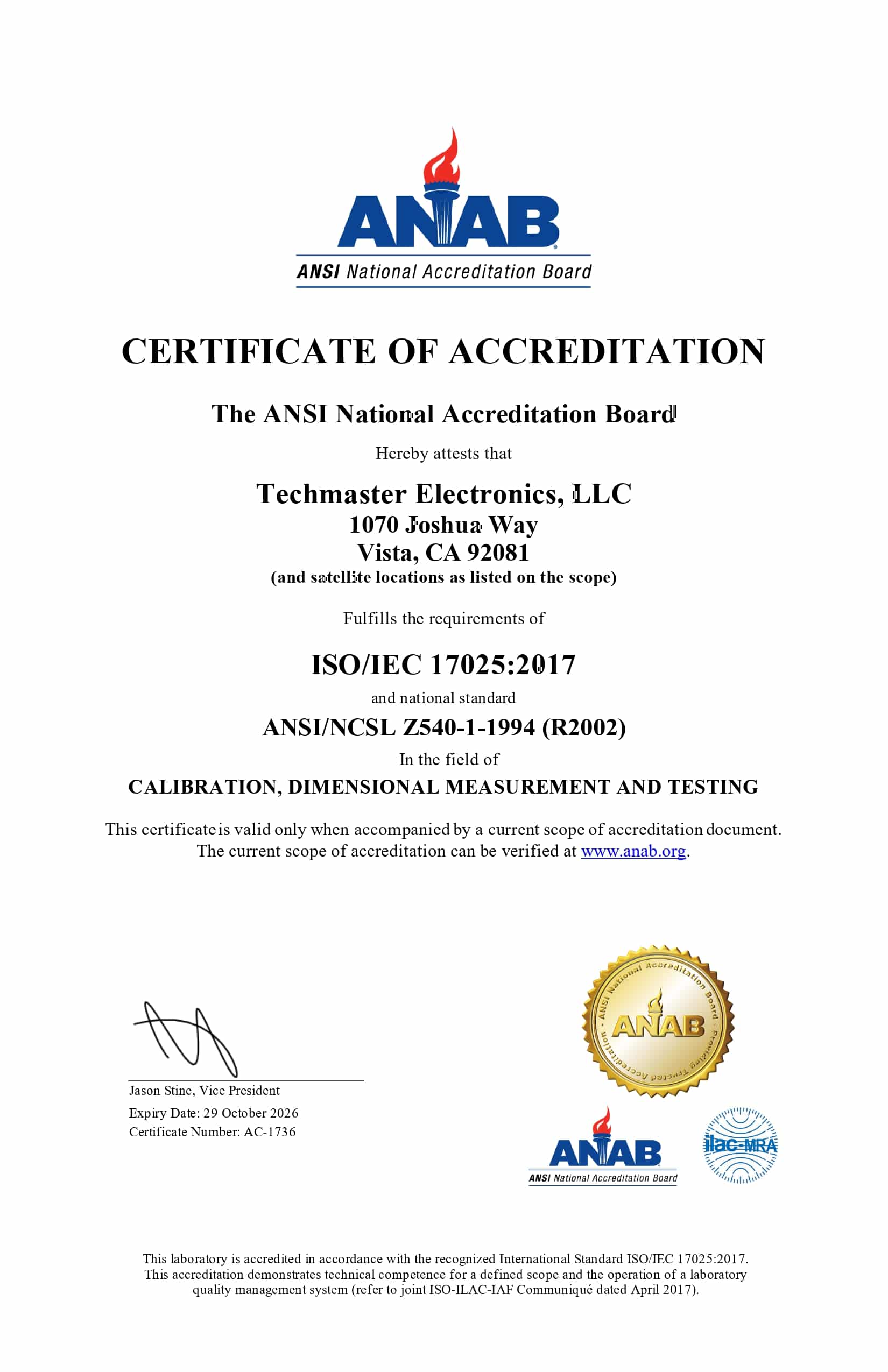
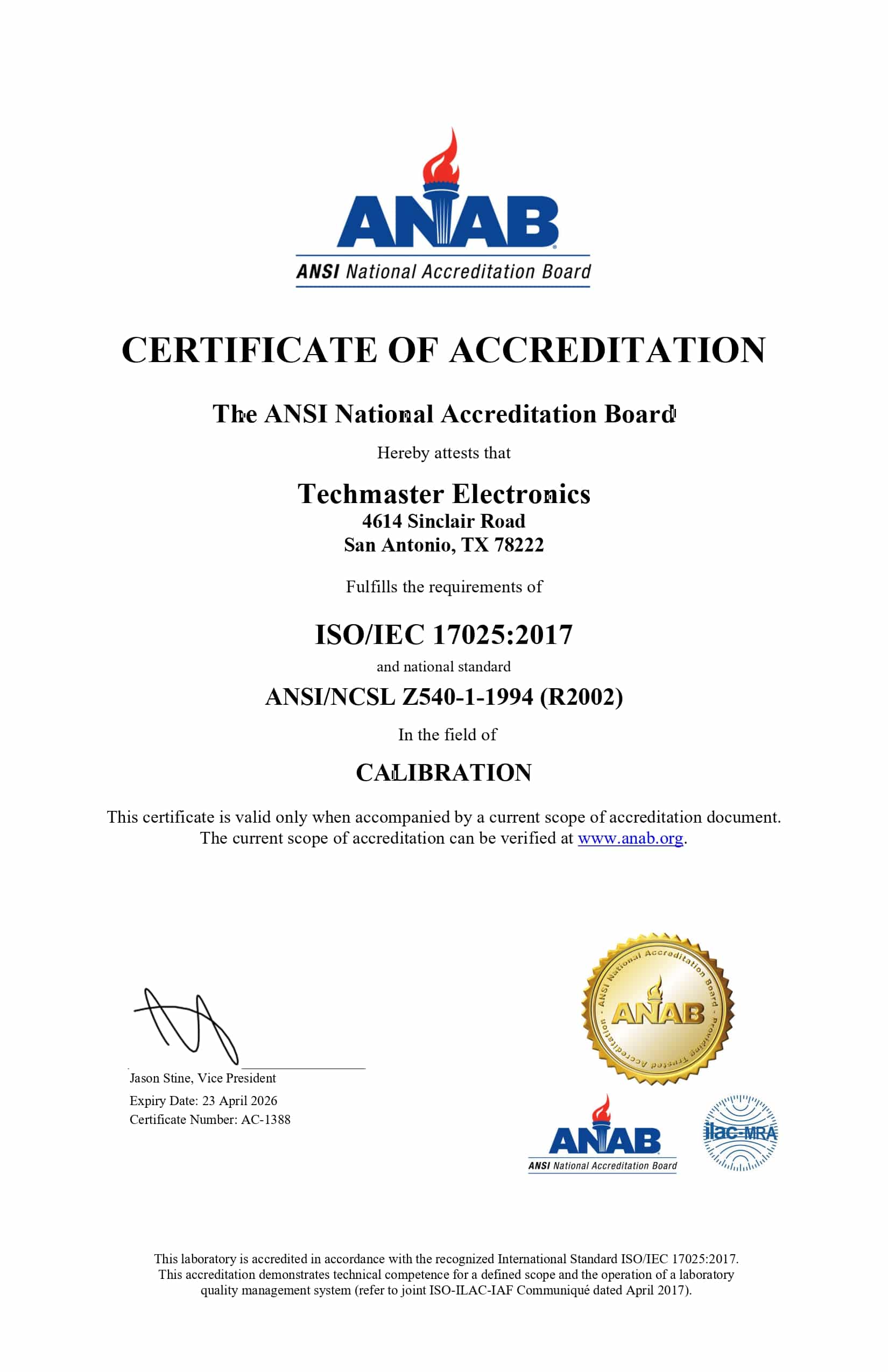
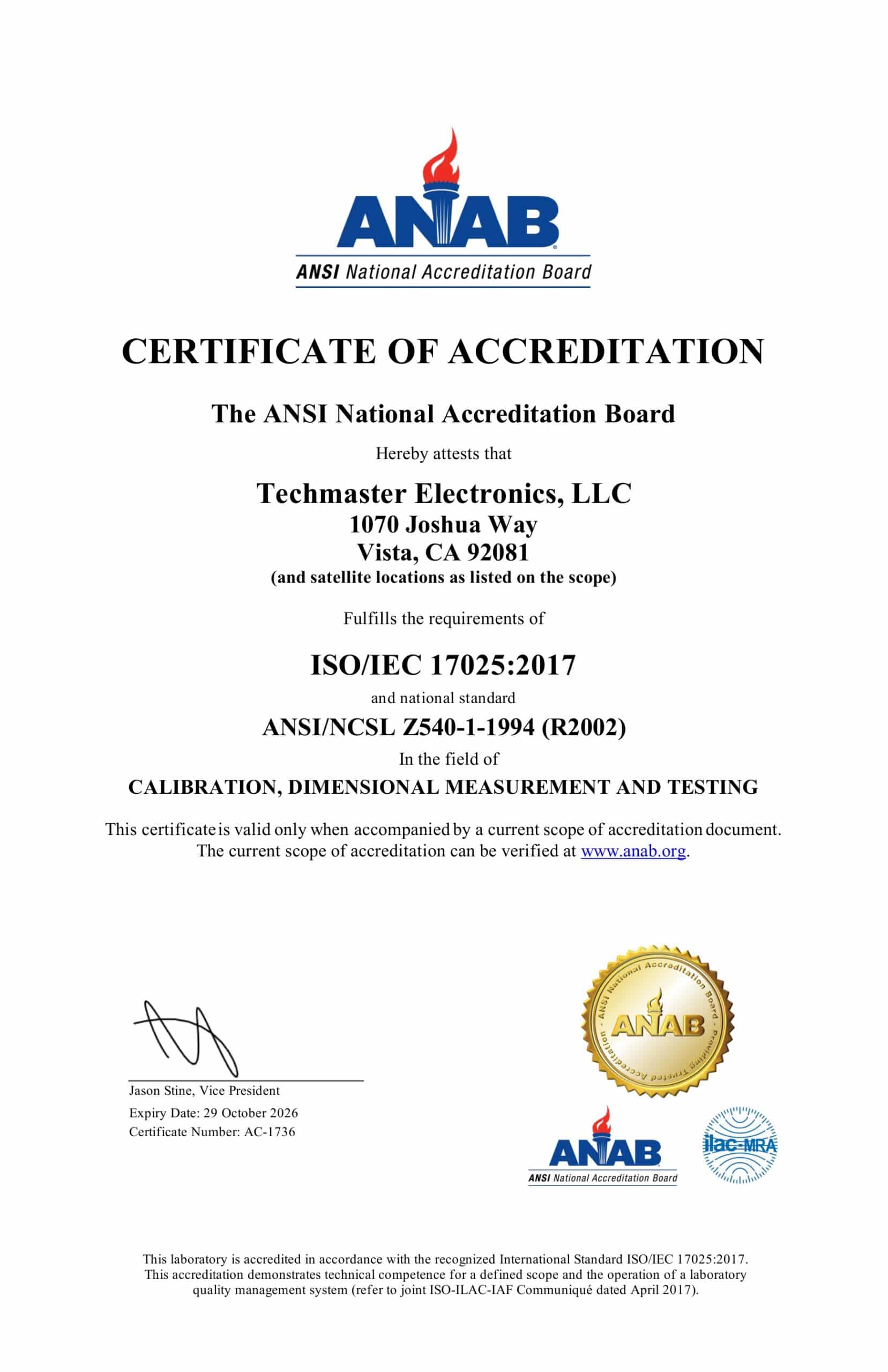
Full ISO/IEC 17025 Accreditation: Every technical procedure is executed under the strict quality governance of our ANAB cert AC-1736 framework.
-
Rapid On-Site Field Calibration: We deploy fully equipped mobile laboratories to verify your ESD systems directly at your production plant, minimizing asset downtime.
-
Comprehensive Metrological Scope: Our capabilities span advanced electronics, thermodynamics, dimensional parameters, and mechanical systems across your entire industrial footprint.
Frequently Asked Questions (FAQs)
1. How often should I calibrate my ESD ionization system?
Standard industry guidelines typically recommend verifying ionizer performance every six to twelve months. However, in high-precision manufacturing or cleanroom environments, quarterly verification is often necessary to ensure strict adherence to ANSI/ESD S20.20 standards.
2. Why does an ionizer stop neutralizing static effectively?
The most common cause is the contamination of the emitter needles, which leads to ion imbalance. As needles accumulate dust or oxidation, the efficiency of ion production declines, and the system may begin to produce more of one ion polarity than the other, resulting in poor neutralization.
3. What is the difference between ion balance and decay time?
Ion balance (offset voltage) measures the equality of positive and negative ion production, while decay time measures the system’s speed in neutralizing a static charge. A high-performance ionizer must be optimized for both to ensure effective ESD protection.
4. Does ISO/IEC 17025 accreditation matter for ESD calibration?
Yes, accreditation provides documented evidence that your ionizer calibration was performed using NIST-traceable instruments and audited procedures. This is a critical requirement for manufacturing high-reliability electronics where ESD compliance is subject to external quality audits.
5. How can I identify if my ionizer is out of calibration?
You can identify potential drift if you notice increased static-related issues on the production floor, such as particle attraction to boards or increased failure rates in ESD-sensitive components. Specialized test equipment, such as a charged plate monitor, is required to confirm these performance issues.
Eliminate False ESD Protection Schemes
Ensure your benchtop, overhead, or room ionization arrays actively defend sensitive electronic components. Connect with Techmaster US today for rapid, certified calibration.
Contact UsFrequently asked questions
What is Ionizer Calibration?
How often should a Ionizer be calibrated?
What standards apply to Ionizer Calibration?
What is included on the certificate?
Can you calibrate the Ionizer on-site?
Need Ionizer calibration?
ANAB-accredited, NIST-traceable, fast turnaround, in-lab or on-site across the USA.
Contact us for a quoteReferences & industry standards
- ISO/IEC 17025 testing & calibration laboratory requirements
- NIST calibration services and measurement traceability
- NCSLI metrology community
- A2LA / ANAB accreditation for calibration laboratories
External standards bodies. Techmaster Electronics is an ISO/IEC 17025-accredited, NIST-traceable calibration laboratory.

Khanh Nguyen is the Marketing Manager at Techmaster Electronics, a B2B marketing leader covering the test, measurement, and ISO/IEC 17025 accredited calibration industry across the US and Vietnam markets.