
Lux Meter Calibration
Lux meter calibration is not on Techmaster’s ANAB ISO/IEC 17025 scope (certificate AC-1736). We calibrate lux meters with NIST-traceable reference standards and issue a NIST-traceable certificate. See what is on our accredited scope.
Accuracy across the range
How Lux Meter calibration works
- Intake & visual inspection
- Environmental stabilization
- As-found measurement
- Comparison to NIST-traceable standards
- Adjustment if required
- As-left results & certificate
Your calibration, covered
In-lab vs on-site calibration
In-lab calibration
- Lab bench with full reference standards
- Best achievable measurement uncertainties
- Pickup & return logistics handled
- Ideal for precision and reference work
On-site calibration
- We calibrate the Lux Meter at your facility
- No shipping risk or transit downtime
- As-found data captured before any move
- Ideal for fixed, large or sensitive assets
In-depth guide
Lux Meter Calibration: Ensuring Precision in Lighting Measurements
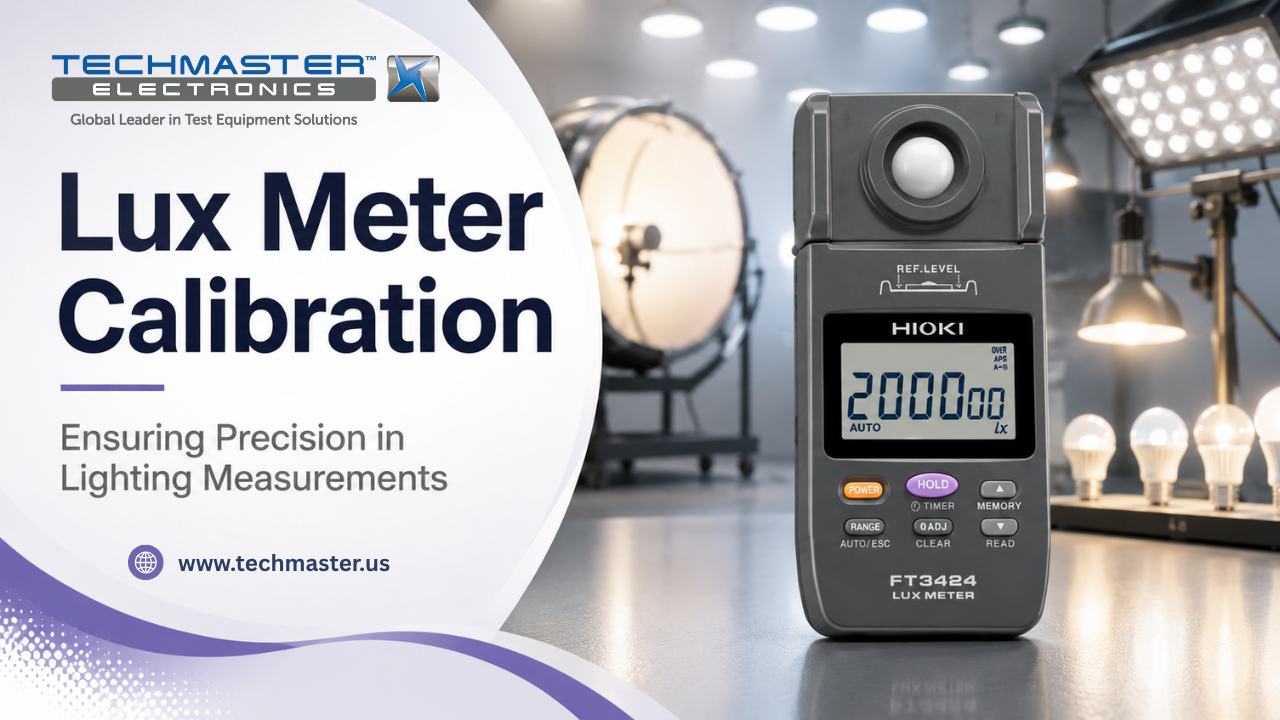
In manufacturing facilities, office environments, cleanrooms, and medical facilities, lighting levels are critical to operational efficiency, visual health, and safety. A high-precision light meter is the primary instrument used by engineers to quantify illuminance and ensure compliance with strict workplace regulations. However, like all precision optical instrumentation, these devices are susceptible to performance degradation over time due to the natural aging of the internal photodiode sensor, dust accumulation, or environmental exposure. Consequently, professional Lux Meter calibration is a fundamental requirement to ensure that your lighting data remains accurate and reliable.
Without periodic verification, light meters commonly experience “measurement drift.” As the photodiode sensor ages, its spectral response to specific wavelengths can shift, causing the device to report values that are higher or lower than the actual illuminance. An uncalibrated instrument creates a false sense of security, potentially leading to suboptimal lighting conditions that can cause human error, reduce productivity, or result in violations of health and safety codes. Traceable calibration is the only way to confirm that your light meter remains traceably linked to international measurement standards.
1. Technical Principles: Photodiode Sensors and Spectral Response
1.1. What fundamental engineering factors affect light meter accuracy?
Lux Meter Calibration is the metrological verification of a light-sensing instrument against traceable reference light sources. This process evaluates spectral sensitivity, linearity, and compensation accuracy to ensure the device mimics the human eye’s photopic response.
1.2. The Mechanism of Sensor Drift
Light meters function by converting incident photon energy into an electrical signal. However, the optical coatings on the sensor can undergo chemical changes when exposed to high-intensity light or UV radiation over extended periods. In addition, the V-Lambda filter, designed to match the spectral sensitivity of the human eye, can become opaque or lose its filtering characteristics, distorting how the meter “perceives” light. Professional calibration laboratories use reference light sources with precisely defined wavelengths to recalibrate these gain coefficients, effectively restoring the meter to its original, accurate state.
2. Industrial Applications: Where Lighting Precision Matters
How does accurate light meter verification impact your operations?
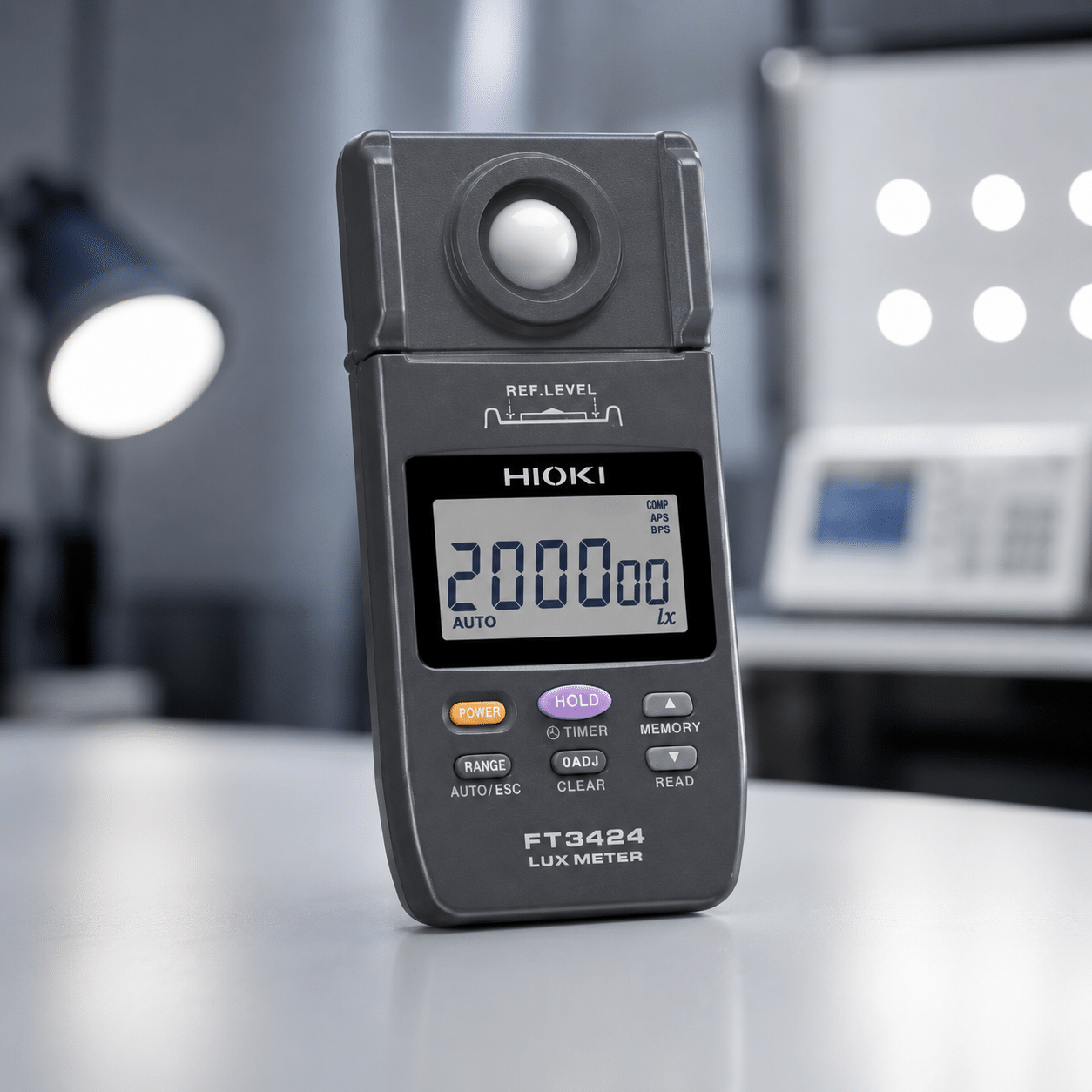
Validating the accuracy of light-measuring instruments provides facility managers and safety engineers with a reliable metric to control lighting environments, ensuring both human productivity and regulatory compliance.
-
Cleanroom and Electronic Assembly: Suboptimal lighting can lead to visual fatigue and errors during the inspection of miniature components. Calibrated devices ensure that work surfaces maintain the specific lumen levels required for high-precision manufacturing.
-
Safety and Regulatory Compliance (OSHA): Occupational safety regulations mandate minimum lighting levels in specific work areas. Data from a calibrated device serves as the primary legal evidence during safety inspections or audits.
-
Energy Management: In smart lighting systems, accurate Lux data allows for the precise calibration of automated lighting controls, which helps organizations optimize energy consumption without compromising workspace safety.
3. The Calibration Pillar: Traceability and Compliance
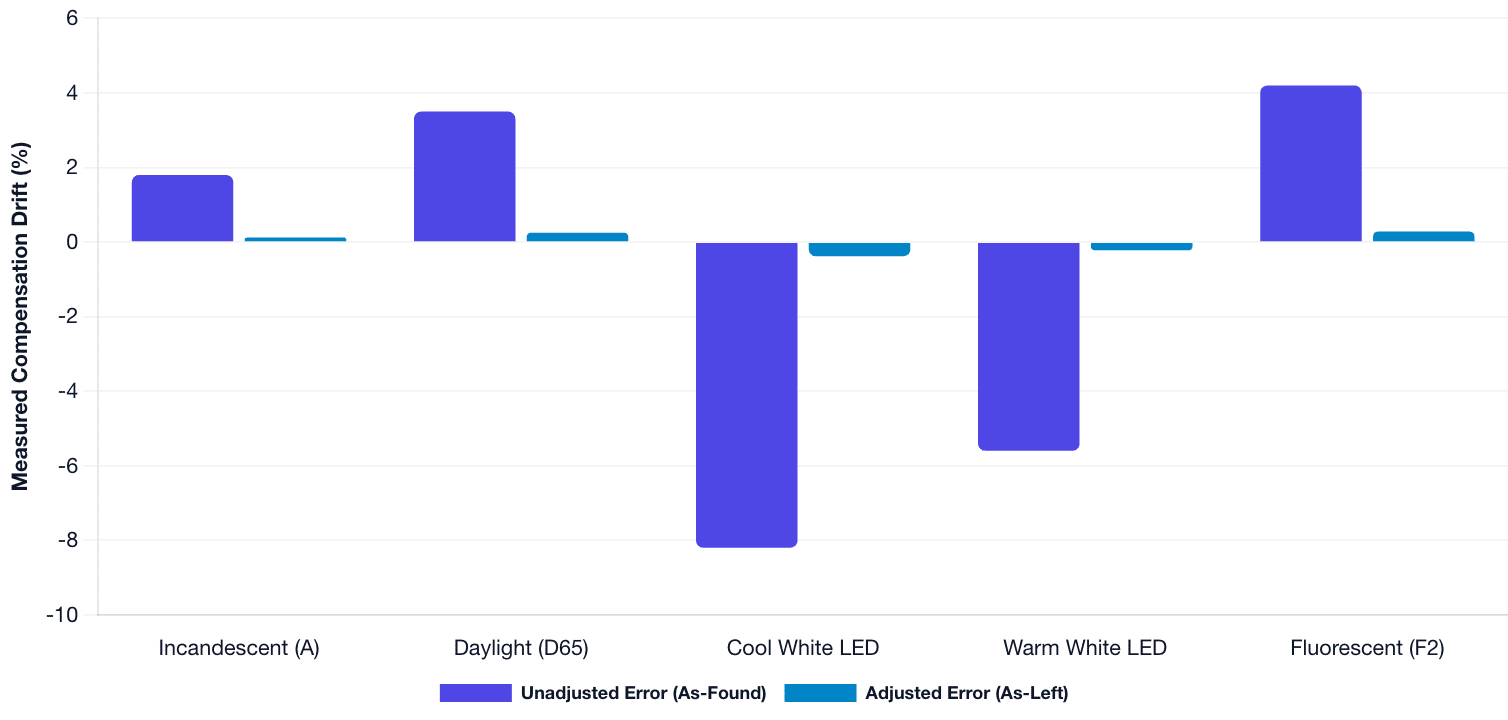
Multi-Source Spectral Compensation Error
Different light sources emit distinct wavelengths. If the optical V-Lambda filter drifts, a lux meter might measure a standard incandescent source correctly, but exhibit high measurement drift when reading modern LED or fluorescent sources. This chart compares source-dependent deviations.
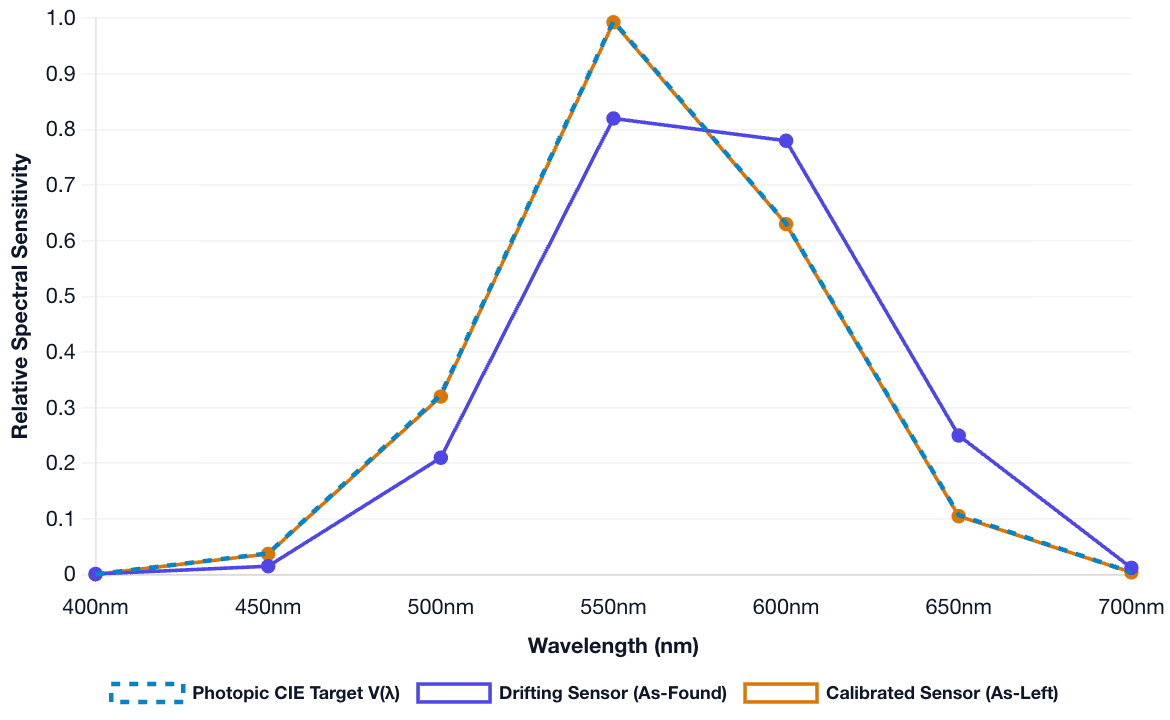
Spectral Matching Curve (Photopic V-Lambda Response)
Evaluates how closely the instrument matches human eye response V(λ) (peak at 555nm). Sensor aging or yellowed V-Lambda optical filters distort color perception, leading to false luminance readouts.
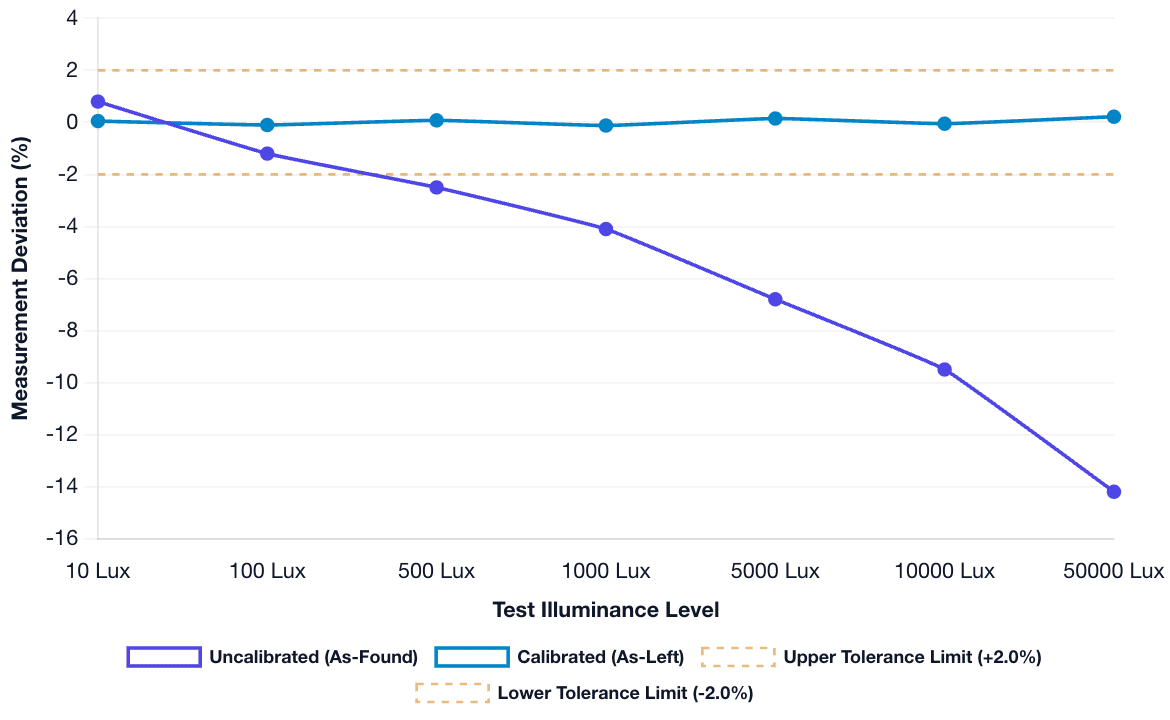
Linearity Error Curve across Intensity
Displays the measurement error percentage (%) at critical target testing points (10 to 50,000 Lux). The uncalibrated (As-Found) sensor degrades significantly at higher illuminance levels, while the calibrated (As-Left) sensor stays within a ±2% tolerance limit.
Why is traceable testing mandatory for optical assets?
Lux Meter Calibration provides a verifiable link between your equipment and international measurement standards. This process quantifies measurement uncertainty and ensures your organization meets the rigorous requirements of ISO/IEC 17025.
Relying on an uncalibrated light meter introduces a significant gap in your Quality Management System. Because measurement drift occurs incrementally, you may not notice a decline until a lighting failure occurs or an audit reveals non-compliance. By adhering to a regular NIST-traceable calibration schedule, you provide your quality team with the necessary certification to prove that your equipment is reliable and that your facility lighting meets all safety specifications.
4. How to Prepare Your Light Meter for Calibration
Follow this checklist to ensure your device is ready for a fast and accurate calibration session at Techmaster US.
1. Clean the Sensor Surface
Use a clean, dry micro-fiber cloth or professional optical-grade cleaning solution to remove dust or fingerprints from the sensor dome.
2. Verify Battery and Power
Ensure the device is equipped with fresh batteries or a stable external power supply to prevent fluctuations during the calibration process.
3. Ensure Thermal Stability
Allow the meter to acclimate to the laboratory environment for at least one hour before testing to reach thermal equilibrium.
4. Provide Usage Context
Inform the lab of your primary use cases, such as indoor office lighting or outdoor high-intensity inspection, so the technician can focus on those measurement ranges.
Techmaster US: Your Calibration Partner
Techmaster Electronics, LLC is an independent, ISO/IEC 17025 accredited calibration laboratory supporting manufacturing sectors across the United States since 1989. Our technical teams operate out of five laboratories (four ISO/IEC 17025 accredited) located in California, Florida, Texas, and North Carolina.
Our metrologists utilize high-precision reference light standards to perform careful Lux Meter Calibration. We integrate our calibration results with advanced digital retrieval systems, allowing quality managers and lab directors to verify certification paperwork instantly, ensuring smooth compliance and documentation.
Why Choose Techmaster US?
-
Quality system: All procedures follow the strict quality governance of our ANAB cert AC-1736 framework.
-
Rapid On-Site Calibration: We provide mobile laboratory services at your facility to verify your systems, minimizing operational downtime.
-
Comprehensive Expertise: Our capabilities span electrical, dimensional, optical, and thermodynamic disciplines.
Frequently Asked Questions (FAQs)
1. How often should a Lux Meter be calibrated?
We generally recommend annual Lux Meter Calibration to ensure long-term reliability. However, if the device is used in harsh environments or high-intensity production settings, a six-month interval is often preferred to detect wear early.
2. Why do light meters drift over time?
Drift is primarily caused by the natural aging of the photodiode sensor materials and the degradation of optical filters due to environmental exposure or intense UV radiation.
3. Why is ISO/IEC 17025 accreditation required?
Accreditation serves as formal evidence that your calibration used repeatable procedures and traceable standards. Which is essential for passing both internal and third-party quality audits.
4. Can I calibrate a Lux Meter myself at home?
No. Accurate calibration requires a dark-room environment. A reference light source with internationally traceable output, and specialized transfer standards that are not available to the average user.
Eliminate Photodiode Measurement Drift
Ensure your workspace and cleanroom lighting audits stand up to regulatory OSHA standards. Partner with Techmaster US for certified, high-stability photometric calibration.
CONTACT USFrequently asked questions
What is Lux Meter Calibration?
How often should a Lux Meter be calibrated?
What standards apply to Lux Meter Calibration?
What is included on the certificate?
Can you calibrate the Lux Meter on-site?
Need Lux Meter calibration?
NIST-traceable calibration, fast turnaround, in-lab or on-site across the USA.
Contact us for a quoteReferences & industry standards
- ISO/IEC 17025 testing & calibration laboratory requirements
- NIST calibration services and measurement traceability
- A2LA / ANAB accreditation for calibration laboratories
External standards bodies. Techmaster Electronics is an ISO/IEC 17025-accredited, NIST-traceable calibration laboratory.

Khanh Nguyen is the Marketing Manager at Techmaster Electronics, a B2B marketing leader covering the test, measurement, and ISO/IEC 17025 accredited calibration industry in the United States.