
Most manufacturers specify a 12-month recalibration interval for an ECal (electronic calibration) module, and sooner after mechanical shock, a dropped module, connector wear, or a failed verification. Because an ECal module’s standards are stored data that drifts with time and use, the interval should be confirmed against your own risk and usage, and the recalibration must be an accredited ISO/IEC 17025, NIST-traceable calibration, not just a field self-characterization.
“How often do I actually need to send my ECal module in?” is one of the most common questions we get from RF and microwave labs, and the honest answer is more than a single number. The 12-month rule is the right starting point, but the real interval depends on how the module is used, how it has drifted in the past, and the risk you carry if it is quietly out of tolerance. This guide walks through all of it.
New to ECal modules or want the full service and model coverage first? Start with our main guide to ECal Module Calibration, then come back here to set your interval.
The short answer: the 12-month rule (and its exceptions)
Keysight and other manufacturers specify a recommended recalibration interval, typically 12 months, for electronic calibration modules. That interval is the default you should plan and budget around. But it is a starting point, not a ceiling: several situations call for recalibrating sooner, and a few well-run labs can justify extending it with documented data.
| Situation | Suggested action |
|---|---|
| Routine bench use, climate-controlled lab | Standard 12-month accredited recalibration |
| High-volume production or shared/shop-floor use | Consider a shortened interval (e.g. 6–9 months) based on usage and history |
| After a drop, over-torque, or mechanical shock | Recalibrate before the next critical measurement, do not wait for the anniversary |
| Failed verification / lost correlation to a golden DUT | Recalibrate (and verify the connector interface) immediately |
| Aerospace/defense (AS9100) or Z540 program | Hold to the documented interval; an expired certificate = out of calibration |
| Module in storage / rarely used | Recalibrate before returning it to service, regardless of last date |
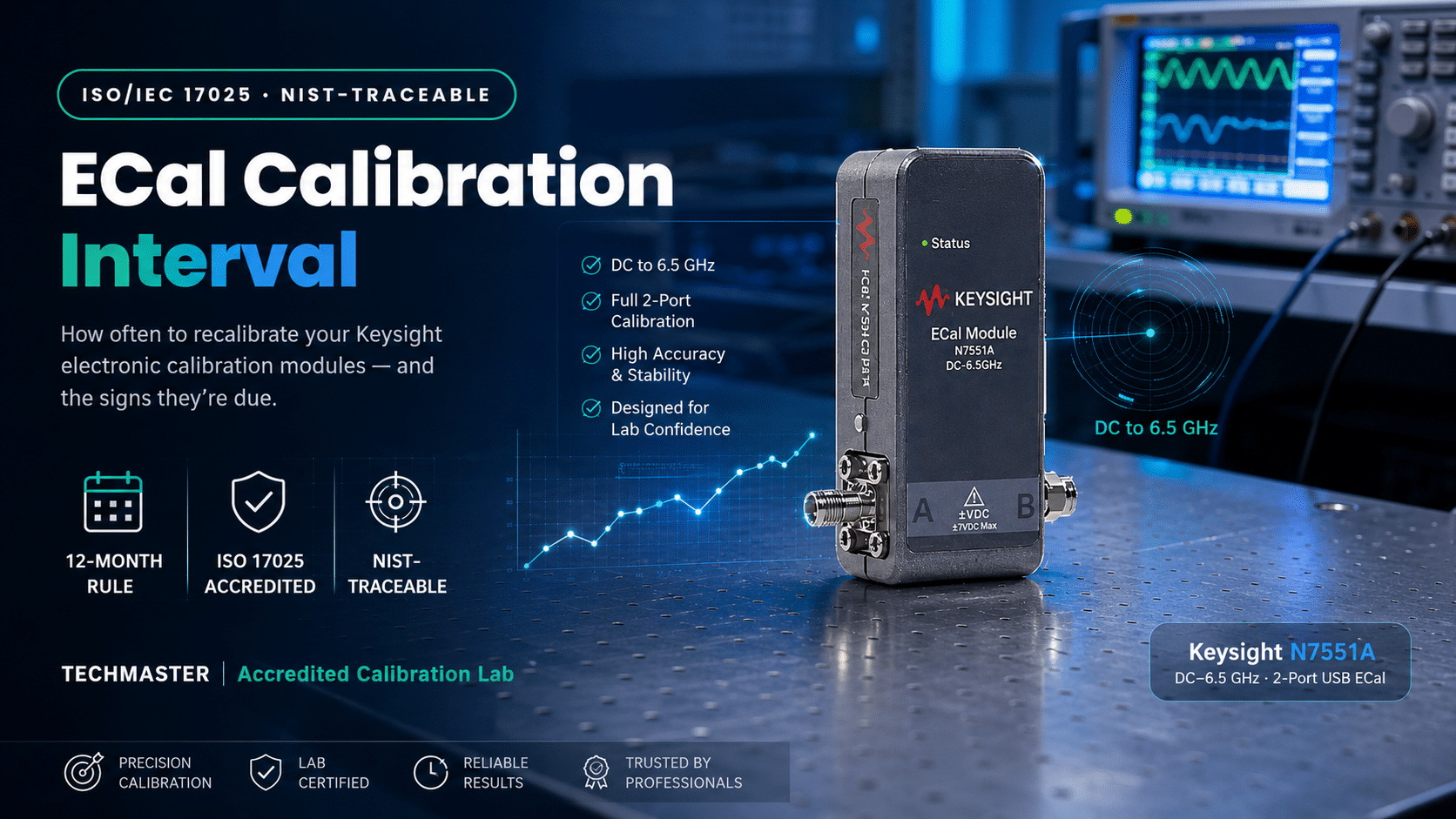
A real Keysight N7551A USB ECal module, its impedance standards are stored data that drifts with time, connector wear and handling. (Lab background composited.)
Why an ECal module drifts in the first place
It helps to remember what is actually inside an ECal module. Unlike a mechanical cal kit where the open, short, load and thru are physical standards, an ECal module stores a set of characterized impedance standards as data in internal memory. The VNA reads that data to establish its reference plane. That stored characterization is itself a measurement, and measurements age:
- Connector wear, every connection slightly changes the reference plane the module was characterized at.
- Mechanical shock, a drop or an over-torqued connector physically shifts the internal standards.
- Thermal cycling, repeated temperature swings on a shop floor or in shipping accelerate drift.
- Time, even a module sitting in a drawer drifts slowly from its last characterization.
None of this is visible from the bench. The module still connects, the VNA still runs, it just runs against standards that no longer match the certificate. That is exactly why a fixed, documented interval exists instead of “recalibrate when it looks wrong.”
6 signs your ECal module is due (or overdue)
Beyond the calendar, treat any of these as a trigger to recalibrate:
It is within ~30 days of its due date
The recommended interval exists for a reason, drift is gradual, so “it still looks fine” is not evidence it is in tolerance.
It was dropped, knocked, or torqued by hand
Mechanical shock and over-torque shift the internal standards and damage the connector interface, recalibrate before the next critical job, not at the next anniversary.
Your VNA fails a verification or correlation check
If a verification kit or a known golden DUT no longer correlates, a drifting ECal module is one of the first suspects.
The connector shows wear, debris, or inconsistent torque
ECal modules are characterized at their connector reference plane; a worn or dirty connector quietly adds uncertainty to every sweep.
It has lived through wide temperature swings
Thermal cycling on a shop floor or in shipping ages the stored characterization faster than a climate-controlled bench.
You can’t find its current accredited certificate
No paper, no proof. For ISO/IEC 17025, AS9100 or Z540 audits, an expired or missing certificate is treated as out of calibration.
Characterization vs. accredited calibration, don’t confuse the two
This is the single most important distinction for ECal modules, and it trips up a lot of otherwise careful labs. There are two different operations that both get called “cal”:
User characterization (field refresh)
Many VNAs let you re-characterize an ECal module against your own analyzer. It is fast and genuinely useful between accredited calibrations, but it inherits your VNA’s uncertainty and is not independently traceable. It cannot satisfy an audit on its own.
Accredited ISO/IEC 17025 calibration
This re-characterizes the module against NIST-traceable references in an accredited lab, and produces an ANAB-accredited certificate with as-found/as-left data and stated measurement uncertainty. This is the calibration your interval refers to, and the one auditors accept. For the full accredited service and the Keysight models in scope, see ECal Module Calibration.
How to set a defensible interval for your lab
If you run a formal quality system, your interval should be a documented decision, not a habit. A simple risk-based approach:
- Start at the manufacturer recommendation (12 months) as your baseline.
- Weigh the usage, a module in daily production earns a shorter interval than one used a few times a quarter.
- Look at drift history, as-found data from past calibrations tells you whether the module hugs spec or creeps toward the limits.
- Weigh the measurement risk, the cost of a wrong S-parameter result on your most critical product.
- Honor program requirements, AS9100 and ANSI/NCSL Z540 programs expect the documented interval to be held and justified.
Labs that track this over time can use interval analysis to extend an interval for a consistently stable module, or to shorten it for one that drifts, and have the records to defend either choice.
The cost of skipping it
An out-of-cal ECal module is the cheapest problem to prevent and one of the most expensive to discover late. Skip the interval and you risk invalid measurements going back to the last good calibration, non-conformance findings in an ISO/IEC 17025 or AS9100 audit, failed customer correlations, and in the worst case a recall or re-test of product that shipped against bad data. A disciplined recalibration schedule with an accredited lab is, frankly, the cheapest insurance in your RF test program.
Stay ahead of the next due date with Techmaster
Techmaster is an ANAB-accredited ISO/IEC 17025 calibration laboratory serving RF, microwave, semiconductor and electronics manufacturers across the USA. We calibrate the full Keysight ECal range, including the latest N7564A/N7564AEP, with NIST-traceable results and far shorter turnaround than an overseas factory return, so holding a 12-month (or tighter) interval never means weeks of bench downtime. Tell us your modules and due dates and we’ll help you stay ahead of every one.
Frequently asked questions
How often should a Keysight ECal module be calibrated?
The standard recommendation is a 12-month recalibration interval. Shorten it for high-usage, shop-floor, or production modules, and recalibrate immediately after any mechanical shock, dropped module, connector damage, or a failed VNA verification, because an ECal module’s standards are stored data that drifts with time and handling.
What is the difference between ECal characterization and ECal calibration?
User characterization is something you can run in the field to refresh a module against your own VNA, useful, but it inherits your analyzer’s uncertainty and is not metrologically traceable on its own. Accredited ECal calibration re-characterizes the module against NIST-traceable references under ISO/IEC 17025 and is issued on an ANAB-accredited certificate with as-found/as-left data and stated uncertainty. For audits, only the accredited calibration counts.
How do I set a recalibration interval for my lab?
Start from the manufacturer’s 12-month recommendation, then adjust using a risk-based approach: how the module is used (production vs. occasional bench), its drift history from past as-found data, the measurement risk if it is out of tolerance, and any program requirement (AS9100, ANSI/NCSL Z540). Labs running a formal interval-analysis program lengthen or shorten the interval based on documented results.
What happens if I skip the ECal recalibration interval?
An out-of-cal ECal module doesn’t fail loudly, it quietly adds uncertainty to every S-parameter sweep until an audit, a failed correlation, or a customer return finds it. You also risk non-conformance findings in an ISO/IEC 17025, AS9100, or Z540 audit, and potentially invalid measurements made since the last good calibration.
Can I recalibrate an ECal module locally instead of shipping it overseas?
Yes. Techmaster provides accredited, NIST-traceable ECal calibration in the USA with fast turnaround across the full Keysight range, so you can hold your interval without weeks of international freight and factory queue time. See our main ECal Module Calibration service for the complete model coverage.
Related calibration guides
- ECal Module Calibration
- RF & microwave calibration services
- function generator calibration
- What is ISO/IEC 17025 accreditation?
Not sure when your ECal module is next due? Send us the model and we’ll help you set a defensible interval, ANAB-accredited, NIST-traceable, fast turnaround.
Get a recalibration quoteRelated reading: Out-of-tolerance calibration results: what an OOT report means and what to do next.
Related reading: test uncertainty ratio and decision rules: reading pass/fail with confidence
References & industry standards
- ISO/IEC 17025 testing & calibration laboratory requirements
- NIST calibration services and measurement traceability
- NIST RF electromagnetics metrology
- A2LA / ANAB accreditation for calibration laboratories
External standards bodies. Techmaster Electronics is an ISO/IEC 17025-accredited, NIST-traceable calibration laboratory.
ECal module calibration at Techmaster, at a glance
- ISO/IEC 17025:2017 accredited by ANAB (Certificate AC-1736)
- NIST-traceable reference standards with a full measurement-uncertainty budget reported on every certificate (as-found / as-left data included)
- 5 US calibration labs: Vista CA, Santa Clara CA, Orlando FL, San Antonio TX, and Holly Springs NC
- Turnaround: 5 business days standard; 1–2 business-day expedite available
- In-lab or nationwide on-site calibration to minimize your downtime
Related reading: VNA calibration kit verification — how to keep SOLT standards traceable

Khanh Nguyen is the Marketing Manager at Techmaster Electronics, a B2B marketing leader covering the test, measurement, and ISO/IEC 17025 accredited calibration industry across the US and Vietnam markets.