
Oscilloscope Calibration Intervals: Accuracy, Compliance & Best Practices
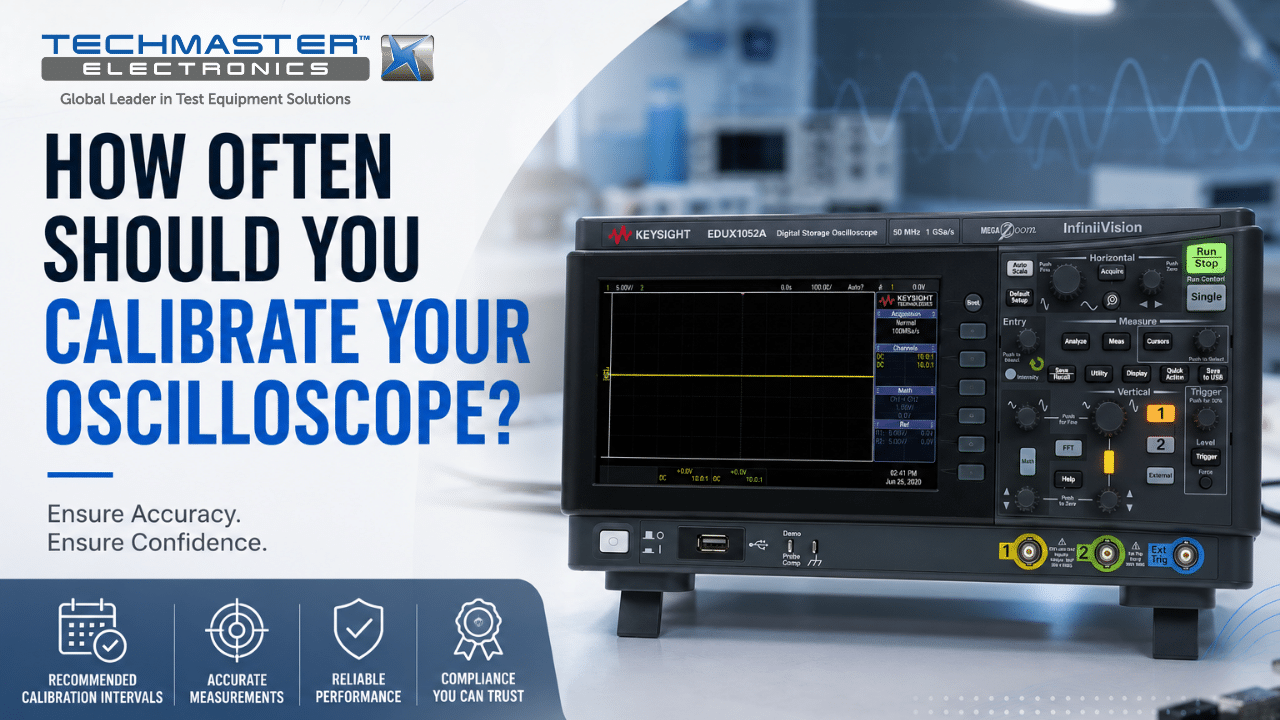
The oscilloscope is a cornerstone instrument for diagnosing signal integrity and electronic circuit performance. One of the most frequent inquiries from engineers and quality managers is how often calibrate oscilloscope units to maintain device reliability. Over time, internal components undergo aging, which, combined with thermal cycling and environmental stressors, induces measurement drift—a gradual deviation that can compromise analytical accuracy if the instrument is not periodically restored to its baseline state.
For what the calibration itself involves, see how to calibrate an oscilloscope.
This calibration falls under our electrical calibration service.
Maintaining an appropriate calibration interval is not merely a task for ISO/IEC 17025 compliance; it is a critical strategy to protect an organization from the risks associated with diagnostic errors, faulty circuit analysis, or non-compliance with technical production standards.
1. Technical Principles: Measurement Drift and Stability
1.1. Why does an oscilloscope lose accuracy over time?
Determining how often calibrate oscilloscope systems depends on managing measurement drift: internal components such as ADC converters, attenuation networks, and crystal oscillators inherently shift in value due to temperature and operational age, resulting in amplitude errors and timing phase shifts.
1.2. Factors Contributing to Performance Degradation
-
Thermal Fatigue: Continuous fluctuations in internal temperature during operation stress semiconductor junctions and soldered connections.
-
Component Aging: Resistive attenuators and capacitors exhibit parameter shifts over years of continuous service.
-
Environmental Conditions: Ambient humidity and particulate accumulation within the laboratory can affect the sensitivity of high-frequency pre-amplifiers.
2. Industrial Applications: The Necessity of Reliable Data
In which fields are rigorous calibration intervals critical?
In high-precision industries, establishing a clear answer to how often calibrate oscilloscope requirements is vital to ensure that voltage and time measurements remain within defined tolerance bands.
-
Medical Device Manufacturing: Diagnostic signals must be captured with absolute fidelity to ensure patient safety and adherence to stringent medical regulatory requirements.
-
Electric Vehicle (EV) Systems: Analysis of Battery Management System (BMS) signals and CAN-bus communications requires oscilloscopes to maintain perfect time-base accuracy to prevent system-wide logic errors.
-
Aerospace & Defense: Verification of radar pulses and flight control systems demands calibration processes that strictly adhere to national measurement standards.
3. The Calibration Pillar: Traceability and Compliance
Why is ISO/IEC 17025 compliance mandatory?
Periodic oscilloscope calibration under the ISO/IEC 17025 framework establishes measurement traceability to international standards, providing objective evidence that your equipment is reliable during global quality audits.
Ignoring established calibration intervals creates invisible technical gaps. An oscilloscope that appears to function correctly but suffers from degraded sensitivity can lead to flawed design decisions, resulting in wasted development costs and potential product recalls.
4. How to Verify: Assessing Your Calibration Needs
Follow these professional steps to assess your equipment status and determine if a calibration cycle is due.
1. Review Equipment Drift History
Examine previous calibration reports; if your oscilloscope consistently trends toward the edge of tolerance, consider shortening your calibration interval.
2. Evaluate Operational Intensity
Equipment utilized 24/7 in industrial environments requires significantly shorter calibration intervals compared to units used sparingly in R&D laboratories.
3. Implement Interim Performance Checks
Use a reference signal generator to perform weekly baseline accuracy checks, allowing you to detect performance degradation before the formal calibration cycle is reached.
Techmaster US: Your Calibration Partner
Techmaster Electronics, LLC is an independent, ISO/IEC 17025 accredited calibration laboratory supporting the U.S. manufacturing sector since 1989. Our experts operate out of five laboratories (four ISO/IEC 17025 accredited) located in California, Florida, Texas, and North Carolina.
We perform oscilloscope calibration using highly traceable measurement standards, ensuring that your equipment remains in compliance with the most rigorous quality requirements.
Why Choose Techmaster US?
-
Full ISO/IEC 17025 Accreditation: Procedures strictly adhere to our ANAB cert AC-1736 quality framework.
-
Flexible Service Options: We offer both in-lab and on-site calibration services to minimize operational downtime.
-
Comprehensive Expertise: Our capabilities cover the full spectrum of disciplines, including electrical, RF, mechanical, and environmental measurement.
Frequently Asked Questions (FAQs)
About Oscilloscope Calibration:
1. How often calibrate oscilloscope units as a standard?
Annual calibration is the industry standard for most professional environments. However, if the oscilloscope is used for high-precision verification or in harsh operating conditions, a 6-month interval is recommended to detect measurement drift early.
2. How do I identify if my oscilloscope has measurement drift?
You can identify drift by comparing measurement results against a known reference signal source. If the displayed amplitude or timing parameters deviate significantly from the expected values, it is a clear indicator that the device requires professional calibration.
3. Why should I avoid self-calibrating my oscilloscope?
While built-in software routines can adjust internal settings, they lack international traceability according to ISO/IEC 17025 standards. Only accredited laboratories have the competency to provide valid calibration certificates required for professional audits.
4. Does calibration improve the processing speed of an oscilloscope?
No, calibration does not alter processing speed but focuses on measurement accuracy. It ensures that captured data represents physical reality, eliminating systematic errors during complex signal analysis.
About EDUX1052A Keysight Oscilloscope Calibration:
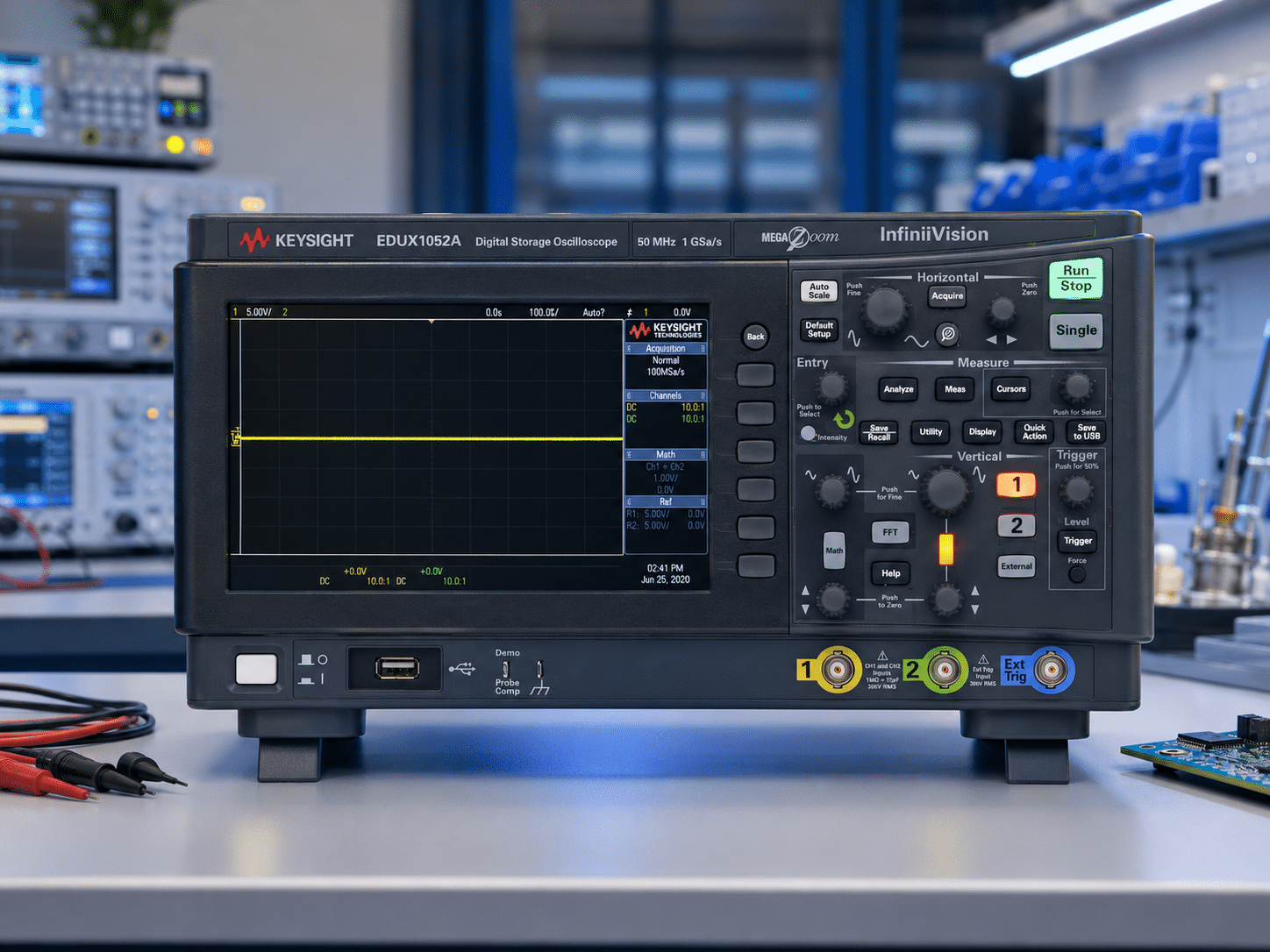
5. What are the specific calibration requirements for the EDUX1052A Keysight oscilloscope?
The EDUX1052A is a high-performance entry-level oscilloscope that requires periodic verification of its vertical gain accuracy, time-base stability, and trigger sensitivity. Following manufacturer recommendations, a 1-year calibration cycle ensures these specifications remain within the factory-defined tolerance levels for educational and industrial applications.
6. Can I use the built-in self-cal function of the EDUX1052A as a substitute for professional calibration?
No, the internal self-calibration of instruments like the EDUX1052A adjusts internal signal paths but does not provide external traceability. Professional, third-party calibration is necessary to ensure the unit meets ISO/IEC 17025 standards for official compliance.
7. Does the EDUX1052A require specialized calibration for high-frequency measurements?
Yes, for applications involving signals near the maximum bandwidth of the EDUX1052A, professional calibration is vital to verify the frequency response and attenuation flatness across the entire range.
8. What happens if I miss a calibration interval for my Keysight oscilloscope?
Missing a calibration interval increases the risk of “false pass” results, where your measurements appear accurate but are actually outside the acceptable tolerance. This can lead to flawed production decisions and potential non-compliance in regulated industries.
9. Should I calibrate my EDUX1052A more frequently if used in a harsh environment?
Yes, if used in environments with significant temperature fluctuations, high vibration, or dust, you should consider shortening the calibration interval to 6 months to account for faster component aging.
10. Does Techmaster US provide calibration for the EDUX1052A series?
Yes, Techmaster Electronics provides comprehensive, ISO/IEC 17025 accredited calibration for the EDUX1052A series, ensuring full traceability and reliable performance documentation for your audit requirements.
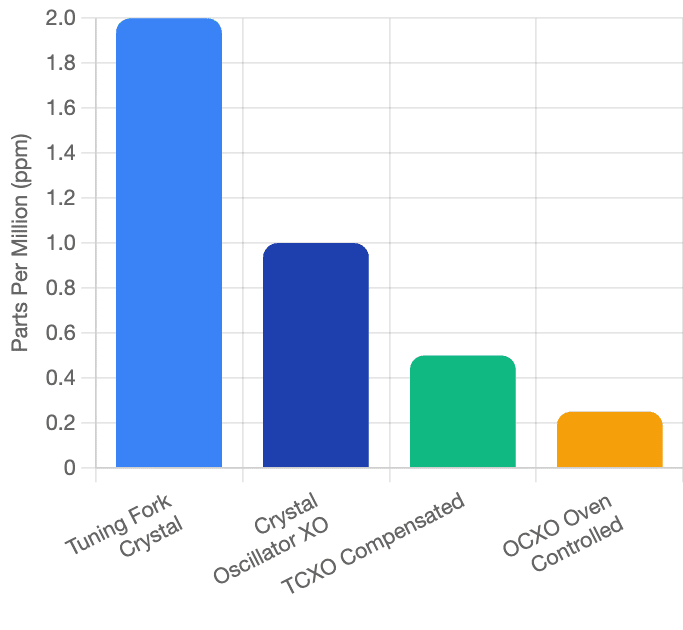
Timing Stability: Crystal Aging Rates
The horizontal timebase depends on the master clock. As shown below, different resonator classes exhibit varying year-one aging rates (ppm/year).
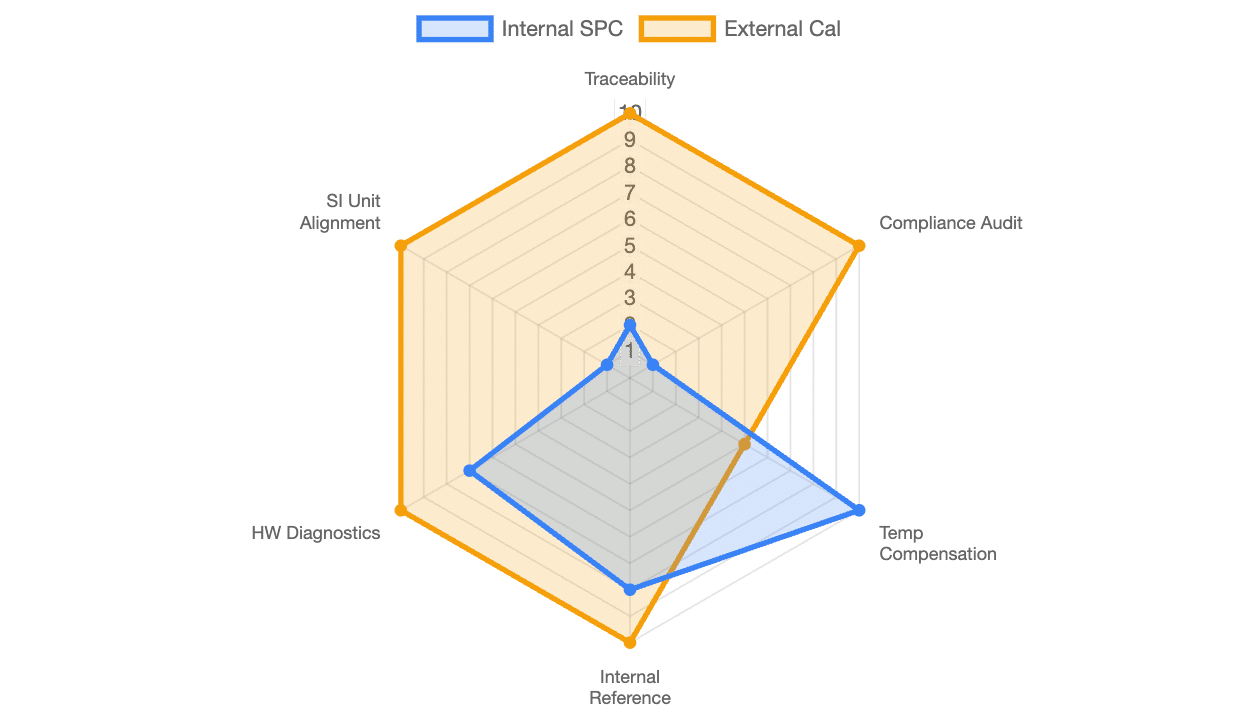
SPC vs. External Metrology
Signal Path Compensation (SPC) handles local temperature variations, but it cannot establish Metrological Traceability.
✔ Internal SPC: Rapid Thermal Correction
★ External: Traceable SI Alignment
Oscilloscope Calibration Strategy
Ensuring accuracy, compliance, and reliability in high-frequency measurements through metrological best practices.
CONTACT USRelated reading: What to do when your oscilloscope comes back out of tolerance: the OOT response guide.
Related reading: How to set and adjust calibration intervals using End-of-Period Reliability
References & industry standards
- ISO/IEC 17025 testing & calibration laboratory requirements
- NIST calibration services and measurement traceability
- NIST Fundamental Electrical Measurements
- A2LA / ANAB accreditation for calibration laboratories
External standards bodies. Techmaster Electronics is an ISO/IEC 17025-accredited, NIST-traceable calibration laboratory.
Related reading: Allan deviation explained: measuring oscillator and frequency-standard stability
Frequently asked questions
What is oscilloscope calibration?
Oscilloscope Calibration is the documented comparison of a oscilloscope against NIST-traceable reference standards under ISO/IEC 17025. It quantifies the oscilloscope’s error and measurement uncertainty and confirms it performs within tolerance, with as-found and as-left data on the certificate.
How often should a oscilloscope be calibrated?
Most quality systems calibrate a oscilloscope every 12 months, or sooner after repair, overload, or before critical measurements. Set your interval from the manufacturer spec and your ISO 9001 / 13485 / AS9100 program and drift history.
Is Techmaster’s oscilloscope calibration ISO 17025 accredited?
Yes. Techmaster Electronics is ISO/IEC 17025:2017 accredited by ANAB (Certificate AC-1736). Every oscilloscope calibration is NIST-traceable and issued with a full measurement-uncertainty budget.
What is the turnaround for oscilloscope calibration?
Standard turnaround is 5 business days, with 1–2 business-day expedite available. On-site calibration removes shipping time entirely for oscilloscopes that can’t leave the floor.
Do you calibrate oscilloscopes on-site or in-lab?
Both. Techmaster runs five US labs (Vista CA, Santa Clara CA, Orlando FL, San Antonio TX, Holly Springs NC) and offers nationwide on-site oscilloscope calibration to minimize downtime.

Khanh Nguyen is the Marketing Manager at Techmaster Electronics, a B2B marketing leader covering the test, measurement, and ISO/IEC 17025 accredited calibration industry in the United States.