
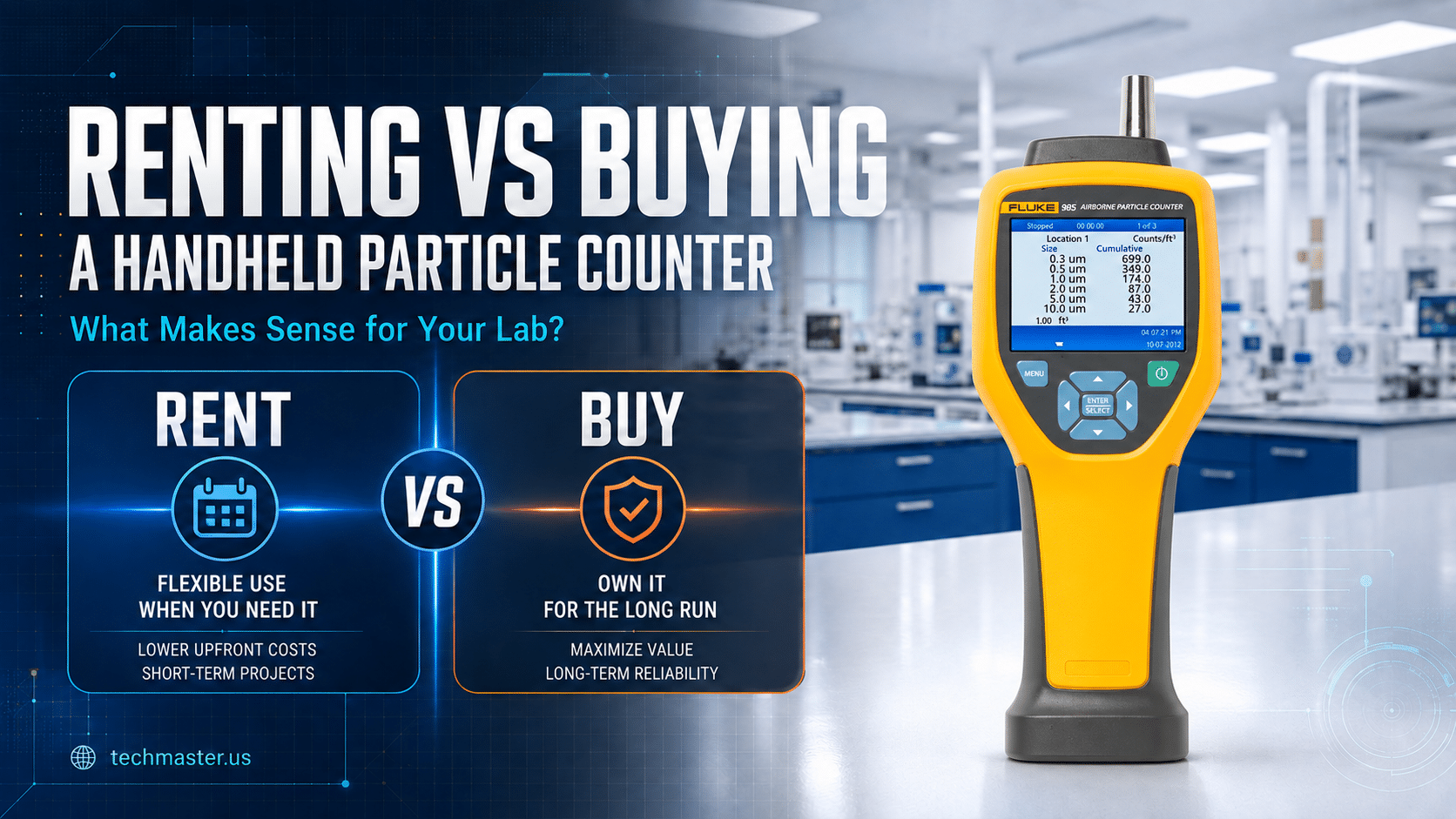
Rent vs Buy Handheld Particle Counter: What Makes Sense for Your Lab?
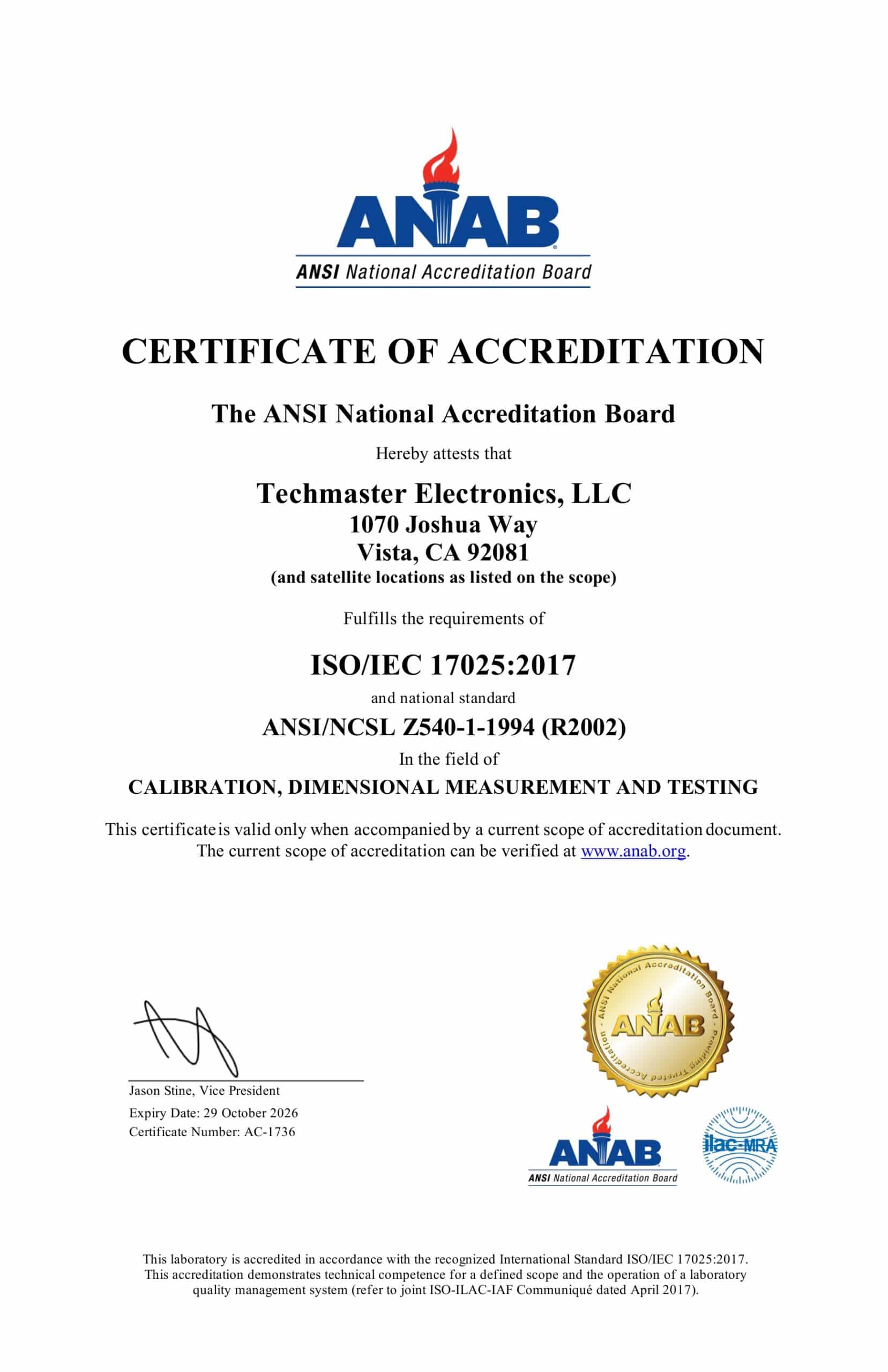
Note on particle counters: This page is for general information only. Techmaster does not calibrate particle counters of any make or model, and particle counters are not on our ANAB ISO/IEC 17025 scope (certificate AC-1736). Techmaster only performs calibration services that are covered by our scope. For particle counter calibration, please contact your instrument’s manufacturer or its authorized service provider, and follow any service requirements they specify. If you prefer, send us your request and, with your permission, we will forward it to the manufacturer. See what is on our accredited scope.
Contamination control demands strict attention in modern laboratories, cleanrooms, and manufacturing facilities. Even microscopic dust particles can ruin expensive microchips, spoil sterile medicines, or compromise critical research. Quality managers and manufacturing engineers must keep these environments perfectly clean to pass strict regulatory audits. To achieve this, you need the right testing tools. But acquiring these tools brings up a major financial and operational choice. Facility leaders must evaluate the rent vs buy handheld particle counter decision to maximize their budgets while maintaining compliance.
This choice changes how your company spends money and manages routine maintenance. Purchasing a tool requires a large upfront capital expense. Renting a tool shifts the cost to daily operations and changes how you handle equipment downtime. Both options offer unique benefits depending on your specific workflow. This guide helps you understand how these measurement tools work, why accurate data matters, and how to choose the best financial path for your facility.
1. What Is a Handheld Particle Counter?
A handheld particle counter is a compact, portable device that detects, sizes, and counts airborne dust and contaminants. Quality teams carry these battery-powered instruments around the cleanroom to spot-check different zones quickly. The device uses a small internal pump to pull in a specific volume of room air, typically at 0.1 or 1.0 cubic feet per minute.
Inside the instrument, a bright laser beam shines across the moving air stream. When a tiny particle hits the laser beam, it scatters the light. A sensitive photodetector captures these light flashes. The internal processor then counts the flashes and measures the size of each particle. These tools detect extremely small contaminants, often measuring sizes like 0.3, 0.5, and 5.0 microns. By reading this data, lab personnel know exactly whether their controlled environment meets required cleanliness standards.
2. Evaluating the Rent vs Buy Handheld Particle Counter Decision
Rent vs. Buy: Handheld Particle Counters
Facilities must manage their equipment budgets carefully. High-precision test instruments cost thousands of dollars. When choosing your option, consider daily usage, calibration downtime, and long-term costs.
Buying Equipment
Buying makes financial sense if your team tests the air every single day across multiple zones. You get instant access, and over five or ten years, the initial purchase saves money compared to continuous daily rentals.
Ownership Responsibilities
- •Your company must pay for all repairs if the unit breaks down.
- •The quality department must track service dates and compliance paperwork.
- •Unavoidable operational downtime during external laboratory calibration.
3. Common Applications for Airborne Particle Counters
Many different industries rely on precise air sampling to protect their products and ensure worker safety. Strict government and industry rules govern how these companies manufacture their goods.
-
Pharmaceutical Manufacturing: Drug makers mix medicines in completely sterile environments. A single speck of contamination can introduce bacteria into a batch of medicine, causing massive recalls.
-
Semiconductor Fabrication: Microchips feature microscopic electrical pathways. One dust particle acts like a boulder, breaking the circuit and ruining the chip.
-
Aerospace Engineering: Engineering teams assemble satellites and optical lenses in clean zones. Dust on a camera lens destroys expensive space imagery.
-
Hospitals and Healthcare: Facility managers use these tools in surgical suites and isolation rooms to prevent airborne pathogens from spreading.
All these industries rely on accurate ISO 14644 cleanroom monitoring to prove their rooms meet legal standards. Without reliable, calibrated tools, they cannot validate their environments or sell their products safely.
4. Calibration Standards and Traceability
Whether you decide to rent or buy your equipment, the data on the screen must reflect reality. A drifting sensor might indicate a room is clean when it actually holds dangerous levels of contamination. To prevent this dangerous scenario, you must calibrate your instruments against known metrology standards.
The metrology industry uses the ISO 21501-4 standard to evaluate these light-scattering airborne particle counters. You need an ISO/IEC 17025 accredited calibration to prove your instrument works perfectly. During this rigorous process, a professional metrologist compares your unit to a master reference standard. The master reference connects directly to the National Institute of Standards and Technology (NIST), providing unbroken traceability.
This chain of documentation proves your instrument generates accurate numbers. When an FDA or ISO auditor visits your facility, they will demand to see your service certificates. If your paperwork lacks the proper accreditation, the auditor will likely fail your cleanroom certification.
5. Common Issues Found During Routine Service
Laser Diode Degradation
The internal laser slowly loses its optical power over the years. When the light grows dim, the instrument misses the smallest dust particles. A dim laser makes your room look cleaner than it really is, creating a false sense of security.
Air Pump Mechanical Wear
The internal pump must pull the exact specified volume of air. Motor parts wear down and slow the pump over time. If the pump pulls too little air, the final particle concentration calculation fails entirely, rendering your data useless.
Dirty Internal Optics
Even pristine cleanrooms contain sticky residues, fumes, and cleaning chemicals. This microscopic dirt coats the internal lenses and mirrors, blocking the laser light. Metrology technicians clean these delicate optical pathways during service.
Zero-Count Filter Failures
A healthy instrument should display zero particles when you attach a HEPA purge filter. Sometimes, electronic noise or air leaks cause phantom dust counts. Technicians run strict zero-count tests to ensure the machine stays quiet in a truly sterile environment.
6. How Often Should This Equipment Be Calibrated?
Equipment Compliance Timelines
You must follow strict timelines to maintain equipment compliance. Your required calibration interval depends entirely on your environment’s risk level.
12-Month Interval
Most device manufacturers require you to calibrate the tool once every 12 months. An annual service interval works perfectly for general manufacturing environments and basic electronics assembly.
- General Manufacturing
- Basic Electronics Assembly
6-Month Interval
However, high-risk facilities require tighter schedules. A contaminated batch of medicine costs millions of dollars in losses and regulatory fines. These strict laboratories usually calibrate their tools every six months.
- Sterile Medicine Manufacturing
- ISO Class 5 Cleanrooms
Review Your SOPs
Always review your internal Standard Operating Procedures (SOPs). Your company’s quality manual dictates exactly when you must send the instruments out for service.
7. What to Look for in a Calibration Provider
You cannot trust just any local shop to test your critical cleanroom tools. You need a highly skilled, accredited laboratory. Use these guidelines to find the best metrology partner for your business.
First, verify their official accreditation documents. The laboratory must display an active ISO/IEC 17025 certificate from a recognized body like ANAB. This certificate proves they passed independent, rigorous audits. Second, ask the laboratory about their measurement uncertainty. A high-quality lab calculates and reports the exact margin of error for their master reference tools.
Third, evaluate their turnaround speed. You need your instruments back quickly to maintain your daily monitoring schedules. Exceptional labs offer expedited processing. Finally, choose a company that answers the phone and provides clear communication. Excellent customer support helps you solve sudden equipment failures quickly and effectively.
8. Techmaster’s Airborne Particle Counter Rental Solutions
Sending your primary monitoring tool away for service creates a massive workflow problem. You still need to test your air every day, but your instrument sits on a delivery truck. Techmaster Electronics solves this problem seamlessly.
We offer fast, flexible airborne particle counter rental options for your facility. When you send us your owned instrument for service, we can immediately ship you a rental unit. Every rental arrives fully tested, thoroughly cleaned, and ready for immediate use. We include a current NIST-traceable calibration certificate in the box. Your team simply opens the case, powers on the unit, and resumes testing. You never miss a single day of environmental monitoring.
9. Why Choose Techmaster Electronics?
Techmaster Electronics opened our doors in 1989. For more than three decades, we have helped quality managers and engineers keep their facilities safe, accurate, and compliant. We operate multiple high-tech calibration laboratories across the United States, supporting the most demanding sectors in the world.
We hold strict ISO/IEC 17025 accreditations from ANAB. Our master metrologists understand the complex compliance rules of the pharmaceutical, aerospace, and semiconductor industries. When you need a reliable Calibration service, you can trust our team to perform the job right the first time. We repair broken tools, sell new equipment, and manage extensive rental fleets. Partner with Techmaster Electronics to enjoy rapid service, flawless paperwork, and expert technical support.
10. Conclusion
Contamination control protects your end products, your customers, and your business reputation. Inaccurate particle counts lead to ruined products, failed regulatory audits, and severe financial losses. You must determine the most efficient way to supply your team with accurate testing instruments.
Buying equipment works well for continuous, daily tasks, while renting bridges short-term gaps, covers calibration downtime, and limits capital spending. No matter which side of the rent vs buy handheld particle counter debate you land on, you must keep the equipment tested and traceable. Partner with a trusted, accredited calibration laboratory to maintain your fleet. Proper metrology care ensures your instruments always tell the truth about your cleanroom air.
11. Frequently Asked Questions (FAQ)
Frequently Asked Questions
Everything you need to know about particle counter calibration, renting vs. buying, and compliance.
References & industry standards
- ISO/IEC 17025 testing & calibration laboratory requirements
- NIST calibration services and measurement traceability
- NIST Time and Frequency Division
- A2LA / ANAB accreditation for calibration laboratories
External standards bodies. Techmaster Electronics is an ISO/IEC 17025-accredited, NIST-traceable calibration laboratory.
Frequently asked questions
What is handheld particle counter calibration?
Handheld Particle Counter Calibration is the documented comparison of a handheld particle counter against NIST-traceable reference standards. It quantifies the handheld particle counter’s error and measurement uncertainty and confirms it performs within tolerance, with as-found and as-left data on the certificate.
How often should a handheld particle counter be calibrated?
Most quality systems calibrate a handheld particle counter every 12 months, or sooner after repair, overload, or before critical measurements. Set your interval from the manufacturer spec and your ISO 9001 / 13485 / AS9100 program and drift history.
Does Techmaster calibrate handheld particle counters?
No. Techmaster Electronics is ISO/IEC 17025:2017 accredited by ANAB (Certificate AC-1736), but particle counters are not on that scope, and Techmaster does not calibrate particle counters of any make or model. For calibration, contact your instrument’s manufacturer or its authorized service provider.
How long does handheld particle counter calibration take?
Turnaround is set by the manufacturer or authorized provider that performs the calibration, so ask them before you ship. Techmaster does not calibrate particle counters.
Where should I send a handheld particle counter for calibration?
To the instrument’s manufacturer or one of its authorized service providers, following any service requirements they specify. Techmaster does not calibrate particle counters; if you send us your request, with your permission we will forward it to the manufacturer.

Khanh Nguyen is the Marketing Manager at Techmaster Electronics, a B2B marketing leader covering the test, measurement, and ISO/IEC 17025 accredited calibration industry across the US and Vietnam markets.