
Note on particle counters: This page is for general information only. Techmaster does not calibrate particle counters of any make or model, and particle counters are not on our ANAB ISO/IEC 17025 scope (certificate AC-1736). Techmaster only performs calibration services that are covered by our scope. For particle counter calibration, please contact your instrument’s manufacturer or its authorized service provider, and follow any service requirements they specify. If you prefer, send us your request and, with your permission, we will forward it to the manufacturer. See what is on our accredited scope.
Is a cleanroom recovery test required for ISO 14644-1 certification?
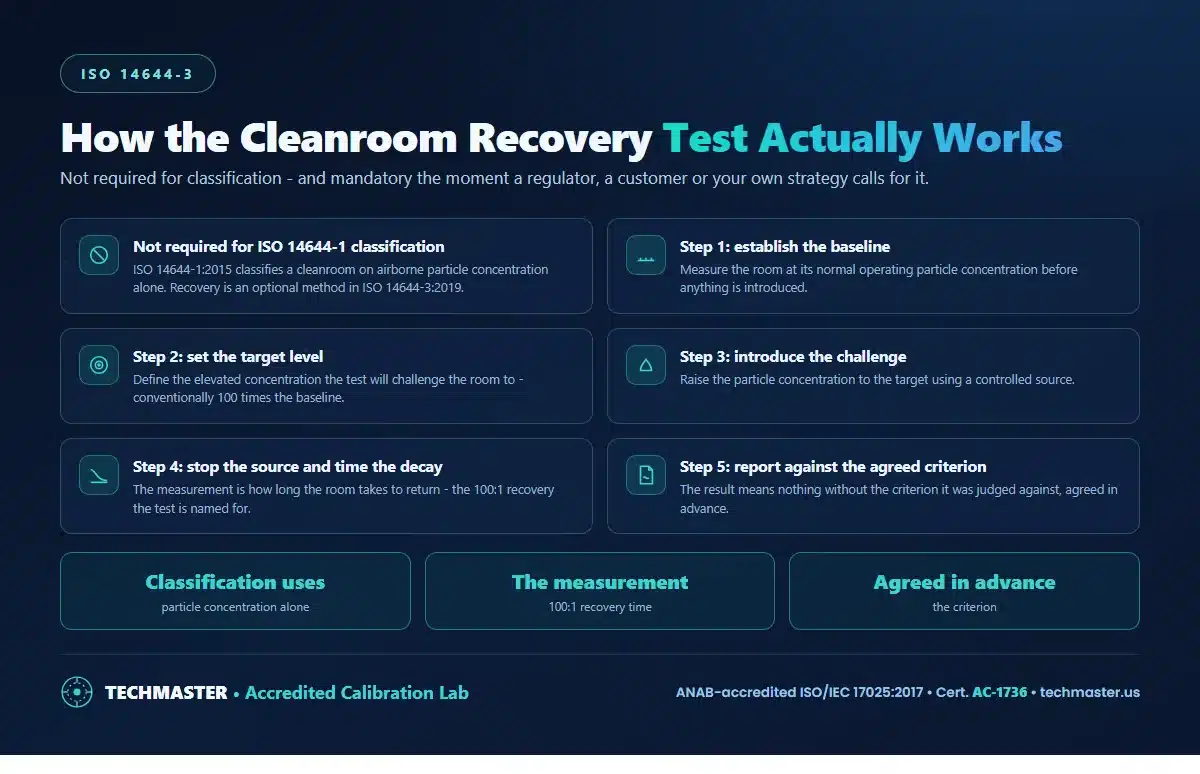
This is the single most common misunderstanding we hear from quality managers preparing for a cleanroom certification. Somebody has read that ISO 14644 "requires a recovery test," a purchase order gets written for one, and the room is then held to an acceptance criterion nobody actually agreed on. The confusion is understandable, because the ISO 14644 series splits the work across separate parts:
- ISO 14644-1:2015 defines the classification itself, the ISO Class 1 through ISO Class 9 designations and the particle concentration limits that go with them.
- ISO 14644-2:2015 defines the monitoring plan and the maximum intervals for demonstrating continued compliance. Airborne particle concentration must be redemonstrated at least every 6 months for ISO Class 5 and cleaner, and at least every 12 months for ISO Class 6 and above. Air pressure difference and airflow are on a 12-month maximum interval for all classes.
- ISO 14644-3:2019 is the test methods document, 52 pages, published August 2019 by ISO/TC 209, with a corrected version issued in June 2020. Recovery sits here, alongside installed filter leakage, airflow direction and visualisation, containment leak, and the other performance tests.
So the honest answer to "do I need one?" is: only if something outside ISO 14644-1 says you do. That "something" is usually EU GMP Annex 1, a client audit checklist, a validation master plan, or an internal contamination control strategy. Deciding this before the certification visit, rather than during it, is what keeps the scope, the cost, and the acceptance criteria under control.
What does the ISO 14644-3 recovery test actually measure?
A classification test answers "how clean is this room right now?" A recovery test answers a different and arguably more operational question: "when something goes wrong in this room, how fast does the HVAC fix it?" That distinction matters because a room can pass classification comfortably at rest and still recover slowly, typically because of poor air distribution, a partially loaded filter bank, an unbalanced return path, or dead zones created by equipment installed after the original design.
ISO 14644-3:2019 describes recovery in terms of a ratio between the challenge concentration and the target concentration. The preferred approach is the 100:1 recovery time: the time required to return from 100 times the target level back to the target. The 2019 edition also introduced a 10:1 ratio as an alternative, which is useful in rooms where generating a 100x challenge is impractical or would risk over-contaminating the space. Recovery testing applies to non-unidirectional (turbulently ventilated) cleanrooms; in unidirectional airflow zones, air velocity and airflow direction testing are the meaningful performance measures instead.
How is the 100:1 recovery test performed, step by step?
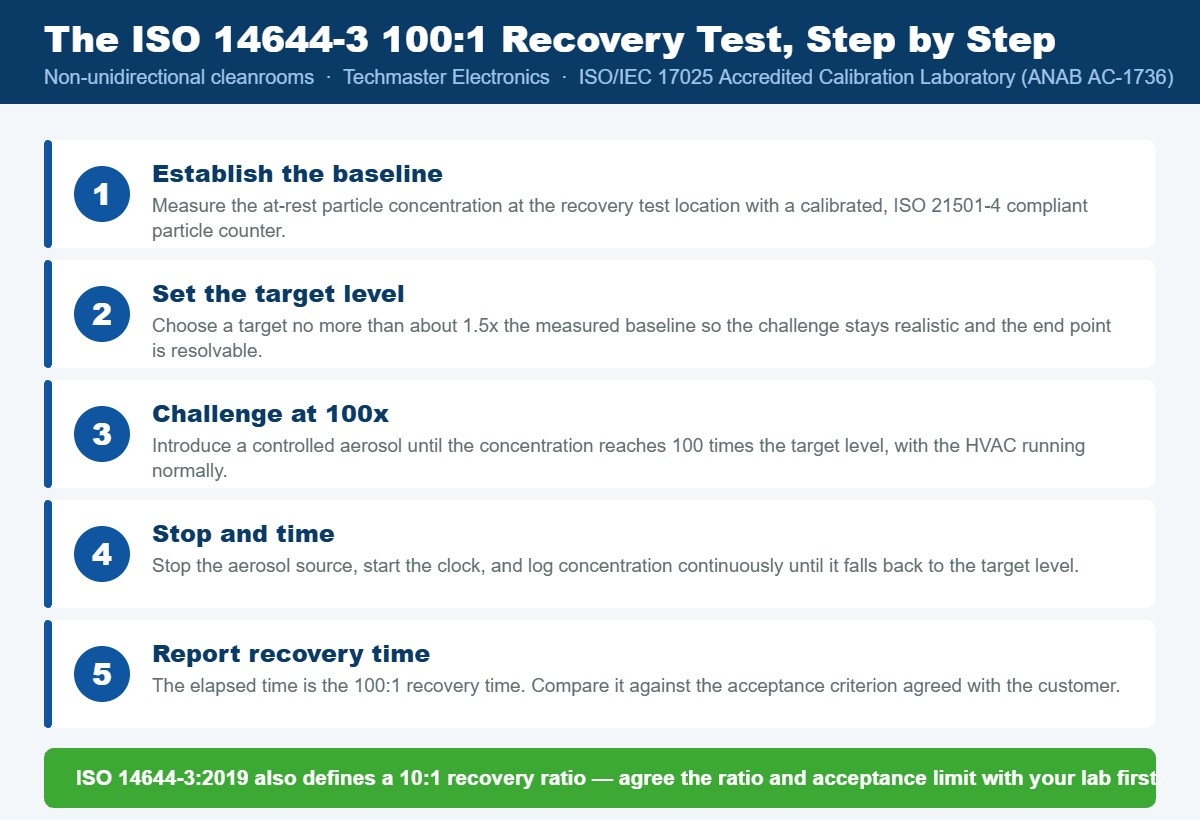
1. Establish the baseline
Measure at-rest particle concentration at the intended recovery test location with a particle counter that carries current, traceable calibration. This baseline is what everything else scales from, so a counter with drifted flow rate or degraded counting efficiency corrupts the whole test.
2. Set the target level
The target should sit above the measured baseline but not far above it, a practical rule of thumb is no more than about 1.5 times baseline. Set it too close to baseline and normal test variation makes the end point ambiguous. Set it too high and the 100x challenge becomes an unnecessarily heavy aerosol load in a production space.
3. Introduce the challenge
With the HVAC running in its normal operating mode, introduce a controlled aerosol until the measured concentration reaches 100 times the target. The challenge aerosol, its generation point, and the measurement point all need to be documented, because moving any of them changes the result.
4. Stop the source and time the decay
Cut the aerosol, start the clock, and log concentration continuously. Recording the full decay curve rather than a single end-point reading is worth the extra effort: the shape of the curve is what tells you whether you have a genuinely slow room or a local mixing problem at the sample point.
5. Report against the agreed criterion
The elapsed time to reach the target level is the 100:1 recovery time. ISO 14644-3 does not set a universal limit, acceptance is agreed between customer and supplier. Many cleanroom operators adopt a 15 to 20 minute expectation, but that is convention and GMP influence, not an ISO requirement. Write the criterion into the protocol before the test, not after seeing the number.
How is a recovery test different from the EU GMP "clean-up" period?
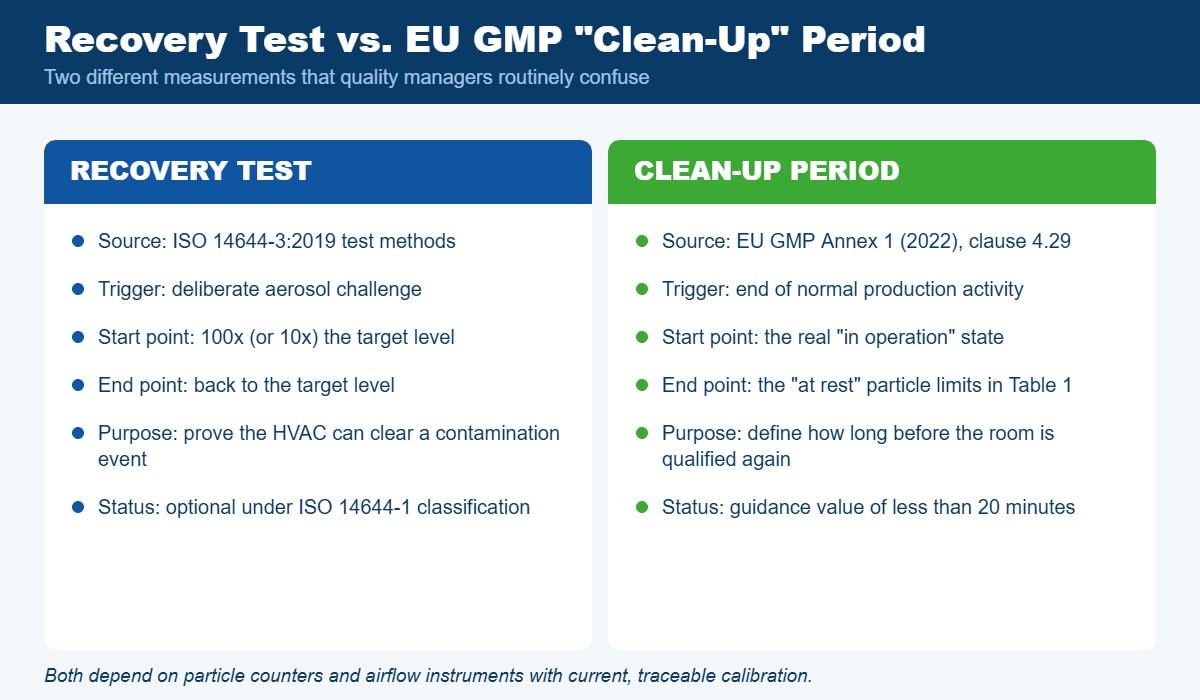
The 2022 revision of EU GMP Annex 1, effective 25 August 2023, is explicit on both points and it is worth reading them side by side. Clause 4.25 lists the recovery test among the tests that should form part of cleanroom and clean air equipment qualification, and points to the ISO 14644 series for methodology. Clause 4.29 then states separately that the "at rest" total particle limits should be achieved after a clean-up period on completion of operations, with a guidance value of less than 20 minutes, determined during qualification and written into procedures.
Two practical consequences follow. First, if a client audit asks for your "recovery time" and you hand over a clean-up study, you have answered a different question, and vice versa. Second, Annex 1 clause 4.32 sets requalification at a maximum of 6 months for grade A and B areas and 12 months for grade C and D, and notes that for grades supplied with non-unidirectional airflow, a recovery test measurement should replace the air velocity test. That is a case where recovery is not optional at all.
Which frameworks actually require or expect a recovery test?
| Framework | Is recovery testing required? | What it says |
|---|---|---|
| ISO 14644-1:2015 | No | Classification is based on airborne particle concentration only. Recovery is not part of assigning an ISO class. |
| ISO 14644-2:2015 | No, but sets the reclassification clock | Particle concentration every 6 months (ISO Class 5 and cleaner) or 12 months (ISO Class 6 and above); airflow and pressure difference every 12 months. |
| ISO 14644-3:2019 | Method only | Defines the 100:1 and 10:1 recovery test methods. Acceptance criteria are agreed between customer and supplier. |
| EU GMP Annex 1 (2022) | Yes, in qualification | Clause 4.25 lists the recovery test in cleanroom qualification; clause 4.32 substitutes recovery testing for velocity testing in non-unidirectional grades. |
| Customer or client specification | Often | Contract manufacturers routinely inherit a recovery acceptance limit from a client quality agreement rather than from any standard. |
| Internal contamination control strategy | Your choice | Recovery data is one of the cleanest ways to show a risk assessment that the room can respond to a contamination event. |
What has to be calibrated before recovery-test data is defensible?
This is where cleanroom certification quietly turns into a metrology problem. A recovery time is a derived value, it depends on a concentration measurement, a flow rate, and a clock, and its credibility is capped by the weakest calibration in the chain. Techmaster Electronics has been calibrating this class of instrumentation since 1989, and across a ten-year internal record of 381,916 calibrations covering 4,913 manufacturers, the cleanroom instruments are consistently the ones customers remember to schedule the week certification is due. In our Clean Rooms discipline the portable particle counters that actually come through the lab are dominated by Lighthouse Worldwide Solutions units, the Solair 3100E, Solair 3016 and Solair 1100, alongside Met One handhelds such as the HHPC 2+, typically at 28 LPM (1 cfm) with an ISO 14644 size range from 0.3 µm upward. Techmaster performs clean room calibration for US manufacturers from its Vista CA, Santa Clara CA and Orlando FL laboratories.
| Instrument | What it decides in a recovery test | Governing reference |
|---|---|---|
| Airborne particle counter | Baseline, target level, 100x challenge point, and the end point, every number in the test | ISO 21501-4 (counting efficiency, size resolution, flow rate) |
| Micromanometer / differential pressure gauge | Whether room-to-room cascade is intact while the room recovers | ISO 14644-3 air pressure difference test |
| Rotating-vane or thermal anemometer | Supply air volume, and therefore the achievable air change rate | ISO 14644-3 airflow test |
| Thermo-hygrometer | Temperature and humidity conditions recorded with the test | ISO 14644-3 temperature and humidity tests |
| Photometer / aerosol generator | Filter integrity, which frequently explains a failed recovery | ISO 14644-3 installed filter system leakage test |
Techmaster ANAB-accredited scope under ISO/IEC 17025:2017, certificate AC-1736, covers clean room calibration parameters at the Vista CA, Santa Clara CA, and Orlando FL laboratories. If you are unsure whether your particle counter certificate meets the ISO 21501-4 expectations an auditor will look for, our guide to ISO 21501-4 particle counter calibration requirements walks through exactly what should appear on the certificate, our step-by-step handheld particle counter calibration guide for ISO/IEC 17025 covers the procedure itself, and our note on how often to calibrate a handheld particle counter covers interval-setting for portable units.
Why do recovery tests fail, and what do you do next?
When a room misses its recovery criterion, resist the urge to re-run the test until it passes. Work through the causes in order of likelihood:
- Air change rate has dropped. Measure supply volume with a calibrated anemometer or flow hood and compare it against the design basis. Filter loading and belt or fan degradation are the usual culprits.
- Return air path is obstructed. Low-level returns blocked by carts, pallets, or newly installed equipment will lengthen recovery even when supply volume is nominal.
- Room layout changed since commissioning. A large isolator, a laminar bench, or shelving installed after the original design can create a poorly swept zone. Airflow visualisation usually finds it in minutes.
- Sample location is unrepresentative. If the probe sits in a stagnant corner, you are measuring that corner, not the room.
- The counter itself is out of tolerance. Check the calibration date and the as-found data on the last certificate before blaming the HVAC. An out-of-tolerance flow rate skews concentration directly.
Whatever the cause, document the investigation and the corrective action. A recovery failure that is investigated, explained, and re-tested with evidence is a functioning quality system. A recovery failure that quietly disappears from the record is a finding waiting to happen. For the broader certification programme, classification, filter integrity, airflow, pressure cascade, and recovery in one visit, see Techmaster ISO 14644 cleanroom certification and environmental testing services, and for instrument-level work, the clean room calibration discipline page.
- ISO 14644-1:2015 classification is based on airborne particle concentration alone, a recovery test is not required to hold an ISO class.
- Recovery is an optional test method in ISO 14644-3:2019, using a 100:1 ratio (preferred) or a 10:1 ratio.
- ISO 14644-3 sets no universal pass/fail time; acceptance is agreed between customer and supplier and belongs in the protocol before testing.
- The EU GMP Annex 1 clean-up period (guidance value under 20 minutes) is a different measurement from a recovery time, do not substitute one for the other.
- Annex 1 clause 4.32 requires recovery testing in place of velocity testing for non-unidirectional grades, at 6-month (grades A/B) or 12-month (grades C/D) requalification intervals.
- A recovery result is only as defensible as the calibration behind the particle counter, anemometer, and micromanometer that produced it.
Frequently asked questions about cleanroom recovery testing
Is a recovery test mandatory for ISO 14644-1 cleanroom classification?
No. ISO 14644-1:2015 classifies a cleanroom on measured airborne particle concentration alone. The recovery test is an optional test method described in ISO 14644-3:2019 and becomes mandatory only when a regulator, customer specification, or internal contamination control strategy requires it.
What is a typical acceptable cleanroom recovery time?
ISO 14644-3 does not define a universal limit; acceptance is agreed between customer and supplier. Many cleanroom operators adopt a 15 to 20 minute expectation, influenced by the EU GMP Annex 1 clean-up guidance value of less than 20 minutes, but that convention should be written into the test protocol rather than assumed.
What is the difference between a 100:1 and a 10:1 recovery test?
The ratio describes how far above the target level the room is challenged before timing begins. The 100:1 method challenges to 100 times the target level and is the preferred approach in ISO 14644-3:2019. The 10:1 ratio, added in the 2019 edition, challenges to 10 times the target and suits rooms where a 100x aerosol load is impractical.
Do unidirectional airflow cleanrooms need a recovery test?
Generally no. Recovery testing is intended for non-unidirectional, turbulently ventilated cleanrooms. In unidirectional airflow zones, air velocity measurement and airflow direction or visualisation testing are the meaningful performance tests. EU GMP Annex 1 reflects this by substituting recovery testing for velocity testing specifically in non-unidirectional grades.
How often must a cleanroom be recertified under ISO 14644-2:2015?
Airborne particle concentration must be redemonstrated at a maximum interval of 6 months for ISO Class 5 and cleaner, and 12 months for ISO Class 6 and above. Airflow and air pressure difference testing are on a maximum 12-month interval for all classes. Risk assessment may justify more frequent testing.
Does the particle counter need ISO 21501-4 calibration for recovery testing?
Yes, in practice. Every value in a recovery test comes from the particle counter, so its counting efficiency, size resolution, and flow rate must be verified against ISO 21501-4 by a laboratory with traceable, accredited capability. An uncalibrated or out-of-tolerance counter invalidates the baseline, the challenge level, and the end point simultaneously.
Planning a cleanroom certification or a recovery study?
Techmaster Electronics has supported US manufacturers since 1989 from ISO/IEC 17025 accredited laboratories in Vista CA, Santa Clara CA, Orlando FL, and San Antonio TX.

Khanh Nguyen is the Marketing Manager at Techmaster Electronics, a B2B marketing leader covering the test, measurement, and ISO/IEC 17025 accredited calibration industry in the United States.