
How to Calibrate a Handheld Particle Counter: ISO/IEC 17025 Step-by-Step
Airborne particles can easily ruin sensitive products. Therefore, cleanrooms and labs need exact air quality data. You must know how to calibrate a handheld particle counter to maintain this exact data. In fact, accurate air testing keeps your facility safe and compliant. Over time, internal parts like lasers degrade naturally. As a result, uncalibrated tools give bad data to your team. This bad data can shut down production lines quickly. In this guide, we explain how particle counter calibration works, so you know what to expect from the manufacturer or authorized provider that performs it.
Note on particle counters: This page is for general information only. Techmaster does not calibrate particle counters of any make or model, and particle counters are not on our ANAB ISO/IEC 17025 scope (certificate AC-1736). Techmaster only performs calibration services that are covered by our scope. For particle counter calibration, please contact your instrument’s manufacturer or its authorized service provider, and follow any service requirements they specify. If you prefer, send us your request and, with your permission, we will forward it to the manufacturer. See what is on our accredited scope.
1. What Is a Handheld Particle Counter?
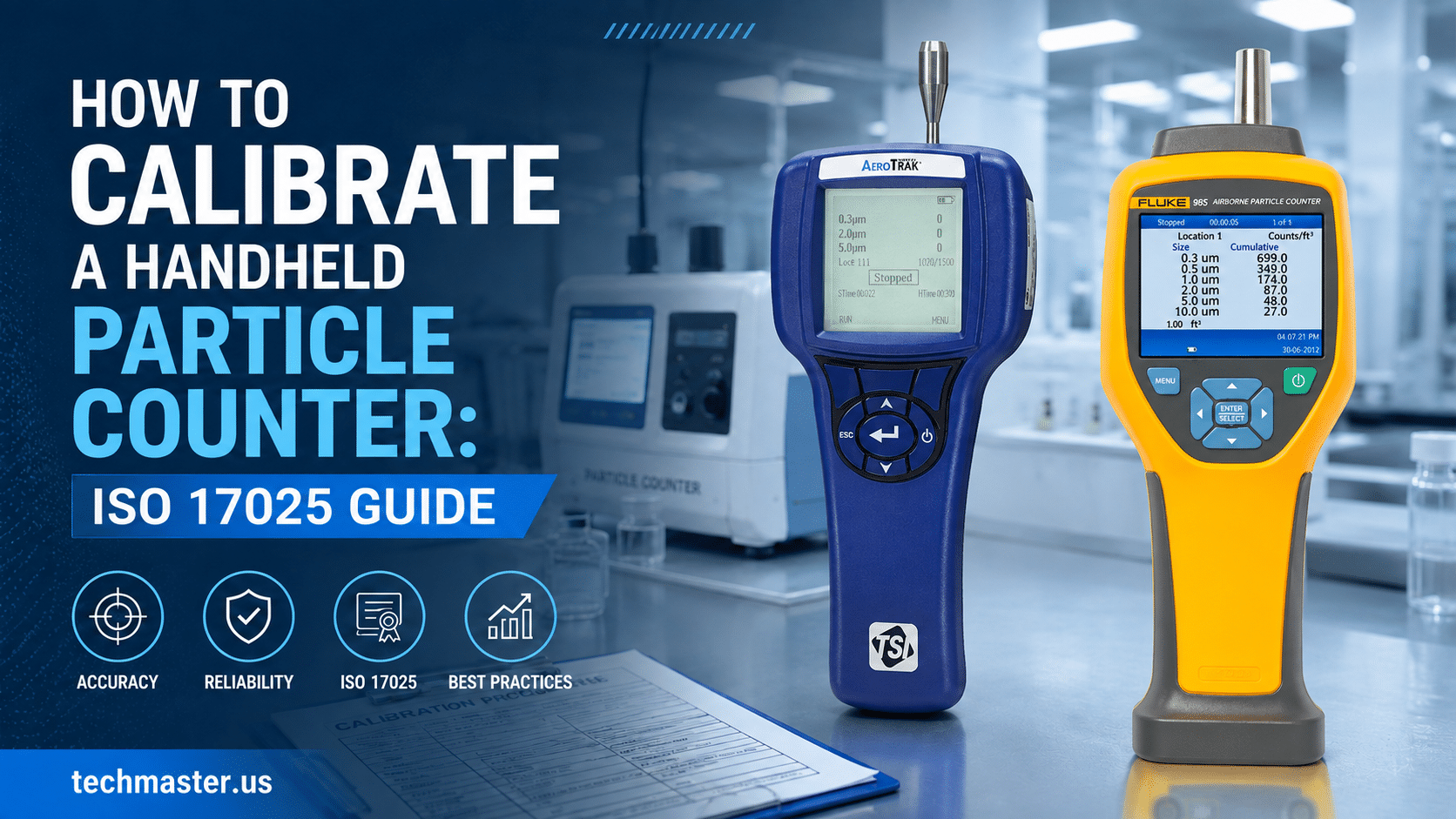
A handheld particle counter is a portable air testing tool. It measures airborne dust and particles in a specific room. Most modern devices use light scattering technology. First, a tiny internal pump pulls air into a small chamber. Next, a laser beam shines directly on the particles in the air. The particles scatter the laser light. Then, an internal sensor measures this scattered light. The sensor turns the light into electrical signals. Larger signals mean larger particles. In addition, more signals mean more particles. Brands like TSI, Fluke, Lighthouse, Met One, and Kanomax make these reliable tools. Cleanroom workers use them daily to check air filters and room safety.
2. Why “How to Calibrate a Handheld Particle Counter” Matters
You must calibrate this equipment for many reasons. First, it ensures strict regulatory compliance. For instance, rules like ISO 14644-1 require accurate cleanroom data. If you skip calibration, auditors will reject your data entirely. Second, proper calibration protects your product safety. For example, pharmaceutical makers need clean air to keep medicines safe. Third, a routine Calibration service catches small problems early. As a result, technicians can fix failing pumps before they break completely. Finally, calibration guarantees pure measurement traceability. Consequently, traceability links your daily readings to strict national standards.
3. Common Applications
Many highly regulated industries rely heavily on these devices. Because of this, accurate particle counts remain critical across many fields.
-
Pharmaceuticals: Drug makers monitor sterile labs closely. They follow strict USP guidelines to protect patients.
-
Semiconductor Manufacturing: Tech companies need clean air to build microchips. Even tiny dust spots destroy computer parts.
-
Aerospace: Engineers build complex satellites in ultra-clean rooms.
-
Healthcare: Medical staff check air filters in surgery rooms frequently.
-
Indoor Air Quality: HVAC teams test office buildings for safe breathing air.
4. Calibration Standards and Traceability
Laboratories follow strict rules when testing these precise tools. The main global rule is ISO 21501-4. This standard details the exact [particle counter calibration standards that labs must use. For the best results, you need an ISO/IEC 17025 particle counter calibration. These accredited labs use special test materials. Specifically, they use NIST-traceable Polystyrene Latex (PSL) spheres. These spheres have exact, known sizes. The lab sprays these spheres into the air to test your device. After the test, the lab gives you a detailed certificate. This document shows exactly how your tool performed during the tests.
5. Step-by-Step Handheld Particle Counter Calibration Procedure
6. Common Issues Found During Calibration
Technicians often find hidden problems during testing. For example, dust can coat the inside lenses over time. This dirt blocks the laser and causes bad readings. In addition, lasers slowly lose power after heavy use. A weak laser misses small particles completely. In addition, internal pumps wear out from daily use. A worn pump ruins the strict air flow rate. Finally, dropping the tool can shift the internal mirrors. As a result, the light misses the sensor entirely. Regular testing catches these hidden problems early.
7. How Often Should This Equipment Be Calibrated?
You should calibrate your particle counter once a year. Most makers and ISO rules recommend this annual schedule. However, you might need more frequent testing. For instance, if you use the tool in very dirty air, test it every six months. Likewise, strict company quality rules might require faster cycles. In addition, you should run a zero-count test yourself every week. This quick check proves the tool works well between lab visits.
8. What to Look for in a Calibration Provider
You must pick the right lab for [environmental test equipment calibration]([INSERT RELEVANT LINK HERE]). Not all labs have the right tools. First, check their ISO/IEC 17025 accreditation papers. Their certificate must specifically list ISO 21501-4 tests. Second, ask about their master reference standards. They must offer a [NIST-traceable particle counter calibration]([INSERT RELEVANT LINK HERE]). Third, review their past paperwork. They should give you clear “as found” and “as left” numbers. Finally, look for fast service times. You need your tool back quickly to keep working.
9. Need Equipment Now? Explore Techmaster’s Renting Service
Sending your primary tool away for testing can cause workflow problems. You still need to check your cleanroom air daily. Therefore, Techmaster Electronics offers an easy equipment renting service. You can rent a fully tested particle counter while we service yours. We keep top industry brands ready to ship immediately. In addition, every rental unit comes with a current NIST-traceable calibration certificate. As a result, your team stays compliant without missing a single day of work. We offer both short rentals and long leases for your convenience.
10. Why Choose Techmaster Electronics?
Techmaster Electronics is a trusted partner for your laboratory needs. We have years of experience with complex test tools. In addition, we hold strict ISO/IEC 17025 accreditations. Our labs use the best primary reference tools to test your particle counters. We proudly serve strict industries like aerospace, medical, and electronics manufacturing. In addition, we promise clear documents and fast turnarounds. We do not make false promises to our clients. Instead, we deliver exact, repeatable results you can trust daily.
11. Conclusion
To recap, accurate air testing keeps your cleanroom products safe. You must understand the calibration steps and follow ISO rules strictly. Regular testing fixes weak lasers and dirty sensors quickly. Therefore, you protect your cleanroom status and avoid costly plant shutdowns. Do not risk your daily data on a drifting optical tool. Contact a trusted calibration lab today to protect your investments.
12. FAQ Section
Related reading: Cleanroom recovery test under ISO 14644-3: is it required and how is it performed?
References & industry standards
- ISO/IEC 17025 testing & calibration laboratory requirements
- NIST calibration services and measurement traceability
- NIST Time and Frequency Division
- A2LA / ANAB accreditation for calibration laboratories
External standards bodies. Techmaster Electronics is an ISO/IEC 17025-accredited, NIST-traceable calibration laboratory.
Frequently asked questions
What is handheld particle counter calibration?
Handheld Particle Counter Calibration is the documented comparison of a handheld particle counter against NIST-traceable reference standards. It quantifies the handheld particle counter’s error and measurement uncertainty and confirms it performs within tolerance, with as-found and as-left data on the certificate.
How often should a handheld particle counter be calibrated?
Most quality systems calibrate a handheld particle counter every 12 months, or sooner after repair, overload, or before critical measurements. Set your interval from the manufacturer spec and your ISO 9001 / 13485 / AS9100 program and drift history.
Does Techmaster calibrate handheld particle counters?
No. Techmaster Electronics is ISO/IEC 17025:2017 accredited by ANAB (Certificate AC-1736), but particle counters are not on that scope, and Techmaster does not calibrate particle counters of any make or model. For calibration, contact your instrument’s manufacturer or its authorized service provider.
How long does handheld particle counter calibration take?
Turnaround is set by the manufacturer or authorized provider that performs the calibration, so ask them before you ship. Techmaster does not calibrate particle counters.
Where should I send a handheld particle counter for calibration?
To the instrument’s manufacturer or one of its authorized service providers, following any service requirements they specify. Techmaster does not calibrate particle counters; if you send us your request, with your permission we will forward it to the manufacturer.

Khanh Nguyen is the Marketing Manager at Techmaster Electronics, a B2B marketing leader covering the test, measurement, and ISO/IEC 17025 accredited calibration industry across the US and Vietnam markets.