
Decade boxes put a precise, switchable value at your fingertips: resistance decades for simulating sensors and checking meters, capacitance and inductance decades for filter and bridge work. They are often treated as permanent references, but switch contacts wear, resistors age and a single damaged decade can affect every setting that uses it.
Decade box calibration measures the box across its decades and switch positions so you know how far each setting is from its nominal value.
What gets measured
- Each decade at several switch positions, not just one setting per box. Because decades add in series, an error in one decade carries into every combined value.
- Zero (residual) value: the resistance, capacitance or inductance present with every dial at zero. It is often the largest correction at low settings.
- Switch repeatability: worn contacts give different values each time a dial is turned.
- Frequency (capacitance and inductance boxes): values are measured at the frequencies you use, because they change with frequency.
Two-wire versus four-wire
For low resistance settings, lead and contact resistance can be larger than the error you are trying to see. Precision resistance decades with separate sense terminals should be measured four-wire, and the certificate should say which connection was used. Two-wire results are only meaningful if you also use the box two-wire.
Using the results
If you use a decade box as a reference, apply the measured corrections rather than the nominal values, and include the box’s uncertainty in your own uncertainty budget. Keep the box at a stable temperature, because resistor values drift with temperature, and give it time to settle after transport.
Related electrical calibration
Decade boxes are often calibrated together with the meters they check. See LCR meter calibration and multimeter calibration.
Accreditation and certificates
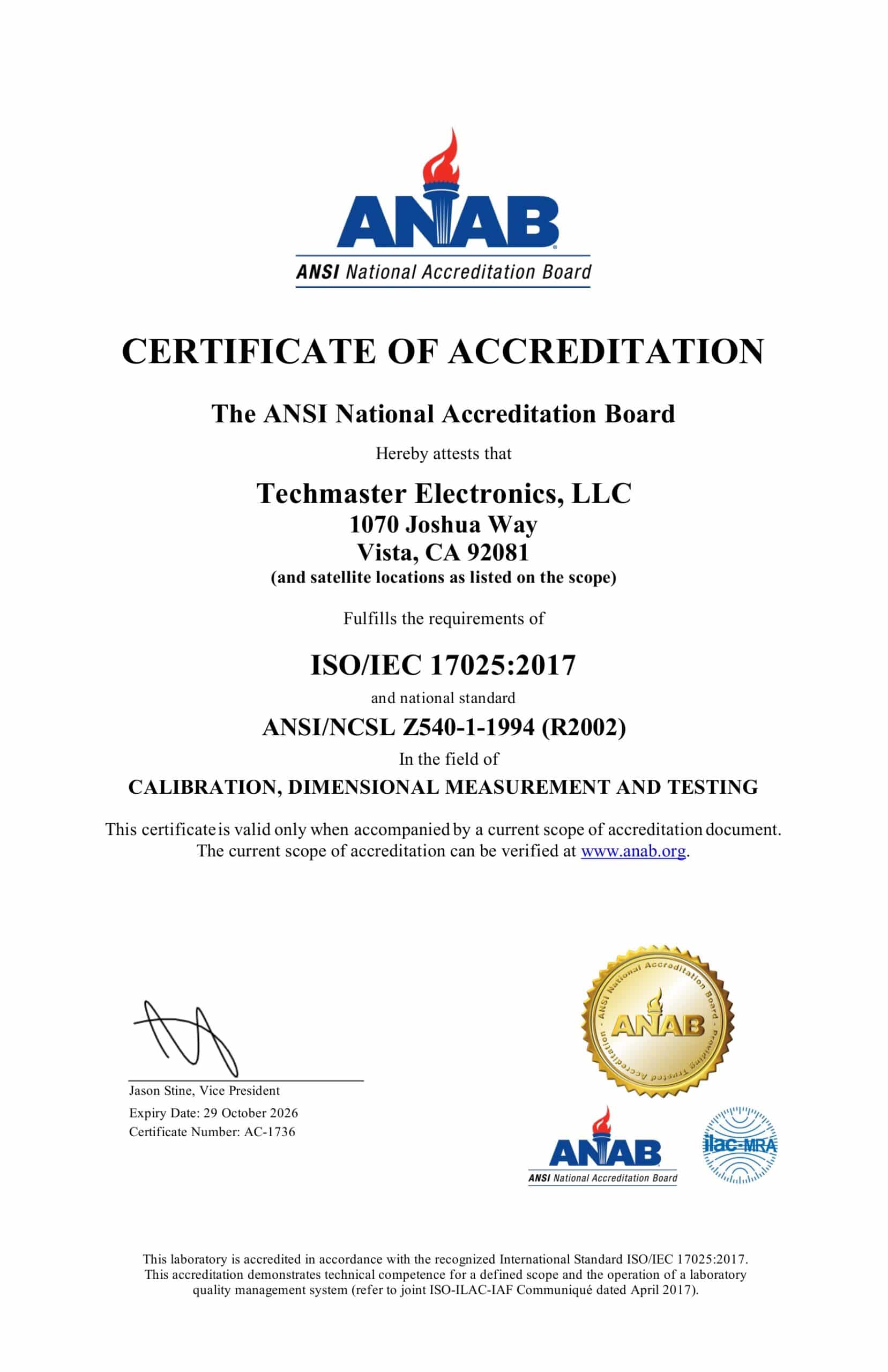
Resistance measurement is on Techmaster’s ANAB ISO/IEC 17025 scope (certificate AC-1736) for electrical DC and low-frequency quantities, so certificates carry the ANAB accreditation symbol along with as-found and as-left data and measurement uncertainty.
Frequently asked questions
How is a decade box calibrated?
Why does the zero setting matter?
Should resistance decades be measured four-wire?
Is decade box calibration accredited?
Related calibration guides
References & industry standards
- ISO/IEC 17025 testing & calibration laboratory requirements
- NIST calibration services and measurement traceability
- A2LA / ANAB accreditation for calibration laboratories
External standards bodies. Techmaster Electronics is an ISO/IEC 17025-accredited, NIST-traceable calibration laboratory.
Accredited calibration at Techmaster
Techmaster Electronics is an ANAB-accredited (Certificate AC-1736) ISO/IEC 17025:2017 calibration laboratory with five US labs, NIST-traceable standards and a full measurement-uncertainty budget on every certificate — in-lab or nationwide on-site, with 5-business-day standard turnaround and expedite options. See our calibration services or request a quote.

Khanh Nguyen is the Marketing Manager at Techmaster Electronics, a B2B marketing leader covering the test, measurement, and ISO/IEC 17025 accredited calibration industry in the United States.