TL;DR: Oscilloscope calibration verifies six parameter families against NIST-traceable standards: vertical (amplitude) accuracy, timebase accuracy, bandwidth/flatness, rise time, trigger sensitivity, and input/probe characteristics. Typical starting interval: 12 months. Market cost: $100–300 up to 1 GHz, $250–600 above. The front-panel self-cal routine is maintenance, not calibration, it can’t verify accuracy against anything outside the scope itself.
An oscilloscope that triggers, draws traces, and passes self-cal can still be quietly wrong, vertical gain drifts, bandwidth sags with age, and nothing on screen warns you. Here’s what a real calibration checks, what it costs, and how to buy it well.
What does oscilloscope calibration include?
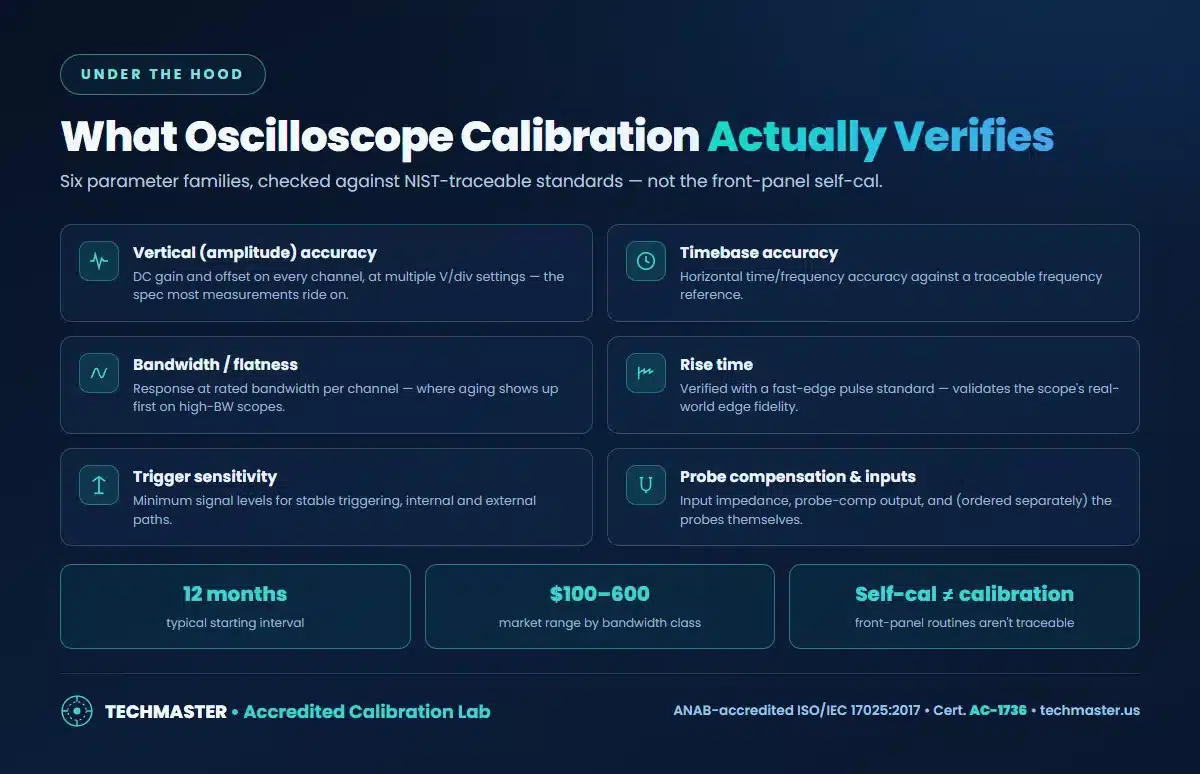
The heart of the job is vertical accuracy, DC gain and offset on every channel across V/div settings, because nearly every measurement rides on it. Timebase accuracy is checked against a traceable frequency reference; bandwidth and flatness catch the aging that high-bandwidth front ends are prone to; a fast-edge standard verifies rise time; and trigger sensitivity plus input impedance/probe compensation round out the set. On an accredited certificate, every one of these arrives with as-found/as-left data and stated uncertainty, see how to read a calibration certificate.
Why isn’t self-calibration enough?
Self-cal aligns the scope’s internal signal paths against its own internal reference, useful maintenance after temperature swings, but circular as evidence: if the reference drifted, self-cal faithfully aligns everything to the wrong answer. Traceable calibration breaks the circle by comparing the scope to external standards with a documented chain to NIST. Auditors know the difference; so do warranty reviewers.
How often and how much?
Start at 12 months and adjust on as-found evidence per the interval guide. Market pricing clusters by bandwidth class, roughly $100–300 up to 1 GHz and $250–600 above, with channel count and options moving the number. Compare quotes on certificate level, data, turnaround, and OOT policy, not the headline price, the full framework is in the 12-point checklist.
What should you look for in an oscilloscope calibration lab?
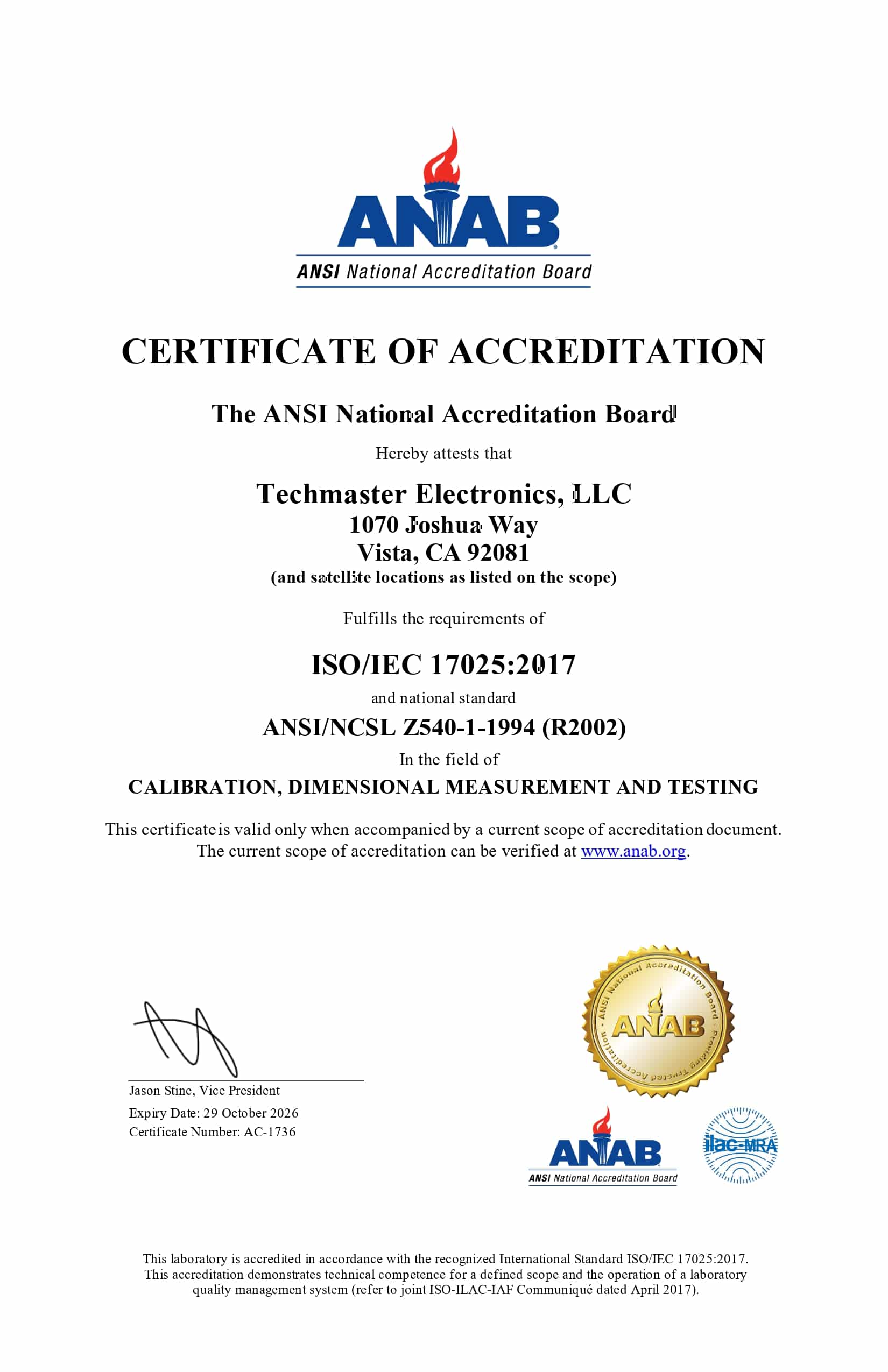
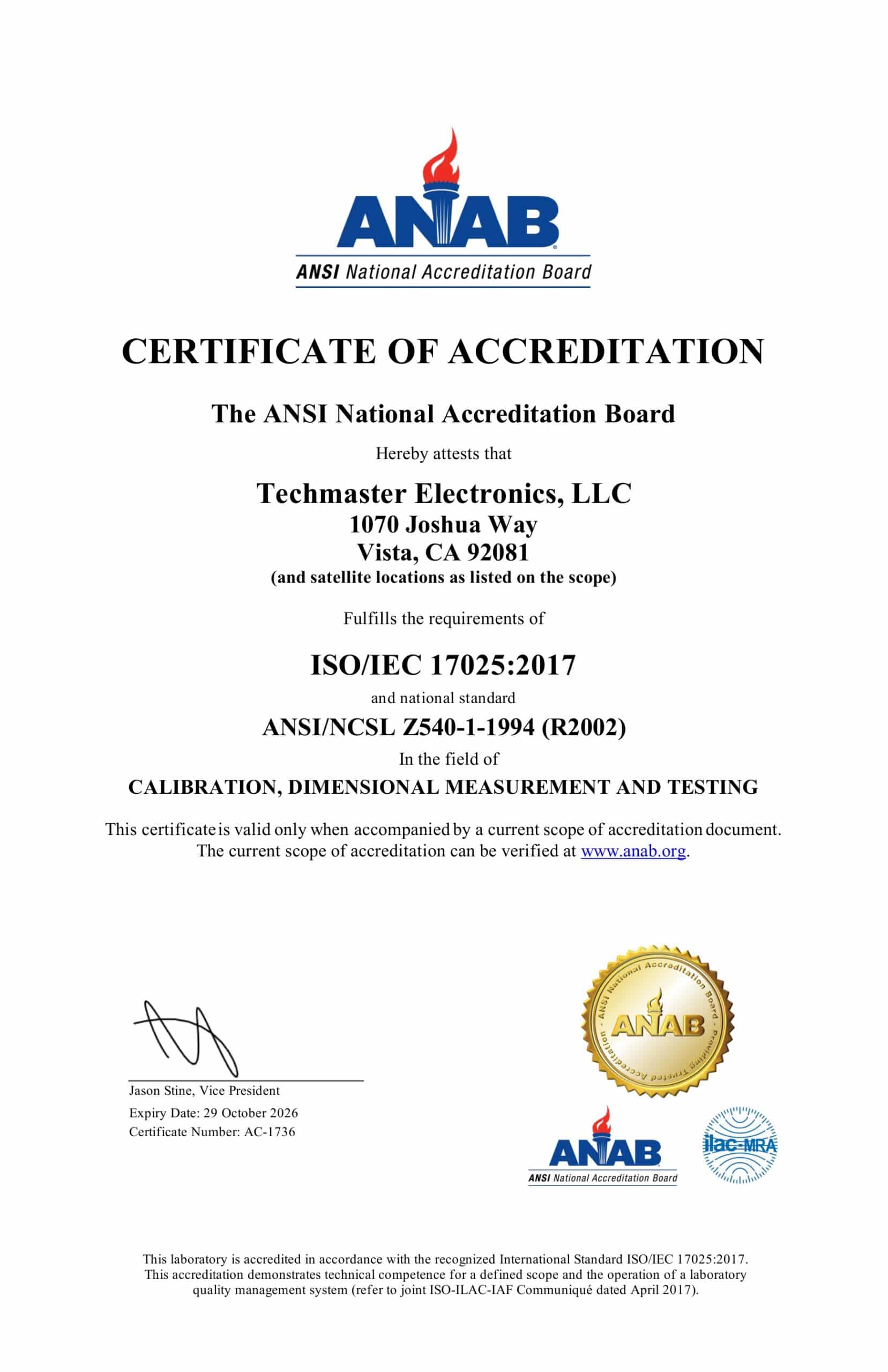
A scope of accreditation that explicitly covers oscilloscopes to your bandwidth, fast-edge capability for rise-time verification, and data on every certificate. Techmaster Electronics calibrates oscilloscopes and the rest of the bench, signal generators, spectrum analyzers, network analyzers, under ANAB certificate AC-1736, with 5-day standard turnaround and 1–2 day expedite options.
Frequently asked questions
How often should an oscilloscope be calibrated?
Every 12 months is the standard starting interval. Extend it only when consecutive as-found results show comfortable margin; high-bandwidth scopes and heavily used production units often justify keeping the annual cycle.
How much does oscilloscope calibration cost?
Market-typical US pricing runs roughly $100–300 for scopes up to 1 GHz and $250–600 above 1 GHz, driven by bandwidth and channel count. Accredited certificates with full data typically add 20–50%.
Is the oscilloscope’s self-calibration enough?
No. Front-panel self-cal routines align internal paths against the scope’s own reference, they are maintenance, not calibration. Only comparison against external NIST-traceable standards verifies the instrument’s actual accuracy.
Do oscilloscope probes need calibration too?
Yes, for measurement-critical work. Probes have their own bandwidth, attenuation, and compensation specs that drift independently of the scope. Have probes calibrated with the scope they’re used with when practical.
The bottom line
Calibrate scopes annually against traceable standards, treat self-cal as maintenance, and buy the certificate level your audits require. One lab for the whole bench beats three vendors and a spreadsheet.
Get an accredited calibration quote
ANAB-accredited ISO/IEC 17025:2017 (Cert. AC-1736) • 5 US labs • 5-day standard, 1–2 day expedite • in-lab or on-site.
Request a quote
Khanh Nguyen is the Marketing Manager at Techmaster Electronics, a B2B marketing leader covering the test, measurement, and ISO/IEC 17025 accredited calibration industry across the US and Vietnam markets.