
An oscilloscope is only as accurate as the probe connected to it. A calibrated scope paired with a probe whose attenuation is off by 3%, or whose compensation is wrong, will show amplitude errors and distorted edges that look like circuit problems.
Probe compensation is a quick adjustment anyone can make at the bench. Probe calibration measures the probe’s real performance against known references and documents it.
Compensation is not calibration
Passive probes have an adjustable capacitor that matches the probe to the scope’s input. Connecting the probe to the scope’s square-wave calibrator output and adjusting until the corners are flat (no overshoot, no rounding) is compensation. It should be done every time a probe moves to a different scope or channel. It does not check attenuation accuracy, bandwidth or DC error, and the scope’s calibrator output is not a traceable reference.
What probe calibration checks
| Probe type | Key checks |
|---|---|
| Passive voltage probes (for example 10:1) | Attenuation ratio at DC, input resistance, compensation range and rise time or bandwidth |
| Active and differential probes | Gain accuracy, offset, common-mode rejection (differential), bandwidth and noise |
| Current probes | Sensitivity (A/V) at DC and AC, degauss and zero function, bandwidth and saturation behavior |
| High-voltage probes | Attenuation at several voltages and insulation condition |
Each check is made against a calibrated source, such as a precision DC voltage or current source and a fast-edge pulse or leveled sine generator, so the result can be traced back to national standards.
Why probes drift and fail
- Bent or damaged tips and ground leads change the probe’s loading and bandwidth.
- Cable flexing breaks internal conductors, causing intermittent readings.
- Active probes can be damaged by overvoltage or electrostatic discharge.
- Current probe jaws that do not close cleanly lose sensitivity.
A probe that fails one of these checks usually needs repair or replacement, not adjustment.
Calibrate probes with the scope
Most labs calibrate probes on the same cycle as the oscilloscopes they serve, and record which probe serial numbers were checked. Many modern scopes read probe identity and correction data automatically, which makes it easy to confirm that a calibrated probe is in use. For the oscilloscope itself, see our oscilloscope calibration guide.
Turnaround and logistics
Probes are small and ship easily, so they are often sent in together with their oscilloscope. Label each probe with the scope it normally lives on, and include accessories such as tips and ground leads if you want them inspected.
Accreditation and certificates
Oscilloscope probe calibration is not listed on Techmaster’s ANAB scope, so it is calibrated with NIST-traceable reference standards and issued a traceable certificate with as-found and as-left data. If your auditor requires an ISO/IEC 17025 accredited certificate, tell us before you send the instrument.
Frequently asked questions
What is the difference between probe compensation and calibration?
How often should oscilloscope probes be calibrated?
Can a damaged probe be calibrated?
Is oscilloscope probe calibration accredited?
Related calibration guides
References & industry standards
- ISO/IEC 17025 testing & calibration laboratory requirements
- NIST calibration services and measurement traceability
- NIST Fundamental Electrical Measurements
- A2LA / ANAB accreditation for calibration laboratories
External standards bodies. Techmaster Electronics is an ISO/IEC 17025-accredited, NIST-traceable calibration laboratory.
Accredited calibration at Techmaster
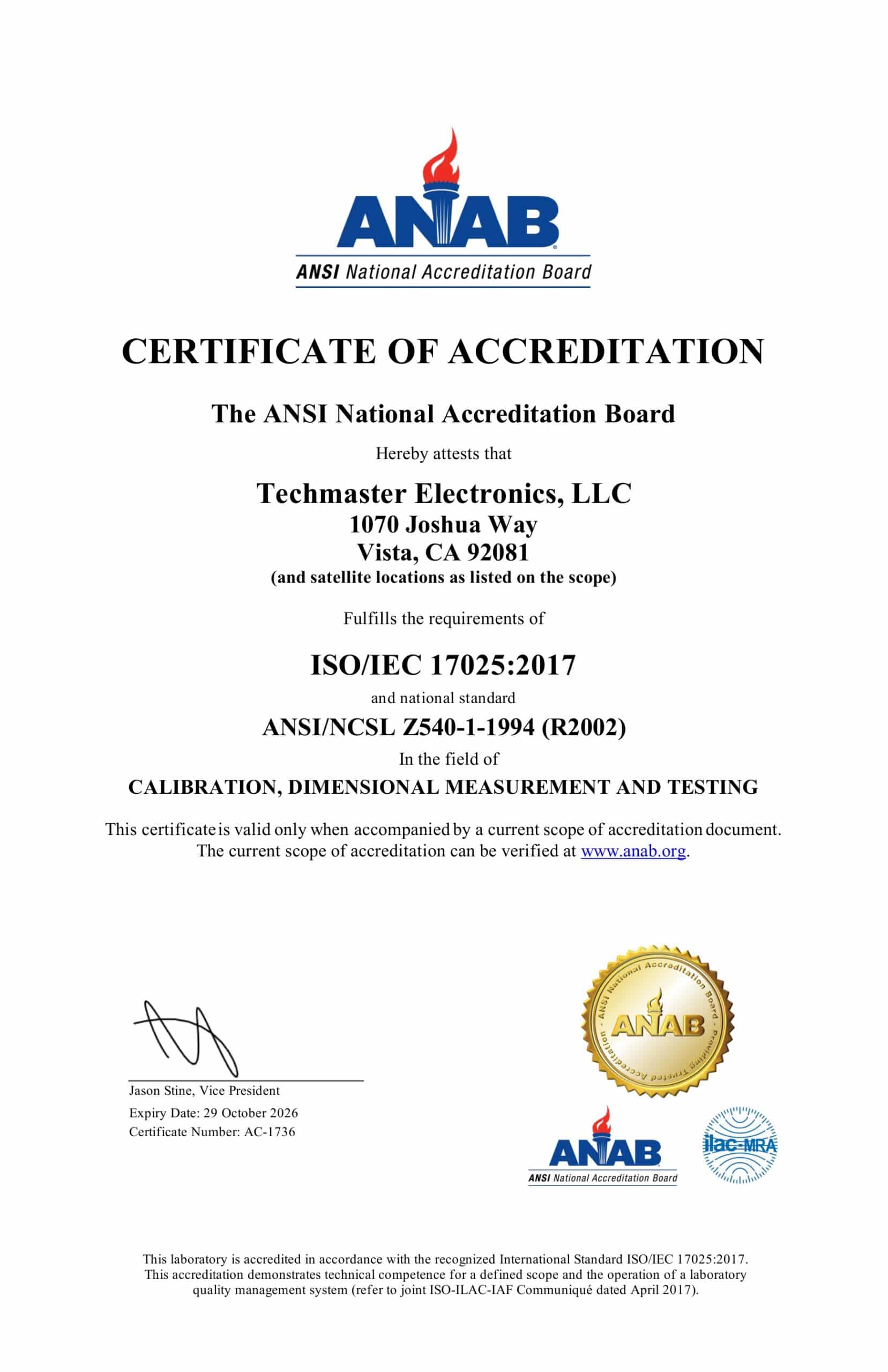
Techmaster Electronics is an ANAB-accredited (Certificate AC-1736) ISO/IEC 17025:2017 calibration laboratory with five US labs, NIST-traceable standards and a full measurement-uncertainty budget on every certificate — in-lab or nationwide on-site, with 5-business-day standard turnaround and expedite options. See our calibration services or request a quote.

Khanh Nguyen is the Marketing Manager at Techmaster Electronics, a B2B marketing leader covering the test, measurement, and ISO/IEC 17025 accredited calibration industry in the United States.