
DATA ANALYZER Calibration
Frequency response at a glance
How DATA ANALYZER calibration works
- Intake & visual inspection
- Environmental stabilization
- As-found measurement
- Comparison to NIST-traceable standards
- Adjustment if required
- As-left results & certificate
Your calibration, covered
In-lab vs on-site calibration
In-lab calibration
- Accredited bench with full reference standards
- Best achievable measurement uncertainties
- Pickup & return logistics handled
- Ideal for precision and reference work
On-site calibration
- We calibrate the DATA ANALYZER at your facility
- No shipping risk or transit downtime
- As-found data captured before any move
- Ideal for fixed, large or sensitive assets
In-depth guide
Data System Analyzers: Modern Applications and the Critical Need for DATA ANALYZER Calibration

In the sophisticated world of smart buildings and life-safety systems, data integrity is the invisible backbone of security. Modern addressable fire alarms, access control systems, and building automation networks have become increasingly complex. To manage these intricate webs of communication, engineers rely on data analyzers as their primary diagnostic “eyes and ears.” However, the insights provided by these tools are only as reliable as the device’s precision. Consequently, regular DATA ANALYZER Calibration has become a non-negotiable requirement for ensuring system stability and safety. This article explores the vital applications of these devices and the indispensable role of professional calibration.
1. How Does a Data System Analyzer Work?

To begin with, we must understand that a data analyzer in an industrial or life-safety environment is much more than a simple data logger. Essentially, the device serves as a high-speed translator that “listens” to the digital conversations between a control panel and its peripheral devices, such as sensors and modules.
Initially, the analyzer scans the electrical pulses, voltages and currents, traveling across the data loop. Subsequently, its internal processor decodes these physical signals into digital data packets. Following this, the device identifies error codes, measures signal latency, and detects electromagnetic interference (EMI). If a technician uses a device that has skipped its scheduled DATA ANALYZER Calibration, the internal voltage sensors may drift. As a result, the analyzer might misinterpret a weak signal as a healthy one, or vice versa, potentially hiding a catastrophic system flaw.
2. Real-World Industrial Applications
Addressable Fire Alarm Systems
Ground Fault Detection
Building Management Systems (BMS)
Standards Compliance & Audits
Data analyzers act as the “heart surgeons” of Extra-Low Voltage (ELV) systems, providing clarity where standard multimeters fail.
2.1. Commissioning Addressable Fire Alarm Systems
During the installation of large-scale fire systems, thousands of detectors connect to a single communication loop that may span several kilometers. Technicians use data analyzers to verify the network topology and ensure that no data packets are lost or duplicated. In addition, this ensures that in a real emergency, the alarm signal reaches the central panel in milliseconds, without interference from communication “collisions.”
2.2. Locating Ground Faults and Signal Noise
In addition to setup, data analyzers are the most effective tools for troubleshooting “ghost” errors. Ground faults are notoriously difficult to locate because they are often intermittent. However, a calibrated data analyzer can detect minute voltage fluctuations on the line, allowing the technician to pinpoint the exact location of a wire leak or interference from nearby high-voltage power cables. Consequently, this drastically reduces system downtime and labor costs.
2.3. Monitoring Building Management System (BMS) Performance
Inside modern smart buildings, the BMS coordinates everything from HVAC to lighting. Engineers use data analyzers to monitor the “traffic” between controllers. For instance, they can identify bottlenecks where data is congested and optimize the response speed of the entire system. This precision ensures that the building operates at peak energy efficiency while maintaining occupant comfort.
2.4. Regulatory Compliance and Safety Audits
International safety standards, such as NFPA or EN54, require rigorous periodic testing of life-safety networks. By utilizing a data analyzer, service providers can generate detailed, transparent reports for fire marshals and insurance companies. These reports serve as proof that the system meets the highest safety benchmarks.
3. The Vital Role of DATA ANALYZER Calibration
Signal Drift Analysis

Even the most advanced analyzer will eventually lose its edge due to electronic component aging and environmental stress. Therefore, prioritizing DATA ANALYZER Calibration offers several strategic benefits:
-
Maintaining Voltage Measurement Accuracy: Modern communication protocols rely on extremely sensitive voltage thresholds. If a meter is off by even 0.1V, it might incorrectly report on battery health or line degradation.
-
Ensuring Microsecond Time Synchronization: Data analysis requires timing accuracy measured in microseconds. Calibration ensures that the internal clock remains perfectly synchronized, which is vital for the correct chronological logging of system events.
-
Validating Packet Integrity: Over time, the internal filters that separate signals from noise can degrade. Professional calibration tests these filters, guaranteeing that the data the technician sees on the screen is a true reflection of the network’s health.
-
Preventing Costly False Alarms: In security and fire systems, false alarms are not just a nuisance; they cause panic and lead to expensive operational shutdowns. A calibrated analyzer ensures that the system is tuned correctly to ignore “noise” while remaining hyper-sensitive to real threats.
4. The Professional Calibration Procedure
A professional DATA ANALYZER Calibration must occur in a controlled laboratory environment following these specific steps:
-
Comprehensive Functional Inspection: First, the technician performs a physical check and updates the device’s firmware. This ensures the analyzer supports the latest communication protocols used in the industry.
-
Reference Signal Simulation: Next, specialists use a high-precision signal generator to feed “perfect” data packets into the analyzer. These packets have absolute values for voltage, frequency, and amplitude.
-
Comparison and Adjustment: The technician then compares the analyzer’s readings against the reference source. If the error exceeds the manufacturer’s tolerance (usually +/- 1%), they perform internal software or hardware adjustments to realign the device.
-
Interference Resistance Testing: A critical step involves testing the device’s noise-cancellation capabilities within high-magnetic-field environments. This confirms the tool will work reliably on a noisy construction site.
-
Certification and Traceability: Finally, the lab issues a formal Calibration Certificate. This document includes “As-Found” and “As-Left” data, providing a clear chain of traceability to international standards.
5. Maintenance Tips for Sustained Accuracy
Store in anti-static ESD bags.
Avoid high-humidity environments.
Use approved test leads only.
To preserve the results of your DATA ANALYZER Calibration, technicians should adopt the following best practices:
-
Use Anti-Static Protection: The electronic components inside data analyzers are highly sensitive to electrostatic discharge (ESD). Always store the device in an ESD-protected bag.
-
Protect Terminals from Oxidation: Humidity can cause corrosion on the input ports, leading to increased resistance. Keep the ports clean and dry to ensure clear signal reception.
-
Only Use Original Leads: The measurement leads provided with the device have a specific internal resistance. Using uncalibrated third-party leads can instantly invalidate your measurement results.
Conclusion
To recap, a data analyzer is the ultimate key to understanding complex communication networks. However, the value of the tool is entirely dependent on its precision. By committing to regular DATA ANALYZER Calibration, organizations do more than just maintain a piece of hardware; they safeguard their infrastructure and ensure the safety of every person inside their buildings. In high-speed data, accuracy is not just a preference, it is the foundation of trust and safety.
Frequently asked questions
What is DATA ANALYZER Calibration?
How often should a DATA ANALYZER be calibrated?
What standards apply to DATA ANALYZER Calibration?
What is included on the certificate?
Can you calibrate the DATA ANALYZER on-site?
Need DATA ANALYZER calibration?
ANAB-accredited, NIST-traceable, fast turnaround, in-lab or on-site across the USA.
Contact us for a quoteReferences & industry standards
- ISO/IEC 17025 testing & calibration laboratory requirements
- NIST calibration services and measurement traceability
- A2LA / ANAB accreditation for calibration laboratories
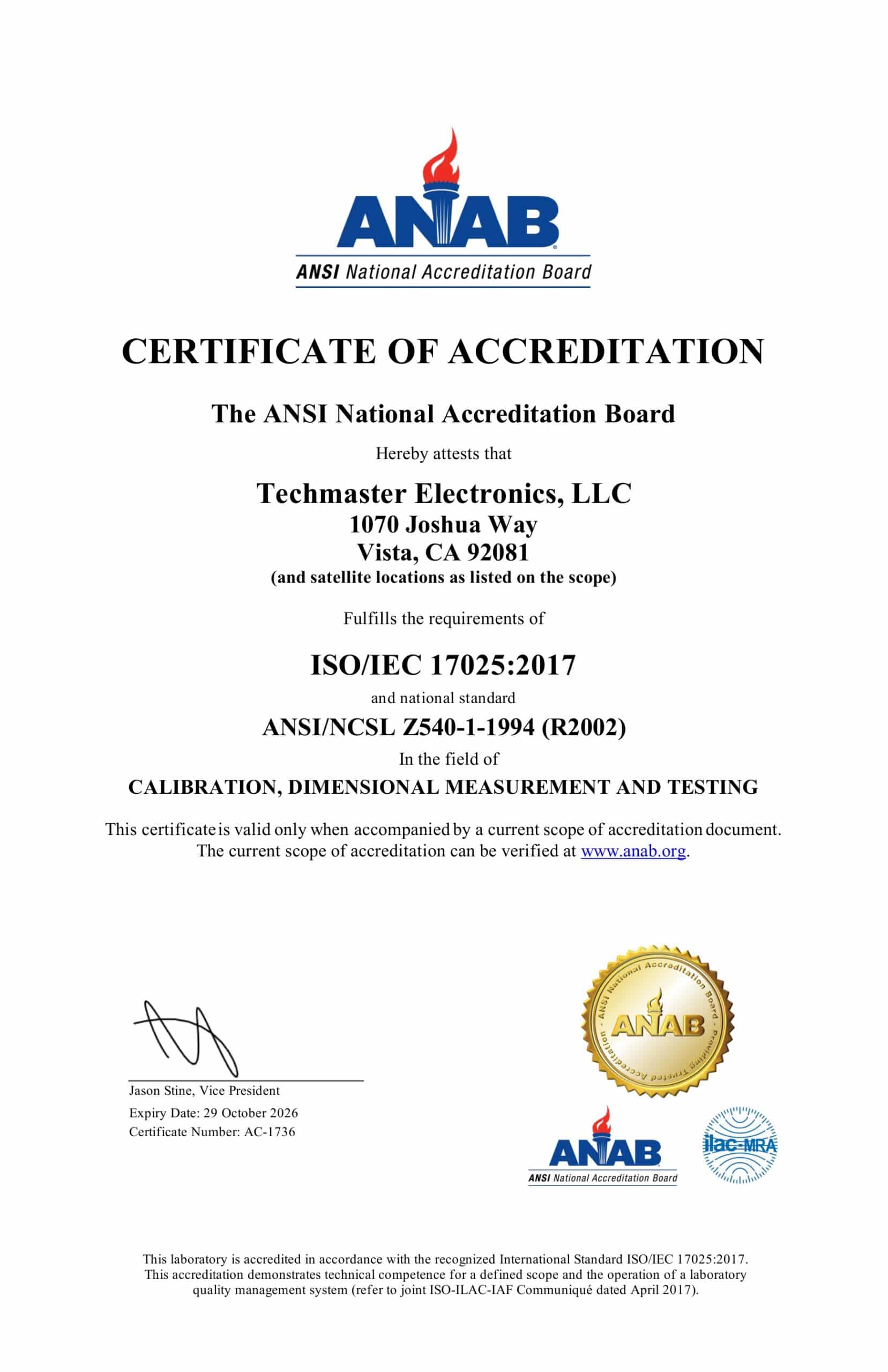
External standards bodies. Techmaster Electronics is an ISO/IEC 17025-accredited, NIST-traceable calibration laboratory.

Khanh Nguyen is the Marketing Manager at Techmaster Electronics, a B2B marketing leader covering the test, measurement, and ISO/IEC 17025 accredited calibration industry across the US and Vietnam markets.