
Function Waveform Generator FAQ: Calibration Intervals, Accuracy & Compliance
Knowing how often to calibrate a function waveform generator helps engineers keep test signals accurate and results reliable. Over time, changes in the internal clock, output circuits, and digital-to-analog converter (DAC) can affect frequency and amplitude. As a result, a generator may produce a signal that differs from its set value. Regular calibration helps teams find these errors and check whether the instrument meets its required limits. In addition, calibration records help support quality checks and audits. When you need accredited results, choose a laboratory whose accredited scope covers the requested service.
1. How Often Should You Calibrate a Function Waveform Generator?
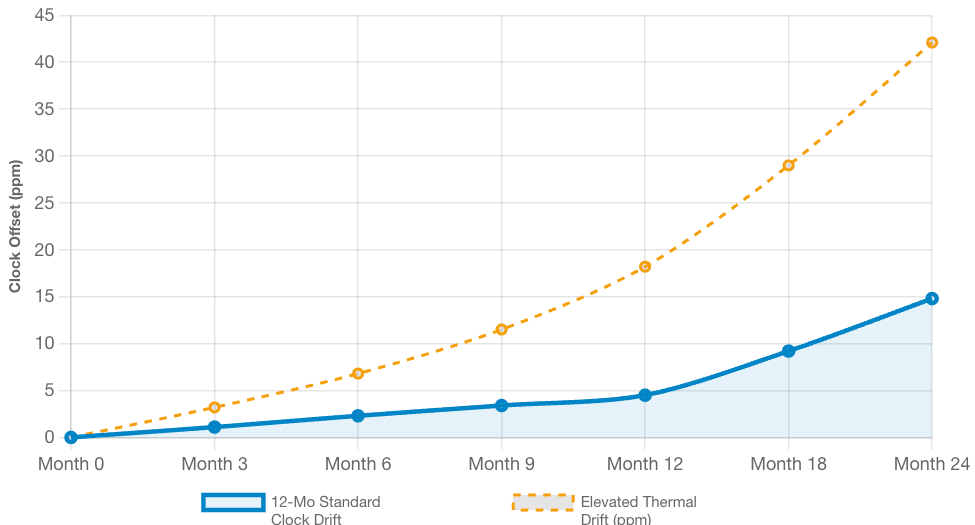
A 12-month interval can serve as a starting point for some function waveform generators. However, it is not a universal requirement under ISO/IEC 17025. The right interval depends on the manufacturer’s guidance, how often you use the instrument, its working conditions, past calibration results, and the risk of inaccurate measurements.
For example, a generator used every day on a busy production line may need more frequent calibration if its results show drift. Likewise, equipment exposed to large temperature changes or frequent transport may need closer review. On the other hand, a stable calibration history may support a different interval if your quality system allows it.
Therefore, review calibration results regularly and document why you choose a specific interval. Also, check any customer or industry requirements that apply to your work.
2. How to Check Function Generator Frequency Accuracy and Amplitude
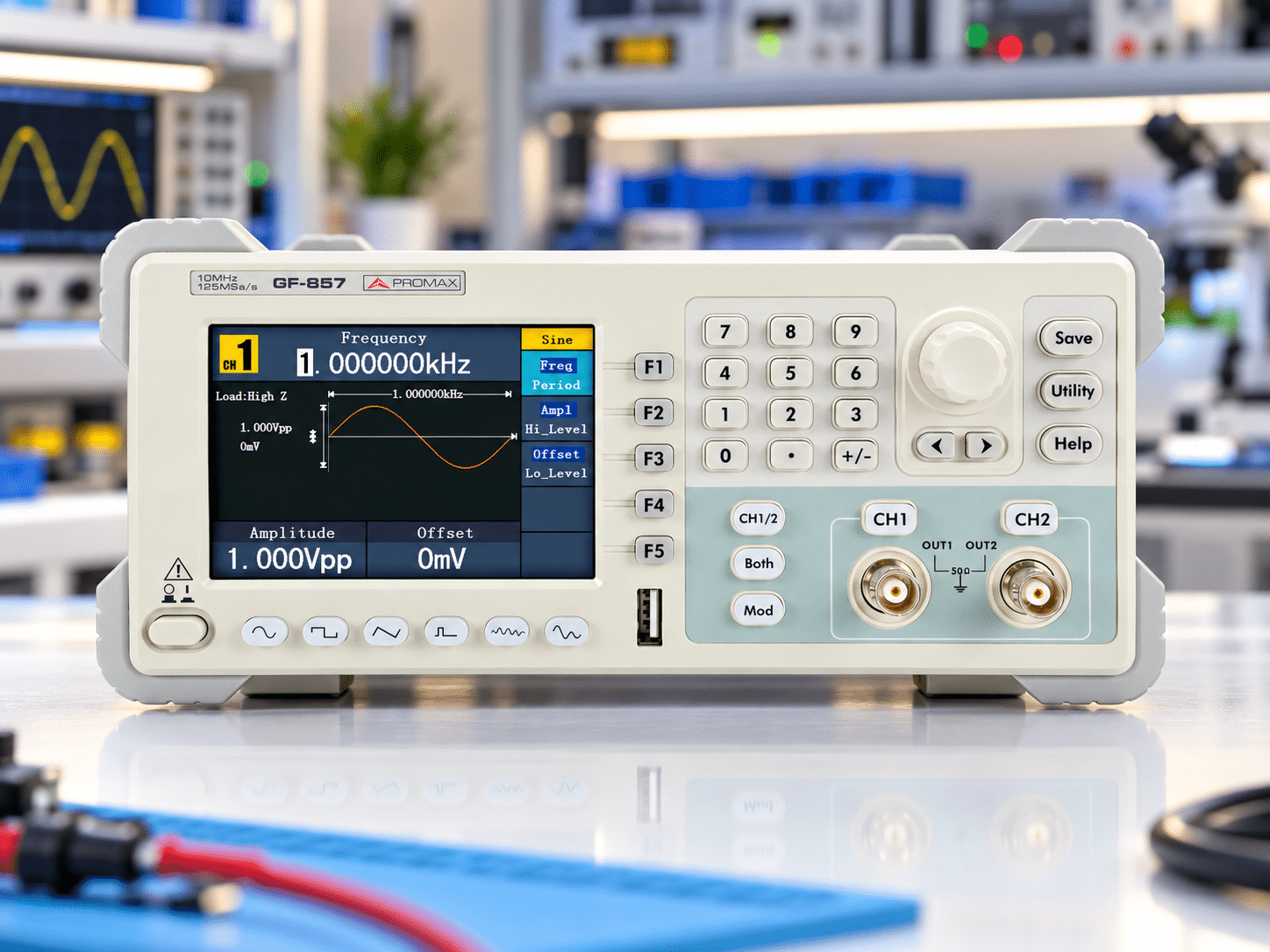
You can perform basic checks to spot possible problems before testing. However, these checks do not replace calibration when you need documented results from a qualified or accredited laboratory.
1. Inspect the Output Connectors and Cables
First, examine the BNC connectors, coaxial cables, and adapters. Look for damaged insulation, bent center pins, loose fittings, or signs of wear.
Next, confirm that the cables and load match the test setup. For example, some measurements require a 50 Ω termination. However, the correct setup depends on the generator’s specifications and the method you use.
2. Allow the Instrument to Warm Up
Next, turn on the waveform generator and the reference equipment. Allow both instruments to warm up according to their manuals.
Some models need a set warm-up period before they reach stable operation. However, do not assume that every generator requires 30 minutes. Instead, follow the manufacturer’s instructions and the approved test procedure.
3. Check Frequency Accuracy
To check frequency, connect the generator to a suitable calibrated frequency counter. Then, select test points across the range required by your procedure.
Record the frequency shown by the generator and compare it with the reference reading. After that, calculate the difference and check whether it falls within the manufacturer’s tolerance.
For high-accuracy work, choose a reference with suitable accuracy and documented measurement traceability. An atomic reference may suit some applications; however, not every test requires a rubidium standard.
4. Check Output Amplitude
Next, set the required waveform, frequency, and output level. Connect the generator to a suitable calibrated oscilloscope or voltage measurement system.
Then, compare the measured voltage with the programmed value. Repeat the check at selected frequencies and output levels to see whether the amplitude changes across the range.
If your test uses a 50 Ω load, make sure the setup matches that requirement. Otherwise, the measured voltage may differ from the value you expect.
5. Check Waveform Distortion
For a sine wave, a suitable analyzer can measure total harmonic distortion (THD). This measurement shows the level of unwanted harmonic content compared with the main signal.
For square waves, the test may include rise time and fall time. In addition, some applications require checks of DC offset or other signal features.
However, the exact tests depend on the generator model and the calibration service. Therefore, confirm the required parameters instead of assuming that every calibration covers every function.
Techmaster US: Function Waveform Generator Calibration
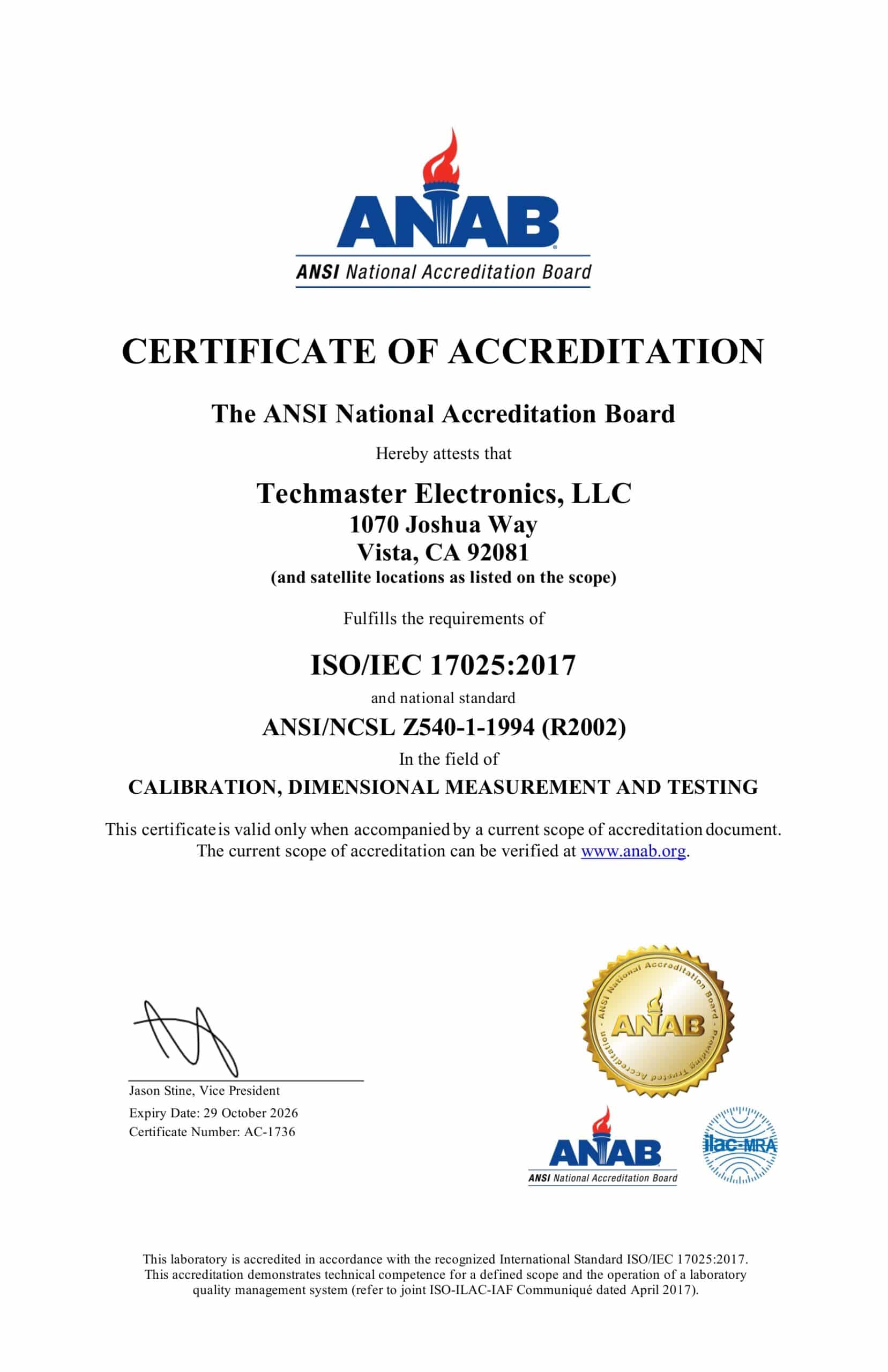
Techmaster Electronics, LLC is an ISO/IEC 17025 accredited calibration laboratory with ANAB certificate AC-1736. Founded in 1989, the company serves customers through laboratories in Vista, California; Santa Clara, California; Orlando, Florida; San Antonio, Texas; and Holly Springs, North Carolina. Its corporate offices are in Vista, California, and Henderson, Nevada.
Techmaster US provides calibration services for electrical, electronic, RF/microwave, dimensional, and mechanical test equipment within its applicable service scope. Therefore, customers can contact the team to ask about calibration options for function waveform generators and related instruments.
In addition, Techmaster US offers mobile on-site calibration when the requested service falls within the laboratory’s accredited scope. To help confirm the right service, provide the instrument’s manufacturer, model, frequency range, and calibration requirements.
Frequently Asked Questions (FAQs)
1. How often calibrate function waveform generator instruments to maintain compliance?
A function waveform generator should be calibrated every 12 months under standard laboratory operating conditions. Units deployed in high-throughput production test lines, extreme thermal environments, or continuous R&D testing should be calibrated on a 6-month cycle to account for internal crystal timebase aging.
2. What causes frequency drift in direct digital synthesis (DDS) waveform generators?
Frequency drift in DDS waveform generators is primarily caused by aging and thermal coefficient shifts in the internal quartz crystal reference oscillator, which alters the system clock frequency and shifts all synthesized output frequencies.
3. Why is amplitude flatness critical during waveform generator testing?
Amplitude flatness ensures that the programmed peak-to-peak voltage Vpp remains constant across the generator’s entire frequency bandwidth. Amplitude roll-off at higher megahertz ranges distorts frequency response testing on filters, amplifiers, and communications receivers.
4. Can internal self-calibration replace accredited ISO/IEC 17025 calibration?
No, internal self-calibration routines only compensate for internal DC offsets and DAC gain adjustments using internal reference points. They cannot evaluate absolute timebase frequency accuracy, harmonic distortion, or frequency response flatness against external national standards.
5. What parameters are tested during accredited function generator calibration?
Accredited calibration verifies frequency accuracy across all ranges, output amplitude flatness into 50Ω loads, DC offset linearity, square wave rise and fall transition times, Total Harmonic Distortion (THD), and modulation depth accuracy.
6. Does Techmaster US offer pickup and delivery services for test equipment calibration?
Yes, Techmaster Electronics provides free local pickup and delivery services for laboratory test equipment across Silicon Valley, Southern California, and the Orlando, Florida regions, alongside nationwide shipping options for all five US accredited laboratories
Conclusion
Function waveform generator calibration helps engineers check frequency, amplitude, and other signal properties. Therefore, choose a calibration interval that fits the instrument’s use, working conditions, and performance history. In addition, inspect cables, verify important settings, and keep clear records. By combining these practices with suitable calibration services, your team can support reliable test results and effective equipment control.

Calibration engineer at Techmaster Electronics, ISO/IEC 17025 accredited laboratory with 35+ years of metrology expertise.