
Sound Level Meter Calibration
Why calibration intervals matter
How Sound Level Meter calibration works
- Intake & visual inspection
- Environmental stabilization
- As-found measurement
- Comparison to NIST-traceable standards
- Adjustment if required
- As-left results & certificate
Your calibration, covered
In-lab vs on-site calibration
In-lab calibration
- Accredited bench with full reference standards
- Best achievable measurement uncertainties
- Pickup & return logistics handled
- Ideal for precision and reference work
On-site calibration
- We calibrate the Sound Level Meter at your facility
- No shipping risk or transit downtime
- As-found data captured before any move
- Ideal for fixed, large or sensitive assets
In-depth guide
Sound Level Meter: The Essential Tool for Health Protection & Noise Control – The Absolute Necessity of Calibration

In industrial, construction, and even residential environments, excessive noise poses a serious threat. It not only harms workers’ auditory health but also negatively impacts quality of life and compliance with environmental regulations. Continuous high noise levels can lead to permanent hearing loss, stress, and reduced productivity. The Sound Level Meter is an essential instrument for accurately measuring the intensity and frequency of noise. This device helps organizations assess noise exposure levels, identify noise sources, and implement effective control measures. However, to ensure that noise measurements truly reflect reality and comply with national/international occupational safety standards, routine Sound Level Meter Calibration is a mandatory requirement. Calibration verifies the device’s accuracy, ensuring we protect human health and maintain quieter environments.
1. What is a Sound Level Meter? The Core Operating Principle

A Sound Level Meter is an electronic instrument used to measure sound pressure levels and convert them into readable values, typically displayed in decibels (dB).
1.1. Objective and Key Measurement Parameters
Key Measurement Parameters
-
Objective: To accurately measure noise levels for risk assessment, regulatory compliance, and noise reduction planning.
-
Key Measurement Parameters:
-
Sound Pressure Level (SPL): Measures instantaneous sound intensity.
-
Equivalent Continuous Sound Level (Leq): Measures the average noise level over a period.
-
Personal Noise Exposure (Dose): Assesses the total noise exposure for an individual during a work shift.
-
Frequency Weighting (A, C, Z filters): Simulates how the human ear perceives sound at different frequencies. (A-weighting is the most common for health assessment).
-
1.2. Basic Operating Principle
Basic Working Principle
-
Microphone: The device uses a sensitive condenser microphone. It converts sound waves into corresponding electrical signals.
-
Signal Processor: This electrical signal passes through an amplifier, frequency weighting filters (A, C, Z), and is calculated to convert it to a logarithmic decibel (dB) scale.
-
Display Screen: The measurement results appear on a digital screen as dB values and other parameters.
2. Vital Applications in Occupational Safety and Environmental Protection
Occupational Health & Safety
Assessing noise exposure in factories and construction sites. Ensuring compliance with OSHA/NIOSH limits (e.g., 85 dBA for 8 hours).
Environmental Noise Control
Measuring traffic and industrial noise for urban planning. An essential tool in Environmental Impact Assessment (EIA).
Product Quality & R&D
Acoustic testing of products (cars, appliances, machinery). Helps manufacturers improve design and reduce noise output.
The ability to accurately measure noise is a key factor in protecting health and maintaining social order.
2.1. Occupational Safety and Health (OSHA/NIOSH)
-
Noise Exposure Assessment: This is the most critical application. Factories, construction sites, and manufacturing workshops use this device to measure the noise levels workers face.
-
Regulatory Compliance: Standards like OSHA (USA) or national occupational safety regulations mandate businesses to monitor noise and implement mitigation measures if levels exceed permissible limits (e.g., 85 dBA for an 8 hour workday).
-
Mitigation Planning: Data from the meter helps identify primary noise sources and plan for acoustic insulation, use of personal hearing protection.
2.2. Environmental Noise Control
-
Urban and Residential Planning: Environmental agencies use the device to measure noise levels from traffic, industry, and other activities. This helps them develop urban plans and set noise limits for residential areas.
-
Environmental Impact Assessment (EIA): Noise meters are crucial tools in EIA studies for large projects (airports, highways, factories).
2.3. Product Quality Control and Development
-
Acoustic Evaluation: Manufacturers of automobiles, home appliances, and machinery use noise meters to evaluate their product’s noise levels. This helps them improve design, reduce noise, and enhance user experience.
3. The Absolute Role of Sound Level Meter Calibration
SLM sensors drift over time. Inaccurate readings can lead to serious health, legal, and financial risks.
The Risk of Undermeasurement
If the device reads lower than the actual noise level, workers suffer excessive exposure, leading to permanent hearing loss.

An inaccurate noise measurement can lead to serious health, legal, and financial consequences, making Sound Level Meter Calibration paramount.
3.1. Ensuring Measurement Accuracy and Standard Compliance
-
Risk of Undermeasurement: If the device reads noise levels lower than actual, workers might experience excessive noise exposure unknowingly. This causes hearing loss or other health problems.
-
Risk of Overmeasurement: If the device reads noise levels higher than actual, businesses might invest unnecessarily in noise reduction solutions or implement excessive protective measures.
-
Value Verification: Sound Level Meter Calibration verifies that the device accurately measures sound pressure and displays the correct value on the decibel scale.
3.2. Legal Compliance and Safety Regulations
-
International/National Standard Requirements: Standards like ANSI S1.4 (USA), IEC 61672-1 (International), and occupational safety regulations mandate that sound level meters must be calibrated periodically by an ISO/IEC 17025 accredited laboratory.
-
Legal Evidence: The Calibration Certificate is the sole documentation that proves noise measurements are valid and traceable. This is extremely important in cases of legal disputes over noise exposure or safety audits.
4. Process of Sound Level Meter Calibration
Basic Calibration Procedure
The process of Sound Level Meter Calibration requires specialized equipment and a controlled environment:
-
Reference Sound Source (Sound Calibrator): A Sound Calibrator generates a precise, stable sound level and frequency (e.g., 94dB or 114 dB at 1 kHz). This calibrator itself must be calibrated by an accredited laboratory.
-
Check and Compare: A technician places the sound level meter’s microphone into the calibrator. They compare the device’s reading with the calibrator’s reference sound level.
-
Adjustment (if necessary): If a deviation beyond permissible limits occurs, the device is adjusted (if possible) to match the reference value, or a correction factor is recorded on the certificate.
-
Certification: A Calibration Certificate is issued, confirming the device’s accuracy and the next calibration due date.
Conclusion
The Sound Level Meter is a crucial tool for protecting hearing and maintaining environmental order. However, its value depends entirely on the accuracy of its measurements. Routine Sound Level Meter Calibration is not optional; it is a mandatory procedure. It ensures that decisions regarding occupational safety and noise control rely on reliable data, helping to protect human health and comply with the strictest regulations.
Frequently asked questions
What is Sound Level Meter Calibration?
How often should a Sound Level Meter be calibrated?
What standards apply to Sound Level Meter Calibration?
What is included on the certificate?
Can you calibrate the Sound Level Meter on-site?
Need Sound Level Meter calibration?
ANAB-accredited, NIST-traceable, fast turnaround — in-lab or on-site across the USA.
Contact us for a quoteReferences & industry standards
- ISO/IEC 17025 testing & calibration laboratory requirements
- NIST calibration services and measurement traceability
- NIST Acoustics
- A2LA / ANAB accreditation for calibration laboratories
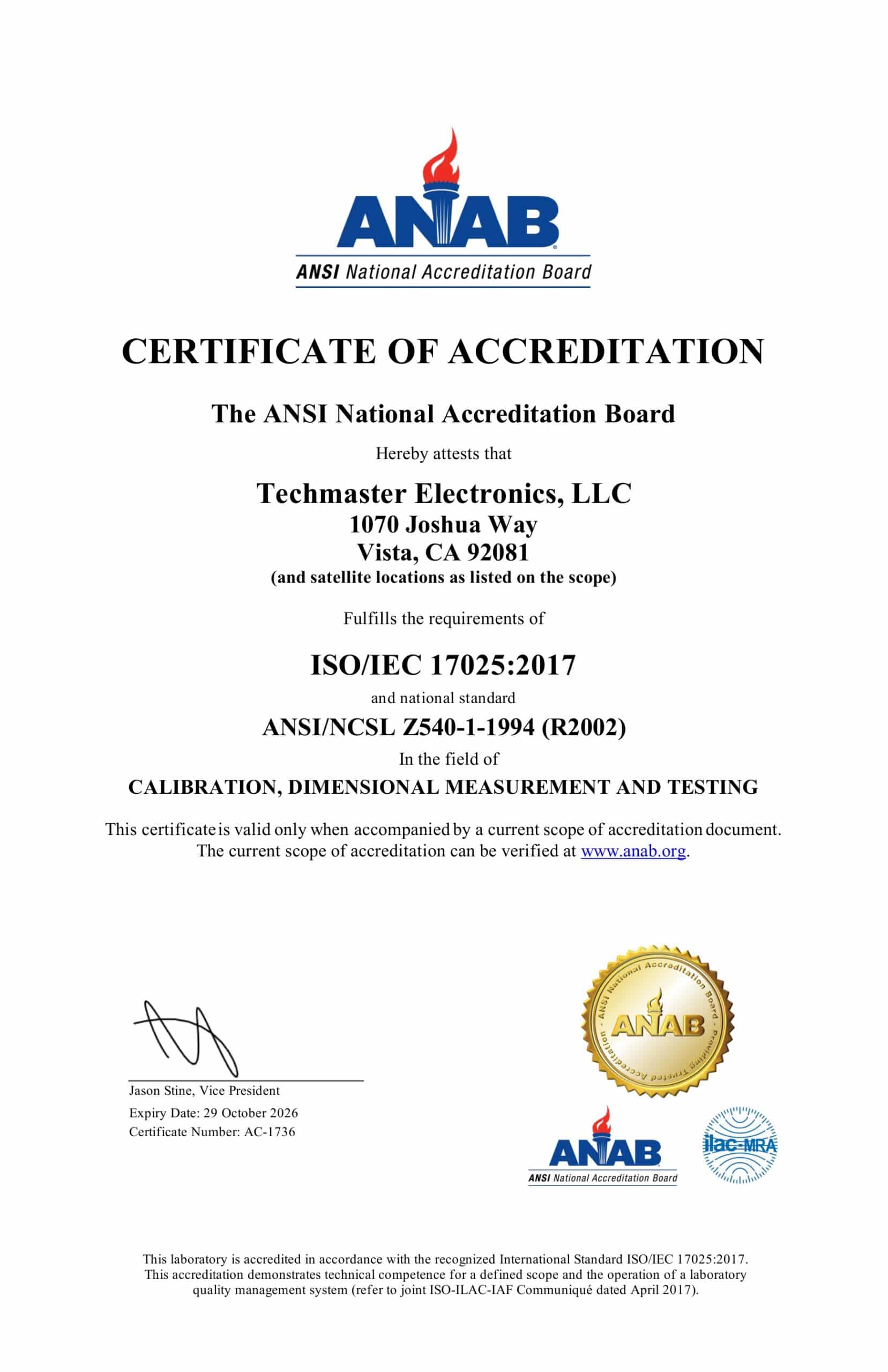
External standards bodies. Techmaster Electronics is an ISO/IEC 17025-accredited, NIST-traceable calibration laboratory.

Khanh Nguyen is the Marketing Manager at Techmaster Electronics, a B2B marketing leader covering the test, measurement, and ISO/IEC 17025 accredited calibration industry in the United States.