
Most rent vs buy test equipment comparisons stop at sticker price versus the monthly rate. That leaves out the costs a quality manager actually pays for: accredited calibration every interval, the weeks the instrument spends at the lab, resale value that falls with each new product generation, and the audit trail needed when results go into ISO/IEC 17025, FDA or AS9100 records. This guide gives you the full break-even formula, worked numbers for five common instrument classes, and a four-question decision path. It is written from the viewpoint of Techmaster Electronics, which has run calibration and test equipment sales and rentals in the United States since 1989.
What is the rent vs buy break-even point for test equipment?
The break-even point is the number of rented months at which renting costs the same as owning. You find it by dividing the total cost of ownership over your planning horizon, usually 36 months, by the monthly rental rate. Need it for fewer months than that? Rent. For more? Buy.
Written as a formula:
Break-even months = [ (Purchase − Resale) + Calibration + Capital cost + Repair reserve + Overhead ] ÷ Monthly rental rate
All the terms are measured over the same horizon. Three years is a sensible default for general-purpose electronic test equipment: it is about the length of a product generation, and it covers two or three annual calibration cycles. For a quick sanity check, divide the break-even months by the horizon. That gives the utilization at which buying starts to pay off. At 11 months out of 36, the threshold is about 31%.
What costs go into owning a test instrument?
Test equipment total cost of ownership is much more than the purchase price. Over three years you pay for the value it loses (price minus resale), recurring accredited calibration, the cost of the capital tied up in it, a repair reserve, and asset overhead such as storage, tracking and insurance. Calibration and downtime are the items people most often leave out.
For the worked examples below we used these assumptions. Swap in your own quotes before making a purchase decision:
- Depreciation: 45% resale value after 36 months, typical for a well-kept, supported mainstream instrument.
- Calibration: one accredited calibration per year, with the interval set as described in ILAC G24 guidelines for recalibration intervals. See also our guide to setting calibration intervals with ILAC G24.
- Capital cost: 8% per year on the average book value over the horizon.
- Overhead: 3% of the purchase price per year, covering asset tracking, storage, insurance and the calibration-recall admin your quality system already carries.
- Repair reserve: not modeled separately here because a new instrument is assumed to be under warranty; add 1 to 2% of the price per year for out-of-warranty units.
- Rental: 8% of the new list price per month. Short-term rates are often higher and long-term rates lower, so get a real quote.
Taxes change the after-tax picture. Purchased equipment can usually be depreciated under MACRS or expensed under the Section 179 election, both described in IRS Publication 946, How To Depreciate Property. Rental payments are generally an operating expense. Run the decision past your tax advisor; the model here is pre-tax on purpose.
How many months of use justify buying?
Under the assumptions above, the test equipment rental break-even lands at roughly 11 to 16 rented months over a three-year horizon for every instrument class we modeled, from a $1,800 bench DMM to a $120,000 vector network analyzer. The cheaper the instrument, the later the break-even, because its fixed calibration cost is a bigger share of ownership.
| Instrument class (illustrative) | List price | Accredited cal / yr | 3-yr cost to own | Monthly rent (8%) | Break-even (rented months) | Calibration share of ownership |
|---|---|---|---|---|---|---|
| 6.5-digit bench DMM (Keysight 34465A class) | $1,800 | $250 | $2,226 | $144 | 15.5 | 34% |
| 4-ch 1 GHz oscilloscope | $25,000 | $500 | $22,000 | $2,000 | 11.0 | 7% |
| Multifunction calibrator (Fluke 5522A class) | $30,000 | $1,800 | $30,000 | $2,400 | 12.5 | 18% |
| EMI test receiver to 7 GHz (R&S ESR class) | $90,000 | $2,000 | $79,800 | $7,200 | 11.1 | 8% |
| 26.5 GHz vector network analyzer | $120,000 | $2,500 | $105,900 | $9,600 | 11.0 | 7% |
All prices, rates and calibration costs are illustrative round numbers chosen to show the method. They are not Techmaster quotes or manufacturer list prices.
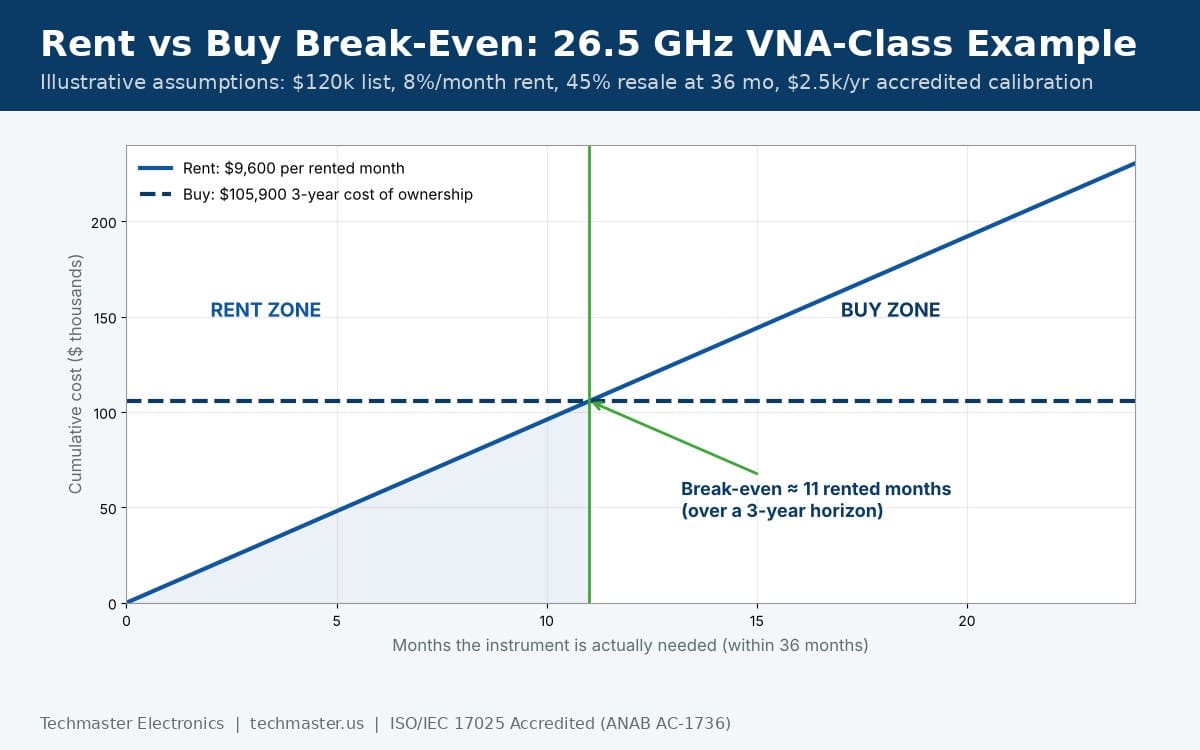
The pattern holds across very different instruments, so a simple rule works for a first pass: if the instrument would sit unused on the shelf two-thirds of the time, rent it. RF and microwave instruments such as VNAs and EMI receivers deserve extra caution, because frequency-range upgrades and new standard editions can cut resale value faster than our 45% assumption. Compare options on our RF and microwave test equipment sales and rentals page.
When does calibration cost tip the decision?
Calibration tips the decision when it is a large share of ownership cost or when downtime at the lab interrupts production. For a 6.5-digit bench DMM in our model, accredited calibration is about 34% of the three-year cost. For a single critical analyzer, the weeks it spends out of service can matter more than the calibration invoice itself.
Two calibration effects get left out of rent vs buy spreadsheets:
- The calibration share. Calibration cost depends on the measurement functions and points tested, not on the purchase price. A low-cost instrument therefore carries a much larger calibration share. In the table, the multifunction calibrator (18%) and the bench DMM (34%) are the cases where leaving calibration out would distort the break-even the most. Our calibration budget guide shows how to estimate that line item for a whole asset list.
- Calibration downtime. If you own only one unit, it is unavailable every time it goes out for calibration, and longer if it comes back out of tolerance and needs adjustment or repair. Many labs cover that gap with a short rental. That bridge rental is a real ownership cost and belongs in the model.
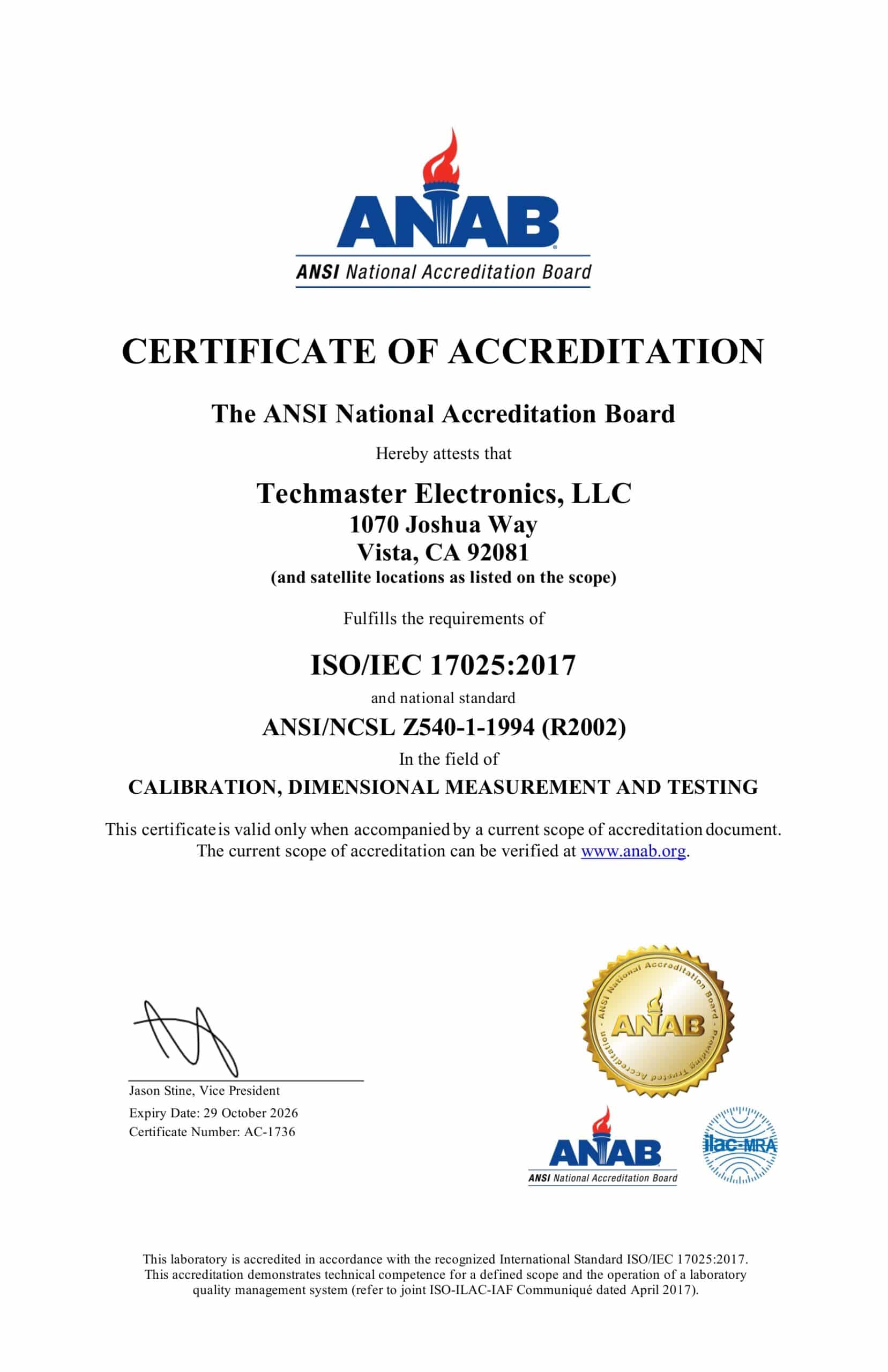
Breadth matters here as well. Across Techmaster’s 10-year dataset of 381,916 calibrations covering 4,913 manufacturers, ownership is cheapest when one accredited provider can calibrate the whole mix of instruments and you avoid splitting work between vendors. Techmaster’s four ISO/IEC 17025 accredited laboratories in Vista and Santa Clara, California; Orlando, Florida; and San Antonio, Texas are listed on ANAB certificate AC-1736. Start with our ISO/IEC 17025 accredited calibration services overview and the ANAB accreditation and scope documents.
Does rented test equipment satisfy ISO/IEC 17025?
Yes, provided the laboratory verifies the rental before using it. ISO/IEC 17025:2017 clause 6.4 covers equipment outside the lab’s permanent control, which includes rentals, and requires the lab to confirm the equipment meets its requirements. In practice that means an accredited calibration certificate, a calibration date that covers the rental period, and a recorded incoming check.
The standard itself is ISO/IEC 17025:2017, General requirements for the competence of testing and calibration laboratories. Before a rental ships, ask for:
- An accredited certificate, not just a NIST-traceable one. It should carry the accreditation body’s symbol and list measurement uncertainties. Check that the functions you will use fall within the calibration lab’s accredited scope.
- Calibration days remaining. Agree in writing on the minimum calibration life left at shipment, for example at least 6 months for a 3-month rental, so the instrument does not go overdue mid-project.
- As-found and as-left data, so you can judge whether the unit was in tolerance before adjustment.
Our guides on who owns the calibration on a rented instrument and incoming checks for used or rented test equipment cover the paperwork in detail.
When does leasing beat both renting and buying?
Leasing beats renting and buying when you have a predictable need of roughly 12 to 36 months, want to keep capital free, and would otherwise rent long enough to pass the break-even point. A lease spreads cost like a rental but runs at a lower monthly rate. Get the calibration responsibility written into the lease agreement.
Leases are often written with you, the lessee, responsible for maintenance and calibration. If the lease does not say who pays for, schedules and documents calibration, treat it as your cost and add it to the comparison. A rent-to-own option is another middle path. It suits a short evaluation that may turn into a permanent need, as long as part of the rental payments is credited toward the purchase price.
How should a quality manager make the final call?
Make the final call by answering four questions in order: how many months you will actually need the instrument, how quickly its technology will date, what calibration adds to its ownership cost, and whether its results feed regulated or accredited records. Utilization settles most cases, and the other three adjust the decision at the margin.
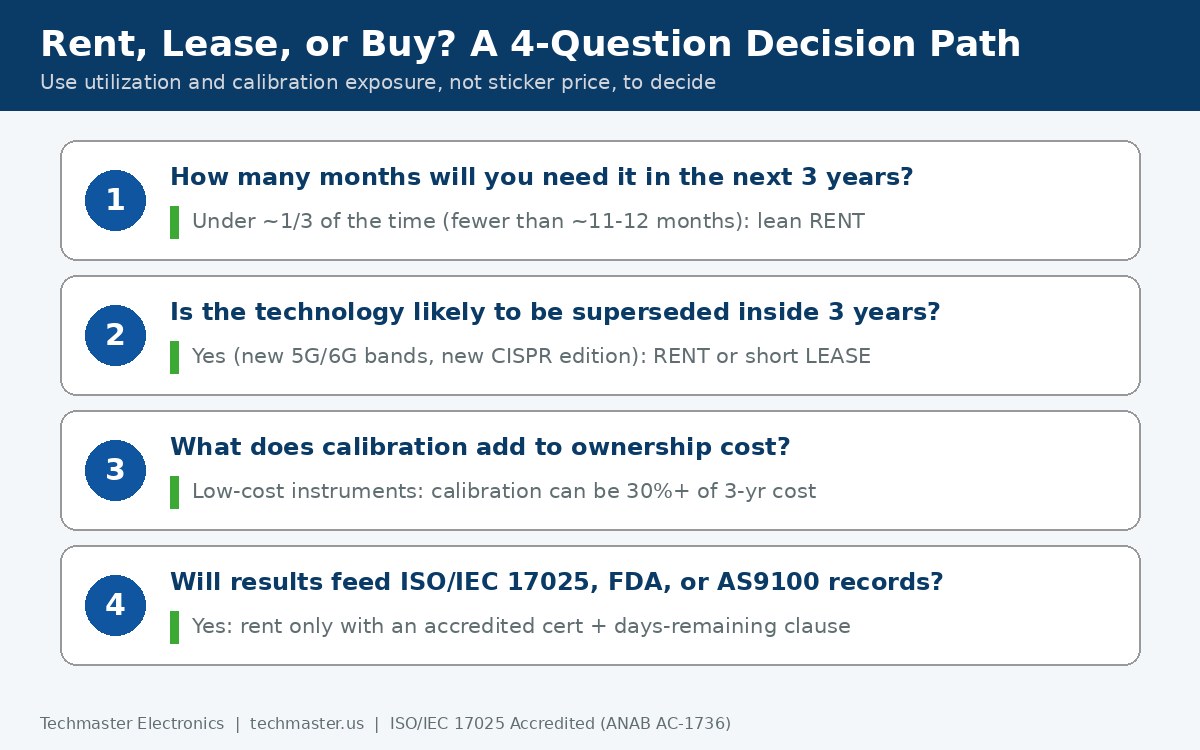
A worked EMC example. A medical device team needs an EMI test receiver for a six-week pre-compliance push ahead of a formal CISPR 11 test slot. Six weeks is about 1.5 rented months, far below the roughly 11-month break-even for that instrument class, so renting is the clear choice. They should rent the receiver with an accredited certificate and enough calibration life left, and add the LISN and antennas from the same EMC/EMI test equipment rental source so the setup is consistent. If the team later builds an in-house pre-compliance bench that runs every week, utilization goes above 30 to 40% and buying the receiver becomes the better option. At that point, accredited EMC/EMI equipment calibration becomes a recurring line in its budget. Our EMC test equipment rental guide covers what has to ship with a rented EMC set.
Key takeaways
- For any rent vs buy test equipment decision, break-even months = three-year cost of ownership ÷ monthly rental rate. Under typical assumptions it lands near 11 to 16 months.
- If you will need the instrument less than about 30 to 40% of the time, rent. If more, buy or lease.
- Accredited calibration can be about one-third of the ownership cost on low-cost instruments. Always include it, along with the downtime while the instrument is at the lab.
- ISO/IEC 17025 clause 6.4 lets labs use rentals, but only after verifying them. Require an accredited certificate and a minimum calibration life remaining.
- Lease for predictable 12 to 36 month needs, and confirm in writing who owns calibration during the lease.
Frequently asked questions
How do you calculate the rent vs buy break-even for test equipment?
Divide the total cost of owning the instrument over your planning horizon by the monthly rental rate. Ownership cost is the purchase price minus expected resale value, plus calibration at your interval, cost of capital, repair reserve and asset overhead. The result is the number of rented months at which buying becomes cheaper.
What is a typical break-even point for renting vs buying test equipment?
Using the illustrative assumptions in this article (rent at 8% of list per month, 45% resale after 36 months), most instrument classes break even at roughly 11 to 16 rented months over three years. In practice that means buying pays off once you need the instrument about 30 to 40% of the time or more.
Should calibration cost be included in a rent vs buy decision?
Yes. A rental normally arrives already calibrated, while an owned instrument must be recalibrated at every interval and is out of service while it is at the lab. For low-cost instruments such as a 6.5-digit bench DMM, accredited calibration can be about one-third of the three-year cost of ownership.
Can an ISO/IEC 17025 lab use rented test equipment?
Yes. ISO/IEC 17025:2017 clause 6.4 covers equipment outside the laboratory’s permanent control, including rentals, but the lab must verify the equipment meets requirements before use. Ask for an accredited calibration certificate, check the calibration date against your rental period, and record the incoming verification.
Is it better to lease or rent test equipment?
Rent when the need is short or uncertain, typically under six months. Lease when you have a predictable need of roughly 12 to 36 months and want to preserve capital, but confirm in writing who pays for and schedules calibration during the lease term, because many leases leave it with you.
Does buying test equipment have tax advantages over renting?
Purchased business equipment can usually be depreciated under MACRS or expensed under Section 179, while rental payments are generally deductible as operating expenses. Which is better depends on your tax position, so use IRS Publication 946 as the reference and confirm the decision with your tax advisor; Techmaster does not give tax advice.
Rent, buy, or calibrate what you own?
Techmaster Electronics can quote a calibrated rental, a purchase, or ISO/IEC 17025 accredited calibration for your existing instruments from four accredited laboratories in California, Florida and Texas.
Request a quote
Khanh Nguyen is the Marketing Manager at Techmaster Electronics, a B2B marketing leader covering the test, measurement, and ISO/IEC 17025 accredited calibration industry in the United States.