
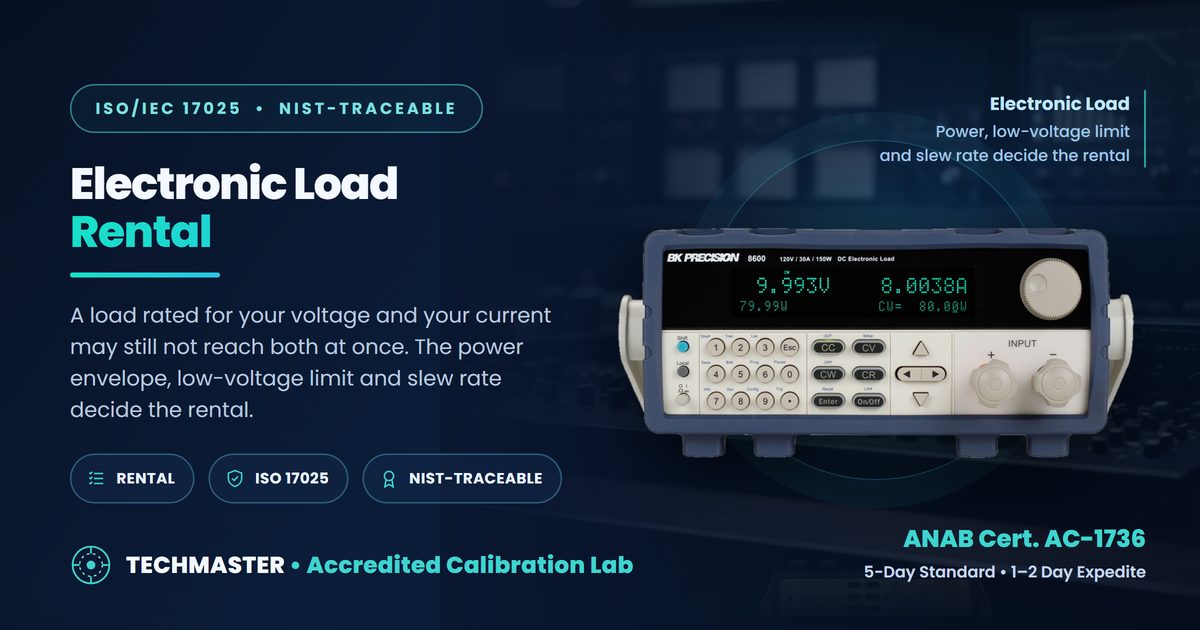
TL;DR: An electronic load rated for your voltage and your current may still not reach both at once: the power rating, the low-voltage limit and the slew rate decide the rental. Plot your operating points against the power curve, check the modes, and confirm the certificate covers the readback you will report.
What decides an electronic load rental?
An electronic load rental is the short-term hire of a programmable DC load sized to a set of operating points, and those points must fit inside the load’s voltage, current and power limits at the same time. Meeting each rating separately is not enough.
Rentals cluster around qualification of a new power supply, battery or converter, burn-in runs and customer witness tests. All of them have fixed operating points, which makes the envelope check something to do before the order rather than on arrival.
How do you check the power envelope?
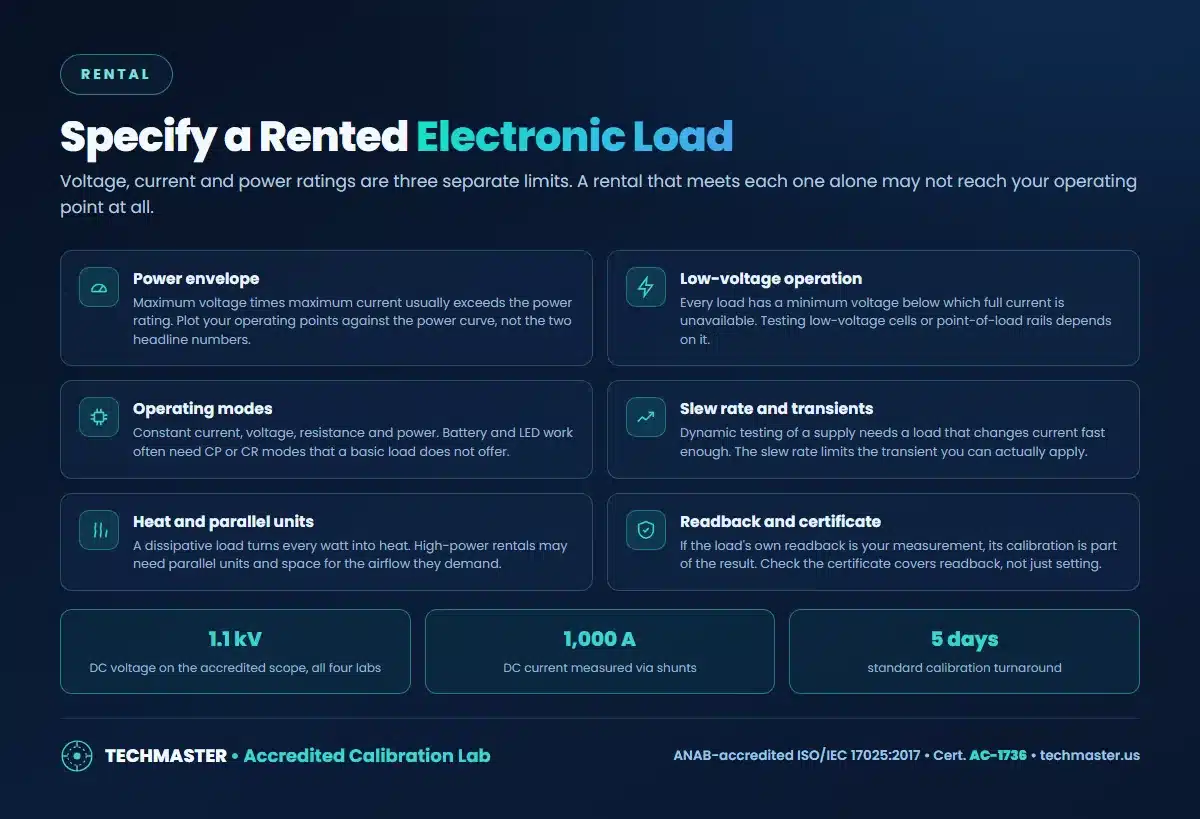
Multiply voltage by current at every operating point and compare the result with the power rating, then check the low end against the minimum operating voltage. A point that passes both is reachable. Most rental mismatches are a high-voltage, high-current corner that neither headline figure reveals.
Heat is the other half of the envelope. A dissipative load turns every watt into heat in your lab, so high-power rentals may arrive as parallel units and need space for their airflow.
Specification, what it decides, when it binds
| Specification | What it decides | When it is the constraint |
|---|---|---|
| Power rating | Which voltage and current combinations are reachable | High-power corners |
| Minimum operating voltage | Full current at low voltage | Cells, low-voltage rails, fuel cells |
| Operating modes | CC, CV, CR or CP behaviour | Battery discharge, LED drivers |
| Slew rate | Transient step you can apply | Supply transient response testing |
| Parallel capability | Total current and power | High-power qualification |
| Readback accuracy and certificate | Whether the load’s numbers are defensible | When readback is the reported result |
Does the rented load need its own calibration?
If you report the load’s own voltage and current readback, yes: that readback becomes part of your measurement. Confirm the certificate covers readback as well as setting accuracy, and that it stays valid through the last test day. Ask us about availability for the ratings you need.
Before deciding to rent at all, see rent versus buy for DC electronic loads and the matching DC power supply guide. What the calibration covers: DC electronic load calibration, the calibration procedure and how often to calibrate one. The supply under test needs the same care: power supply calibration. On rental certificates: used and rented equipment calibration and accredited versus NIST-traceable.
Frequently asked questions
What should I specify when renting an electronic load?
Your operating points plotted against the load’s power curve, the minimum voltage at which you need full current, the modes you need (constant current, voltage, resistance or power), the slew rate for transient testing, whether parallel units are needed, and a certificate that covers the readback you will rely on.
Why can a load rated for my voltage and current still fail to reach my test point?
Because voltage, current and power are separate limits. Maximum voltage multiplied by maximum current is usually far above the power rating, so a load can meet the voltage and the current individually and still be unable to sink both at once.
What is the low-voltage limit on an electronic load?
Every load needs a minimum voltage across its terminals to draw full rated current. Below it the available current falls. Testing single cells, low-voltage rails or fuel cells depends on this figure more than on the headline ratings.
Is electronic load calibration on Techmaster’s accredited scope?
Yes. Electronic loads are calibrated under electrical DC and low frequency, which is accredited at all four laboratories, with DC voltage to 1.1 kV, a 20.5 A current source and current measurement to 1,000 A via shunts. Send the model and we will confirm which ranges fall inside the scope.
Techmaster Electronics is accredited by ANAB to ISO/IEC 17025:2017 under certificate AC-1736, across eight accredited calibration fields at four US laboratories, Vista CA, Santa Clara CA, Orlando FL and San Antonio TX. Ask us to confirm your specific instrument and parameter ranges against the current scope before shipping.
Send us the model list. We will come back with an itemized quote, the service level per instrument, and which items sit inside our ANAB accredited scope, usually within one business day. Request a quote.
Techmaster Electronics, LLC is an independent ISO/IEC 17025:2017 accredited calibration laboratory. We are not affiliated with, authorized by, or endorsed by any manufacturer named on this page. All product names and model designations are trademarks of their respective owners and are used here only to identify the equipment we calibrate, repair, or rent. Confirm that our accredited scope covers your instrument’s parameters and ranges before shipping, ask us and we will check it against your model list.

Khanh Nguyen is the Marketing Manager at Techmaster Electronics, a B2B marketing leader covering the test, measurement, and ISO/IEC 17025 accredited calibration industry in the United States.