
TL;DR: To find accredited calibration services, search the public directory of a recognized accreditation body such as ANAB or A2LA. Then open each candidate lab’s scope of accreditation and check three things: your instrument and range are listed, the uncertainty is good enough, and the site that will do the work is covered. Finally, confirm the certificate is current and that your calibration certificate will be issued as accredited. The six steps below take about fifteen minutes per lab.
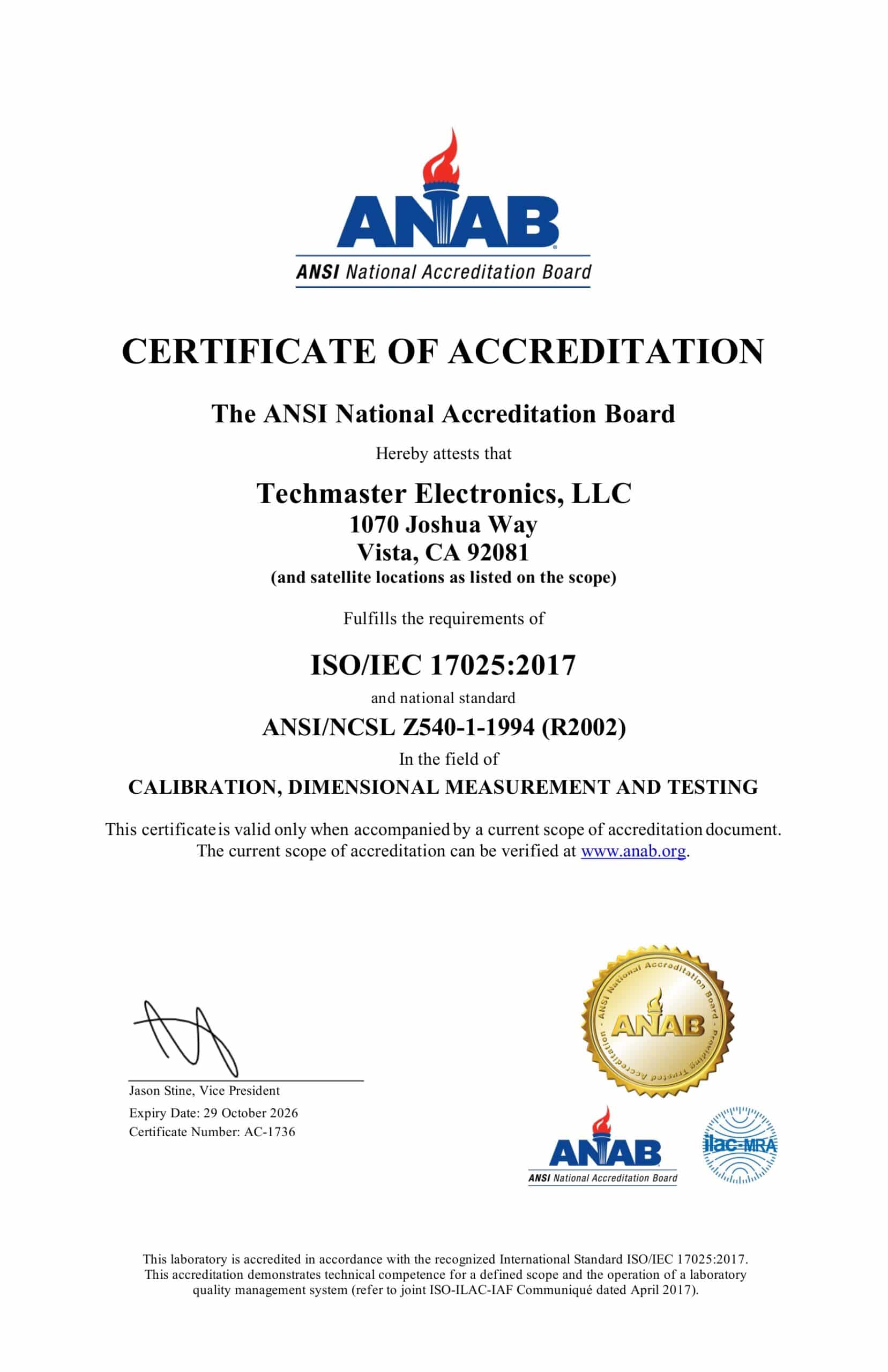
Many companies say they are “ISO 17025”. Far fewer are accredited for the instrument you need, at the site that will handle it. This guide shows how to find accredited calibration services and how to verify them yourself, so an auditor never finds the gap first. We use our own accreditation, ANAB certificate AC-1736, as the worked example.
Where can you find accredited calibration services in the US?
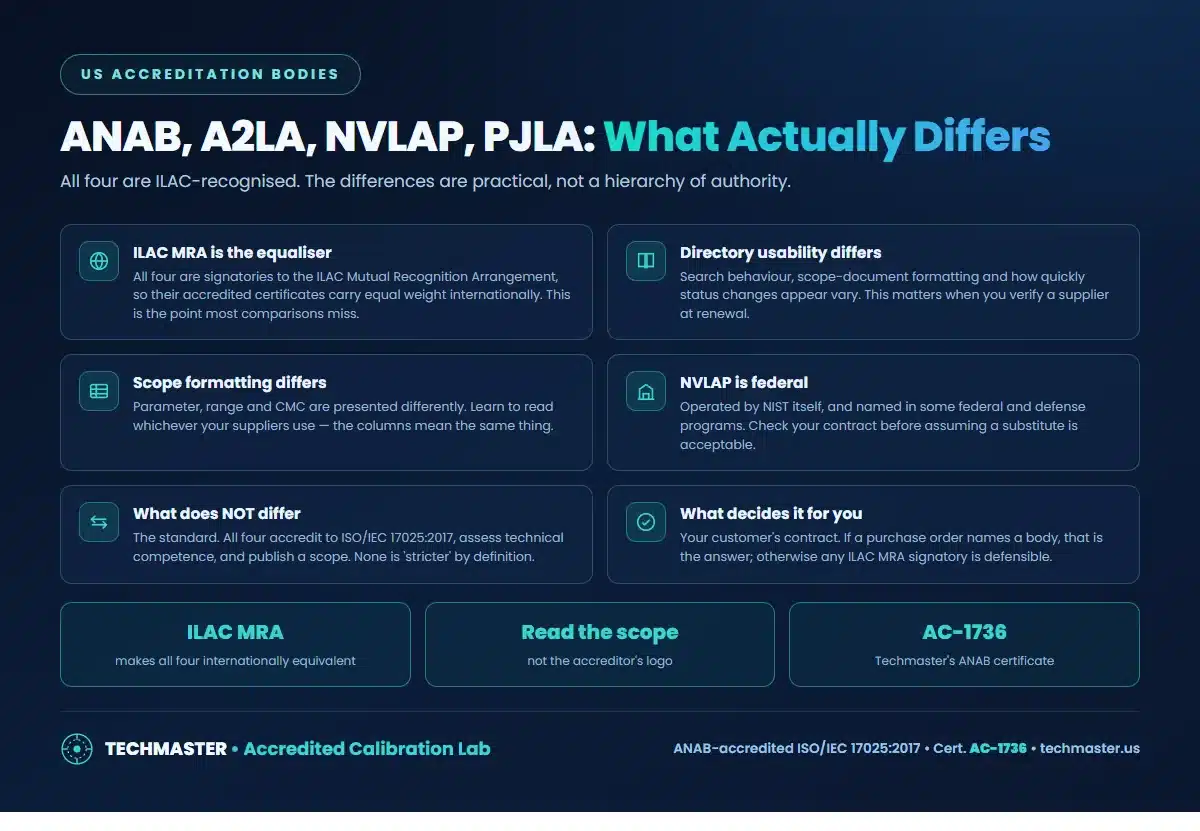
Start with the accreditation bodies, not with a web search. In the US, calibration laboratories are accredited to ISO/IEC 17025 by a small group of bodies. Each one publishes a free directory of the labs it accredits. In addition, every body below signs the ILAC Mutual Recognition Arrangement, so their accreditations are treated as equivalent.
- ANAB (ANSI National Accreditation Board)
- A2LA (American Association for Laboratory Accreditation)
- IAS (International Accreditation Service)
- NVLAP, run by NIST
- PJLA (Perry Johnson Laboratory Accreditation)
Directories are the only list that is complete and current. Listicles, search ads and supplier portals are useful for a shortlist. However, they cannot tell you what a lab is accredited to do.
How do you verify a calibration lab’s ISO/IEC 17025 accreditation?
Use the same six steps for every lab on your shortlist. The first four are pass or fail.
1. Write down what you need calibrated
List each instrument with its model, the parameters and ranges you use, and the tolerance you must meet. For example, “DMM, DC voltage to 1000 V, 0.01% tolerance” is something you can check against a scope. “Multimeter” is not. Also note whether you need in-lab, on-site or pickup service.
2. Search the accreditation body’s directory
This is the fastest way to find accredited calibration services near you. Filter by calibration, by the field you need (electrical, RF and microwave, dimensional, and so on) and by state. Each result shows the lab’s legal name, certificate number, expiry date and scope document. If a lab says it is accredited but you cannot find it in any directory, stop there.
3. Read the scope of accreditation, not just the certificate
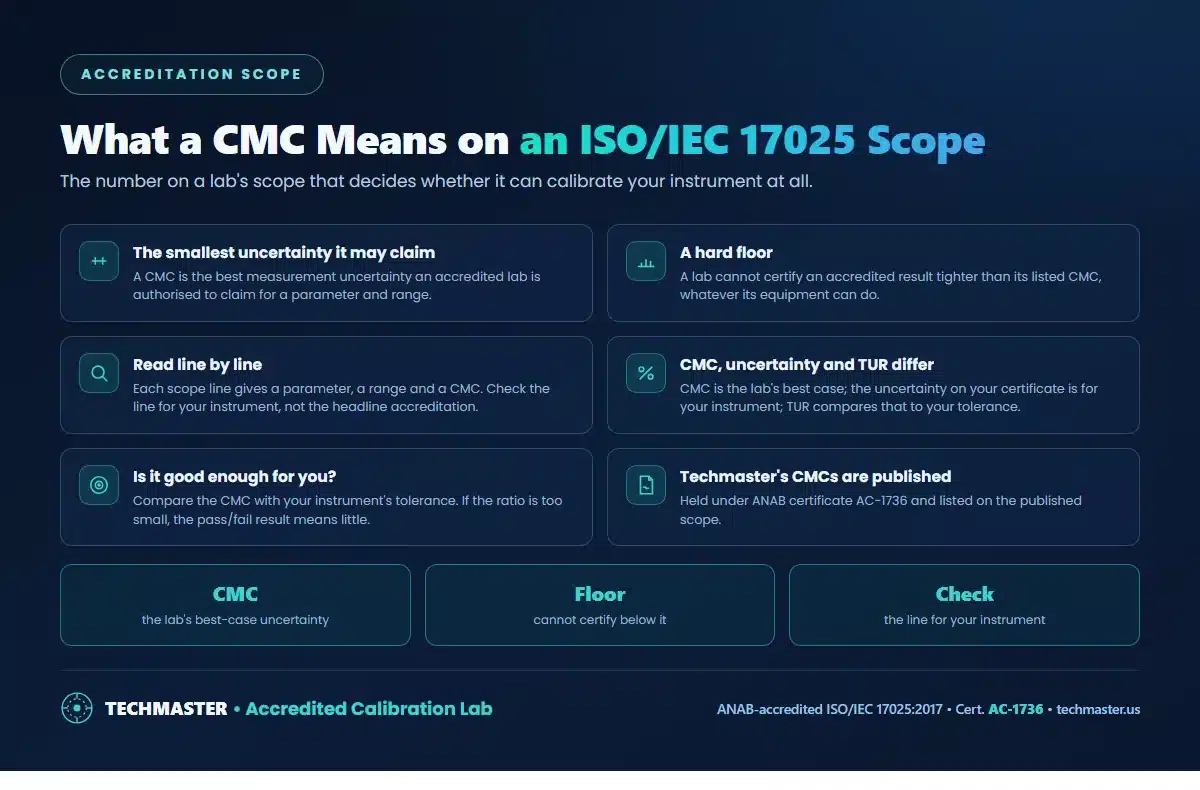
The certificate says a lab is accredited. The scope says for what. It lists every parameter, range and method, together with the lab’s calibration and measurement capability (CMC), the smallest uncertainty it is accredited to achieve. So check that your instrument and range appear, and that the CMC is small enough for your tolerance. Our guide on how to choose a calibration service explains how to weigh the uncertainty against your tolerance.
4. Check that the scope covers the site doing the work
Accreditation applies to named locations. A company can run several labs and have only some of them on its scope. Therefore, ask which address will calibrate your instrument, and find that address on the scope document.
5. Confirm the certificate is current
Check the expiry date in the directory, not on a PDF the lab emailed you months ago. Also check for a suspension notice. If a lab’s accreditation lapses, calibrations it performs during the gap are not accredited.
6. Ask how your calibration certificate will be issued
An accredited calibration produces a certificate that identifies itself as accredited. It usually carries the accreditation body’s symbol or certificate number and reports measurement uncertainty. Some labs hold accreditation but issue a cheaper “traceable” certificate unless you ask. So state “accredited calibration with data” on your purchase order. Then use our guide to reading a calibration certificate when the first one arrives.
Worked example: verifying Techmaster Electronics
Here is the same check applied to our own laboratory, so you can see what a pass looks like when you find accredited calibration services.
- Directory: ANAB lists Techmaster Electronics under certificate AC-1736, accredited to ISO/IEC 17025:2017. You can search for it in ANAB’s directory of accredited organizations.
- Scope: one scope document (version V-023, PDF) lists every parameter, range and CMC across electrical, RF and microwave, time and frequency, dimensional, mass and mechanical, thermodynamic and other disciplines. Our scope page explains it in plain language.
- Sites: four labs are on the scope: Vista, CA; Santa Clara, CA; Orlando, FL; and San Antonio, TX. Our Holly Springs, NC lab is not on the accredited scope, and our Henderson, NV office does no calibration. The lab locations page shows the status of each site.
- Current: the certificate is valid through 29 October 2028.
- Certificates: accredited calibrations are issued with measurement data and uncertainty.
That is exactly the level of detail to expect from any provider you shortlist. If a lab cannot show you its directory entry, its scope and its sites within a day, treat that as an answer.
Red flags when you look for accredited calibration services
- “ISO 17025 compliant” instead of “accredited”. Anyone can claim compliance; only an accreditation body can grant accreditation.
- ISO 9001 offered as proof. ISO 9001 covers quality management, not measurement competence.
- “NIST traceable” with no accreditation. Traceability alone does not prove the lab measured correctly.
- A certificate number the directory cannot find, or a scope that does not list your parameter.
- No uncertainty on the calibration certificate. Without it, you cannot apply a decision rule.
Reviews help with a different question: whether a lab is easy to work with. Our reviews page shows how we are rated. However, use accreditation as the gate and reviews as the tiebreak. The benefits of accredited calibration explains why the gate matters.
Frequently asked questions
Where can I find ISO/IEC 17025 accredited calibration labs in the US?
To find accredited calibration services, search the public directories of the US accreditation bodies: ANAB, A2LA, IAS, NVLAP (run by NIST) and PJLA. Filter by calibration, by field and by state. Every accredited lab is listed with its certificate number and its scope of accreditation.
How do I verify a calibration lab’s ISO/IEC 17025 accreditation?
Ask the lab for its certificate number and scope. Then look the certificate up in the accreditation body’s directory yourself. Check that it is current, that the scope lists your instrument, range and uncertainty, and that it covers the site that will do the work. For example, Techmaster Electronics is listed by ANAB under certificate AC-1736.
Is NIST traceable the same as ISO/IEC 17025 accredited?
No. NIST traceable means the measurement links back to national standards through an unbroken chain. ISO/IEC 17025 accreditation means an independent body has assessed the lab’s competence for the specific calibrations on its scope. An accredited calibration is traceable, but a traceable calibration is not necessarily accredited.
Does accreditation cover every location and every instrument a company services?
No. Accreditation covers the activities and sites listed on the scope. A company can have one accredited site and others that are not, or be accredited for DC voltage but not for RF power. Always check the scope for your instrument and for the address that will calibrate it.
Is ISO 9001 certification enough for a calibration lab?
No. ISO 9001 certifies a quality management system. It does not assess whether a lab can make a specific measurement correctly. For calibration, look for ISO/IEC 17025 accreditation from a recognized body.
The bottom line
To find accredited calibration services you can trust, start in the accreditor’s directory, then read the scope line by line. Check the site and the expiry date, and put “accredited” on the purchase order. Fifteen minutes of checking is far cheaper than a failed audit.
Get an accredited calibration quote
ANAB-accredited ISO/IEC 17025:2017 (Cert. AC-1736) • 4 accredited US labs • 5-day standard, 1–2 day expedite • in-lab or on-site.
Request a quote
Khanh Nguyen is the Marketing Manager at Techmaster Electronics, a B2B marketing leader covering the test, measurement, and ISO/IEC 17025 accredited calibration industry in the United States.