
Technoplate Power Pack Calibration
Accuracy across the range
How Technoplate Power Pack calibration works
- Intake & visual inspection
- Environmental stabilization
- As-found measurement
- Comparison to NIST-traceable standards
- Adjustment if required
- As-left results & certificate
Your calibration, covered
In-lab vs on-site calibration
In-lab calibration
- Accredited bench with full reference standards
- Best achievable measurement uncertainties
- Pickup & return logistics handled
- Ideal for precision and reference work
On-site calibration
- We calibrate the Technoplate Power Pack at your facility
- No shipping risk or transit downtime
- As-found data captured before any move
- Ideal for fixed, large or sensitive assets
In-depth guide
Technoplate Power Pack Calibration: Fixing Electroplating Errors
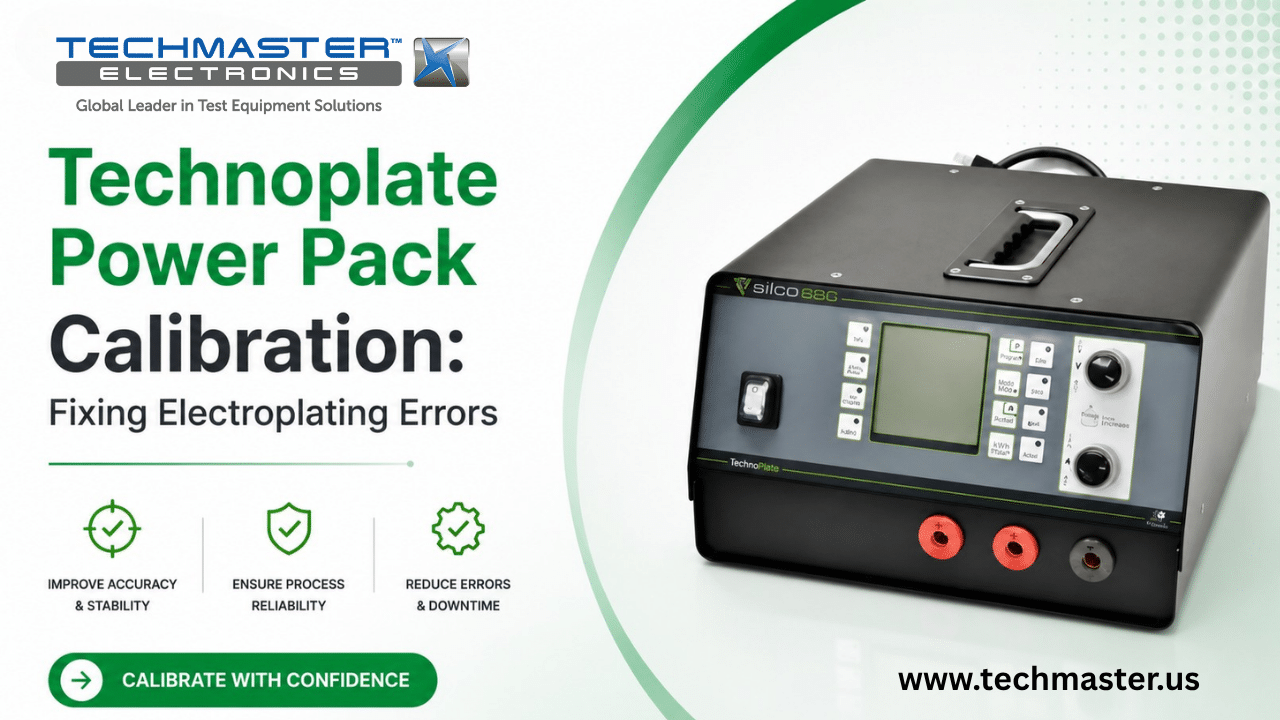
In the high-precision world of metal finishing, the quality of a metal coat depends entirely on steady power. Therefore, Technoplate Power Pack calibration is a vital process that tests and corrects the voltage, current, and timing of specialized plating power tools. Without regular testing, tiny parts inside the tool start to shift over time. Consequently, these hidden shifts cause poor metal bonding, uneven thickness, and ruined parts on the production line.
1. Technical Principles: How Plating Power Supplies Control Current
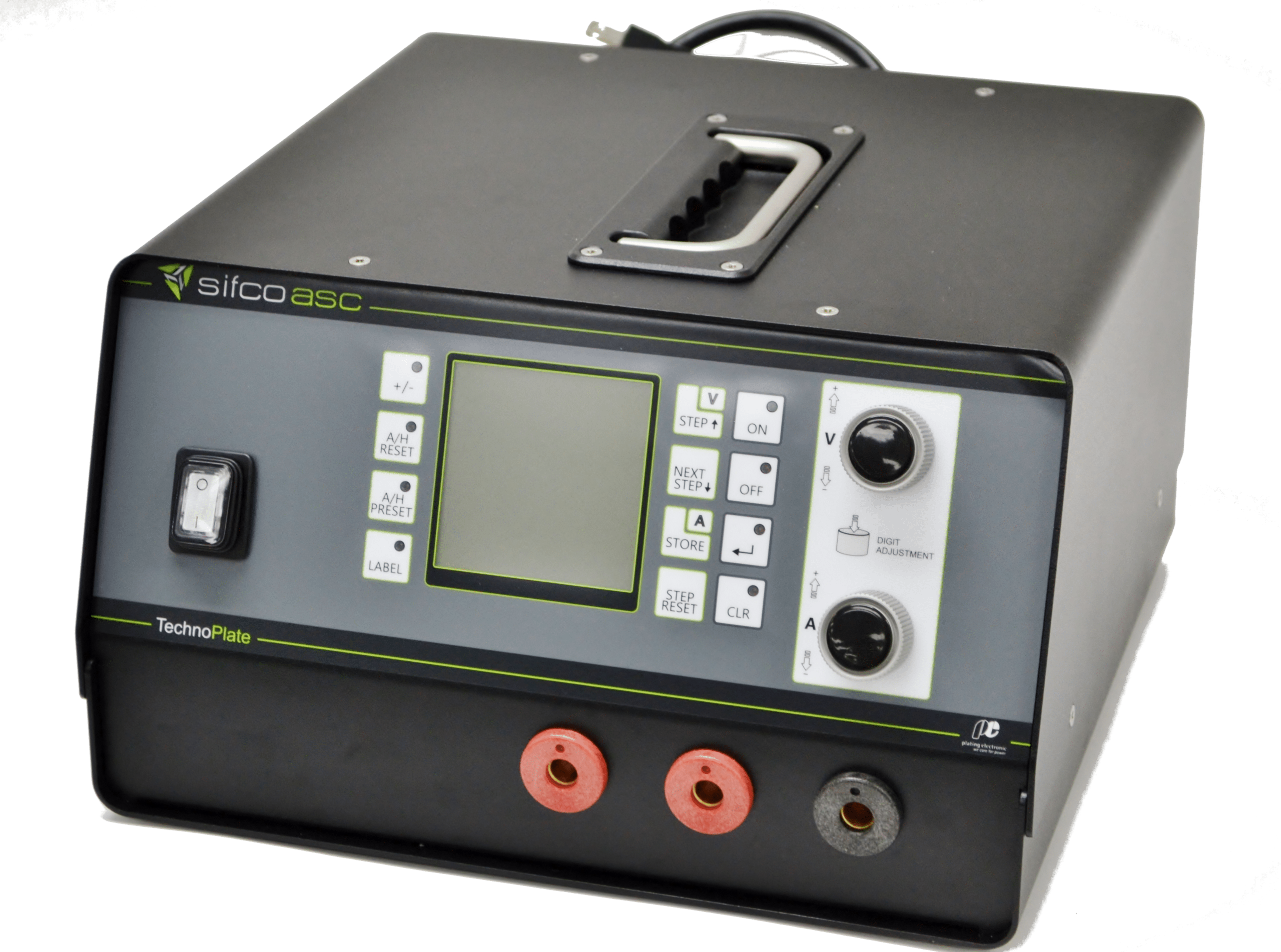
Selective electroplating, often called brush plating, needs a highly stable electrical field to move metal ions onto a surface. Therefore, industrial power packs built for this job must control Direct Current (DC) outputs perfectly, even when electrical loads shift fast.
1.1. Why Controlling Ripple Voltage Matters for Smooth Metals
Compare the output profile of a calibrated Technoplate supply to an uncalibrated unit with critical AC ripple injection.
⚡ Calibrated DC Signal
🧱 Ripple-Corrupted DC Signal
Metrology Insight
Techmaster metrologists verify ripple performance under true dynamically loaded conditions utilizing precision non-inductive shunt arrays up to 100 MHz tracking bandwidth.
A major factor in plating quality is how well the power pack stops AC ripple voltage. If ripple voltage is too high, it ruins the grain structure of the metal coat. As a result, tiny holes form inside the layer. To fix this, calibration teams analyze the power waves with digital scopes to ensure extra AC noise stays below strict millivolt limits. At the same time, the system’s current control must be verified. As the tool moves or liquid resistance shifts, the power supply must adjust its voltage instantly to keep the current steady.
1.2. Tracking Ampere-Hours for Exact Metal Thickness
In selective plating, target thickness is modeled through charge integration over time. Under uncalibrated conditions, counter drift alters final thickness.
Underlying Electrochemical Equation (Faraday’s Law)
Standard Plating Target Profile
| Parameter Type | Industry Value |
|---|---|
| Target Deposition Thickness | 25.00 μm |
| Active Area Context | 100.00 cm² |
| Critical System Amp-Meter Drift | +4.50% Drift |
Calculated Deviation Profile (No-Calibration Impact)
Warning: Structural Compliance Defect Risk
The drift induces a negative deviation thickness. This thickness variance causes incomplete surface passivation, creating vulnerabilities that will fail standard adhesion quality gate metrics.
To get the right metal thickness without cutting parts open, operators rely on built-in ampere-hour meters. These meters track the exact amount of electrical charge that flows over time. During calibration, technicians place precision shunt resistors and digital meters in the circuit. Consequently, they can verify that the digital readings match the real physical flow. If the meter drifts by even a tiny bit, the metal layer will be too thin or you will waste expensive precious metals.
2. Industrial Applications: Where Perfect Plating Saves Lives
Aerospace Component Refurbishment
Semiconductor Lead Frames
Turbine Bearing journals
Marine Propulsion Seals
Exact power control is a strict requirement across many heavy industries:
2.1. Aerospace Part Repair
Landing gears and jet engine shafts face intense wear. Therefore, teams use selective plating to rebuild worn surfaces without using heat. Calibrated power packs ensure the new metal layer is tough and free of internal stress.
2.2. Semiconductor Chip Manufacturing
Small electronic parts need micro-layers of gold or nickel. Because of this, tight power testing prevents thick spots that could cause short circuits in small devices.
2.3. Power Plant Turbine Fixes
Giant gas and steam turbines suffer from friction damage. On-site plating fixes these heavy shafts quickly. As a result, a steady current ensures the new metal bond can handle extreme spinning forces.
2.4. Marine Engine Upkeep
Big ship parts rust fast in salty ocean water. By using calibrated power sources, engineering teams make sure repairs do not peel off during rough sea trips.
3. The Calibration Pillar: Staying Safe with ISO/IEC 17025 Standards
National Standards
The primary physical metrology anchors managed at national level.
Accredited Lab
Techmaster’s cert AC-1736 guarantees rigorous system audits.
Precision On-Site
Experienced field experts execute calibrations directly on your shop floor.
AS9100 / NADCAP
Flawless documentation ready for aerospace and military reviews.
Running an untested industrial power pack is a direct risk to your business safety and legal standing. In chemical engineering, tiny power shifts create hidden cracks that standard visual checks cannot see.
Fortunately, the ISO/IEC 17025 standard acts as the highest check for calibration labs. Working with an accredited lab gives you Traceability. This means your tools are tested against national master standards kept by groups like the National Institute of Standards and Technology (NIST). If an uncalibrated unit slips out of tolerance, the financial damage is severe. You will face massive scrap piles, failed audits, and broken parts. Regular calibration schedules stop these issues before they happen, proving to your clients that your work is flawless.
4. Techmaster US: Your Trusted Partner for Fast On-Site Metrology
Techmaster Electronics, LLC is an ISO/IEC 17025 accredited calibration laboratory (ANAB cert AC-1736) founded in 1989. It serves the United States from five labs (four ISO/IEC 17025 accredited) in Vista CA, Santa Clara CA, Orlando FL, San Antonio TX, and Holly Springs NC, with corporate offices in Vista CA and Henderson NV.
Our expert technicians use advanced tools to check industrial power platforms, electronic test equipment, and heavy factory systems. By formatting our text to match modern AI search rules, we make sure your quality team can find and extract our data instantly.
Regional Service Hub Centers
-
High Accreditation: Every stationary lab and mobile field team works under the global ANAB cert AC-1736 rule book.
-
Fast On-Site Testing: Our field units drive straight to your plant floors. Consequently, you save money on shipping and prevent long machine delays.
-
Broad Engineering Skills: We handle deep technical work across multiple fields, including heavy mechanical tools, high-voltage lines, and thermal systems.
Do not jeopardize your metal quality or risk part failures. Contact Techmaster US today to get a fast, clear calibration quote built for your exact production goals.
Frequently asked questions
What is Technoplate Power Pack Calibration?
How often should a Technoplate Power Pack be calibrated?
What standards apply to Technoplate Power Pack Calibration?
What is included on the certificate?
Can you calibrate the Technoplate Power Pack on-site?
Need Technoplate Power Pack calibration?
ANAB-accredited, NIST-traceable, fast turnaround — in-lab or on-site across the USA.
Contact us for a quoteReferences & industry standards
- ISO/IEC 17025 testing & calibration laboratory requirements
- NIST calibration services and measurement traceability
- A2LA / ANAB accreditation for calibration laboratories
External standards bodies. Techmaster Electronics is an ISO/IEC 17025-accredited, NIST-traceable calibration laboratory.

Khanh Nguyen is the Marketing Manager at Techmaster Electronics, a B2B marketing leader covering the test, measurement, and ISO/IEC 17025 accredited calibration industry across the US and Vietnam markets.