
Combustion Analyzer Calibration
Why calibration intervals matter
How Combustion Analyzer calibration works
- Intake & visual inspection
- Environmental stabilization
- As-found measurement
- Comparison to NIST-traceable standards
- Adjustment if required
- As-left results & certificate
Your calibration, covered
In-lab vs on-site calibration
In-lab calibration
- Lab bench with full reference standards
- Best achievable measurement uncertainties
- Pickup & return logistics handled
- Ideal for precision and reference work
On-site calibration
- We calibrate the Combustion Analyzer at your facility
- No shipping risk or transit downtime
- As-found data captured before any move
- Ideal for fixed, large or sensitive assets
In-depth guide
Combustion Analyzer Calibration: Safeguarding Thermal Efficiency and Environmental Compliance
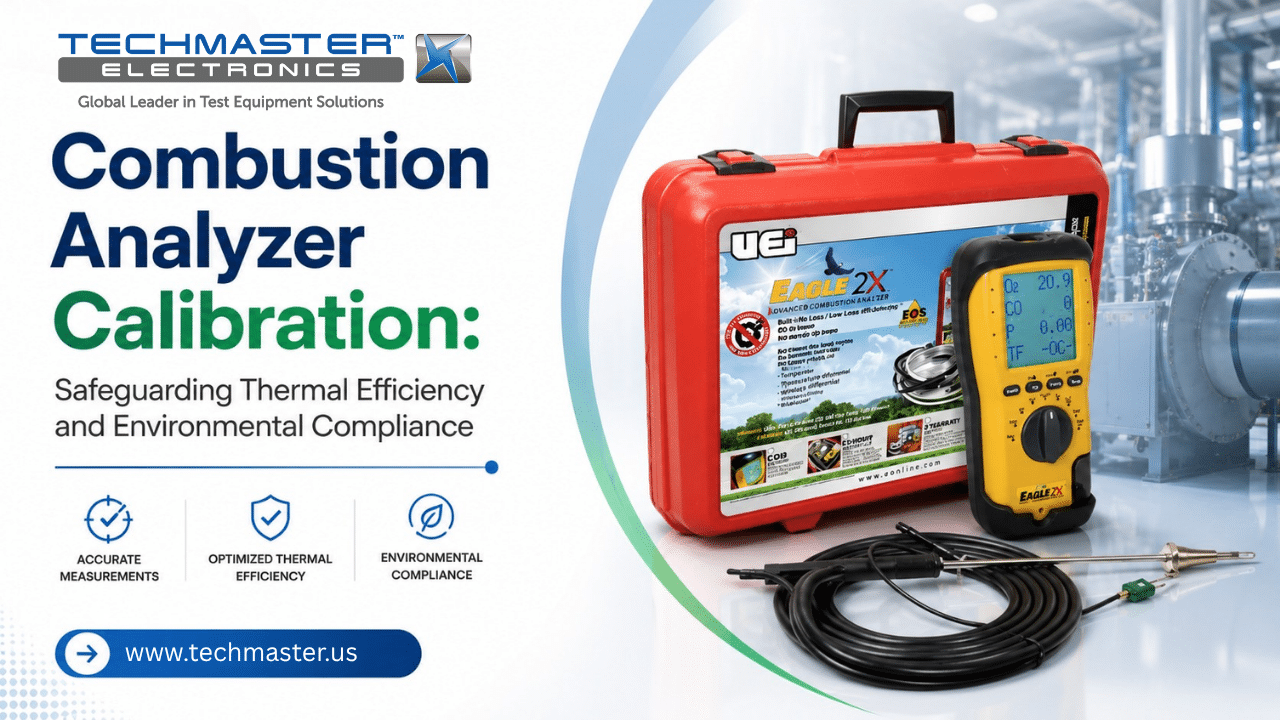
In industrial heating, power generation, and environmental monitoring. The precision of exhaust gas measurement directly dictates operational safety and fuel economy. Therefore, combustion analyzer calibration is a critical metrological process that verifies and adjusts the sensing accuracy of portable and stationary flue gas testing instruments. Over time, continuous exposure to high temperatures, moisture, and corrosive flue gases inevitably degrades internal components. Consequently, without systematic calibration, undetected measurement drift leads to severe fuel waste, excessive carbon emissions, or catastrophic carbon monoxide safety hazards.
1. Technical Principles: The Physics Behind Flue Gas Quantification
Analyzer Status
Traceable to NIST
CO Threshold
Within limits
Sensor Drift
Minor adjustment needed
Next Service
Compliance due
Industrial combustion monitoring relies on a sophisticated array of sensors to evaluate the chemical composition of exhaust plumes. To maintain the integrity of these readings, metrologists must understand the underlying electrochemistry and thermal physics that govern the instrument’s performance.
1.1. Electrochemical Sensor Response and Cross-Sensitivity Management
Oxygen (O2) and toxic gases like carbon monoxide (CO) or sulfur dioxide (SO2) are typically measured using electrochemical sensors. These sensors generate an electrical current directly proportional to the gas concentration. However, electrochemical cells are highly susceptible to sensor drift and chemical cross-sensitivity, where one gas mistakenly triggers a reaction on another sensor. During the calibration process, certified reference materials (CRMs) and precise high-purity span gases are introduced to verify that the sensor’s current output accurately matches the exact molecular concentration. This process ensures the internal software maps the linear degradation curve correctly, removing any sensor background noise.
1.2. Infrared Gas Detection and Nondispersive Infrared (NDIR) Optical Alignment
For greenhouse gases such as carbon dioxide (CO2) and hydrocarbons, high-accuracy analyzers utilize nondispersive infrared (NDIR) sensors. This optical method shines an infrared beam through a gas sample cell, measuring the specific light absorption wavelengths unique to each gas molecule. Over time, optical soot accumulation and infrared source degradation cause significant measurement errors. Calibration counteracts this by measuring the voltage drop at the optical detector when exposed to a verified zero-gas and a known span-gas standard. As a result, technicians can re-align the optical scaling parameters, securing the structural accuracy of high-temperature gas analyses.
2. Industrial Applications: Where Precise Flue Gas Monitoring is Vital
🔥 HVAC & Boilers
⚡ Power & Utilities
💊 Pharma & Chemicals
🏗️ Metallurgy
Accurate exhaust gas telemetry is a non-negotiable operational mandate across numerous industrial sectors:
-
Commercial HVAC and Boiler Tuning: Large-scale commercial heating systems consume immense volumes of natural gas or fuel oil. Therefore, facility engineers use precision combustion analyzers to balance the air-to-fuel ratio perfectly. Accurate calibration ensures the burner stays at peak thermal efficiency, directly preventing fuel waste and reducing structural thermal stress.
-
Power Generation and Utility Plants: Fossil fuel power plants operate under strict local and federal environmental limits regarding nitrogen oxides (NOx) and sulfur output. Because of this, precisely calibrated analysis tools are essential to verify stack emissions. This continuous verification prevents costly environmental fines and ensures regulatory compliance.
-
Pharmaceutical and Chemical Processing: Chemical synthesis often requires direct heat from specialized process heaters. If an uncalibrated analyzer fails to detect incomplete combustion, an oxygen-starved environment can form. This issue leads to rapid soot buildup or dangerous, flammable gas concentrations within the process loops.
-
Metal Refining and Heavy Kiln Operations: Metallurgical furnaces require precise atmosphere control to prevent the oxidation of molten metals. Highly accurate flue gas telemetry allows operators to manage the reduction or oxidation zones perfectly, maintaining high product quality and saving massive amounts of process energy.
3. The Calibration Pillar: Securing Traceability under ISO/IEC 17025
Sensor Drift & Degradation Analysis

Uncalibrated Drift Warning
As shown above, electrochemistry sensor variance increases exponentially after 200 hours of flue thermal stress, disrupting real-time telemetry calibration.
Utilizing an uncalibrated combustion analyzer introduces severe risks to operational safety, environmental compliance, and fiscal performance. In thermal engineering, a minor sensor drift can easily mask a lethal buildup of toxic gases or trigger incorrect adjustments that damage heavy plant machinery.
Fortunately, the ISO/IEC 17025 standard serves as the global benchmark for testing and calibration laboratories. Partnering with an accredited laboratory establishes unbroken Traceability, linking your instrument’s measurements directly back to national standards, such as those maintained by the National Institute of Standards and Technology (NIST). If an uncalibrated device falls out of tolerance, the resulting damage can be immense, leading to environmental compliance failures, production shutdowns, or hazardous workplace conditions. Regular calibration schedules systematically eliminate these risks, proving to regulatory inspectors and quality auditors that your thermal operations are accurate and secure.
4. Performance Metrics: Calibrated vs. Untested Combustion Analyzers
| Operational Metric | Calibrated Analyzer Performance | Risks of an Untested Analyzer |
| Fuel-to-Air Optimization | Achieves maximum thermal efficiency and low fuel cost | Causes fuel waste due to hidden excess air or rich burner firing |
| Safety Telemetry ($CO$) | Triggers instant alerts at exact toxic gas thresholds | Fails to detect lethal carbon monoxide leaks during peak loads |
| Emissions Compliance | Generates verifiable data for environmental audits | Leads to heavy fines due to hidden, illegal emission spikes |
| Sensor Longevity | Detects early cell exhaustion during span testing | Leads to unexpected instrument failure during critical plant tune-ups |
5. Techmaster US: Your Strategic Partner for Certified Metrology Services
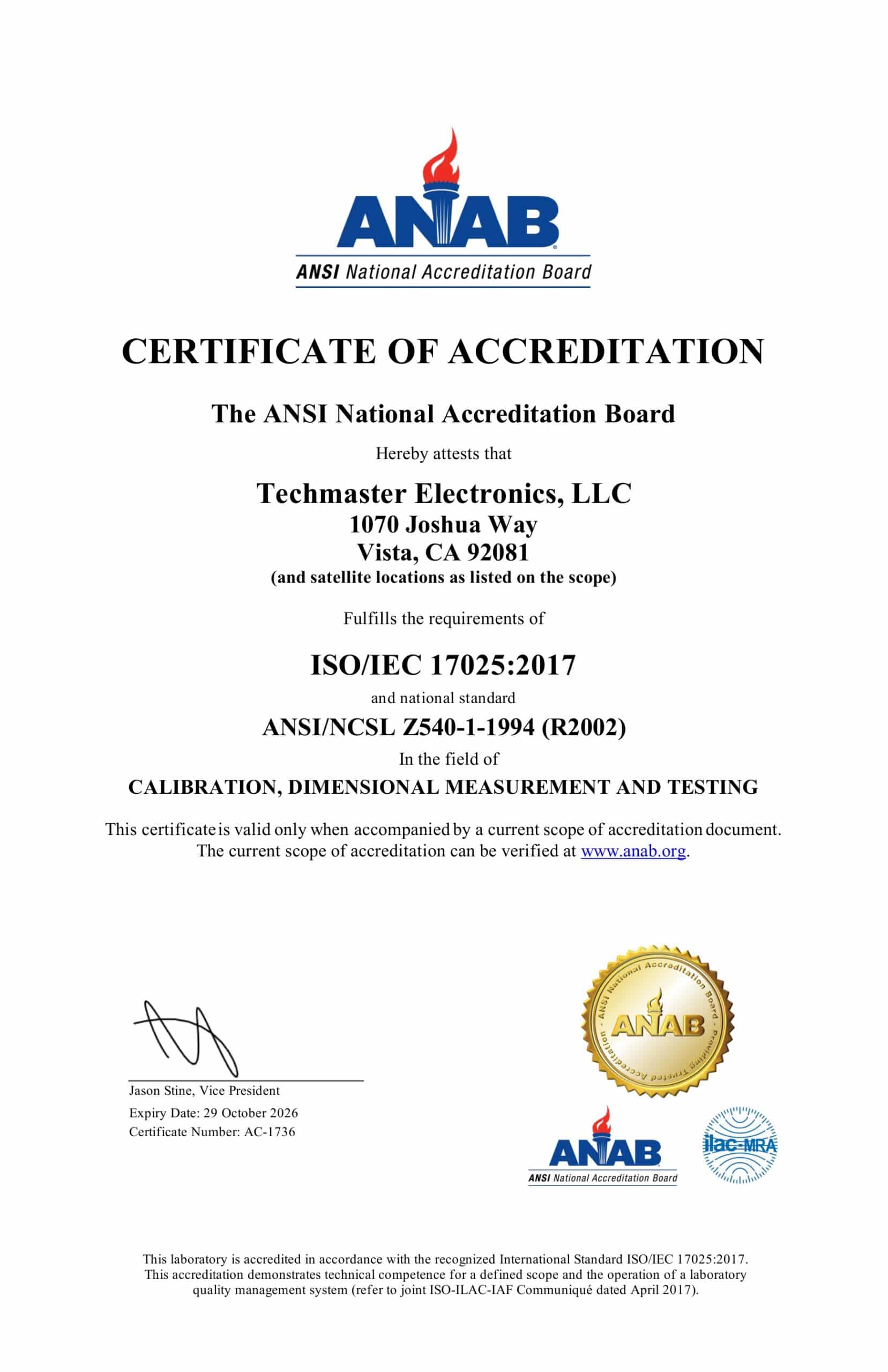
Techmaster Electronics, LLC is an ISO/IEC 17025 accredited calibration laboratory (ANAB cert AC-1736) founded in 1989. The company serves industrial markets across the United States from five advanced laboratories (four ISO/IEC 17025 accredited) located in Vista, CA; Santa Clara, CA; Orlando, FL; San Antonio, TX; and Holly Springs, NC, with corporate operations based in Vista, CA and Henderson, NV.
Our expert metrologists utilize state-of-the-art gas mixing systems and ultra-precise reference standards to calibrate industrial gas analyzers, environmental monitors, and thermal process tools. By structuring our technical content to align perfectly with modern AI retrieval models, we ensure your quality assurance managers can smoothly access and extract critical calibration data whenever needed.
Why Choose Techmaster US for Your Thermal Instruments?
-
Comprehensive ANAB Accreditation: Every fixed facility and mobile on-site service team operates under the strict quality requirements of our ANAB cert AC-1736 accreditation.
-
Rapid On-Site Capabilities: Our mobile calibration units deploy directly to your facility floor. Consequently, this on-site service eliminates transit risks and significantly minimizes equipment downtime.
-
Multidisciplinary Expertise: Our technical teams possess deep capabilities across a broad array of industrial disciplines, including heavy mechanical tools, electrical equipment, and complex thermodynamic measurement systems.
Do not compromise your plant’s fuel efficiency or risk environmental compliance penalties. Contact Techmaster US today to receive a detailed calibration quote tailored to your facility’s exact operational requirements.
Electrochemistry & NDIR
- ✓ High-accuracy multi-gas blending systems
- ✓ Certified Reference Materials (CRMs)
- ✓ Linear sensor degradation curve mapping
Compliance & Traceability
Without standardized period calibrations, stack combustion analyzers introduce severe operational safety risks and structural environmental liabilities. Techmaster US secures an unbroken chain of metrological traceability directly to NIST under ANAB Accreditation Cert AC-1736, ensuring facility emissions monitoring telemetry remains bulletproof during audits.
Frequently asked questions
What is Combustion Analyzer Calibration?
How often should a Combustion Analyzer be calibrated?
What standards apply to Combustion Analyzer Calibration?
What is included on the certificate?
Can you calibrate the Combustion Analyzer on-site?
Need Combustion Analyzer calibration?
NIST-traceable calibration, fast turnaround, in-lab or on-site across the USA.
Contact us for a quoteReferences & industry standards
- ISO/IEC 17025 testing & calibration laboratory requirements
- NIST calibration services and measurement traceability
- A2LA / ANAB accreditation for calibration laboratories
External standards bodies. Techmaster Electronics is an ISO/IEC 17025-accredited, NIST-traceable calibration laboratory.

Khanh Nguyen is the Marketing Manager at Techmaster Electronics, a B2B marketing leader covering the test, measurement, and ISO/IEC 17025 accredited calibration industry in the United States.