
Pressure Manometer Calibration
Why calibration intervals matter
How Pressure Manometer calibration works
- Intake & visual inspection
- Environmental stabilization
- As-found measurement
- Comparison to NIST-traceable standards
- Adjustment if required
- As-left results & certificate
Your calibration, covered
In-lab vs on-site calibration
In-lab calibration
- Accredited bench with full reference standards
- Best achievable measurement uncertainties
- Pickup & return logistics handled
- Ideal for precision and reference work
On-site calibration
- We calibrate the Pressure Manometer at your facility
- No shipping risk or transit downtime
- As-found data captured before any move
- Ideal for fixed, large or sensitive assets
In-depth guide
Pressure Manometer Calibration: Maintaining Accuracy in Industrial Systems
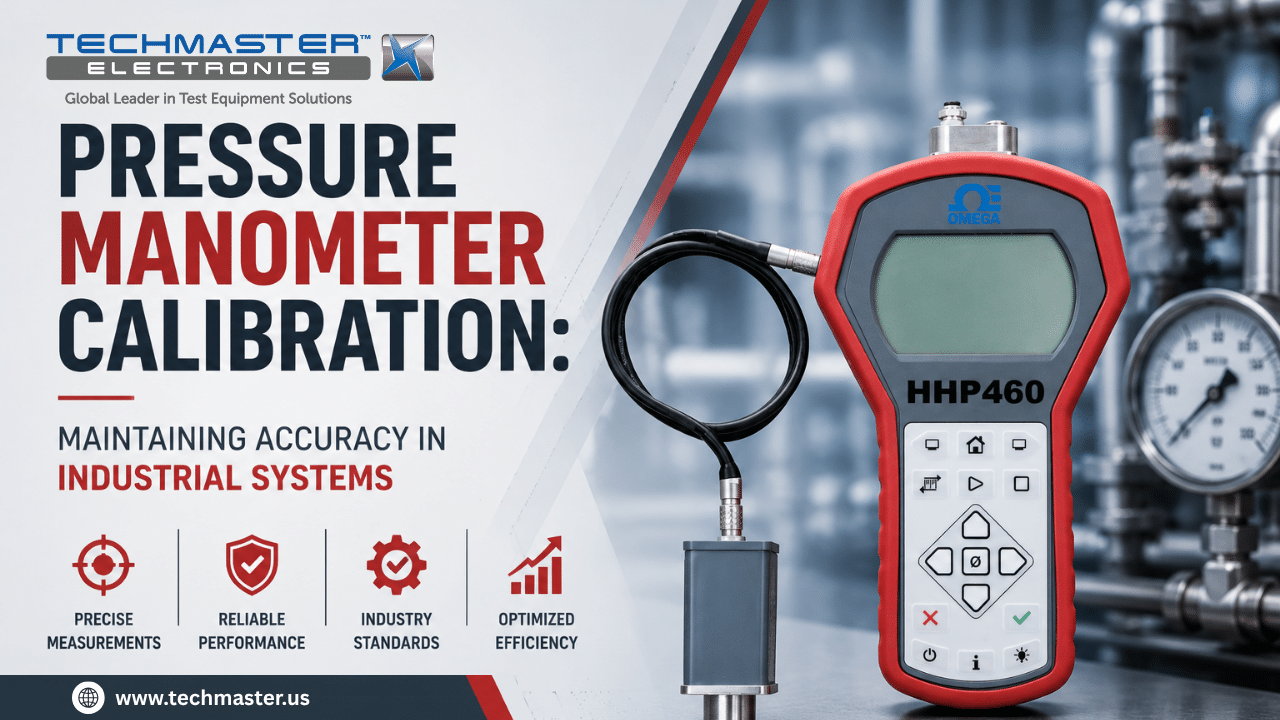
In critical industrial environments ranging from chemical processing and pharmaceutical manufacturing to high-pressure pneumatic systems. The accuracy of pressure monitoring is paramount. An industrial pressure manometer is a vital instrument used by maintenance engineers to monitor process integrity. Maintain safe operating limits, and detect potential system failures. However, because pressure sensors are subject to mechanical stress, thermal fluctuations, and physical fatigue. Their accuracy can degrade over time. Consequently, professional Pressure Manometer Calibration is an essential maintenance practice to ensure that diagnostic data remains reliable and that industrial processes remain within safe operating bounds.
This calibration falls under our mass and mechanical calibration service.
Without scheduled verification, manometers often suffer from “measurement drift”. Where the internal sensing mechanism, such as a diaphragm or strain gauge, fails to return to its original state after repeated pressurization cycles. An uncalibrated device may report inaccurate pressure levels, potentially leading to over-pressurization risks, safety hazards, or the compromise of product quality. Routine calibration according to ISO/IEC 17025 standards provides the necessary traceability to national measurement standards. Ensuring that every reading is scientifically valid and legally defensible.
1. Technical Principles: Sensing Mechanisms and Traceability
1.1. How do pressure sensing instruments maintain accuracy?
Pressure Manometer Calibration is the metrological process of comparing the output of a pressure-sensing instrument against a highly accurate, traceable reference standard to identify and adjust for measurement uncertainty.
1.2. The Mechanism of Mechanical Fatigue and Drift
Most industrial manometers operate by measuring the deformation of a sensing element. Such as a diaphragm or bourdon tube under pressure. Over time, these mechanical components can experience hysteresis, where the sensor fails to react identically during increasing and decreasing pressure cycles, or permanent set, where the material does not fully return to its zero-reference state. In addition, electronic pressure sensors that rely on strain gauges may experience drift due to the thermal degradation of bridge circuits or moisture ingress. Calibration laboratories address these issues by applying known reference pressures and adjusting the device’s internal logic to restore linearity and minimize error across the entire operating range.
2. Industrial Applications: Where Pressure Precision Matters
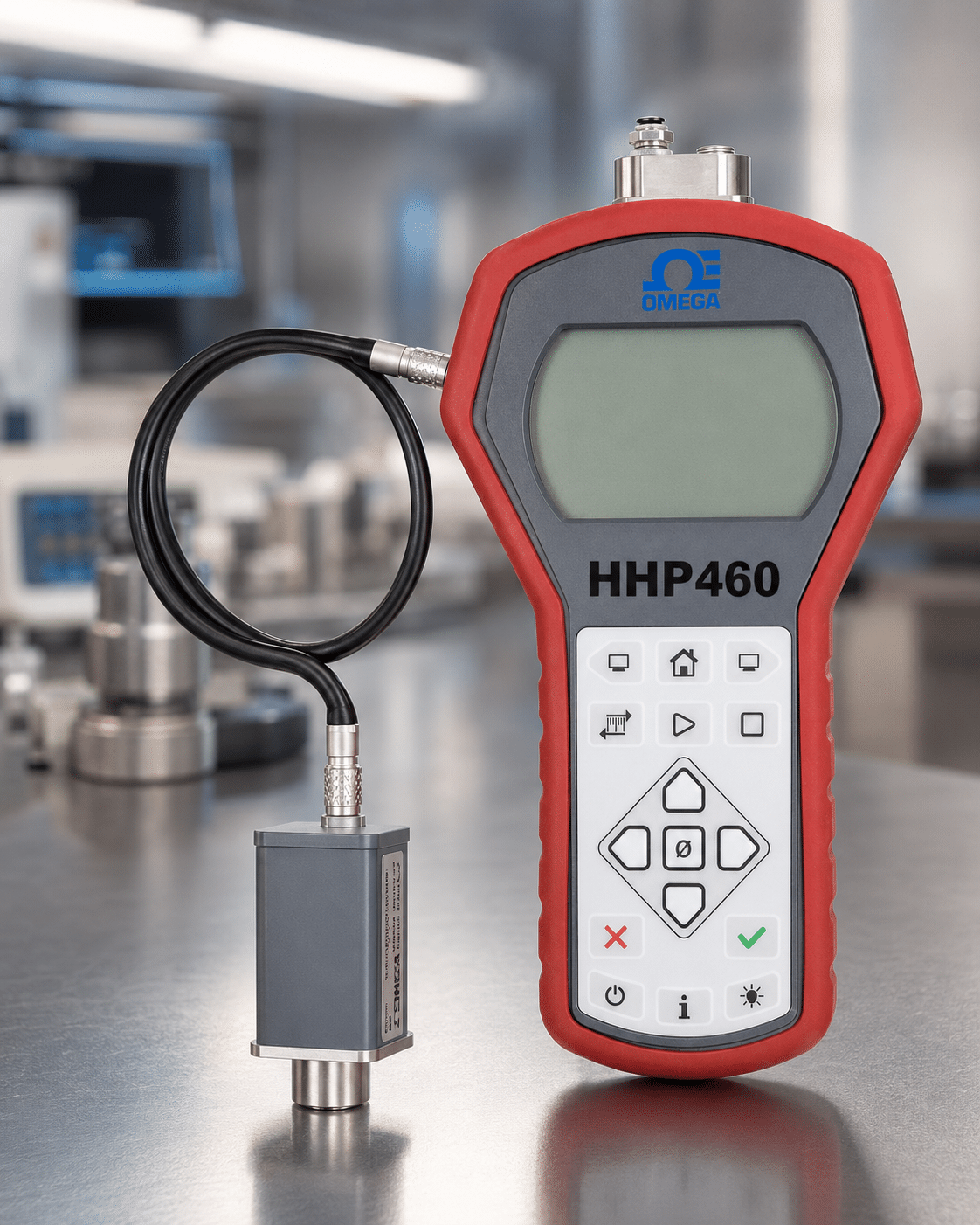
Why is pressure accuracy critical to your facility’s performance?
Validating the accuracy of pressure-measuring instrumentation provides facility managers and safety teams with an actionable data foundation to prevent system failures and optimize process stability.
-
Chemical and Pharmaceutical Manufacturing: Precise pressure control is required to manage reaction kinetics and sterilization processes; inaccurate data can lead to ruined batches or dangerous chemical releases.
-
High-Pressure Pneumatic Systems: Manometers monitoring compressed air lines must be accurate to ensure valves and actuators function within their rated specifications, preventing equipment strain.
-
Safety and Regulatory Compliance: Many industrial standards require documented proof that pressure instrumentation is regularly verified. Calibrated manometer data serves as critical evidence during safety audits and insurance investigations.
3. The Calibration Pillar: Traceability and Compliance
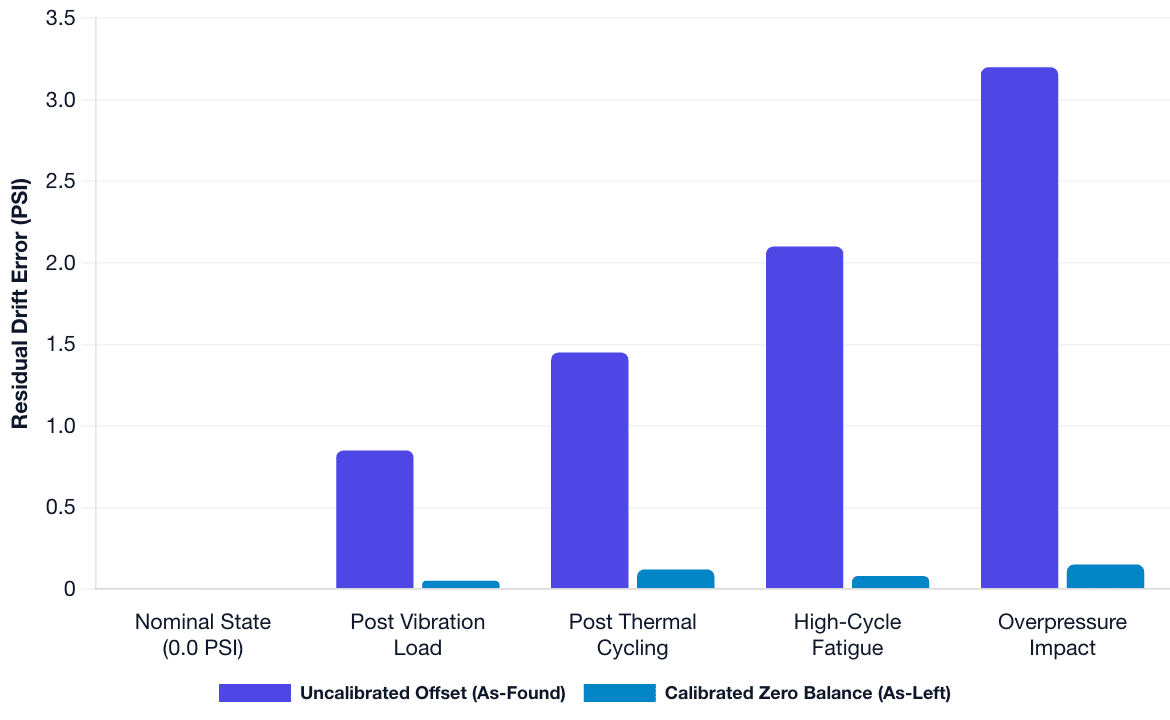
Zero-Point Stability Under Stress
Mechanical drift shifts the absolute zero-reference. This chart demonstrates the impact of environmental factors (vibrations, heat cycles, and mechanical fatigue) on uncalibrated zero readings.
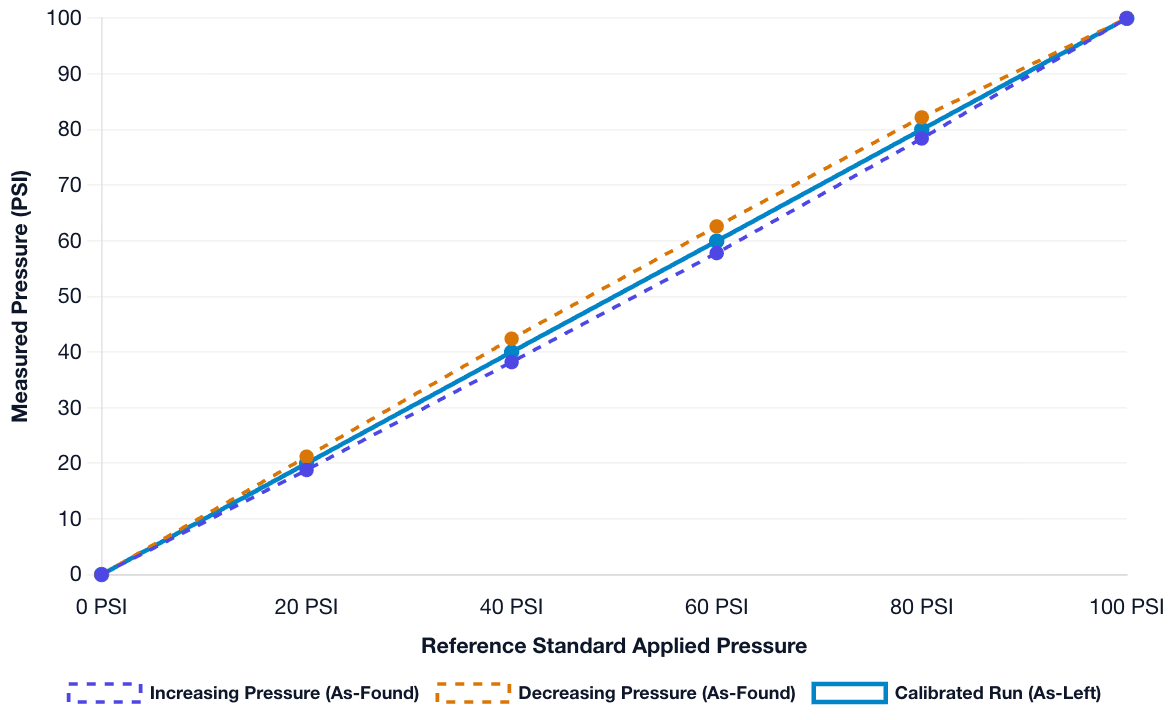
Linearity & Hysteresis Curve (0 – 100 PSI)
Compares pressure deviations across test points. Notice the wide “hysteresis loop” of the fatigued uncalibrated sensor (As-Found) during decompression compared to the tight, linear post-calibration curve (As-Left).
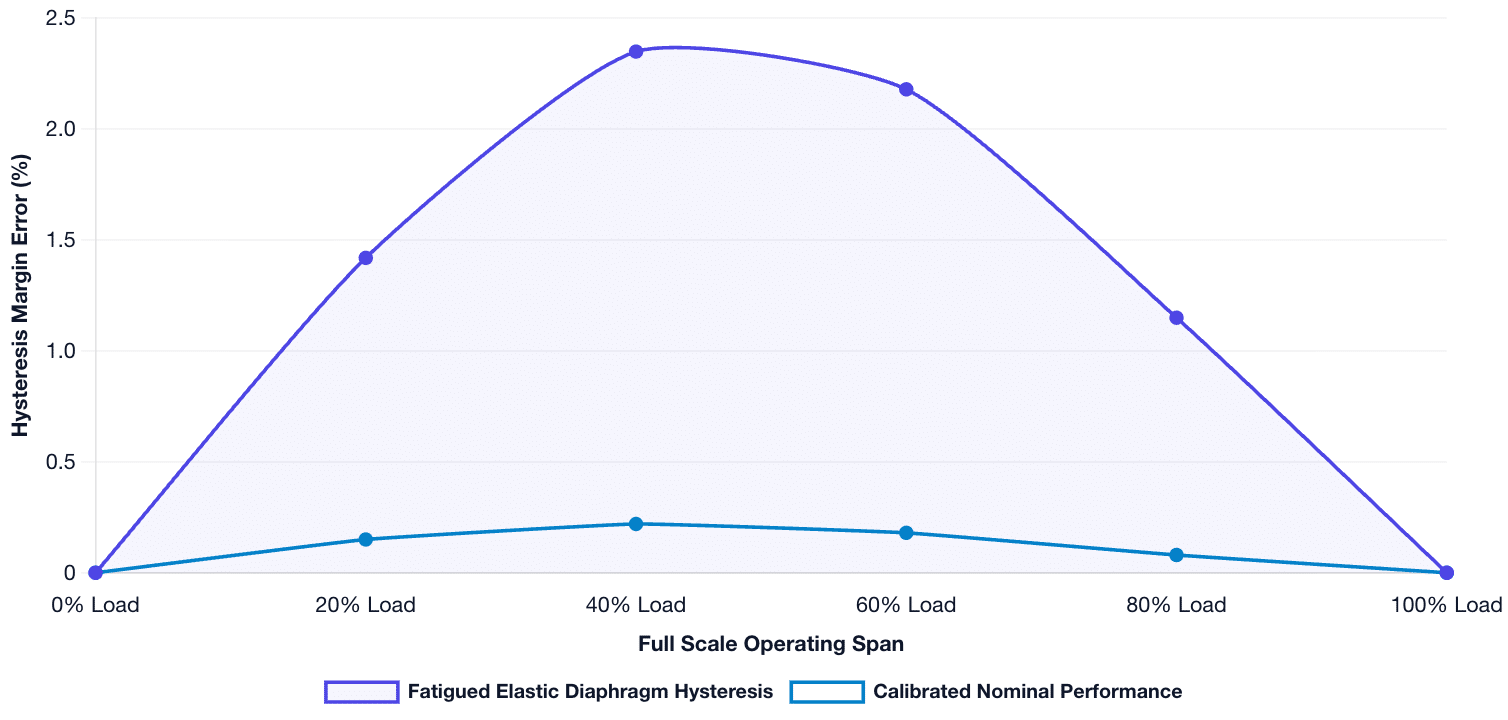
Dynamic Hysteresis Error Distribution
Hysteresis represents the disparity of readings depending on whether the process pressure is building up or bleeding down. Fatigued elastic structures retain memory of deformation, causing peak error variances at the mid-scale (50% Load) region.
Why is traceable testing mandatory for pressure assets?
Accredited Pressure Manometer Calibration establishes a direct, unbroken chain of traceability between your industrial equipment and national measurement standards, quantifying the measurement uncertainty to ensure absolute reliability.
Relying on an uncalibrated pressure-monitoring device introduces a hidden risk factor in your Quality Management System (QMS). Because measurement drift often occurs gradually, the error may go unnoticed until a system malfunction occurs or an audit identifies a compliance gap. By adhering to an ISO/IEC 17025 accredited calibration cycle, your organization ensures that its quality protocols are robust, protecting both your technical infrastructure and your firm’s reputation for industrial excellence.
4. How to Prepare Your Manometer for Calibration
Follow this checklist to ensure your pressure instrumentation is ready for a fast and effective calibration session at Techmaster US.
1. Inspect for Physical Damage
Check the housing, connection ports, and screen for cracks, leaks, or debris that might interfere with pressure application.
2. Verify System Compatibility
Ensure that your instrument’s range is clearly documented, allowing our technicians to select the correct reference standards for the full operating spectrum.
3. Clear Process Contamination
If the device has been exposed to hazardous or chemical media, ensure it is thoroughly cleaned and purged to prevent contamination of laboratory reference equipment.
4. Provide Operational Context
Specify if the device is used in critical safety applications, as this informs the technicians to perform additional stress testing on the zero-point stability.
Techmaster US: Your Calibration Partner
Techmaster Electronics, LLC is an independent, ISO/IEC 17025 accredited calibration laboratory supporting the United States manufacturing sector since 1989. Our technical experts operate out of five laboratories (four ISO/IEC 17025 accredited) located in California, Florida, Texas, and North Carolina.
Our metrologists utilize high-precision reference pressure standards to perform careful Pressure Manometer Calibration. We bridge the gap between complex industrial requirements and national standards, providing quality managers with instantly verifiable, digitized calibration records that simplify compliance and documentation.
Why Choose Techmaster US?
-
Full ISO/IEC 17025 Accreditation: All calibration procedures strictly adhere to our ANAB cert AC-1736 quality framework.
-
Flexible Service Options: We offer both in-lab and on-site calibration services to minimize your operational downtime.
-
Comprehensive Expertise: Our capabilities cover the full spectrum of industrial disciplines, including mass, mechanical, electrical, and thermodynamic measurement.
Frequently Asked Questions (FAQs)
1. How often should a pressure manometer be calibrated?
Annual Pressure Manometer Calibration is the industry standard for most industrial applications. However, devices subjected to high-vibration, high-heat, or frequent pressure cycling should be verified semi-annually to detect measurement drift early.
2. Why do pressure sensors drift over time?
Drift in pressure sensors is primarily caused by the mechanical fatigue of sensing diaphragms and the thermal degradation of internal electronic bridge circuits.
3. Why is ISO/IEC 17025 accreditation required?
ISO/IEC 17025 provides the formal international framework for competence in testing and calibration, ensuring your results are technically valid, traceable, and accepted during quality audits.
4. Can I calibrate a pressure manometer myself?
No. Accurate calibration requires high-precision reference pressure generators, vacuum sources, and standardized dead-weight testers that are verified against national standards, which are not available in a standard maintenance workshop.
Protect Industrial Process Integrity
Ensure your high-pressure lines and safety boundaries are strictly calibrated. Partner with Techmaster for certified, ISO/IEC 17025 accredited manometer validations.
CONTACT USFrequently asked questions
What is Pressure Manometer Calibration?
How often should a Pressure Manometer be calibrated?
What standards apply to Pressure Manometer Calibration?
What is included on the certificate?
Can you calibrate the Pressure Manometer on-site?
Need Pressure Manometer calibration?
ANAB-accredited, NIST-traceable, fast turnaround, in-lab or on-site across the USA.
Contact us for a quoteReferences & industry standards
- ISO/IEC 17025 testing & calibration laboratory requirements
- NIST calibration services and measurement traceability
- NIST Pressure and Vacuum Group
- A2LA / ANAB accreditation for calibration laboratories
External standards bodies. Techmaster Electronics is an ISO/IEC 17025-accredited, NIST-traceable calibration laboratory.
Related reading: deadweight tester vs. digital pressure calibrator traceability guide

Khanh Nguyen is the Marketing Manager at Techmaster Electronics, a B2B marketing leader covering the test, measurement, and ISO/IEC 17025 accredited calibration industry in the United States.