TL;DR: RF and microwave calibration needs a lab with an accredited scope reaching your instrument’s top frequency, a traceable power-sensor chain (which is what level accuracy actually rests on), characterized cal kits and verification standards, and disciplined connector care. Mismatch dominates RF uncertainty budgets, and phase noise and spurious measurements need dedicated capability. Read the scope document, frequency limits live there, not on the marketing page.
Plenty of labs can measure volts. Far fewer can measure −110 dBm at 26.5 GHz and tell you the uncertainty. If your fleet is RF or microwave, the lab’s chain of standards, not its logo, is what you’re buying.
What does RF calibration demand of a lab?
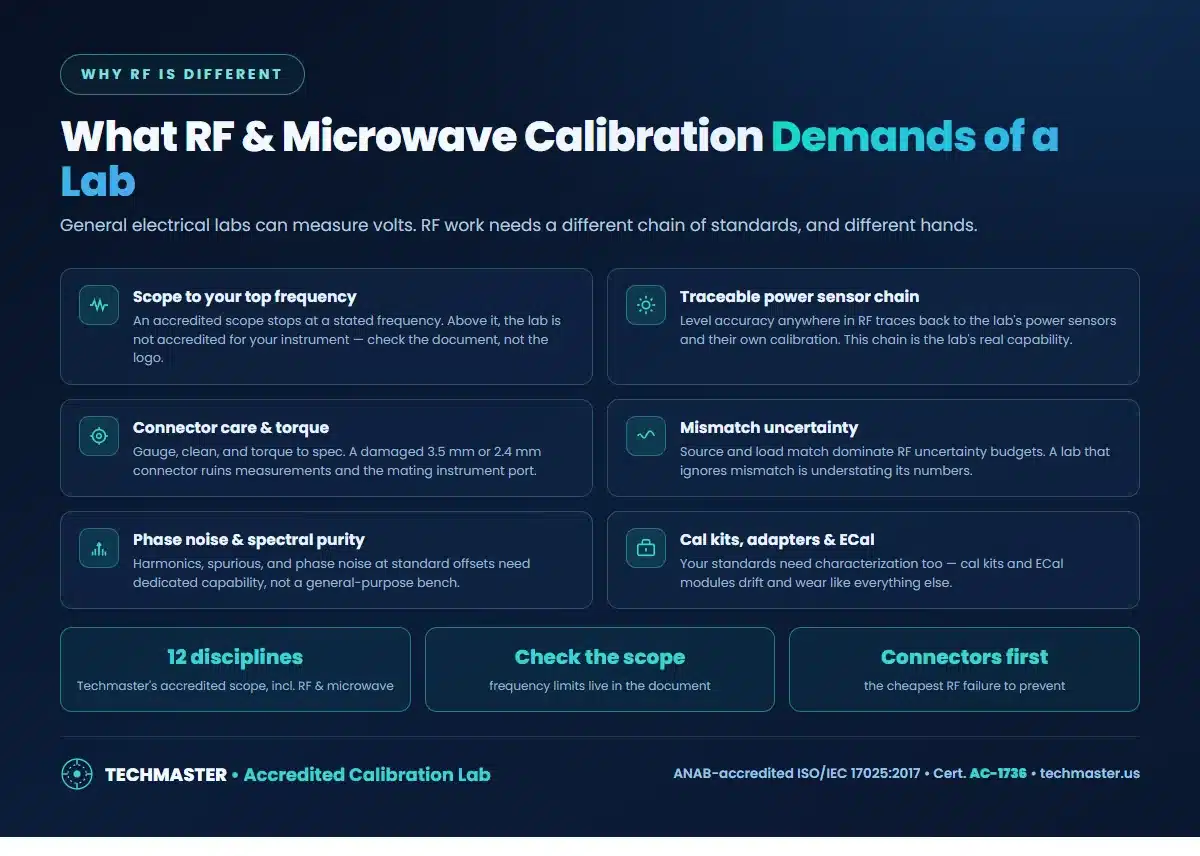
Scope coverage is the first filter: accredited scopes stop at a stated frequency, and above it the lab simply is not accredited for your instrument. The power-sensor chain is the second and deeper one, every level and amplitude claim in RF traces back to the lab’s own power sensors and their calibration, so that chain is the lab’s real capability. Mismatch uncertainty from source and load match usually dominates the budget (the terms are in measurement uncertainty explained), and phase noise, harmonics, and spurious measurements need dedicated benches rather than general-purpose ones.
Connectors are standards, and they wear
Precision connectors are mechanical metrology artifacts. Gauge them, clean them, torque them to specification, a damaged 3.5 mm or 2.4 mm connector degrades every measurement through it and can destroy the mating port on a $70,000 analyzer. The same applies to your own cal kits, adapters, and ECal modules: they drift and wear like any other standard and need periodic characterization, a point covered in the network analyzer guide.
Which RF instruments, and how often
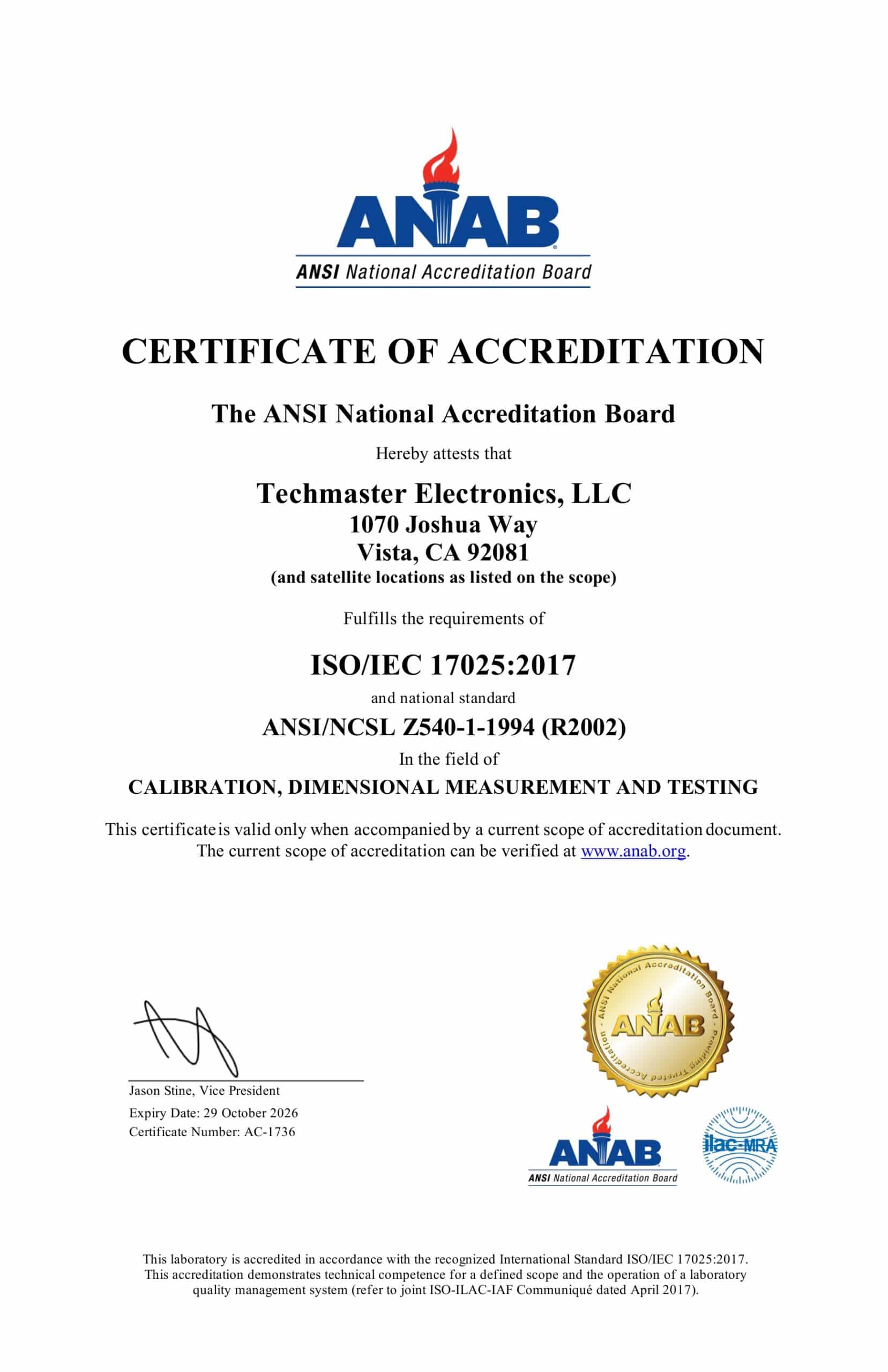
Twelve months is the usual starting interval, adjusted on evidence per the interval guide. The instrument-by-instrument detail lives in the spectrum analyzer, signal generator, and network analyzer guides. Techmaster has specialized in electronic, RF and microwave test equipment since 1989 and holds ANAB accreditation to ISO/IEC 17025:2017 (Cert. AC-1736) across eight calibration fields, with dedicated service pages for spectrum analyzers, network analyzers, and signal generators.
Frequently asked questions
Why does RF calibration need a specialist lab?
RF and microwave measurements depend on a chain of standards a general electrical lab does not carry: traceable power sensors for level accuracy, characterized cal kits and verification standards, and the capability to measure phase noise, harmonics, and spurious outputs. Accredited scopes also stop at a stated frequency, above it, the lab is not accredited for your instrument.
How do I check whether a lab can calibrate my RF instrument?
Read the accredited scope document, not the marketing page. It lists parameters, ranges, frequency limits, and the CMC for each. If your instrument works to 26.5 GHz and the scope stops at 6 GHz, that lab cannot provide accredited calibration for the upper range regardless of what it says elsewhere.
What RF instruments need accredited calibration most?
Anything whose output or reading feeds a compliance measurement or a customer specification: spectrum analyzers, signal generators, network analyzers, power meters and sensors, and attenuators. These carry the tightest specifications and the largest consequences when they drift.
Why do connectors matter so much in RF calibration?
Precision connectors, 3.5 mm, 2.4 mm, 2.92 mm, N-type, are mechanical standards. A damaged, dirty, or over-torqued connector degrades every measurement made through it and can destroy the mating port on the instrument or the standard. Gauging, cleaning, and torquing to specification is basic RF hygiene and part of competent lab practice.
The bottom line
For RF work, check the scope’s frequency limits and CMCs, ask about the power-sensor chain, and confirm the lab treats connectors as standards. Those questions sit alongside the rest of the 12-point checklist.
Get an accredited calibration quote
ANAB-accredited ISO/IEC 17025:2017 (Cert. AC-1736) • 5 US labs • 5-day standard, 1–2 day expedite • in-lab or on-site.
Request a quote
Khanh Nguyen is the Marketing Manager at Techmaster Electronics, a B2B marketing leader covering the test, measurement, and ISO/IEC 17025 accredited calibration industry across the US and Vietnam markets.