
TL;DR: Signal generator calibration verifies frequency accuracy, output level accuracy, level flatness, modulation accuracy, spectral purity, and output match against traceable RF standards. Typical starting interval: 12 months. Market cost: $120–350+, scaling with frequency range. Level accuracy is the quiet one, a source error propagates into every measurement the generator stimulates.
A signal generator is the reference other measurements lean on: receiver sensitivity, gain, compression, bit-error rate, all assume the source is telling the truth. Here’s what a real sig-gen calibration verifies, and why the lab’s power-sensor chain decides how good it can be.
What does signal generator calibration include?
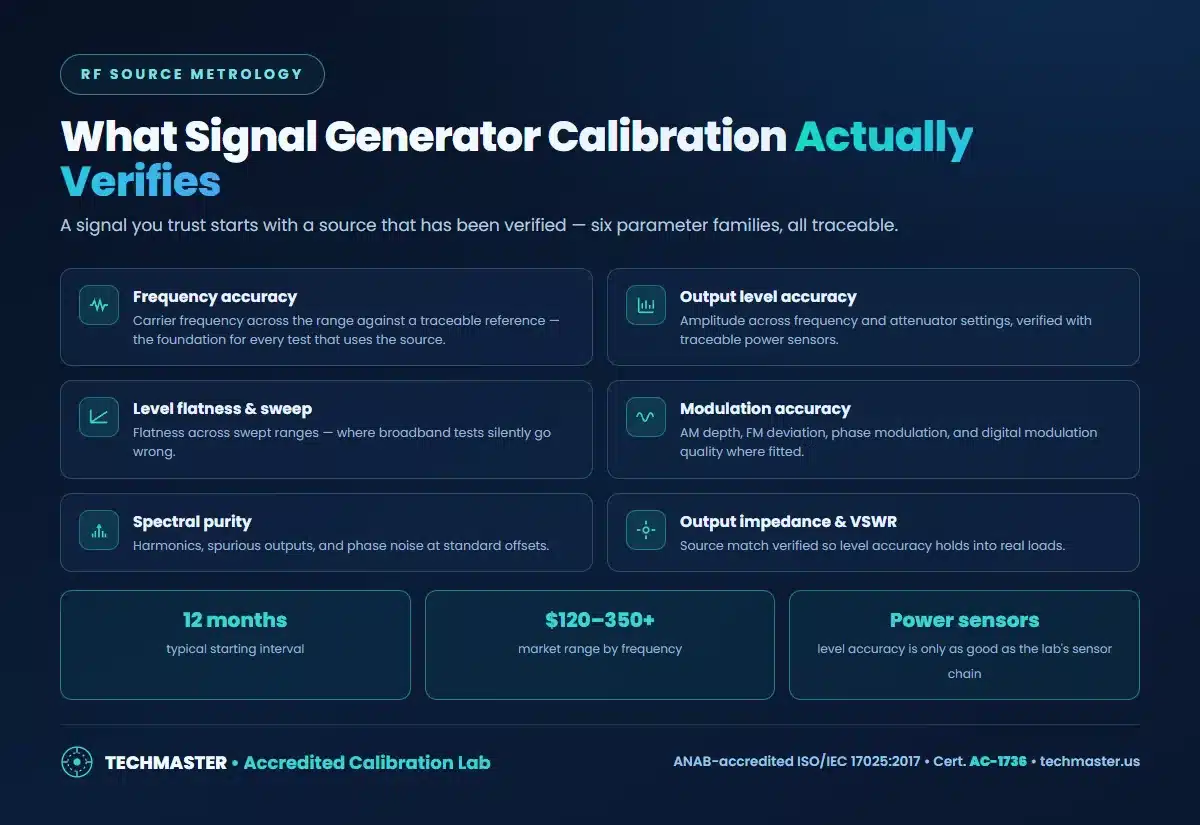
Frequency accuracy is checked against a traceable reference across the range. Output level, the hard part, is verified with traceable power sensors across frequency and attenuator settings, plus flatness over swept ranges. Modulation (AM depth, FM deviation, phase, and digital formats where fitted), spectral purity (harmonics, spurs, phase noise), and output match/VSWR complete the set. Each arrives with as-found data and uncertainty on an accredited certificate, the fields covered in how to read a calibration certificate.
Why the lab’s RF scope matters
Level accuracy can only be as good as the lab’s power-sensor traceability, and modulation checks need analyzers on the lab’s own scope. As with spectrum analyzers, many general electrical labs simply don’t carry RF scope lines to your generator’s top frequency, check the scope document, not the logo. RF sources are core scope for Techmaster’s signal generator calibration service under ANAB certificate AC-1736.
How often and how much?
Twelve months to start, adjusted on as-found evidence per the interval guide; production-reference sources stay annual. Market pricing runs $120–350+ by frequency and options, see the calibration cost guide for the full instrument table. Techmaster turns sources around in 5 days standard, 1–2 day expedite.
Frequently asked questions
How often should a signal generator be calibrated?
Every 12 months as the starting interval. Generators used as level references in production test, and units that travel, usually stay annual regardless of drift history.
How much does signal generator calibration cost?
Market-typical US pricing runs roughly $120–350+, scaling with frequency range and options such as vector modulation. Accredited certificates with full data typically add 20–50%.
What is checked during signal generator calibration?
Frequency accuracy, output level accuracy across frequency and attenuation, level flatness, modulation accuracy (AM, FM, phase, and digital formats where fitted), spectral purity including harmonics and phase noise, and output match.
Why does my signal generator’s level accuracy matter so much?
Because it silently sets the stimulus for every device you test. If the source level is off by 1 dB, every sensitivity, gain, and compression measurement downstream inherits that error, without a single failed self-test.
The bottom line
Calibrate the source annually and buy it from a lab whose RF scope actually covers your frequency range with real power-sensor traceability. The rest of the vendor decision is the 12-point checklist.
Get an accredited calibration quote
ANAB-accredited ISO/IEC 17025:2017 (Cert. AC-1736) • 5 US labs • 5-day standard, 1–2 day expedite • in-lab or on-site.
Request a quoteReferences & industry standards
- ISO/IEC 17025 testing & calibration laboratory requirements
- NIST calibration services and measurement traceability
- NIST RF electromagnetics metrology
- A2LA / ANAB accreditation for calibration laboratories
External standards bodies. Techmaster Electronics is an ISO/IEC 17025-accredited, NIST-traceable calibration laboratory.
Accredited calibration at Techmaster
Techmaster Electronics is an ANAB-accredited (Certificate AC-1736) ISO/IEC 17025:2017 calibration laboratory with five US labs, NIST-traceable standards and a full measurement-uncertainty budget on every certificate — in-lab or nationwide on-site, with 5-business-day standard turnaround and expedite options. See our calibration services or request a quote.

Khanh Nguyen is the Marketing Manager at Techmaster Electronics, a B2B marketing leader covering the test, measurement, and ISO/IEC 17025 accredited calibration industry across the US and Vietnam markets.