
TL;DR: A signal generator rental is specified by modulation type first, not frequency range. An analogue generator cannot produce a vector or arbitrary waveform at any frequency. After that, the things that decide the job are frequency headroom for harmonics and spurs, phase noise at your offset, output level accuracy at the bottom of the range, the connectors and cables, and a certificate that is in date on the last day of the hire.
What is a signal generator rental for?
A rented signal generator supplies a known, traceable RF stimulus for a defined period — typically a project, a qualification, a capability the laboratory needs once or twice a year, or cover while an owned generator is away for calibration or repair. Because it is the source of record for that work, its certificate and its own spectral purity carry the same weight as the results it helps produce.
Signal generators were a recurring cluster in the requests reaching our laboratories over the last two quarters, split fairly evenly between rentals, repairs and requests for accredited calibration — including work subcontracted to us by other calibration laboratories.
How do you specify a signal generator rental?
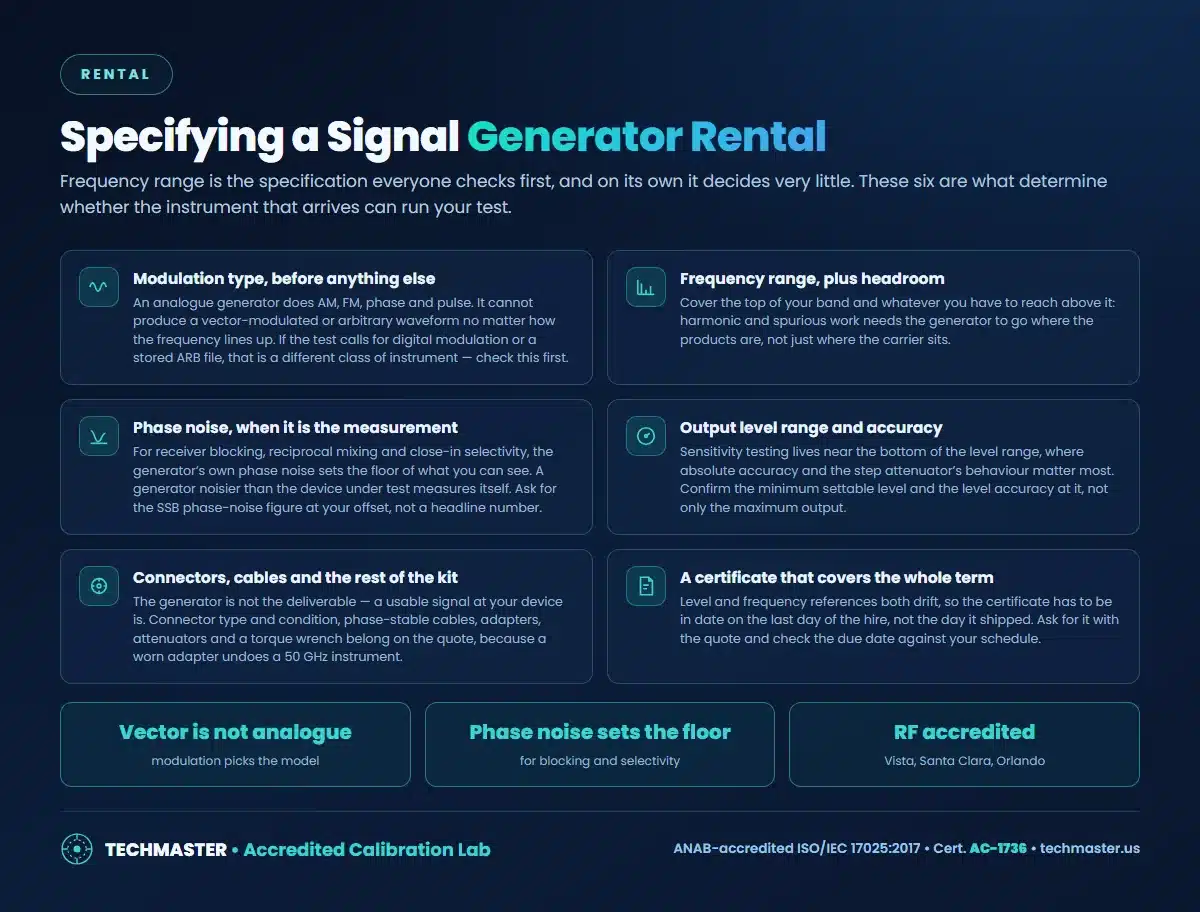
Modulation type first, because analogue and vector generators are different instruments. Then frequency range with headroom above your carrier for harmonic and spurious work, single-sideband phase noise at the offset your test uses, output level range and accuracy near the minimum settable level, the connectors, cables and attenuators that deliver the signal to your device, and a calibration certificate covering the whole term.
Frequency range is the specification everyone checks first and, on its own, it decides very little. Two generators covering the same band can differ by tens of decibels in phase noise and be entirely different instruments as far as your test is concerned.
Analogue or vector: which generator does the test need?
If the test needs AM, FM, phase or pulse modulation, an analogue generator is sufficient and usually cheaper and quieter. If it needs digital modulation, a standard-defined waveform or a stored arbitrary file, it needs a vector generator. No amount of frequency coverage substitutes for the missing modulator.
| What the test needs | Generator class | Watch out for |
|---|---|---|
| AM, FM, phase or pulse modulation | Analogue | Pulse timing resolution and on/off ratio |
| Digital or standard-defined modulation | Vector | Waveform licences are often separate from the hardware |
| A stored or custom waveform file | Vector with ARB | ARB memory depth and sample rate |
| Receiver blocking or reciprocal mixing | Low phase noise, either class | SSB phase noise at your offset, not a headline number |
| Receiver sensitivity near the noise floor | Either, with good level accuracy | Accuracy at the minimum settable level |
| Harmonic and spurious measurement | Frequency headroom above the carrier | The generator must reach where the products are |
Why do the connectors and cables belong on the quote?
Because the deliverable is a usable signal at your device, not a box on a bench. Connector type and condition, phase-stable cables, adapters, attenuators and a connector torque wrench all sit between the generator and the measurement, and a worn adapter undoes an otherwise excellent instrument. The same logic governs the reference standards in VNA calibration kit verification and the sensors in RF power sensor calibration.
What certificate should come with the generator?
A certificate that is in date on the last day of the rental, not the day the instrument shipped, and at the level your quality system requires — NIST-traceable, ANSI/NCSL Z540 or ISO/IEC 17025 accredited. Ask for it with the quote so the due date can be checked against your schedule before the booking is made.
The distinction between those levels is set out in accredited versus NIST-traceable calibration, and reading the document itself is covered in how to read an ISO/IEC 17025 certificate.
What capability stands behind the calibration?
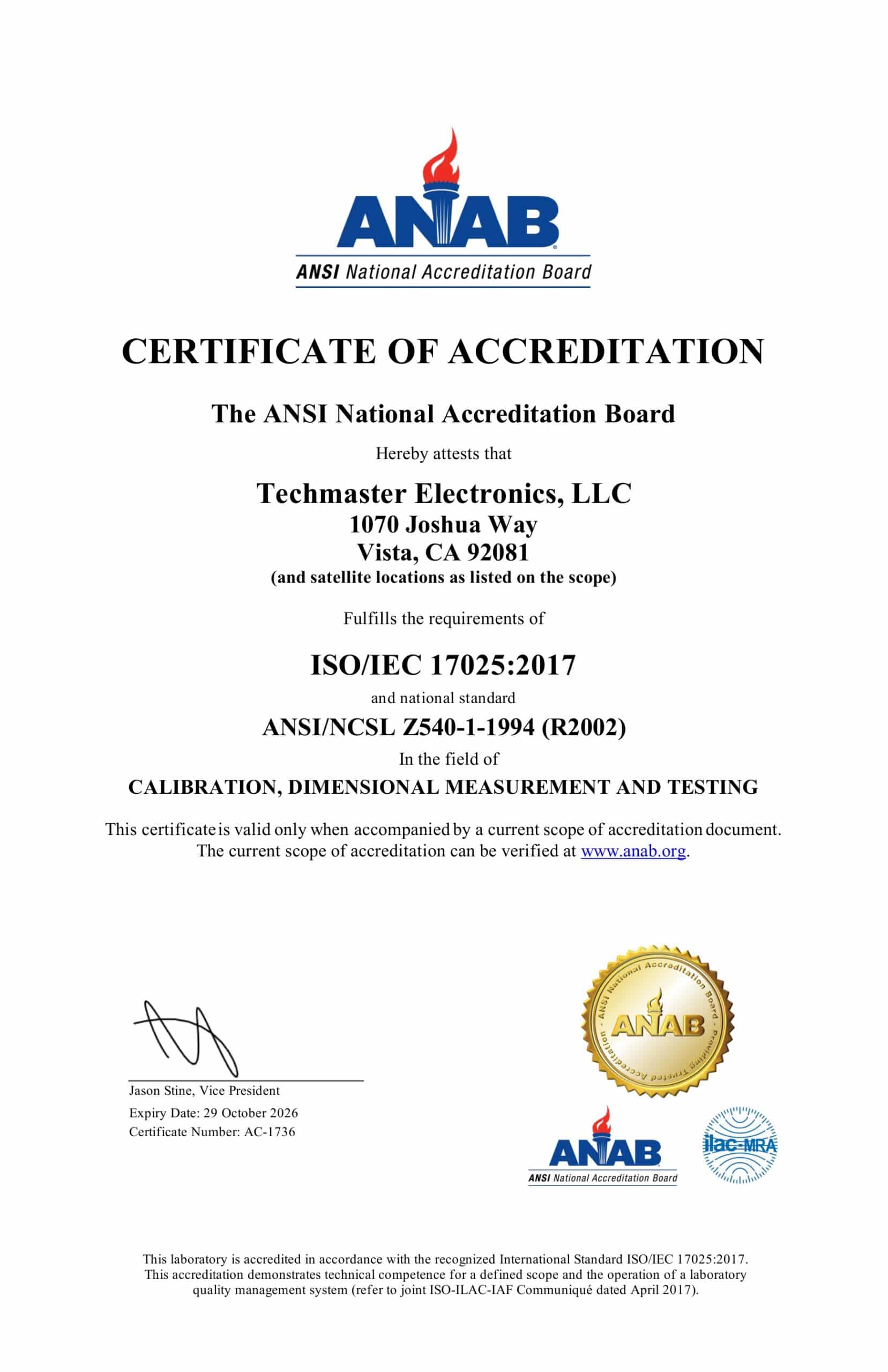
RF and microwave calibration sits on Techmaster’s ANAB ISO/IEC 17025 scope (Cert. AC-1736) at the Vista, Santa Clara and Orlando laboratories, including single-sideband phase noise to 50 GHz. RF and microwave work is not performed under that scope at San Antonio, so confirm the laboratory as well as the parameter when accreditation matters. Related instrument coverage is in signal generator calibration, function generator calibration, spectrum analyzer calibration and network analyzer calibration. Sector requirements are described in RF and microwave calibration for AS9100, and the service itself in our RF and microwave calibration service.
Frequently asked questions
What should I check first when renting a signal generator?
Modulation type, before frequency. An analogue generator produces AM, FM, phase and pulse modulation and nothing else; it cannot generate a vector-modulated or arbitrary waveform however well the frequency range lines up. If your test calls for digital modulation or a stored ARB file, that is a different class of instrument, and it is the specification most often discovered too late.
Does the phase noise of a rented signal generator matter?
It matters whenever the generator is the interferer rather than the stimulus. In receiver blocking, reciprocal mixing and close-in selectivity tests, the generator’s own phase noise sets the floor of what you can resolve, so a generator noisier than the device under test ends up measuring itself. Ask for the single-sideband phase noise at the offset your test uses, not a headline figure.
Do I need a calibration certificate with a rented signal generator?
Yes, if the measurements are going into a quality system or a report. Level and frequency references both drift, so the certificate has to be in date on the last day of the hire rather than the day the instrument shipped. Ask for it with the quote and check the due date against your schedule before you book.
Is it better to rent or buy a signal generator?
Rent when the need is a project, a short-term capability gap, or a frequency or modulation capability you use once or twice a year, and when an owned instrument is away for calibration. Buy when the generator is in routine use, because utilisation makes ownership cheaper quickly and you keep control of the calibration interval.
The bottom line
Modulation type, then headroom, then phase noise, then level accuracy at the bottom of the range, then the kit, then the certificate. Send the test you have to run rather than a model number and the rental can be specified against the measurement.
Need a quote, a rental, or a repair evaluation?
Techmaster Electronics — ISO/IEC 17025 accredited calibration laboratory, ANAB Cert. AC-1736, founded 1989. Five US labs, 5-day standard turnaround, 1–2 day expedite.
Request a quote →Techmaster Electronics, LLC is an independent ISO/IEC 17025:2017 accredited calibration laboratory. We are not affiliated with, authorized by, or endorsed by any manufacturer named on this page. All product names and model designations are trademarks of their respective owners and are used here only to identify the equipment we calibrate, repair, or rent. Confirm that our accredited scope covers your instrument’s parameters and ranges before shipping — ask us and we will check it against your model list.

Khanh Nguyen is the Marketing Manager at Techmaster Electronics, a B2B marketing leader covering the test, measurement, and ISO/IEC 17025 accredited calibration industry across the US and Vietnam markets.