
TL;DR: Power meter and sensor calibration verifies calibration factors across frequency, linearity across the power range, the 1 mW / 50 MHz power reference, sensor match (VSWR), zero drift and noise, and the meter’s own accuracy and ranging. Typical interval: 12 months. Calibrate the meter and sensor as the pair you measure with, and treat them as reference assets, because every RF level claim in your lab traces back to them.
Power sensors are the quiet backbone of an RF lab. Analyzer level accuracy, generator output accuracy, amplifier gain figures, check the chain and it ends at a power sensor, either yours or your calibration lab’s. That makes their calibration foundational rather than routine.
What does power meter calibration verify?
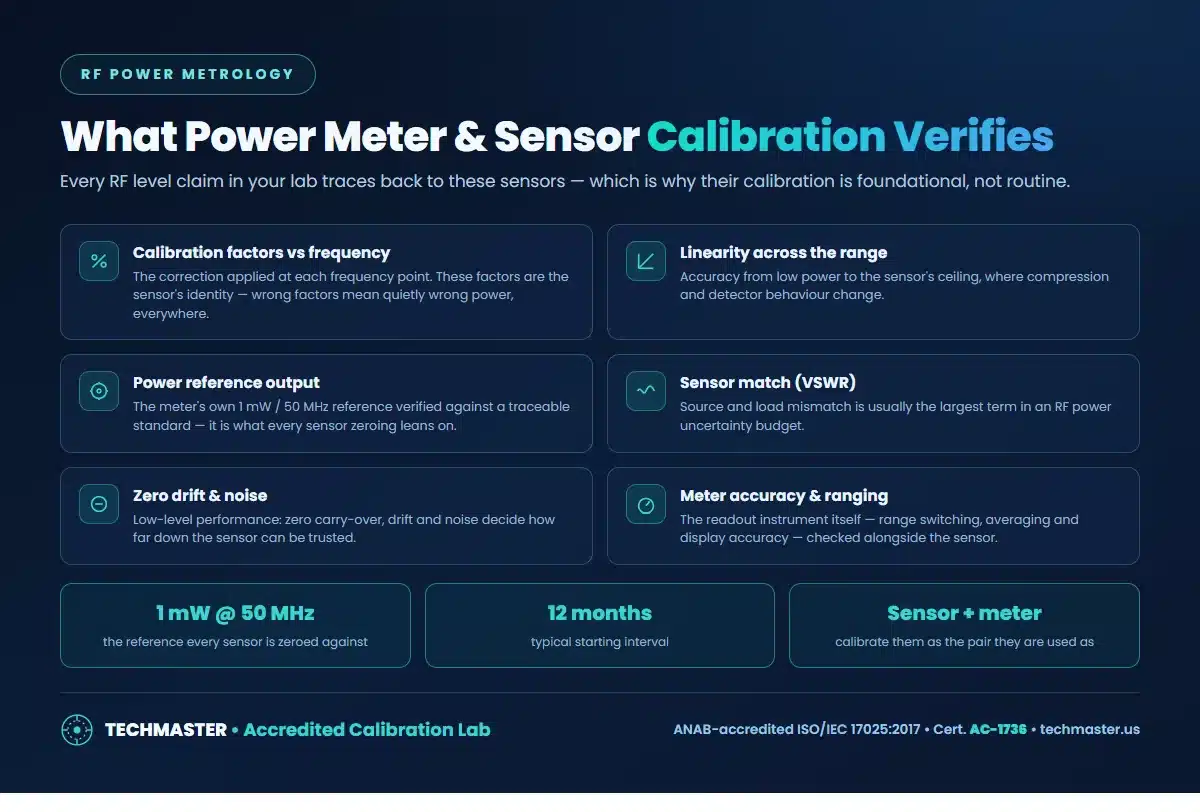
Calibration factors versus frequency are the heart of it: the frequency-by-frequency corrections the meter applies. Linearity is checked from low power up to the sensor’s ceiling, where detector behaviour changes. The 1 mW / 50 MHz reference gets verified against a traceable standard, because every zeroing operation leans on it. Sensor match matters because mismatch typically dominates RF power uncertainty budgets (see measurement uncertainty explained). Zero drift and noise set how far down the sensor can be trusted, and the meter’s own accuracy and range switching complete the picture.
Why this instrument deserves extra care
Two reasons. First, errors propagate silently: an out-of-spec sensor doesn’t fail, it just biases every level measurement made through it, and unlike a dead instrument, nothing announces the problem. Second, connectors. Power sensors get connected and disconnected constantly, and a worn or damaged precision connector changes the match that the calibration factors assume. Gauge them, keep caps on, and torque to specification, the RF hygiene covered in RF and microwave calibration.
Cost, interval and what to ask for
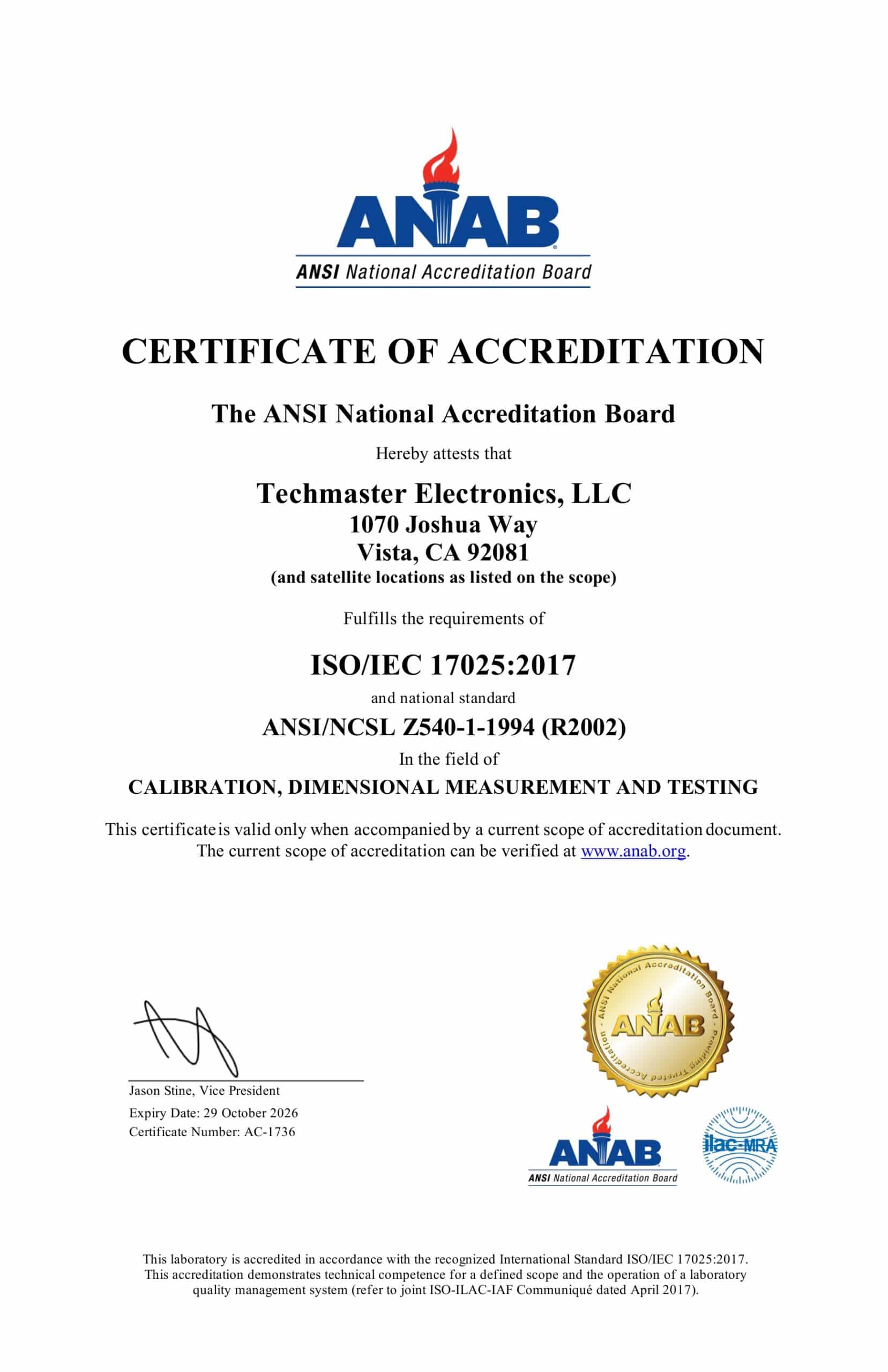
Twelve months to start, adjusted on as-found evidence per the interval guide. Ask for accredited calibration with the full calibration-factor table and as-found data, not just a pass statement, since the factor table is what you actually use. Check that the lab’s accredited scope reaches your sensor’s top frequency, and that its CMC is tight enough for your tolerance. Techmaster calibrates RF power meters and sensors under ANAB accreditation to ISO/IEC 17025:2017 (Cert. AC-1736).
Frequently asked questions
How often should RF power sensors be calibrated?
Every 12 months as the standard starting interval. Power sensors are reference-grade assets whose calibration factors underpin every level measurement in the lab, so most organizations keep them annual regardless of drift history, and sensors that see connector wear or overload events warrant more frequent checks.
What are calibration factors on a power sensor?
Calibration factors are frequency-dependent corrections that account for the sensor’s efficiency and mismatch at each frequency. The meter applies them to convert what the sensor detects into a corrected power reading. They are effectively the sensor’s identity, wrong or outdated factors produce quietly wrong power everywhere they are used.
Should the power meter and sensor be calibrated together?
Yes, whenever they are used as a pair. The meter contributes its own accuracy, ranging and reference oscillator, while the sensor contributes calibration factors and linearity. Calibrating them together characterizes the combination you actually measure with.
What is the 1 mW 50 MHz power reference for?
It is the traceable reference built into most power meters, used to zero and reference the sensor before measurement. Because every subsequent reading is anchored to it, the reference output’s own accuracy is verified during calibration, a drifted reference shifts every measurement made with that meter.
The bottom line
Treat power sensors as reference standards, calibrate them with their meter, insist on the full calibration-factor table, and protect the connectors. Related guides: spectrum analyzer, signal generator, and network analyzer calibration.
Get an accredited calibration quote
ANAB-accredited ISO/IEC 17025:2017 (Cert. AC-1736) • 5 US labs • 5-day standard, 1–2 day expedite • in-lab or on-site.
Request a quote
Khanh Nguyen is the Marketing Manager at Techmaster Electronics, a B2B marketing leader covering the test, measurement, and ISO/IEC 17025 accredited calibration industry across the US and Vietnam markets.