
TL;DR: Environment is a real uncertainty contributor, not housekeeping. Temperature (specifications are usually stated near 23 °C with a tolerance), stabilization time after transport, humidity for high-resistance and insulation work, and EMI and vibration for low-level and RF measurements all move results. Accredited laboratories record conditions because their stated uncertainty depends on them, and the same physics applies on your bench.
Ask why two measurements of the same instrument disagree and the answer is usually assumed to be the instrument. Often it is the room, the one contributor that never appears in a photograph of the setup.
How does the environment change a measurement?
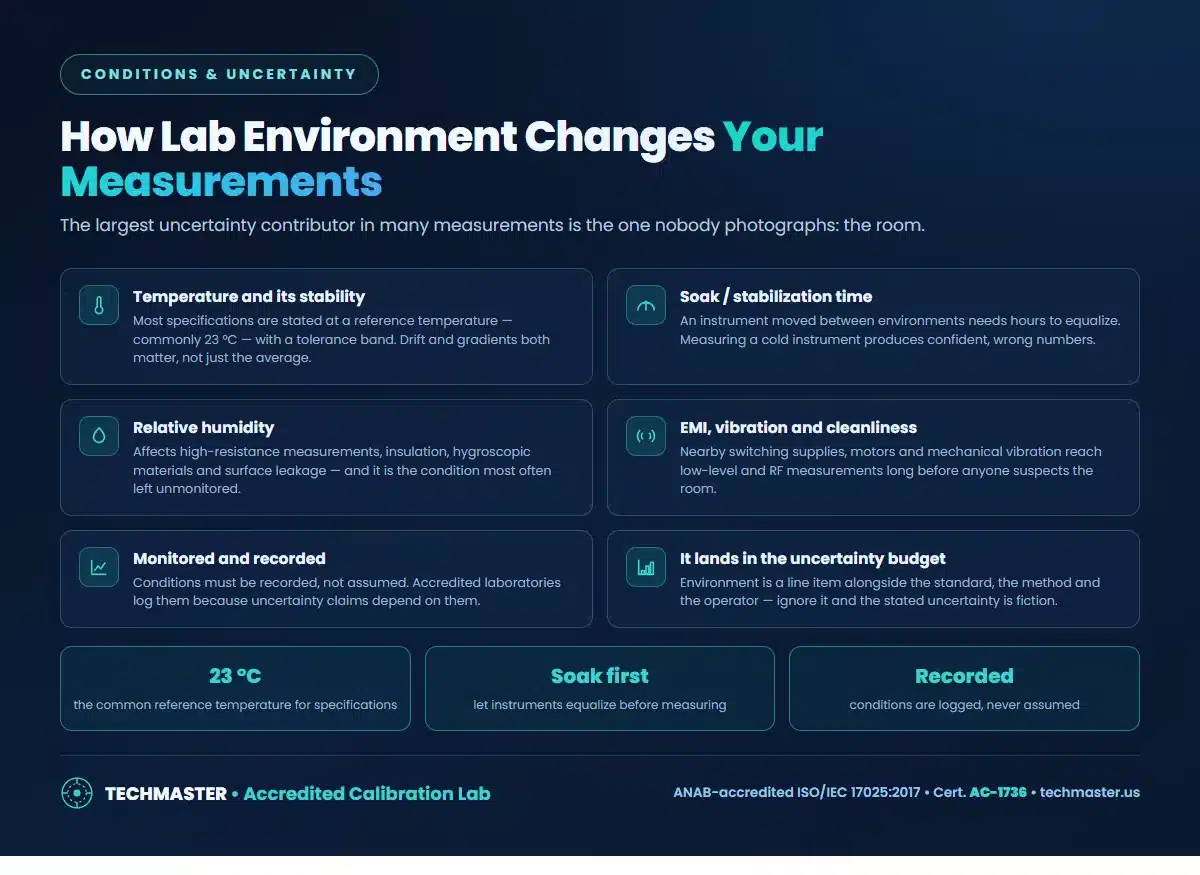
Temperature comes first because specifications assume it: performance is stated at a reference temperature with a tolerance band, and both drift over time and gradients across a bench matter, not just the daily average. Soak time is the practical consequence, an instrument brought in from a vehicle or a different building needs hours to equalize, and measuring it early yields confident wrong numbers. Humidity shows up in high-resistance and insulation measurements and surface leakage, which is exactly why it matters for insulation testers and high-value resistance work. EMI and vibration reach low-level and RF measurements long before anyone suspects the room.
Why this lands in the uncertainty budget
An uncertainty budget sums every contributor: the reference standard, the method, the instrument’s repeatability, the operator, and the environment. Leave it out and the number on the certificate is not conservative, it is wrong, which is why accredited laboratories control and log conditions as a condition of their accreditation. The concepts behind this are in measurement uncertainty explained, and the reason a laboratory’s CMC is achievable at all is that it is quoted under controlled conditions.
What this means for your own bench
Three practical habits. Let instruments settle before you trust them, particularly after shipping, a point worth remembering when equipment returns from calibration, as covered in shipping test equipment. Keep critical measurements away from switching supplies, motors and doorways. And record conditions for measurements that matter, because reconstructing them afterwards is impossible. If your own environment cannot be controlled, that is a legitimate argument for sending work to a laboratory whose environment is, one of the honest entries in the in-house vs outsourced comparison.
Frequently asked questions
What temperature should a calibration lab be at?
Instrument specifications are normally stated at a reference temperature, commonly 23 °C, with a stated tolerance band, and accredited laboratories control and record conditions to suit the measurements they perform. What matters is not one number but three things: that conditions stay inside the band the specification assumes, that they are stable rather than drifting, and that they are recorded.
How long should an instrument stabilize before measurement?
Long enough to equalize with the room, which for an instrument that has travelled between very different environments can be several hours. Measuring an instrument that is still thermally settling produces readings that look perfectly plausible and are simply wrong, which is also why calibration laboratories do not begin work on an instrument the moment it arrives.
Does humidity really affect electrical measurements?
Yes, in specific and important places: high-resistance and insulation measurements, surface leakage across insulators and PCBs, and any hygroscopic material in the measurement path. It is the condition most often left unmonitored, which is why it tends to surface as an unexplained discrepancy rather than a suspected cause.
Why do accredited laboratories record environmental conditions?
Because their uncertainty claims depend on them. Environment is a contributor in the uncertainty budget alongside the standard, the method and the operator. A laboratory that cannot show the conditions its measurements were made under cannot substantiate the uncertainty printed on its certificates.
The bottom line
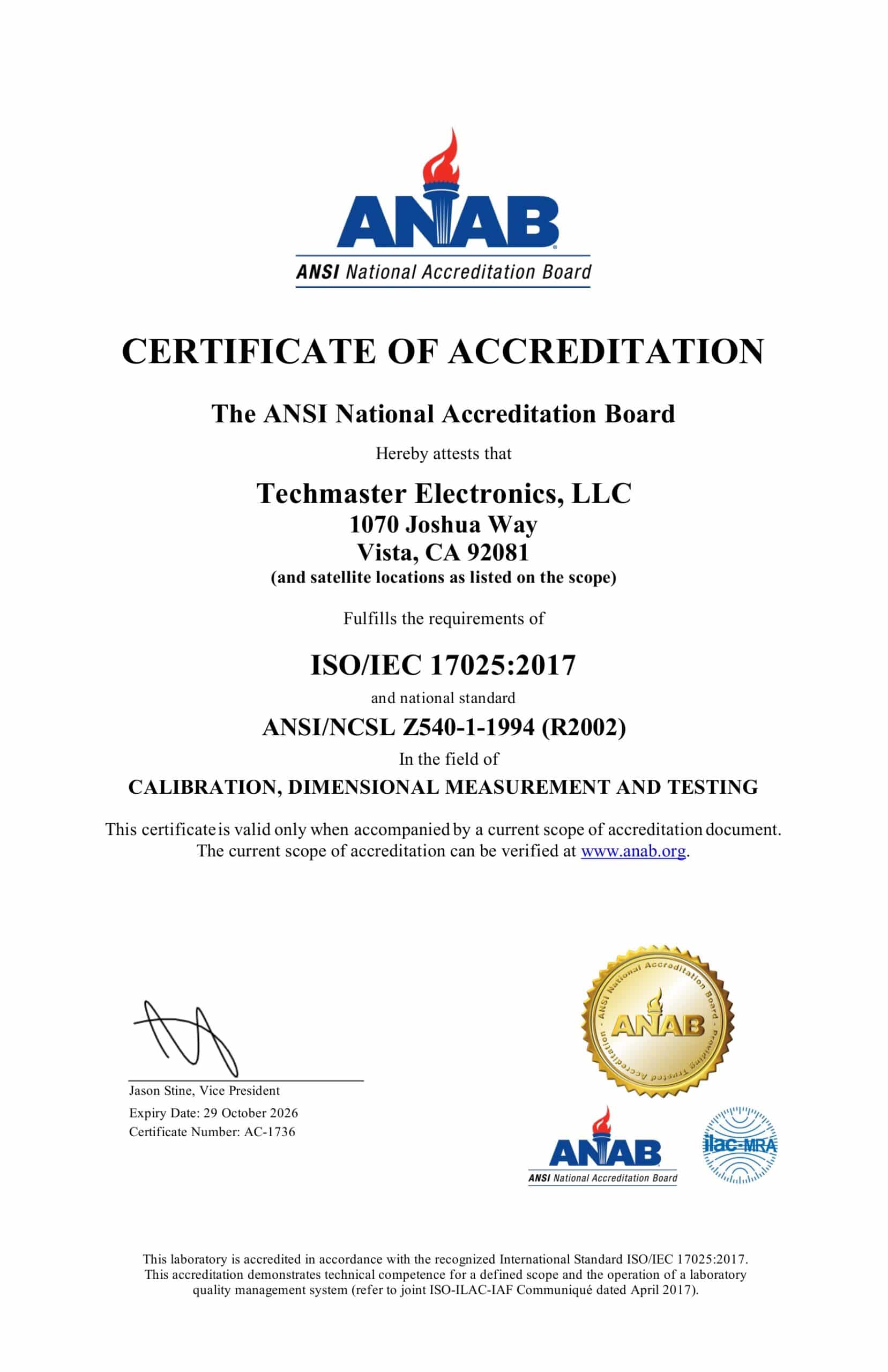
The room is part of the measurement. Control what you can, let instruments stabilize, record the rest, and expect your calibration laboratory to do the same. Techmaster performs accredited calibration under controlled and recorded conditions (ANAB Cert. AC-1736).
Get an accredited calibration quote
ANAB-accredited ISO/IEC 17025:2017 (Cert. AC-1736) • 5 US labs • 5-day standard, 1–2 day expedite • in-lab or on-site.
Request a quote
Khanh Nguyen is the Marketing Manager at Techmaster Electronics, a B2B marketing leader covering the test, measurement, and ISO/IEC 17025 accredited calibration industry in the United States.