TL;DR: In-house calibration pays off only at volume, typically several hundred same-discipline instruments, because the real costs are working standards (4:1 TUR), their own perpetual accredited calibration, trained metrology staff, and accreditation if customers require it, not labor. Most companies land on a hybrid: simple high-volume checks in-house, RF/high-accuracy/accredited work outsourced. Never in-source work whose standards you’d use twice a year.
The make-or-buy question looks like a labor-savings calculation and isn’t. Here’s the math that actually decides it, and the hybrid model most labs land on once they’ve done it.
What does an in-house lab really cost?
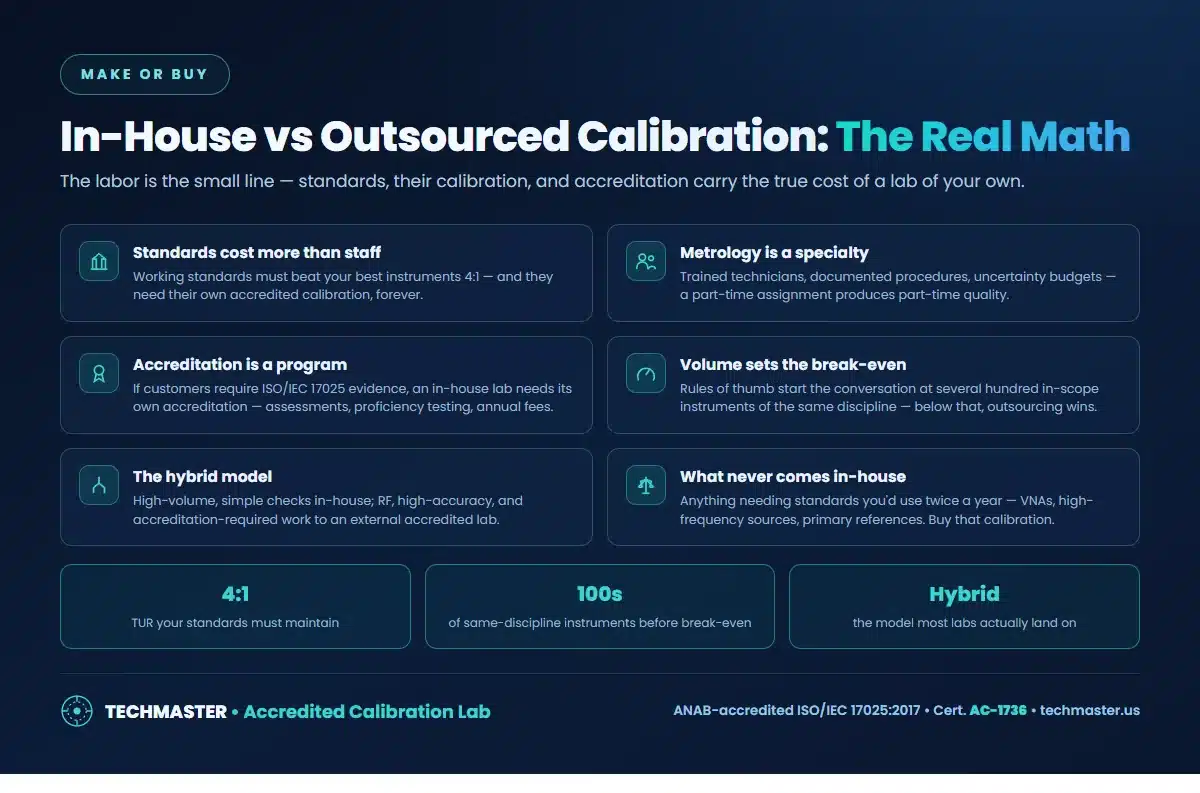
Standards cost more than staff. Working standards must generally maintain a 4:1 test-uncertainty ratio over the instruments they verify, and they need their own accredited calibration, forever, from a lab like the ones you were trying to stop paying. Metrology is a specialty: procedures, uncertainty budgets, and training aren’t a part-time assignment. Accreditation is a program: if customers require ISO/IEC 17025 evidence (most AS9100 flow-downs do), an internal lab needs its own accreditation, assessments, proficiency testing, annual fees. Price all three before counting saved labor.
Where is the break-even?
Volume of the same discipline is what matters, because standards don’t share across disciplines: a DC/LF bench serves meters and supplies but does nothing for spectrum analyzers. Rules of thumb start the conversation at several hundred in-scope instruments; the cost guide prices the outsourced side of the comparison, and the budgeting guide shows the cheaper levers to pull first, interval right-sizing and vendor consolidation usually capture most of the savings an in-house lab promises, without the fixed costs.
The hybrid model, and what never comes in-house
The stable end state for most companies: torque tools, gauges, and handheld meters verified internally on a modest DC/LF bench; everything RF, everything high-accuracy, and everything needing an accredited certificate sent out. Never in-source work whose standards you’d exercise twice a year, VNA cal kits, high-frequency sources, primary references, because idle standards still need calibration and still depreciate. For large fleets, onsite calibration captures much of the downtime benefit of in-house without owning anything: Techmaster runs onsite programs nationwide from 5 US labs.
Frequently asked questions
When does in-house calibration make financial sense?
As a rule of thumb, the conversation starts at several hundred instruments of the same discipline, enough volume that one set of working standards and one trained technician stay busy. Below that, the fixed costs of standards, their own accredited calibration, training, and procedures exceed what an external lab charges.
What are the hidden costs of an in-house calibration lab?
The standards themselves (which must typically maintain 4:1 accuracy over the instruments they verify), the accredited calibration those standards need forever, technician training and turnover, documented procedures and uncertainty budgets, environmental control, and, if customers require it, ISO/IEC 17025 accreditation with assessments, proficiency testing, and annual fees.
Can in-house calibration satisfy ISO 9001 or AS9100?
Yes for ISO 9001, if you maintain traceable standards, documented procedures, and records. For AS9100 and regulated customers it gets harder: many contracts require ISO/IEC 17025 accredited calibration, which means your internal lab would need its own accreditation, a program, not a purchase.
What is a hybrid calibration model?
High-volume, simple, low-risk checks are done in-house, torque tools, handheld meters, gauges, while RF/microwave, high-accuracy, and accreditation-required work goes to an external accredited lab. Most companies that calibrate anything internally land here, because it captures the volume savings without owning rarely-used standards.
The bottom line
Do the math on standards, staffing, and accreditation before believing the labor savings, and remember the hybrid model exists precisely because the full in-house case almost never closes. For the outsourced share, pick the lab with the 12-point checklist.
Get an accredited calibration quote
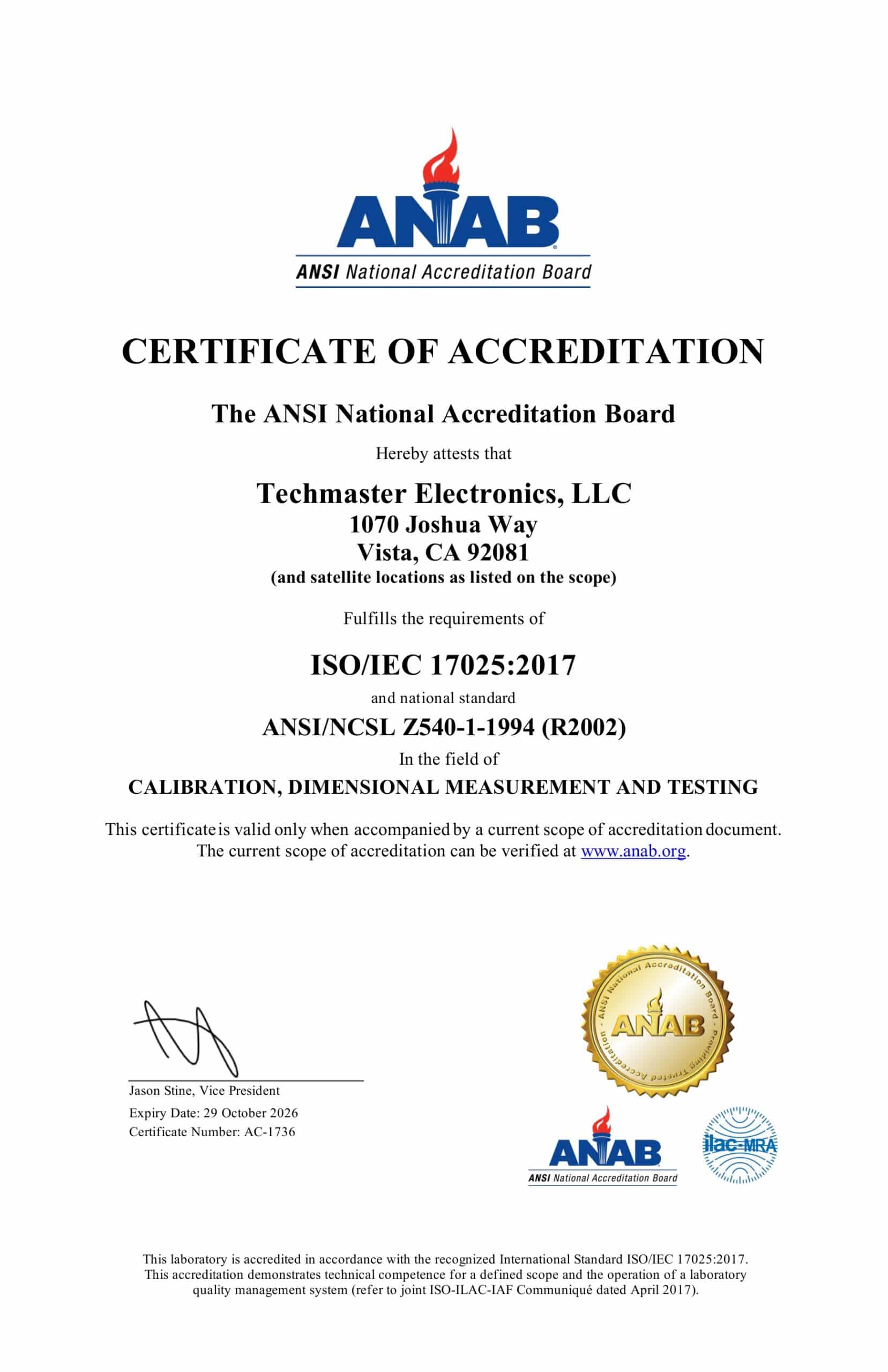
ANAB-accredited ISO/IEC 17025:2017 (Cert. AC-1736) • 5 US labs • 5-day standard, 1–2 day expedite • in-lab or on-site.
Request a quoteReferences & industry standards
- ISO/IEC 17025 testing & calibration laboratory requirements
- NIST calibration services and measurement traceability
- A2LA / ANAB accreditation for calibration laboratories
External standards bodies. Techmaster Electronics is an ISO/IEC 17025-accredited, NIST-traceable calibration laboratory.

Khanh Nguyen is the Marketing Manager at Techmaster Electronics, a B2B marketing leader covering the test, measurement, and ISO/IEC 17025 accredited calibration industry across the US and Vietnam markets.