
TL;DR: Insulation and safety tester calibration verifies insulation resistance across very high ranges, test voltage under load (not open circuit), low-resistance continuity for bonding, earth bond test current, leakage current, and timers and automatic discharge. These instruments issue a verdict on whether equipment is safe to energize, which makes their calibration a safety control, not a paperwork exercise.
Most calibration decisions trade cost against measurement risk. This category is different: the output is a judgment about whether equipment can be safely put in front of people, and an instrument reading generously produces a pass on insulation that should have failed.
What does safety tester calibration verify?
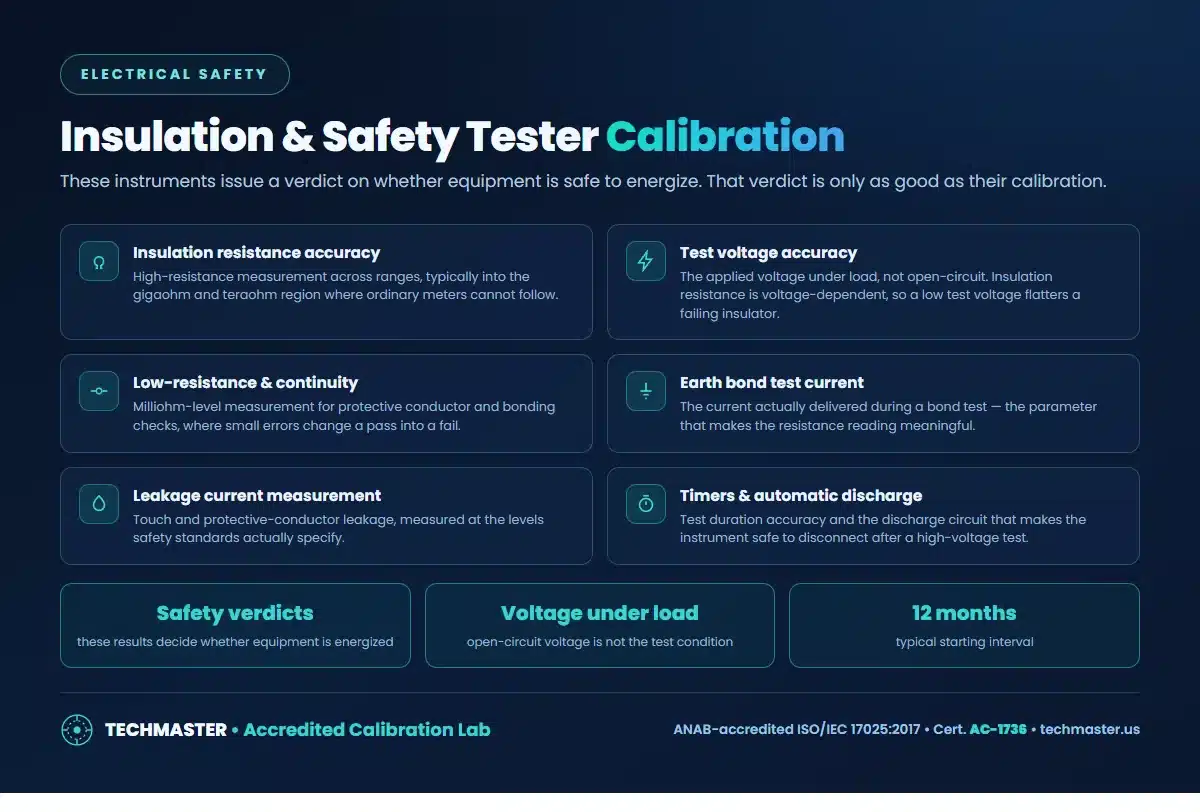
Insulation resistance is measured at the extreme end of the resistance scale, where ordinary meters cannot follow, verification needs standards built for gigaohms and beyond. Test voltage under load is the parameter people overlook: insulation resistance depends on the applied voltage, so a tester delivering 400 V when it claims 500 V under-stresses the insulation and flatters it. Low-resistance and continuity measurement at milliohm level decides protective-conductor and bonding results, and earth bond test current is what makes that resistance figure meaningful. Leakage current is checked at the levels safety standards specify. And the timer and discharge circuit govern both test validity and operator safety after a high-voltage test.
Why the interval argument is different here
Elsewhere in this library the advice is to extend intervals where as-found evidence supports it, see extending a calibration interval. Safety testers are the clearest case for not doing that. The consequence of a drifted instrument is not a scrapped batch but equipment wrongly certified as safe, and the calibration record is what demonstrates due diligence if that is ever questioned. Keep them annual, and keep the certificates with as-found data (why as-found matters).
What to ask for
State the test voltages and ranges you use, and ask for verification of voltage under load rather than open circuit. Ask for as-found data, and check the lab’s accredited scope reaches your instrument’s highest resistance range and test voltage, use how to read a scope document. For fleets of handheld testers spread across sites, the recall mechanics in building a recall system and the on-site option in on-site vs in-lab both apply.
Frequently asked questions
What does insulation tester calibration verify?
Insulation resistance accuracy across ranges, typically into the gigaohm and teraohm region, plus the accuracy of the applied test voltage under load, low-resistance and continuity measurement for bonding checks, earth bond test current, leakage current measurement, and test timers and the automatic discharge circuit.
Why does test voltage accuracy matter on an insulation tester?
Because insulation resistance is voltage-dependent. If the instrument delivers less than its nominal test voltage under load, it stresses the insulation less than the test requires and can report a comfortable pass on insulation that would fail at the correct voltage. Open-circuit voltage is not the test condition, the voltage under load is what counts.
How often should electrical safety testers be calibrated?
Twelve months is the standard starting interval. These instruments make a strong case for staying annual regardless of drift history, because their output is a safety verdict: the decision about whether equipment is fit to energize and put in front of people.
Do PAT testers and multifunction installation testers need accredited calibration?
If the results support compliance records, customer sign-off, or a safety case, accredited calibration with as-found data is appropriate, you may need to demonstrate the instrument was sound when the tests were performed. For informal internal checks, standard NIST-traceable calibration is usually proportionate.
The bottom line
Calibrate safety testers annually, verify test voltage under load, and keep the as-found data, it is the evidence that your safety verdicts were sound when you made them. Techmaster calibrates insulation, continuity and electrical safety instruments under ANAB accreditation (Cert. AC-1736).
Get an accredited calibration quote
ANAB-accredited ISO/IEC 17025:2017 (Cert. AC-1736) • 5 US labs • 5-day standard, 1–2 day expedite • in-lab or on-site.
Request a quoteReferences & industry standards
- ISO/IEC 17025 testing & calibration laboratory requirements
- NIST calibration services and measurement traceability
- A2LA / ANAB accreditation for calibration laboratories
External standards bodies. Techmaster Electronics is an ISO/IEC 17025-accredited, NIST-traceable calibration laboratory.

Khanh Nguyen is the Marketing Manager at Techmaster Electronics, a B2B marketing leader covering the test, measurement, and ISO/IEC 17025 accredited calibration industry in the United States.