
TL;DR: Specify a pressure gauge rental by span sized to the working pressure, aim to work at 25 to 75 percent of span, not at the bottom, then by media compatibility, accuracy class and process connection. Ask for a certificate whose calibration points span the pressures you will actually apply, with as-found data. Range is the specification people get wrong most often and the one that quietly ruins the data.
What is a pressure gauge rental for?
A rented pressure gauge covers a bounded measurement need, a proof or hydrostatic test, a commissioning campaign, a leak investigation, or cover while an owned test gauge is away being calibrated, and it is the measuring instrument of record for that work. Its certificate and its span therefore carry the same weight as the numbers it displays.
Pressure instruments were one of the largest clusters in the requests reaching our laboratories over the last quarter, spanning gauges, manometers, transmitters and calibrators, with rental a recurring theme across the window.
What do I need to specify?
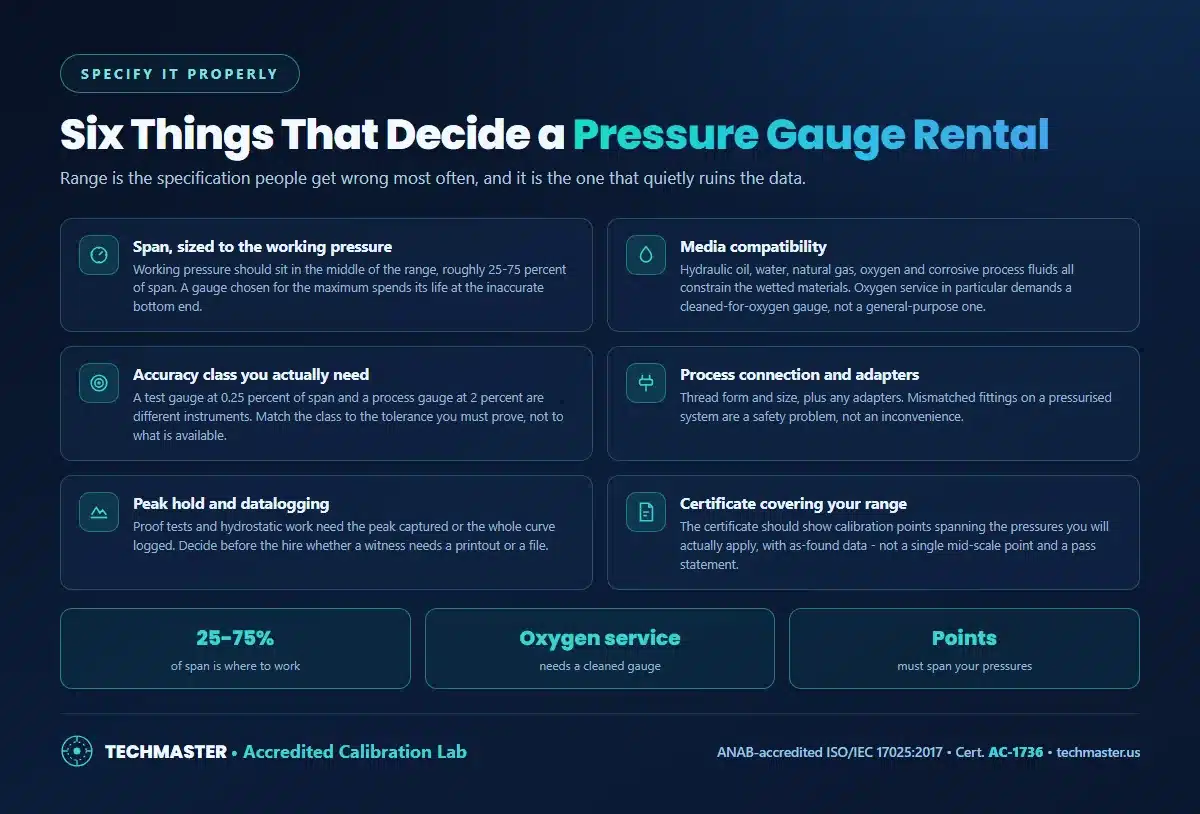
Span sized so the working pressure sits near mid-scale, media compatibility including any oxygen-service requirement, accuracy class matched to the tolerance you must prove, process connection and adapters, peak hold or datalogging if the test needs a record, and a certificate whose points span your working pressures.
Why span is the specification people get wrong
Pressure gauge accuracy is normally a percentage of full span rather than of reading, so the absolute error is roughly constant across the scale. Working at 10 percent of span makes that fixed error large relative to the reading; working between 25 and 75 percent of span keeps it small. Choosing the gauge for the maximum pressure it might ever see is what pushes the working point to the wrong end.
The same reasoning drives how a gauge is calibrated in the first place, points across the working range rather than one convenient value, as covered in pressure gauge calibration and digital test gauge calibration.
Rent, buy, or send yours out?
| Situation | Usual answer | Why |
|---|---|---|
| One-off proof or hydrostatic test | Rent | Bounded need, often at an unusual range |
| Owned test gauge away for calibration | Rent to bridge | Keeps commissioning moving |
| Pressure range you meet once a year | Rent | A gauge in a drawer still needs calibrating |
| Daily process checks | Buy | Utilisation justifies ownership quickly |
| Oxygen or aggressive media service | Rent the correct gauge | Wetted materials and cleaning are not adaptable |
| Witnessed test needing a record | Rent with logging or peak hold | A written-down reading is weaker evidence |
What the certificate has to show
Calibration points spanning the pressures you will apply, both increasing and decreasing where hysteresis matters, the measurement uncertainty, and as-found data. A single mid-scale point with a pass statement cannot tell you whether the gauge was correct at the pressure you actually tested at.
How to read what comes back is covered in how to read an ISO/IEC 17025 certificate, and the related instrument families in digital pressure gauge calibration, digital manometer calibration, pressure transmitter calibration and, for reference standards, deadweight testers versus digital pressure calibrators.
What capability stands behind the certificate?
Pressure is on Techmaster’s ANAB ISO/IEC 17025 scope (Cert. AC-1736) from −12 psi to 10,000 psi, with the highest ceiling, 15,000 psi, held at the San Antonio, Texas laboratory, plus barometric measurement to 39 psia. Fire-protection work has its own conventions, covered in pressure gauge calibration for fire suppression systems. Rental availability and terms vary by laboratory, ask us what is available for your range and dates.
Frequently asked questions
What range of pressure gauge should I rent?
One where your working pressure falls in the middle of the span, roughly 25 to 75 percent. Accuracy on a pressure gauge is normally expressed as a percentage of full span, so a gauge chosen for the highest pressure it might ever see spends its working life at the bottom of the scale where that fixed error is largest relative to the reading.
Does the process media affect which gauge I can rent?
Yes, and it is not optional. Hydraulic oil, water, natural gas, steam and corrosive process fluids each constrain the wetted materials and the fill. Oxygen service in particular requires a gauge that has been cleaned for oxygen use, because ordinary residues present a genuine hazard rather than a measurement problem.
What accuracy class do I need on a rented pressure gauge?
Match it to the tolerance you have to prove. A test gauge at 0.25 percent of span and a general process gauge at 2 percent are different instruments for different jobs. If the gauge is being used to demonstrate compliance with a specification, the gauge’s own uncertainty has to be small relative to that specification.
Does a rented pressure gauge come with a certificate?
It should, and the certificate should show calibration points spanning the pressures you will actually apply rather than a single mid-scale point and a pass statement. Ask for as-found data as well, so that if a result is later disputed you can establish what the gauge was doing on the day.
The bottom line
Size the span to where you will actually work, confirm the wetted materials suit the media, match the accuracy class to the tolerance you must prove, and insist the certificate covers your pressures. Send the working pressure, the media and the connection, and the gauge can be specified in one exchange.
Need a quote, a rental, or a repair evaluation?
Techmaster Electronics, ISO/IEC 17025 accredited calibration laboratory, ANAB Cert. AC-1736, founded 1989. Five US labs, 5-day standard turnaround, 1–2 day expedite.
Request a quote →Techmaster Electronics, LLC is an independent ISO/IEC 17025:2017 accredited calibration laboratory. We are not affiliated with, authorized by, or endorsed by any manufacturer named on this page. All product names and model designations are trademarks of their respective owners and are used here only to identify the equipment we calibrate, repair, or rent. Confirm that our accredited scope covers your instrument’s parameters and ranges before shipping, ask us and we will check it against your model list.

Khanh Nguyen is the Marketing Manager at Techmaster Electronics, a B2B marketing leader covering the test, measurement, and ISO/IEC 17025 accredited calibration industry in the United States.