
TL;DR: A process calibrator fails quietly: the mA source drifts, the battery degrades accuracy as it discharges, or a pressure module loses zero. None of it trips an error, and every transmitter trimmed against it inherits the error. Send the modules with the base unit, and recalibrate after any repair.
Why does a drifting process calibrator matter more than most faults?
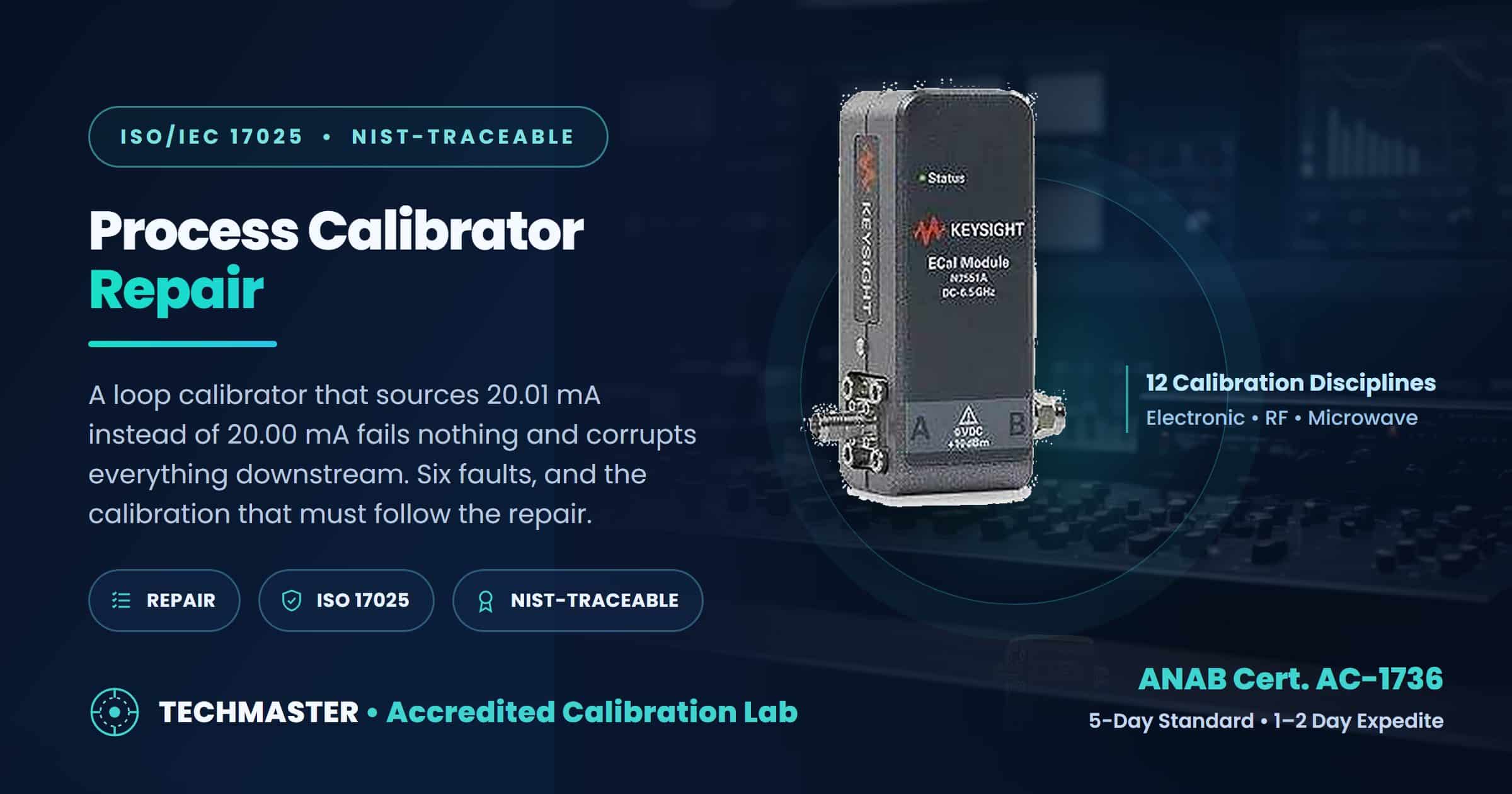
Because the error propagates: a calibrator that sources 20.01 mA instead of 20.00 mA passes every self-test and then mis-trims every transmitter it is used on. The instrument that was supposed to be the reference becomes the source of error, and the fault spreads to each loop it touches until someone checks it against a second instrument.
That is the argument for treating a field calibrator as a reference standard rather than a hand tool — a shorter interval, a recorded history, and repair the moment it is suspect.
Why do so many faults trace back to the battery?
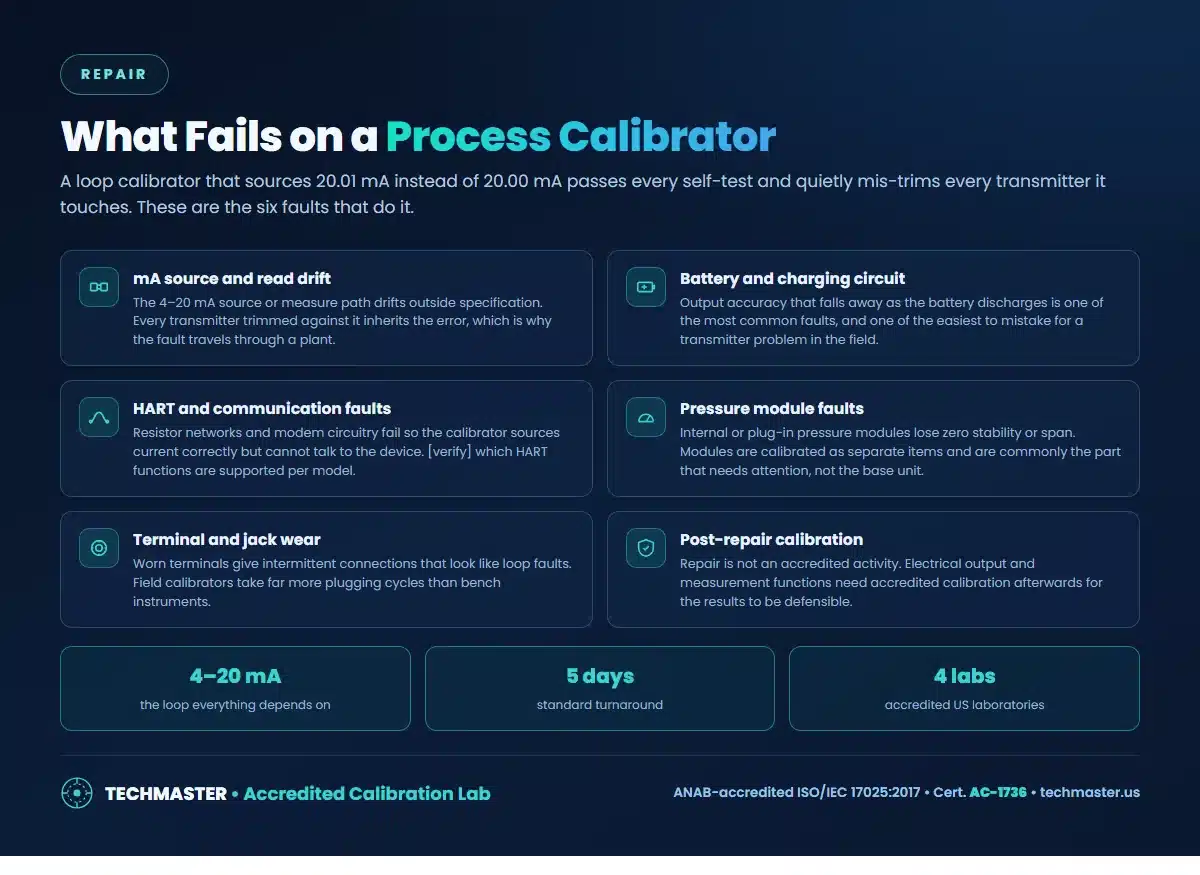
Because the symptom looks like something else. Output accuracy that falls away as the battery discharges gives readings that are correct first thing in the morning and wrong by mid-afternoon — which technicians reasonably blame on the transmitter, the loop or the wiring before they suspect the calibrator.
If the same loop reads differently at the start and end of a shift, check the calibrator’s charge state before anything else.
Faults, symptoms and what they affect
| Fault | How it presents | What it affects |
|---|---|---|
| mA source or measure drift | Passes self-test, fails against a second reference | Every transmitter trimmed with it |
| Battery and charging | Accuracy degrades through the shift | Afternoon work only |
| HART communication | Sources current but cannot talk to the device | Configuration, not the loop signal |
| Pressure module zero/span | Module out, base unit fine | Pressure loops only |
| Terminal and jack wear | Intermittent, looks like a loop fault | Any measurement |
| Damaged test leads | Mistaken for instrument failure | Rule out first — cheapest fix |
What should you send with the calibrator?
Send the pressure modules with the base unit. Modules are calibrated as separate items with their own ranges and uncertainties, and it is common for a module to be out of tolerance while the calibrator itself is fine. A base unit returned without its modules usually means a second shipment.
Background on what the calibration covers: process calibrator calibration, documenting process calibrator calibration and loop calibrator calibration. For pressure specifically, deadweight testers versus digital pressure calibrators covers how the reference itself is chosen, and manometer calibration the instrument it is often checked against. On certificate levels, see accredited versus NIST-traceable calibration and how to read a calibration certificate.
Frequently asked questions
What usually fails on a process calibrator?
Drift in the 4–20 mA source or measure path, battery and charging faults that degrade accuracy as the charge falls, HART communication failures, pressure module zero and span instability, and worn terminals. Field calibrators take far more plugging cycles and physical handling than bench instruments, and the faults reflect that.
Why does a small mA error matter so much?
Because the error propagates. A calibrator sourcing 20.01 mA instead of 20.00 mA passes its own self-test and then mis-trims every transmitter it touches. The fault travels silently through a plant and is usually found only when a loop is checked against a second instrument.
Are pressure modules calibrated separately from the calibrator?
Yes. Plug-in and internal pressure modules are handled as separate calibrated items with their own ranges and uncertainties. It is common for the modules to need attention while the base unit is within tolerance, so send the modules with the calibrator.
Does the calibrator need recalibrating after repair?
Yes. Repair is not an accredited activity — accreditation applies to the calibration performed afterwards. Any work on the source, measure or reference circuitry invalidates the previous certificate regardless of the due date on it.
Techmaster Electronics is accredited by ANAB to ISO/IEC 17025:2017 under certificate AC-1736, across eight accredited calibration fields at four US laboratories — Vista CA, Santa Clara CA, Orlando FL and San Antonio TX. Ask us to confirm your specific instrument and parameter ranges against the current scope before shipping.
Send us the model list. We will come back with an itemized quote, the service level per instrument, and which items sit inside our ANAB accredited scope. Request a quote.
Techmaster Electronics, LLC is an independent ISO/IEC 17025:2017 accredited calibration laboratory. We are not affiliated with, authorized by, or endorsed by any manufacturer named on this page. All product names and model designations are trademarks of their respective owners and are used here only to identify the equipment we calibrate, repair, or rent. Confirm that our accredited scope covers your instrument’s parameters and ranges before shipping — ask us and we will check it against your model list.

Khanh Nguyen is the Marketing Manager at Techmaster Electronics, a B2B marketing leader covering the test, measurement, and ISO/IEC 17025 accredited calibration industry across the US and Vietnam markets.