
What is a conductivity cell constant and why does it drift?
Any conductivity meter calibration starts from one equation: conductivity is calculated as κ = K × G, where G is the measured conductance and K is the cell constant. A nominal K of 1.0 cm-1 is only a label. The true value of each cell is determined by comparing it to a standard of known conductivity, and that determination is exactly what a calibration certificate should report.
Three mechanisms move K in the field. Films of oil, biofilm, or scale reduce the effective electrode area. Platinum black coatings on low-range cells slowly strip, which raises polarization error at higher conductivity. Finally, cable and connector changes add series resistance, which matters most on K = 10 cm-1 cells measuring high-conductivity brines. In Techmaster’s ten-year dataset of 381,916 calibrations, conductivity meters (44 units), conductivity standard solutions (33 units), and combination pH/conductivity meters (10 units) are among the chemical instruments we see most. Because the cell is usually the weak link, our ISO/IEC 17025 chemical calibration services always report the cell constant as-found and as-left.
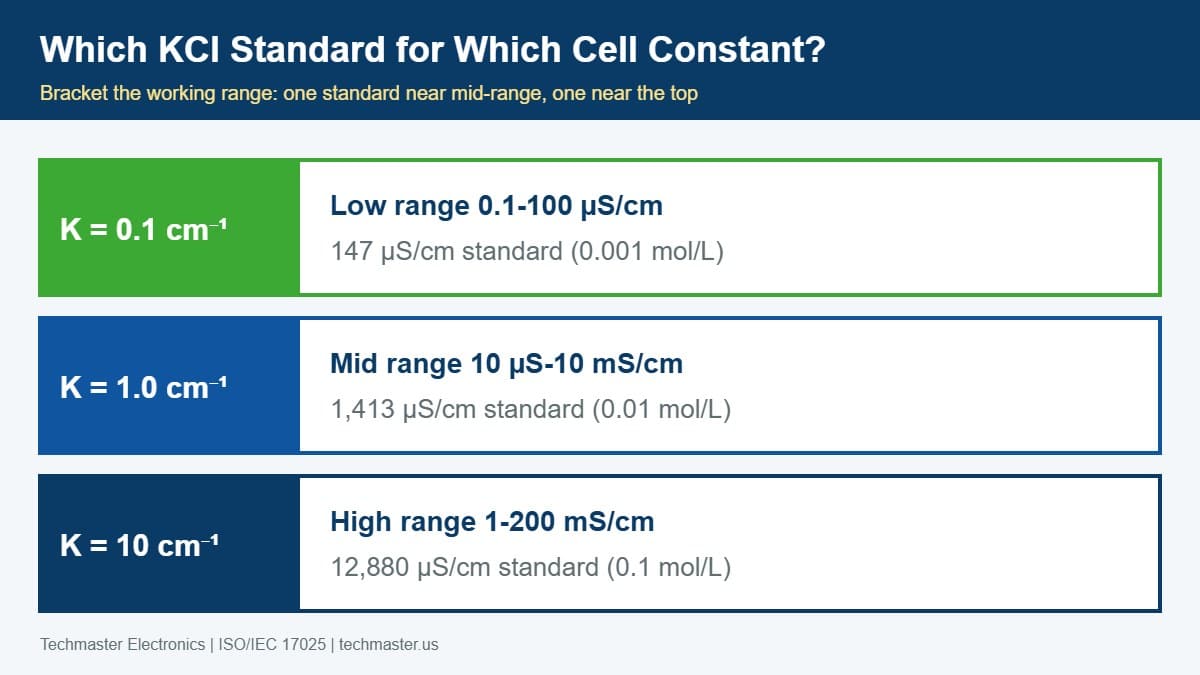
Which KCl standard should you use for each cell constant?
| KCl concentration | Conductivity at 25 °C | Typical cell constant | Best used for |
|---|---|---|---|
| 0.001 mol/L | about 147 µS/cm | K = 0.1 cm-1 | Purified water, boiler feed, rinse water |
| 0.01 mol/L | about 1,413 µS/cm | K = 1.0 cm-1 | General-purpose lab and process checks |
| 0.1 mol/L | about 12,880 µS/cm | K = 10 cm-1 | Brines, plating baths, high-TDS samples |
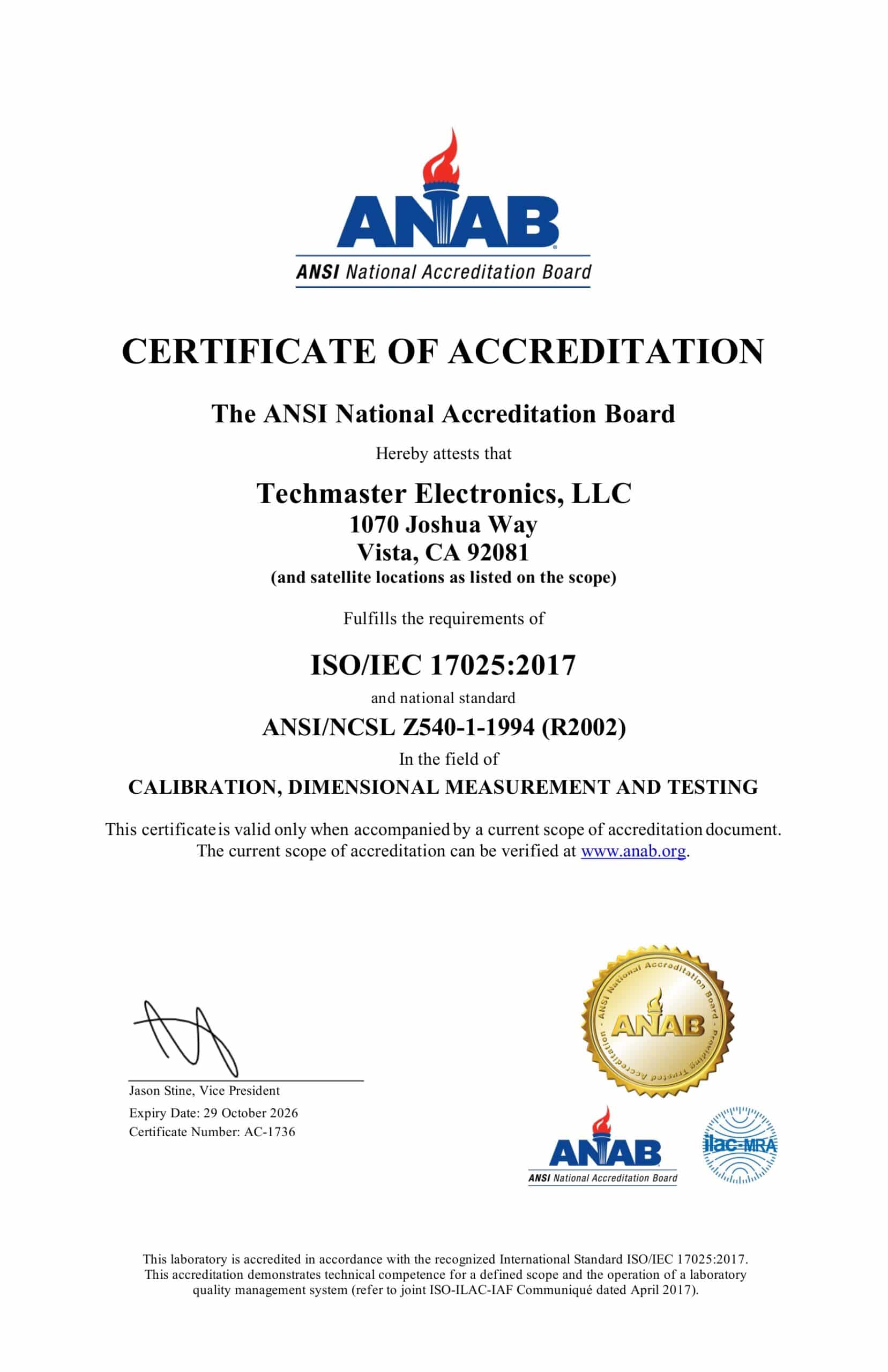
Our Vista, CA laboratory calibrates conductivity meters by comparison to standard solutions from 100 to 10,000 µS/cm on its ANAB scope (Cert. AC-1736), which covers the 1,413 µS/cm point most labs use. Review the full chemical calibration scope for the Vista, CA laboratory before shipping an instrument that works outside that window. For a related electrochemical check, see our guide to pH meter calibration slope, offset, and buffer requirements.
How much error does temperature add to a conductivity calibration?
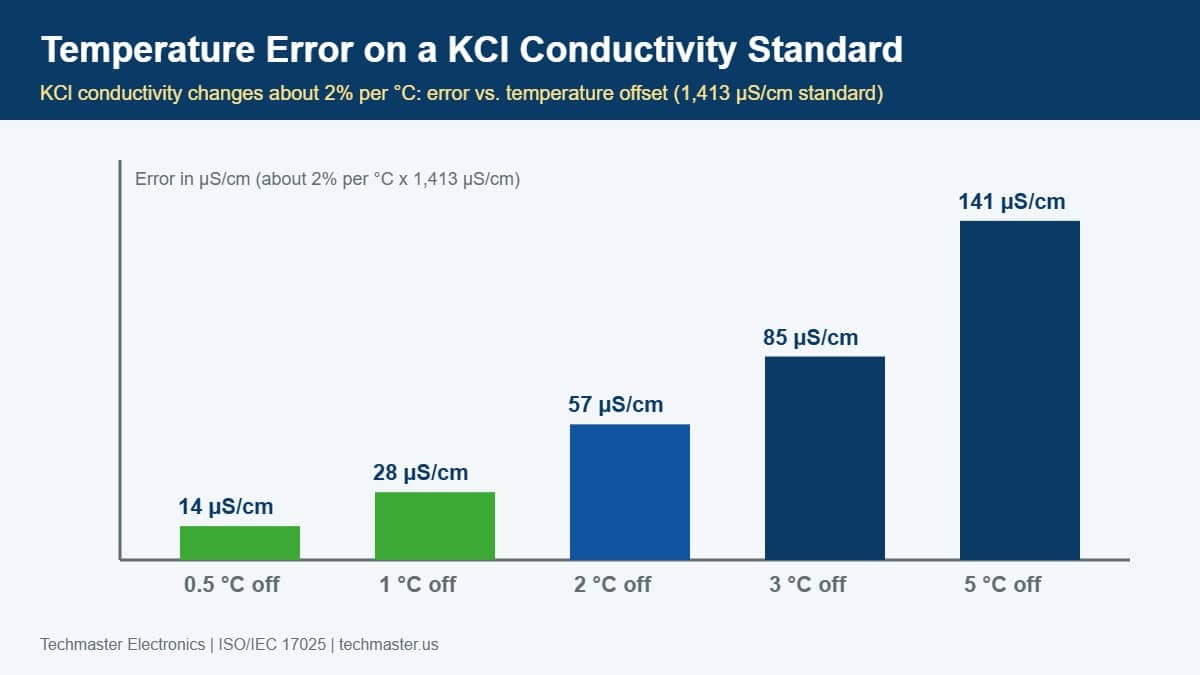
Worked example: a meter reads 1,380 µS/cm in a fresh 1,413 µS/cm standard held at 25.0 °C. The as-found error is (1,380 − 1,413) / 1,413 = −2.3 percent. If the cell constant was entered as 1.000 cm-1, the corrected value is 1.000 × 1,413 / 1,380 = 1.024 cm-1. Had the standard been 1 °C cool, roughly 2 percent of that error would have been temperature, not the cell. This is why technicians record temperature next to every reading.
The compensation coefficient is another quiet error source. A meter set for 2.00 percent per °C compensating a natural water that behaves closer to 1.8 percent will misreport at any temperature away from 25 °C. For calibration, measure at 25 °C and disable or verify compensation.
Why do opened conductivity standards go bad so quickly?
The ten-year Techmaster record includes 33 conductivity standard solutions and 16 conductivity standards, and standard age and handling are common causes of error. Three habits prevent most problems: rinse the cell three times with the standard before the reading, pour fresh standard for every calibration, and write the open date on the bottle.
Traceability matters here too. A certificate should name the standard’s lot, value, uncertainty, and expiry, and link to a national metrology institute. NIST maintains the NIST Standard Reference Materials program that anchors that chain in the United States.
What do USP <645> and FDA rules expect for water conductivity?
Pharmaceutical water systems add a regulatory layer on top of good metrology. USP Chapter <645> describes how to measure water conductivity, including the staged limits and the requirement that cell constant verification be done with traceable solutions. The current-good-manufacturing-practice rule on laboratory controls, 21 CFR 211.160 on laboratory controls and instrument calibration, requires calibration at suitable intervals according to a written program with limits for accuracy and precision.
Your quality system should therefore document three things: the standards used and their traceability, the as-found condition of every cell, and the action taken when a cell is out of tolerance. For accreditation context, see how ISO/IEC 17025 accreditation and ANAB Cert. AC-1736 defines what an accredited calibration certificate must contain.
How do you run an audit-ready conductivity meter calibration?
- Equilibrate the standard, rinse beaker, and cell at 25 °C and record the temperature.
- Rinse the cell three times with the standard and take the as-found reading before any adjustment.
- Calculate error and compare it to your tolerance, commonly 1 to 2 percent of reading for lab meters.
- If out of tolerance, clean the cell per the manufacturer, rinse, and recheck. Adjust K only if the error persists.
- Verify a second standard near the top of your range to confirm linearity.
- Record as-left values, lot numbers, expiry, and the next due date.
The same discipline applies across the instruments in a typical lab. Our guide to EC meter calibration for EV and green-energy applications covers the high-conductivity side, and the UV-Vis spectrophotometer calibration guide completes the analytical-instrument picture.
When should you send a conductivity meter to an ISO/IEC 17025 lab?
In-house verification is excellent for catching drift, but it does not replace an accredited certificate. Auditors from ANAB, FDA, and customer quality teams ask for the measurement uncertainty and traceability statement, which only an ISO/IEC 17025 laboratory can supply. Techmaster Electronics, founded in 1989, calibrates from four accredited laboratories in Vista and Santa Clara, CA, Orlando, FL, and San Antonio, TX. Conductivity meters are handled at Vista. See the full discipline overview on our ISO/IEC 17025 calibration services page, and the ILAC guidance series for accredited laboratories for the international policy basis, or ANAB to verify an accredited scope.
Key Takeaways
- In conductivity meter calibration, the cell constant, not the meter, is the usual source of error. Record it as-found and as-left.
- Match the KCl standard to the cell: 147, 1,413, or 12,880 µS/cm for K = 0.1, 1.0, or 10 cm-1.
- Temperature alone adds about 2 percent per °C, so hold standards at 25 °C.
- Opened low-conductivity standards drift; pour a fresh portion and respect expiry dates.
- For auditors, an ISO/IEC 17025 chemical calibration certificate gives uncertainty and traceability.
Frequently asked questions
How often should a conductivity cell be calibrated?
Check the cell constant against a traceable KCl standard before critical use and at least monthly for pharmaceutical water systems, then set the formal ISO/IEC 17025 calibration interval from drift history. Fouled or heavily used cells drift faster, so shorten the interval whenever a check shifts the constant by more than 1-2 percent.
Can I reuse an opened conductivity standard solution?
Only briefly. Once opened, low-conductivity standards absorb carbon dioxide and evaporate, which shifts the value. Pour a small working portion into a clean beaker, never return it to the bottle, discard it after use, and replace the bottle by its expiry date or sooner if it has been open for weeks.
What is the difference between a one-point and a two-point conductivity calibration?
A one-point calibration adjusts only the cell constant at a single standard. A two-point calibration checks linearity across two standards bracketing your working range. Use two points when samples span more than one decade of conductivity, and always record as-found values before adjusting the meter.
Why does my conductivity reading drift after cleaning the electrode?
Cleaning removes fouling, so the cell constant returns toward its nominal value, but a wet or partly conditioned cell also needs time to stabilize. Rinse with the standard, wait for a stable reading, and recheck the constant. If the value will not settle within 1 percent, the platinum black coating or the cell body may be damaged.
Does Techmaster calibrate conductivity meters under ISO/IEC 17025?
Yes. Our Vista, CA laboratory calibrates conductivity meters by comparison to traceable standard solutions from 100 to 10,000 µS/cm on its ANAB ISO/IEC 17025 scope (Cert. AC-1736). Measurements outside that range or on other chemical analyzers should be confirmed with us before shipping.
Is temperature compensation enough to ignore the temperature of the standard?
No. Automatic temperature compensation applies a nominal coefficient, but KCl solutions change about 2 percent per degree Celsius. A probe that is 1 °C off adds roughly 28 µS/cm of error on a 1,413 µS/cm standard, so let the standard and cell equilibrate and verify the thermometer.
Send your cell and meter to Techmaster Electronics’ ISO/IEC 17025 laboratory in Vista, CA.
Request a calibration quote

Khanh Nguyen is the Marketing Manager at Techmaster Electronics, a B2B marketing leader covering the test, measurement, and ISO/IEC 17025 accredited calibration industry in the United States.