
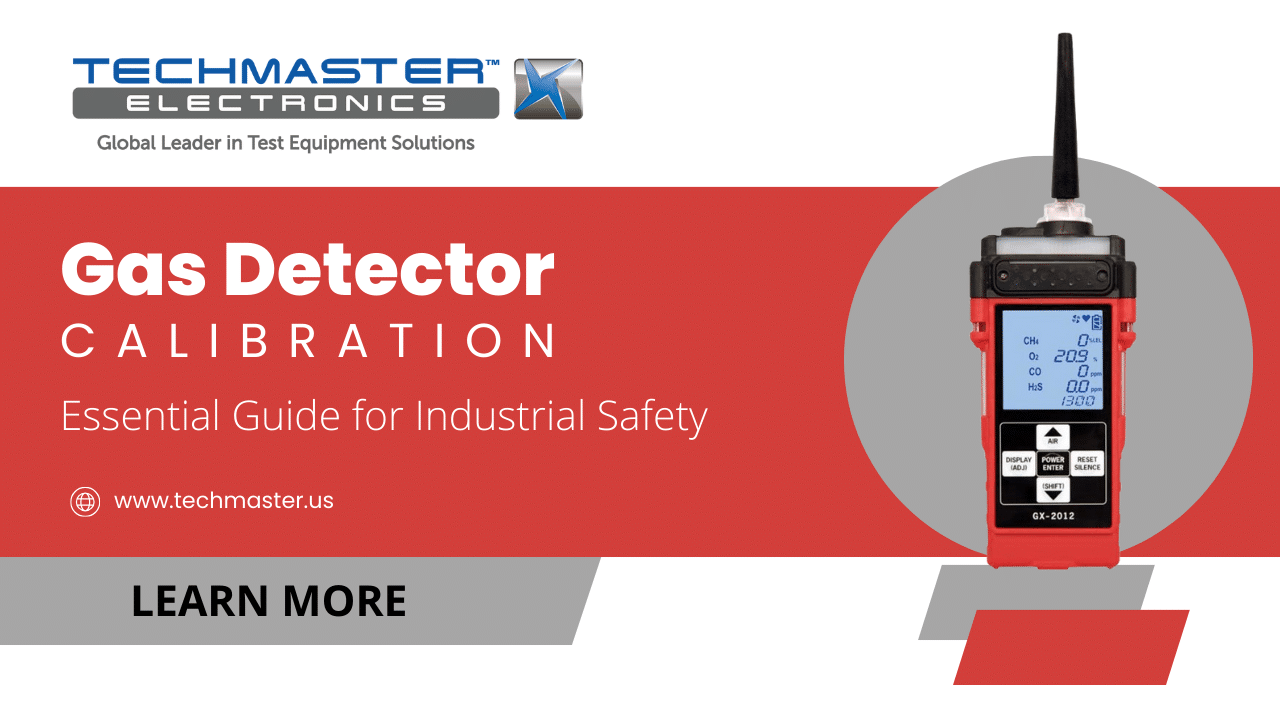
Gas Detector Calibration
Why calibration intervals matter
How Gas Detector calibration works
- Intake & visual inspection
- Environmental stabilization
- As-found measurement
- Comparison to NIST-traceable standards
- Adjustment if required
- As-left results & certificate
Your calibration, covered
In-lab vs on-site calibration
In-lab calibration
- Lab bench with full reference standards
- Best achievable measurement uncertainties
- Pickup & return logistics handled
- Ideal for precision and reference work
On-site calibration
- We calibrate the Gas Detector at your facility
- No shipping risk or transit downtime
- As-found data captured before any move
- Ideal for fixed, large or sensitive assets
In-depth guide
Gas Detectors: The Shield for Life and the Critical Necessity of Gas Detector Calibration
In hazardous working environments like mines, storage tanks, or chemical plants, the risk of toxic gas is always present. Often, these gases are colorless, odorless, and impossible to detect with human senses. A portable gas detector is the most important piece of personal protective equipment (PPE) in these zones. However, a gas detector can only protect workers if its readings are completely reliable. Sensor drift, environmental factors, and normal wear over time can all reduce accuracy without obvious signs of failure. This is why Gas Detector Calibration is a globally mandated safety standard, it ensures precise measurements, correct alarm activation, and dependable performance when lives are at risk.
This calibration falls under our chemical calibration service.
1. How Does a Gas Detector Work?

Modern gas detectors integrate multiple sensors into a compact device. These usually include electrochemical sensors, catalytic bead sensors, and infrared sensors.
The device works by constantly sampling the surrounding air. When gas concentrations exceed a safe limit, the device triggers alarms. These include loud sounds, flashing lights, and vibrations. However, these sensors are very sensitive to the environment. Dust, humidity, and physical impacts can reduce their sensitivity. Therefore, Gas Detector Calibration is required to realign the sensor’s response. This ensures the device alarms at exactly the right moment.
2. Diverse Industrial Applications of Gas Detectors
⚓
Confined Spaces
🛢️
Gas
⚒️
Mining
🚒
Emergency Response
Multi-gas detectors are essential tools in various extreme work scenarios:
2.1. Confined Space Entry
This is the most critical application. Before workers enter sewers, tanks, or ship hulls, they must test the air. Gas detectors identify oxygen deficiency or the presence of $H_2S$, $CO$, and explosive gases ($LEL$). Using a device that has passed Gas Detector Calibration prevents tragic suffocation accidents.
2.2. Oil, Gas, and Petrochemical Industry
At drilling rigs or refineries, the risk of methane and hydrocarbon leaks is high. Gas detectors find the smallest leaks before they become explosions. Technicians carry these devices to monitor their immediate work area constantly.
2.3. Mining and Tunneling
Underground, methane buildup can cause devastating dust explosions. Gas detectors help miners recognize danger so they can evacuate. In this environment, the accuracy of the device is a matter of life and death.
2.4. Firefighting and Emergency Response
When approaching a fire or a chemical spill, firefighters need to know if the environment is safe. Gas detectors help them determine the necessary level of protective gear before they enter a danger zone.
Sensor Sensitivity Decay (Illustrative)

3. Why is Gas Detector Calibration Mandatory?
📉
Sensor Drift
Restores accuracy lost due to aging.
🧪
Poisoning Detection
Identifies silicone & lead contamination.
⚖️
OSHA Compliance
Legal proof after incidents.
Many people wrongly assume that if a device turns on, it is working fine. In reality, Gas Detector Calibration is mandatory for several reasons:
-
Compensating for Sensor Drift: Gas sensors age naturally. Over time, their output signal weakens. Calibration compensates for this “drift” to maintain accuracy.
-
Detecting Sensor Poisoning: Certain chemicals, like silicone or lead, can permanently “poison” a sensor. Only calibration can reveal if a sensor is still reacting to the target gas.
-
Legal Compliance: Safety organizations like OSHA require periodic calibration of gas detection equipment. A valid calibration record is vital legal evidence if an accident occurs.
-
Preventing False Alarms: An uncalibrated device may trigger false alarms constantly. This causes workers to ignore the device. This “alarm fatigue” is dangerous when a real threat emerges.
4. The Difference Between a Bump Test and Full Calibration
Bump Test vs. Full Calibration

Users must understand these two distinct safety checks:
-
Bump Test (Function Check): This involves exposing the device to a small amount of gas to see if the alarms activate. This should be done daily before every shift.
-
Full Calibration (Technical Alignment): This is a deeper technical process. A technician adjusts the internal electronics so the reading matches a certified gas concentration. This is usually performed every 3 to 6 months.
Both procedures use calibration gas, but full calibration provides a much higher level of reliability.
5. The Professional Gas Detector Calibration Procedure
1️⃣
Inspection2️⃣
Zero Cal3️⃣
Span Cal4️⃣
T90 Timing5️⃣
A professional Gas Detector Calibration follows a strict set of steps:
-
Visual Inspection: Technicians check the casing, screen, and sensor filters. A dirty filter will slow down the device’s reaction time.
-
Zero Calibration: The device is placed in clean air or pure Nitrogen. This sets the “zero” point for toxic gases and 20.9% for Oxygen.
-
Span Calibration: The device is exposed to a certified gas mixture. The technician adjusts the sensor gain so the display matches the gas concentration in the cylinder.
-
Response Time Check ($T_{90}$): The lab measures how long it takes for the device to reach 90% of the gas value. If this takes too long, the sensor may be too old and needs replacement.
-
Certification and Tagging: Once finished, the device receives a calibration sticker. This shows the date of service and the next due date.
6. Maintenance Tips After Calibration
To maintain the results of your Gas Detector Calibration, follow these tips:
-
Proper Charging: Low battery levels can cause signal noise in the sensors. Always ensure a full charge before entering a work zone.
-
Avoid Dirty Environments: Use additional protective filters if working in very dusty areas.
-
Clean Regularly: Use a clean, damp cloth. Never use harsh chemicals, as they can damage the internal sensors.
-
Dry Storage: High humidity can damage sensitive circuits. Store the device in its specialized case when not in use.
Conclusion
A gas detector is more than a device, it is a lifeline in hazardous environments. But that protection is only effective when the detector is accurate. Over time, sensors drift, and without proper calibration, readings can no longer be trusted.
Regular gas detector calibration ensures reliable alarms, protects workers’ lives, and maintains compliance with safety regulations. Ignoring this process can turn a small technical issue into a serious incident with costly consequences.
Keep your gas detectors calibrated and ready, because when safety is on the line, accuracy is everything.
Gas Sensor and CO2 Sensor Calibration
A gas detector is only as good as the sensor inside it, and different gases need different sensing technologies. Each type ages in its own way:
| Sensor type | Typical gases | What drifts |
|---|---|---|
| Electrochemical | CO, H2S, O2, NO2, SO2, Cl2 | Sensitivity falls as the electrolyte is consumed; most cells last a few years |
| Catalytic bead (pellistor) | Combustible gases (%LEL) | Poisoned by silicones, lead and sulfur compounds, which reduces response without warning |
| Infrared (NDIR) | CO2, methane and other hydrocarbons | Stable sensitivity, but zero drifts with optics contamination and lamp aging |
| Photoionization (PID) | VOCs | Lamp output and window fouling change the response |
How a sensor calibration is done
Each sensor is zeroed in clean air or zero gas, then exposed to certified calibration gas near its alarm set point, at the flow rate the manufacturer specifies. The as-found reading is recorded before any adjustment. Response time is checked, and the alarms are confirmed to trigger at their set points. The calibration gas cylinder is part of the traceability chain, so its certificate, concentration and expiry date belong in the record.
CO2 sensors: building, incubator and safety monitors
CO2 sensors are almost always NDIR. Building and HVAC sensors often use automatic baseline correction, which assumes the room returns to outdoor levels (around 400 ppm) at some point each day. In spaces that never empty, that assumption pulls readings low. CO2 incubators are verified at their working set point, commonly 5%, with an independent analyzer or certified gas. Safety monitors for CO2 storage areas are checked at the alarm levels your site uses.
Gas detector and sensor calibration is performed with certified gas mixtures traceable to NIST. Gas sensors are not listed on Techmaster’s ANAB scope, so certificates are NIST-traceable.
Frequently asked questions
What is Gas Detector Calibration?
How often should a Gas Detector be calibrated?
What standards apply to Gas Detector Calibration?
What is included on the certificate?
Can you calibrate the Gas Detector on-site?
Need Gas Detector calibration?
NIST-traceable calibration, fast turnaround, in-lab or on-site across the USA.
Contact us for a quoteReferences & industry standards
- ISO/IEC 17025 testing & calibration laboratory requirements
- NIST calibration services and measurement traceability
- A2LA / ANAB accreditation for calibration laboratories
External standards bodies. Techmaster Electronics is an ISO/IEC 17025-accredited, NIST-traceable calibration laboratory.

Khanh Nguyen is the Marketing Manager at Techmaster Electronics, a B2B marketing leader covering the test, measurement, and ISO/IEC 17025 accredited calibration industry in the United States.