
Superheat & Subcooling Calibration
Why calibration intervals matter
How Superheat & Subcooling calibration works
- Intake & visual inspection
- Environmental stabilization
- As-found measurement
- Comparison to NIST-traceable standards
- Adjustment if required
- As-left results & certificate
Your calibration, covered
In-lab vs on-site calibration
In-lab calibration
- Accredited bench with full reference standards
- Best achievable measurement uncertainties
- Pickup & return logistics handled
- Ideal for precision and reference work
On-site calibration
- We calibrate the Superheat & Subcooling at your facility
- No shipping risk or transit downtime
- As-found data captured before any move
- Ideal for fixed, large or sensitive assets
In-depth guide
Precision Thermal Management: The Ultimate Guide to Superheat & Subcooling Calibration
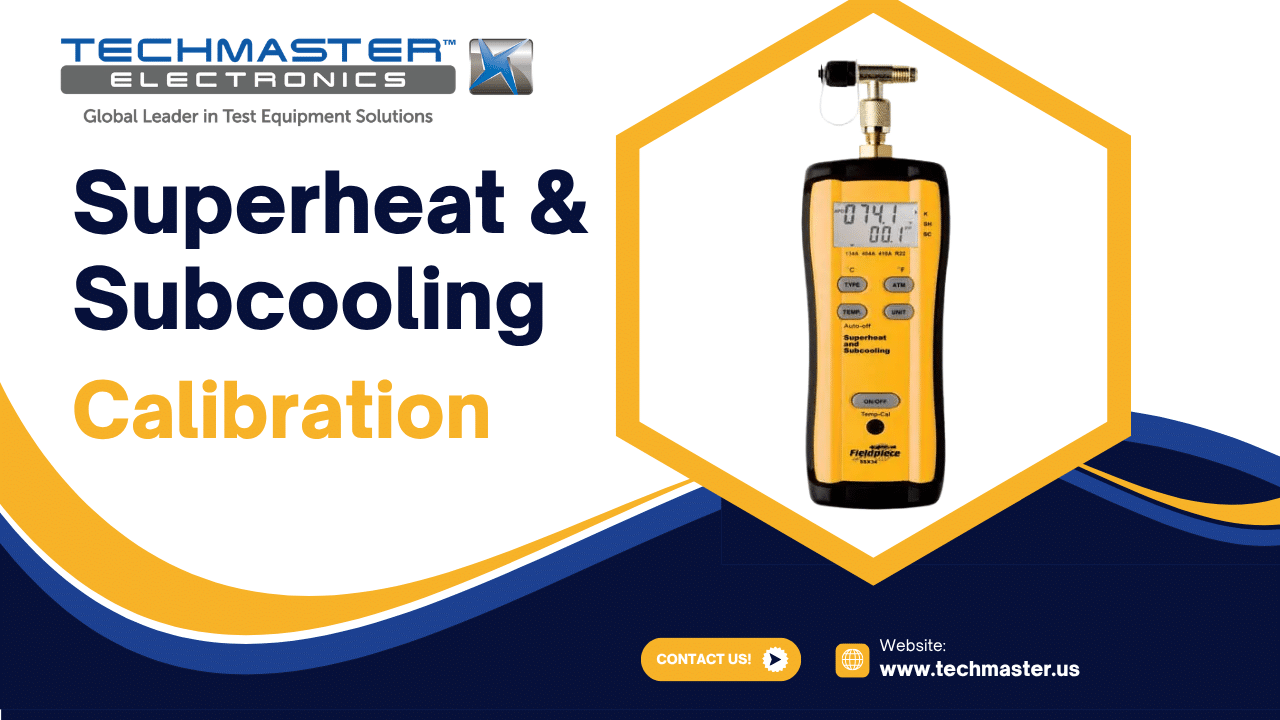
In the modern industrial landscape, temperature and pressure are the two most critical variables affecting product quality, safety, and operational consistency. For HVAC/R (Heating, Ventilation, Air Conditioning, and Refrigeration) systems, these variables manifest in two vital metrics: Superheat and Subcooling. To ensure these indices accurately reflect operational reality, professional technicians must prioritize Superheat & Subcooling Calibration for their diagnostic tools.
1. Understanding the Mechanics: How Precision Diagnostics Work
Superheat (SH)
Subcooling (SC)
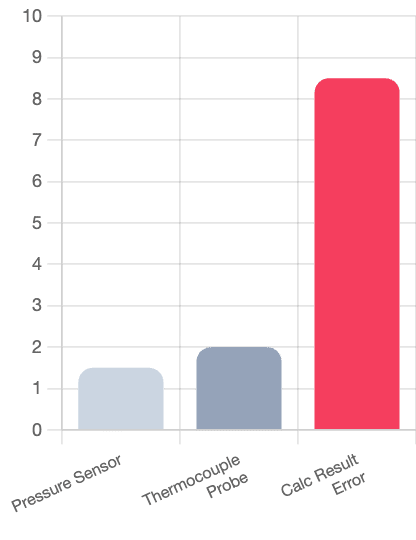
“Device error is a combination of pressure sensor drift and thermocouple inaccuracy. A small deviation in each can lead to a calculation error of over 10% in the final system analysis.”
Error Accumulation Analysis (%)
To appreciate the necessity of Superheat & Subcooling Calibration, one must first understand how digital manifolds and analyzers process thermal data:
-
Superheat Calculation: The device simultaneously measures suction line pressure, to derive the saturated evaporation temperature, and the actual temperature at the evaporator outlet. The difference between these two values is the Superheat.
-
Subcooling Calculation: The device measures liquid line pressure, to derive the saturated condensing temperature, and the actual temperature at the condenser outlet. This difference defines the Subcooling.
Because these parameters rely on the integration of pressure sensors and temperature probes, any minor inaccuracy or “electronic drift” in either sensor will lead to significant errors in the final calculated result.
2. Industrial Applications: Where Accuracy is Paramount
Compressor Protection
Prevents liquid slugging, significantly extending the service life of the compression mechanism.
Precise Charging
The gold standard for systems using Thermal Expansion Valves (TXV) and fixed orifices.
Efficiency Optimization
Maximizes evaporator surface usage, reducing monthly energy consumption and costs.
Fault Diagnosis
Identifies restricted valves, dirty coils, or inefficient compressor performance.
The monitoring of Superheat and Subcooling is utilized across a vast array of sectors, acting as the “brain” for complex thermal cycles:
2.1. Compressor Protection
Monitoring Superheat ensures that the refrigerant has completely vaporized before entering the compressor. This prevents “liquid slugging,” a condition where liquid refrigerant enters the compressor, potentially destroying internal mechanical components.
2.2. Precision Charging and System Efficiency
For systems with fixed orifices, Superheat is the primary indicator for a proper charge. Conversely, Subcooling is the “gold standard” for charging systems equipped with Thermal Expansion Valves (TXV). Accurate readings ensure the system utilizes its maximum surface area for heat exchange, significantly increasing cooling efficiency.
2.3. System Diagnostics and Maintenance
Anomalies in these readings help technicians quickly identify hidden issues. Whether it is a restricted expansion valve, dirty condenser coils, or an inefficient compressor, precise thermal data allows for deep analysis before a catastrophic failure occurs.
3. The Critical Role of Superheat & Subcooling Calibration
When to Calibrate?
Every 12 Months: Maintain stability for sensitive electronic components.
Thermocouple Change: Every probe has a unique thermal drift profile.
After Thermal Shock: Harsh environments can shift reference circuits.
Techmaster US
Premier calibration provider for HVAC/R instruments from Fieldpiece, Keysight, 3M, and more.
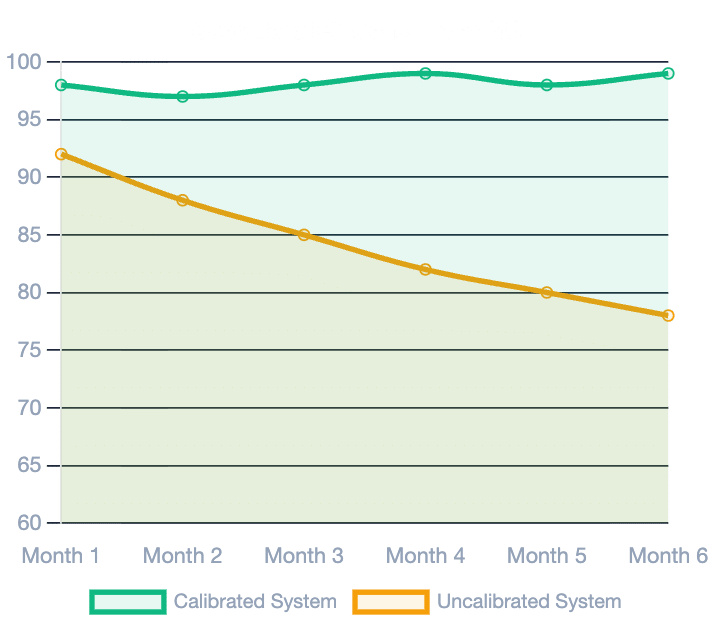
While modern diagnostic tools feature high-performance microprocessors, they are not immune to gradual loss of accuracy caused by environmental factors or component aging. Superheat & Subcooling Calibration addresses these issues through several core benefits:
-
Eliminating Cumulative Error: Accuracy errors are often a combination of drifts from both the pressure sensor and the thermocouple probe. Calibration synchronizes these sensors to ensure highest precision, typically within ±1°F.
-
Energy Efficiency and Operational Savings: A system with improper thermal points diminishes expansion efficiency and increases power consumption. Calibration allows technicians to return systems to their ideal operating points, extending equipment life.
-
Regulatory Compliance and Safety: Many industrial projects must adhere to strict international standards. Utilizing tools verified through professional calibration ensures compliance with ISO 9001 and ISO/IEC 17025, providing the documented evidence required by auditors.
4. When Should You Schedule Calibration?
When to Calibrate?
Every 12 Months: Maintain stability for sensitive electronic components.
Thermocouple Change: Every probe has a unique thermal drift profile.
After Thermal Shock: Harsh environments can shift reference circuits.
To maintain the integrity of your thermal systems, technicians should monitor specific milestones that indicate a need for professional Superheat & Subcooling Calibration:
-
Periodic Intervals (12 Months): A yearly check-up is the industry standard for maintaining the reliability of electronic sensors.
-
Sensor or Thermocouple Replacement: Whenever a new probe is installed, the device must be calibrated to ensure the new sensor-controller pair is perfectly synchronized.
-
Exposure to Extreme Environments: Physical shock, drops, or sudden thermal shock can shift the internal reference circuits of digital manifolds.
-
Inconsistent Results: If production yields show unexpected variations or the display values begin to jump, immediate verification is required.
Techmaster US: Your Leading Partner for Precision Calibration
Techmaster US is a premier provider of specialized calibration solutions for HVAC/R and industrial measurement equipment. We are committed to delivering absolute precision for your diagnostic tools through a team of highly skilled technicians and state-of-the-art facilities.
-
Diverse Capabilities: We offer expert calibration for leading brands such as Fieldpiece, Keysight, 3M, and Extech.
-
International Standards: Our protocols are strictly aligned with ISO 9001 and specifically ISO/IEC 17025 accredited standards.
-
Traceability Guaranteed: All measurement results ensure traceability to national and international standards, providing confidence for technically demanding projects.
-
Flexible Service: We provide calibration at our advanced centers or through convenient on-site support to minimize operational downtime for your business.
Choosing Techmaster US is an investment in safety, energy efficiency, and your brand reputation. Ensure your thermal measurements are infallible by partnering with the experts in metrology.
Techmaster US
Premier calibration provider for HVAC/R instruments.
Conclusion
Superheat & Subcooling Calibration is not simply about adjusting a measuring device, but about ensuring accuracy for the entire maintenance and operation process of the refrigeration system. A well-calibrated device is the foundation for creating durable, safe, and energy-efficient HVAC/R systems.Frequently asked questions
What is Superheat & Subcooling Calibration?
How often should a Superheat & Subcooling be calibrated?
What standards apply to Superheat & Subcooling Calibration?
What is included on the certificate?
Can you calibrate the Superheat & Subcooling on-site?
Need Superheat & Subcooling calibration?
ANAB-accredited, NIST-traceable, fast turnaround, in-lab or on-site across the USA.
Contact us for a quoteReferences & industry standards
- ISO/IEC 17025 testing & calibration laboratory requirements
- NIST calibration services and measurement traceability
- A2LA / ANAB accreditation for calibration laboratories
External standards bodies. Techmaster Electronics is an ISO/IEC 17025-accredited, NIST-traceable calibration laboratory.

Khanh Nguyen is the Marketing Manager at Techmaster Electronics, a B2B marketing leader covering the test, measurement, and ISO/IEC 17025 accredited calibration industry across the US and Vietnam markets.