Metrology guide · ISO/IEC 17025 · ANAB-accredited
Temperature Chamber & Oven Calibration…
Temperature Chamber & Oven Calibration verifies a Temperature Chamber & Oven against NIST-traceable standards under ISO/IEC 17025. Techmaster performs a documented multi-point check, reports measurement uncertainty, and issues an ANAB-accredited certificate, in-lab or on-site across the USA.
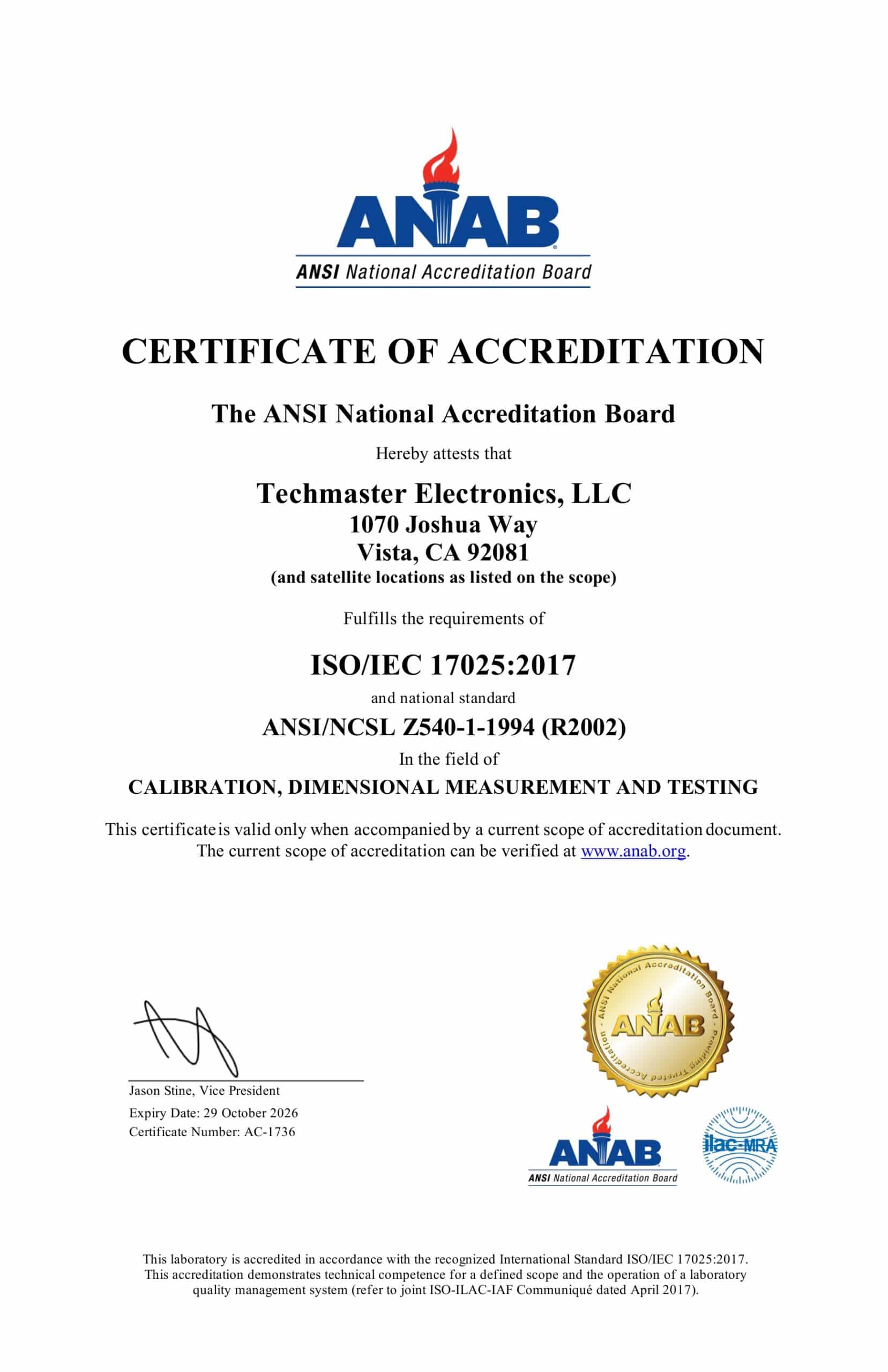
ANAB accredited ISO/IEC 17025 NIST traceable
ISO 17025Accredited method
NISTTraceability
12 moTypical interval
ANABAccreditation
In this guide
Why calibration intervals matter
Uncorrected drift creeps toward the tolerance limit over time; scheduled calibration resets it before measurements fall out of spec.
How Temperature Chamber & Oven calibration works
- Intake & visual inspection
- Environmental stabilization
- As-found measurement
- Comparison to NIST-traceable standards
- Adjustment if required
- As-left results & certificate
Your calibration, covered
In-lab calibrationAccredited bench service with pickup
On-site calibrationWe calibrate at your facility
Expedited turnaroundRush options to cut downtime
Accredited certificateANAB ISO 17025 with uncertainty
In-lab vs on-site calibration
In-lab calibration
- Accredited bench with full reference standards
- Best achievable measurement uncertainties
- Pickup & return logistics handled
- Ideal for precision and reference work
On-site calibration
- We calibrate the Temperature Chamber & Oven at your facility
- No shipping risk or transit downtime
- As-found data captured before any move
- Ideal for fixed, large or sensitive assets
In-depth guide
Precision Perfected: Temperature Chamber & Oven Calibration in Semiconductor & High-End Electronics Manufacturing
High-tech manufacturing sector is active and demanding. Here, precision is not just a goal; it’s the foundation of every operation. Temperature chambers and ovens are essential tools. Manufacturers use them throughout the complex production process, to dry, cure, anneal, and stress-test sensitive components such as microchips, circuit boards, sensors, and MEMS devices. Temperature Chamber & Oven Calibration plays a critical role in this process. Even a tiny temperature deviation can cause major problems, leading to significant defects, poor product performance, and substantial financial losses. Consequently, calibrating these vital thermal units is more than a compliance check, it is a fundamental need to ensure the quality, reliability, and success of advanced electronic products.Why Temperature Chamber & Oven Calibration is Vital in High-Tech Manufacturing
Precision is crucial in high-tech sectors. Accurate temperature control is a must. Calibrating thermal chambers and ovens ensures this precision at every step.
Ensuring Temperature Uniformity and Stability
- Precise Process Control: In semiconductor making, even small temperature changes can create structural defects. These can alter material properties or reduce chip performance. Calibration provides a detailed temperature map of the entire chamber. This ensures every point inside the unit reaches and holds the right temperature. This must be uniform and stable throughout the process.
- Key Process Needs: Processes like curing, photoresist drying, or thermal stress testing demand very precise temperature control. This prevents damage or faulty products.
Preventing Defects and Boosting Yield
- Fewer Imperfections: An uncalibrated oven might run at the wrong temperature. This could lead to overheated components (causing damage) or underheated ones (failing to finish processing). Such issues cause high defect rates. They also waste expensive raw materials.
- Optimized Production: Regular calibration finds and fixes temperature errors quickly. This makes sure all product batches are processed evenly. As a result, it boosts production yield and greatly cuts manufacturing costs.
Meeting Strict Industry Standards
- Regulatory Needs: The electronics and semiconductor industries follow tough international quality standards, like ISO 9001. They also follow specific component reliability testing standards (e.g., MIL-STD, JEDEC). These standards require all measuring and environmental control equipment (like ovens and chambers) to be calibrated regularly. In addition, all calibrations must be traceable to national standards (NIST-traceable).
- Global Market Access: Meeting these rules is vital for selling products worldwide. It also ensures success in audits and quality reviews by customers or regulators.
Guaranteeing Test Reliability

- Accurate Performance Checks: Companies use temperature chambers for aging tests and thermal cycling. These tests check the lifespan and strength of electronic parts under different conditions.
- Reliable Data: If a thermal chamber is not calibrated correctly, test data will be unreliable. This can lead to wrong product performance or lifespan estimates. Such errors pose big risks when the product is used in the real world.
Special Needs and Challenges in Semiconductor Calibration
Calibrating ovens and temperature chambers for high-end electronics faces tough demands. There are also unique challenges:- Very High Accuracy: Calibration processes and standard equipment need extremely high precision. This is often at a milli-degree Celsius level. This accuracy is vital for sensitive materials.
- Many Calibration Points: Calibration must happen at many different temperature points. These include ambient, high, and very high temperatures. For environmental chambers, very low temperatures are also key. Each point requires careful checking.
- Extensive Uniformity Mapping: Ensuring consistent temperature across a large volume inside the chamber is crucial. This is especially true for big industrial ovens with many product trays. Detailed thermal mapping, often using dozens of sensors, is necessary.
- Minimizing Downtime: Production line downtime is costly. So, calibration services must be efficient. They need quick service times without losing accuracy. This reduces disruptions to manufacturing schedules.
- Handling Sensitive Gear: Calibration experts must be highly skilled. They handle delicate and often costly semiconductor processing equipment. They ensure no damage happens during calibration.
Smart Solutions and Top Trends in Temperature Chamber & Oven Calibration
To meet these tough demands, the calibration industry is adopting advanced solutions and new trends:Advanced Multi-Point Mapping
Modern calibration uses deep multi-point mapping. This involves a dense network of temperature sensors. They are placed in key spots inside the chamber. This creates detailed 3D temperature profiles. It helps find any hot or cold spots. This detail is crucial for processes needing exact uniformity.Automated Data Logging and Analysis
Automation boosts efficiency and accuracy. Advanced systems automatically collect calibration data. They then use special software to check uniformity, stability, and other performance metrics. This reduces human errors and speeds up reports.Onsite Calibration: Maximizing Uptime
Onsite calibration services are growing. Service providers bring their standard equipment directly to the factory. This greatly cuts transport risks. More importantly, it keeps critical ovens and chambers running. It’s perfect for large, fixed, or highly integrated equipment.Risk-Based & Performance-Driven Calibration
Companies are moving away from fixed calibration dates. Instead, they use risk-based methods. Calibration frequency changes based on equipment drift data. It also considers how important the equipment is to production. This saves money by focusing resources on the most vital tools.Integrating Calibration Data with Digital Systems
Digital transformation is essential. Integrating calibration data directly into electronic Quality Management Systems (eQMS) is becoming standard. This allows easy tracking and clear calibration data. It also helps meet audit rules from bodies like the FDA.Emerging Technologies: IoT & AI for Smart Calibration
The future of thermal calibration is smart.- IoT Integration: Internet of Things (IoT) sensors are placed in or near temperature chambers. They provide real-time remote monitoring of the units. This data helps find the best times for calibration. It also shows potential drift before it affects production.
- AI for Predictive Maintenance: Artificial Intelligence (AI) and Machine Learning (ML) analyze past calibration data and live sensor readings. They can predict when a chamber might go out of limits. This allows for scheduled calibration, preventing costly unplanned stops. It also ensures continuous precision.
Conclusion: Partnering for High-Tech Future
Calibrating ovens and temperature chambers in semiconductor and high-end electronics manufacturing is a unique field. It demands extreme accuracy and strict rule-following. Investing in top-quality calibration services from trusted partners is therefore key. It ensures product quality, smooth operations, and a strong edge in the fast-paced, high-tech industry. By using advanced calibration methods and working with experts who understand your specific manufacturing needs, you can ensure your thermal processing equipment always gives accurate results. This protects your products, simplifies operations, and keeps you at the forefront of innovation. Contact Techmaster Electronics today for advanced temperature chamber and oven calibration services, expert consultation, and solutions tailored to your specific semiconductor and electronics manufacturing needs.Frequently asked questions
What is Temperature Chamber & Oven Calibration?
Temperature Chamber & Oven Calibration is the documented comparison of a Temperature Chamber & Oven against NIST-traceable reference standards under ISO/IEC 17025, measuring its error and measurement uncertainty and confirming it performs within tolerance.
How often should a Temperature Chamber & Oven be calibrated?
Most quality systems calibrate a Temperature Chamber & Oven every 12 months, and sooner after repair, overload or heavy use. Follow the manufacturer specification and your ISO 9001/13485/AS9100 program.
What standards apply to Temperature Chamber & Oven Calibration?
Calibration is performed under ISO/IEC 17025 with NIST-traceable references and the relevant manufacturer specification. Techmaster is ANAB-accredited.
What is included on the certificate?
An ANAB-accredited ISO/IEC 17025 certificate with as-found and as-left results and the measurement uncertainty for each point.
Can you calibrate the Temperature Chamber & Oven on-site?
Yes. Techmaster offers in-lab calibration with pickup and on-site service across the USA to minimize downtime.
Need Temperature Chamber & Oven calibration?
ANAB-accredited, NIST-traceable, fast turnaround, in-lab or on-site across the USA.
Contact us for a quoteReferences & industry standards
- ISO/IEC 17025 testing & calibration laboratory requirements
- NIST calibration services and measurement traceability
- NIST Thermodynamic Metrology Group
- A2LA / ANAB accreditation for calibration laboratories
External standards bodies. Techmaster Electronics is an ISO/IEC 17025-accredited, NIST-traceable calibration laboratory.

Khanh Nguyen is the Marketing Manager at Techmaster Electronics, a B2B marketing leader covering the test, measurement, and ISO/IEC 17025 accredited calibration industry in the United States.