
Metrology guide · ISO/IEC 17025 · ANAB-accredited
Thermal Imager Calibration
Thermal Imager Calibration verifies a Thermal Imager against NIST-traceable standards under ISO/IEC 17025. Techmaster performs a documented multi-point check, reports measurement uncertainty, and issues an ANAB-accredited certificate, in-lab or on-site across the USA.
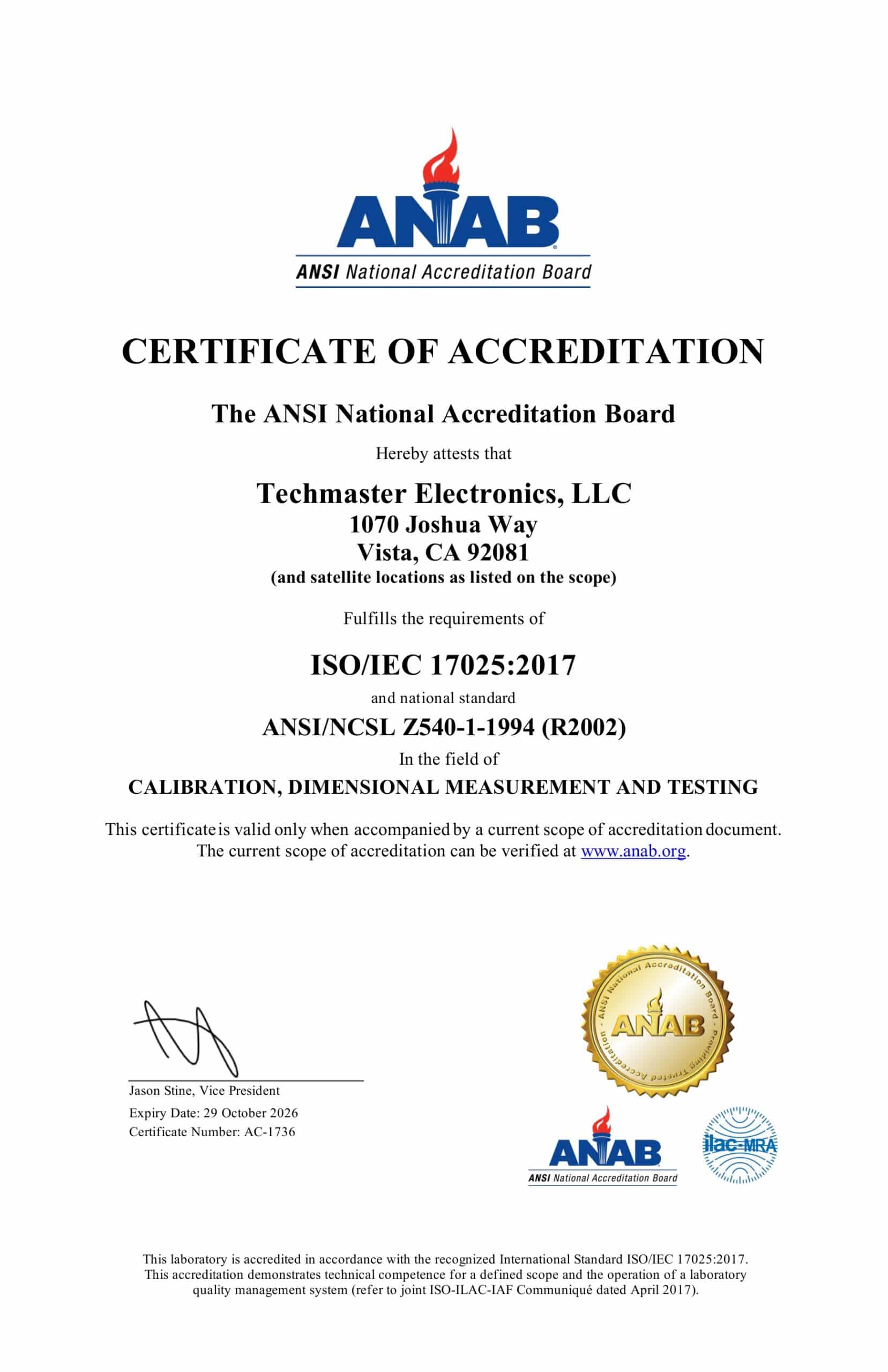
ANAB accredited ISO/IEC 17025 NIST traceable
ISO 17025Accredited method
NISTTraceability
12 moTypical interval
ANABAccreditation
In this guide
Why calibration intervals matter
Uncorrected drift creeps toward the tolerance limit over time; scheduled calibration resets it before measurements fall out of spec.
How Thermal Imager calibration works
- Intake & visual inspection
- Environmental stabilization
- As-found measurement
- Comparison to NIST-traceable standards
- Adjustment if required
- As-left results & certificate
Your calibration, covered
In-lab calibrationAccredited bench service with pickup
On-site calibrationWe calibrate at your facility
Expedited turnaroundRush options to cut downtime
Accredited certificateANAB ISO 17025 with uncertainty
In-lab vs on-site calibration
In-lab calibration
- Accredited bench with full reference standards
- Best achievable measurement uncertainties
- Pickup & return logistics handled
- Ideal for precision and reference work
On-site calibration
- We calibrate the Thermal Imager at your facility
- No shipping risk or transit downtime
- As-found data captured before any move
- Ideal for fixed, large or sensitive assets
In-depth guide
Thermal Imager: The Comprehensive Diagnostic Tool and The Absolute Role of Calibration

1. How the Thermal Imager Works and Its Core Benefits

1.1. Basic Principles
A thermal imager is an optical device utilizing a specialized sensor array (microbolometer). This array detects the infrared radiation (heat) emitted by all objects. Each pixel on the sensor records the intensity of the thermal radiation and converts it into an electrical signal. Subsequently, the image processor creates a thermal map, displayed as a colored image, where each color corresponds to a certain temperature range.- Non-Contact Measurement: Absolute safety when inspecting objects with high temperatures, dangerous voltages, or moving parts.
- Early Problem Detection: “Seeing” temperature changes is the first indication of a fault, allowing intervention before breakdown occurs.
- Night/Smoke Visibility: Since it measures thermal radiation rather than visible light, the thermal imager works well in darkness, fog, or smoke.
🔥🖼️
Converts invisible thermal energy into visible information
1.2. The Difference Between a Thermal Imager and an IR Thermometer
| Feature | Thermal Imager | IR Thermometer |
|---|---|---|
| Result Format | Thermal image (temperature map of area) | Numerical value at a single point |
| Measurement Area | Entire surface or scene | Single spot |
| Resolution | Pixel-by-pixel analysis (spatial detail) | No spatial resolution |
| Purpose | Diagnosis, visualization, detection | Point measurement |
2. Expanded Diverse Applications of the Thermal Imager
A thermal imager is a versatile diagnostic tool, widely applied across various industries and specialized fields.⚡
Electrical Systems
- Detect loose connections or high resistance.
- Identify overload or load imbalance.
⚙️
Mechanical Maintenance
- Diagnose friction in bearings or gearboxes.
- Check fluid levels and pipeline blockages.
🏠
Construction & Energy Audit
- Detect insulation failure or energy loss.
- Find water leaks via cold spots.
2.1. Electrical System Inspection (Electrical Inspection)
This is one of the most common and high-value applications.- Hot Spot Detection: The thermal imager quickly identifies abnormal hot spots on energized electrical equipment. These hot spots are indicative of:
- Loose Connections: Causing high resistance and temperature increase at the contact point.
- Overloading and Phase Imbalance: Detecting temperature differences between phases in three-phase systems, which can damage motors.
- Fire and Incident Prevention: Early detection of thermal issues allows for timely maintenance planning, preventing fires, power outages, and costly damages.
2.2. Mechanical Maintenance
- Friction and Failure Diagnosis: Detects elevated temperatures in moving mechanical parts (such as bearings, gearboxes, pumps, motors). High temperature is a sign of excessive friction, lack of lubrication, misalignment, or wear.
- Tank and Pipe Inspection: Checks the level of fluid, sludge, or gas inside sealed tanks. It also identifies areas of restricted flow or blockage in pipes by observing temperature shifts.
2.3. Building and Energy Auditing
- Insulation Inspection: Identifies defects in wall, roof, and floor insulation. Abnormal cold/hot spots reveal energy loss, helping improve the building’s energy efficiency.
- Water Leak and Moisture Detection: Locates damp areas or water leaks. Evaporating water often cools the surface, creating visible cold spots on the thermal image.
3. Practical Applications in Public Safety and Specialized Fields
🚒
Firefighting & Rescue
Helps firefighters see through smoke, locate victims, and identify heat sources quickly.🔒
Security & Surveillance
Monitors large areas in darkness, fog, or foliage by detecting human body heat.🩺
Medical Thermography
Detects inflammation or abnormal circulation through temperature distribution imaging.- Firefighting: Helps firefighters see through thick smoke. It is used to locate victims and precisely identify the heat source (hot spot) of the fire for effective suppression.
- Security and Surveillance: Assists in monitoring large areas or security fences in total darkness, fog, or dense foliage by detecting body heat.
- Medical (Medical Thermography): Used to detect issues related to blood circulation, inflammation, or areas of increased metabolic activity (related to tumors) through the distribution of skin temperature in medical diagnostics.
4. The Key role of Thermal Imager Calibration
Illustration 1: Error due to Incorrect Emissivity

Illustration 2: Sensor Drift Over Time

4.1. Ensuring Absolute Accuracy and Reliable Analysis
- Fundamental Principle: The thermal imager must be tested and compared against standard heat sources (Blackbody Radiators) across various temperature ranges. This ensures that every pixel on the thermal image accurately corresponds to the true temperature value.
- Avoiding Misdiagnosis: An uncalibrated thermal imager can display temperature inaccuracies. This leads to false diagnoses (e.g., overlooking a critical hot spot) and incorrect maintenance decisions, wasting resources.
4.2. Compliance with Standards and Legal Requirements
- Traceability Certificate: Periodic calibration provides a traceability certificate. This document is essential evidence in quality audits (ISO 9001), safety inspections, and industry regulations (especially in medical and firefighting fields).
- Emissivity Check: Calibration helps verify and correct the optical parameters of the device.
4.3. Calibration Frequency and Performance Maintenance
- Recommended Frequency: Most manufacturers and certifying bodies recommend calibrating the thermal imager at least once every 12 months (annually).
- Abnormal Recalibration: The device should be recalibrated immediately after a drop, severe impact, signs of unstable operation, or after major repairs. This ensures optimal measurement performance is maintained.
Conclusion
The Thermal Imager is a powerful and versatile diagnostic tool, providing benefits not only in industry but also in public safety and medical fields. It converts invisible heat energy into visible information, helping detect problems early and make timely decisions. However, to fully exploit this potential and ensure all data is reliable, routine Thermal Imager Calibration is a mandatory investment. This practice not only ensures regulatory compliance but also protects assets, minimizes risks, and contributes to the sustainable safety and efficiency of all industrial operations.THERMAL IMAGER CALIBRATION FREQUENCY
🗓️ RECOMMENDED (12 MONTHS)
💥 AFTER SEVERE IMPACT
🔧 AFTER MAJOR REPAIR
Frequently asked questions
What is Thermal Imager Calibration?
Thermal Imager Calibration is the documented comparison of a Thermal Imager against NIST-traceable reference standards under ISO/IEC 17025, measuring its error and measurement uncertainty and confirming it performs within tolerance.
How often should a Thermal Imager be calibrated?
Most quality systems calibrate a Thermal Imager every 12 months, and sooner after repair, overload or heavy use. Follow the manufacturer specification and your ISO 9001/13485/AS9100 program.
What standards apply to Thermal Imager Calibration?
Calibration is performed under ISO/IEC 17025 with NIST-traceable references and the relevant manufacturer specification. Techmaster is ANAB-accredited.
What is included on the certificate?
An ANAB-accredited ISO/IEC 17025 certificate with as-found and as-left results and the measurement uncertainty for each point.
Can you calibrate the Thermal Imager on-site?
Yes. Techmaster offers in-lab calibration with pickup and on-site service across the USA to minimize downtime.
Need Thermal Imager calibration?
ANAB-accredited, NIST-traceable, fast turnaround, in-lab or on-site across the USA.
Contact us for a quoteReferences & industry standards
- ISO/IEC 17025 testing & calibration laboratory requirements
- NIST calibration services and measurement traceability
- A2LA / ANAB accreditation for calibration laboratories
External standards bodies. Techmaster Electronics is an ISO/IEC 17025-accredited, NIST-traceable calibration laboratory.

Khanh Nguyen is the Marketing Manager at Techmaster Electronics, a B2B marketing leader covering the test, measurement, and ISO/IEC 17025 accredited calibration industry across the US and Vietnam markets.