
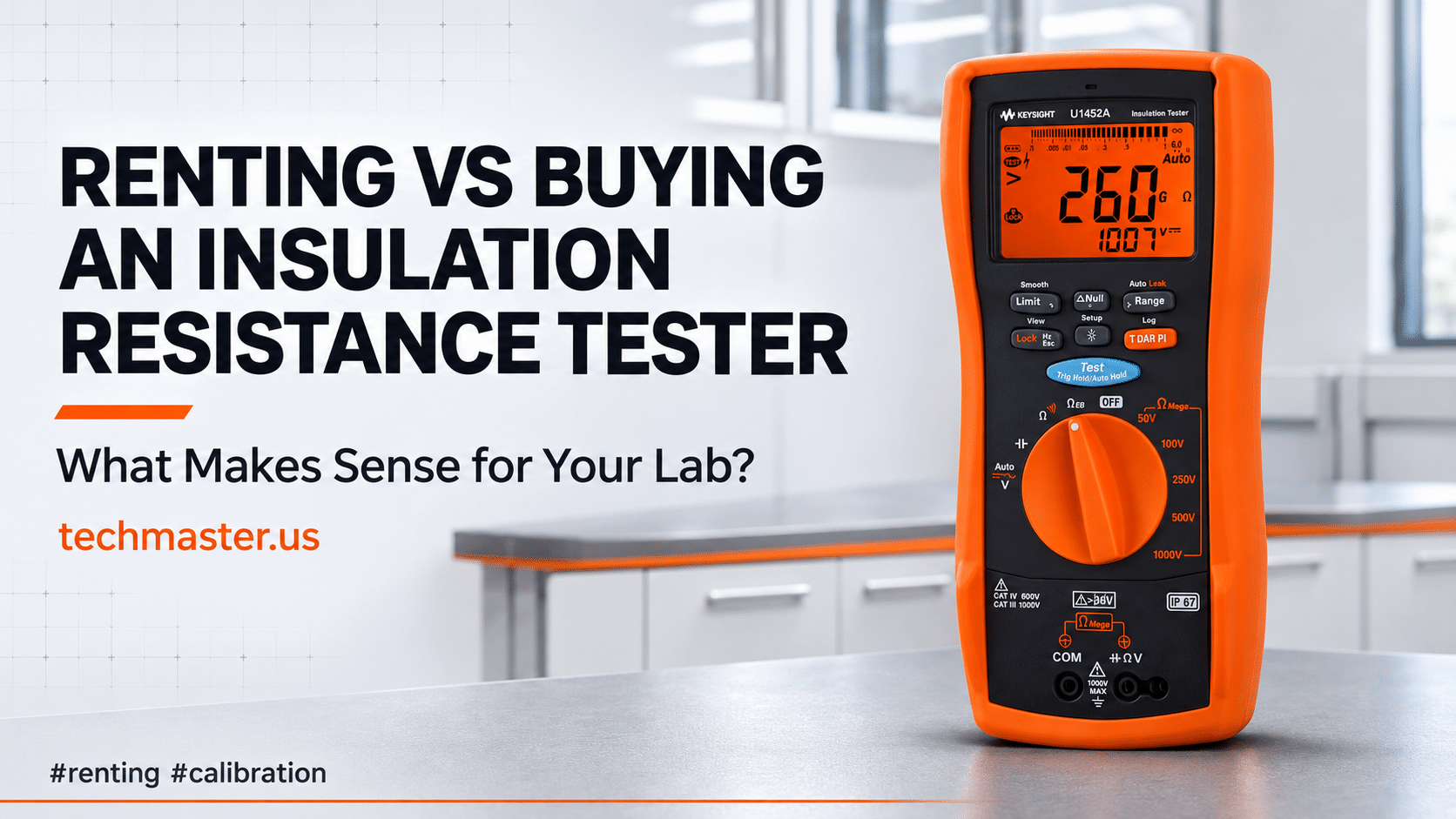
Rent vs Buy an Insulation Resistance Tester

November 27, 2026
Rent vs Buy an Insulation Resistance Tester — Techmaster ISO 17025 calibration Rent an insulation resistance tester for a defined project, temporary replacement, or occasional need when an acceptable unit is available. Buy when recurring demand, scheduling control, or a standardized fleet justifies ownership. In both cases, verify the exact model and certificate against your test procedure.

1. When should you rent vs. buy an insulation resistance tester?
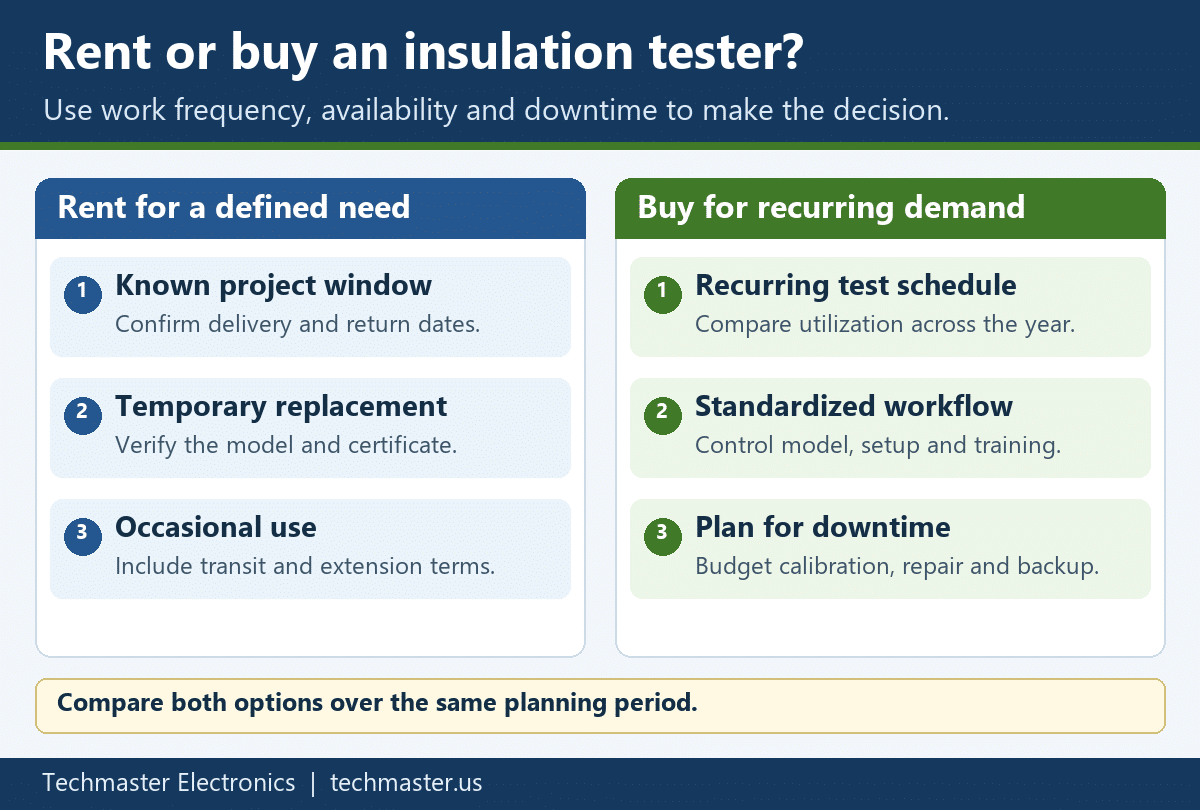
Rent or buy an insulation tester?. Use work frequency, availability and downtime to make the decision.. Rent for a defined need: Known project window, Temporary replacement, Occasional use. Buy for recurring demand: Recurring test schedule, Standardized workflow, Plan for downtime.
Compare both options over the same planning period.
Start with the work schedule. List the jobs that require the instrument, the days it must be available, and which jobs might overlap. A rental can fit a defined project with a known start and return date. Ownership becomes more attractive when an instrument supports recurring work and delays would interrupt operations. If several teams share the tester, compare the cost and availability of separate units against a shared schedule. Include receiving and return time. A project may need the meter for three days but require it on site earlier for documentation review and setup. Add time to receive accessories, resolve discrepancies, and return the unit after the last shift. Ask for availability in writing before committing to a schedule that depends on a rental.

2. Which technical requirements apply to either choice?

Requirement What to verify
DC test voltage settings The settings specified by the work instruction are available on the exact model.
Resistance measurement The range and applicable accuracy support decisions near the acceptance threshold.
Accessories Required leads, probes, or other accessories are included and suitable for the application.
Documentation The certificate identifies the actual unit and relevant measurements for the job.
Data handling The instrument can provide the records your procedure requires, using an approved workflow.
Use the manufacturer’s instructions for the exact model. For example, the Fluke 1550C/1555 user manual describes model-specific operating modes and safety requirements. A substitution can change the available functions, interfaces, or accessories even when the supplier describes both models as insulation testers. Have the technical owner review substitutes before the unit ships.

3. How should you compare total costs?

For a rental, request the rate, minimum term, shipping costs, and extension terms. Ask when billing starts, when it stops, and what happens if the project ends early or shifts by a week. Include administrative time for receiving, certificate review, coordination, and return. For ownership, count acquisition, calibration, preventive care, repair, storage, accessories, and the cost of covering downtime. If the organization already has a calibration and asset program, use its actual costs and workload as inputs. Evaluate both options over the same planning period. Include the expected number of jobs and the cost of an unavailable instrument. Keep uncertain items separate so you can see which assumptions change the decision. Try a low-use and a high-use case. If the outcome changes with a small shift in the number of jobs, a short rental can provide evidence about actual usage before purchase. If repeat work is already booked and rental terms expose the team to frequent extensions or shortages, include that exposure in the purchasing decision.

4. What should the receiving team check before use?
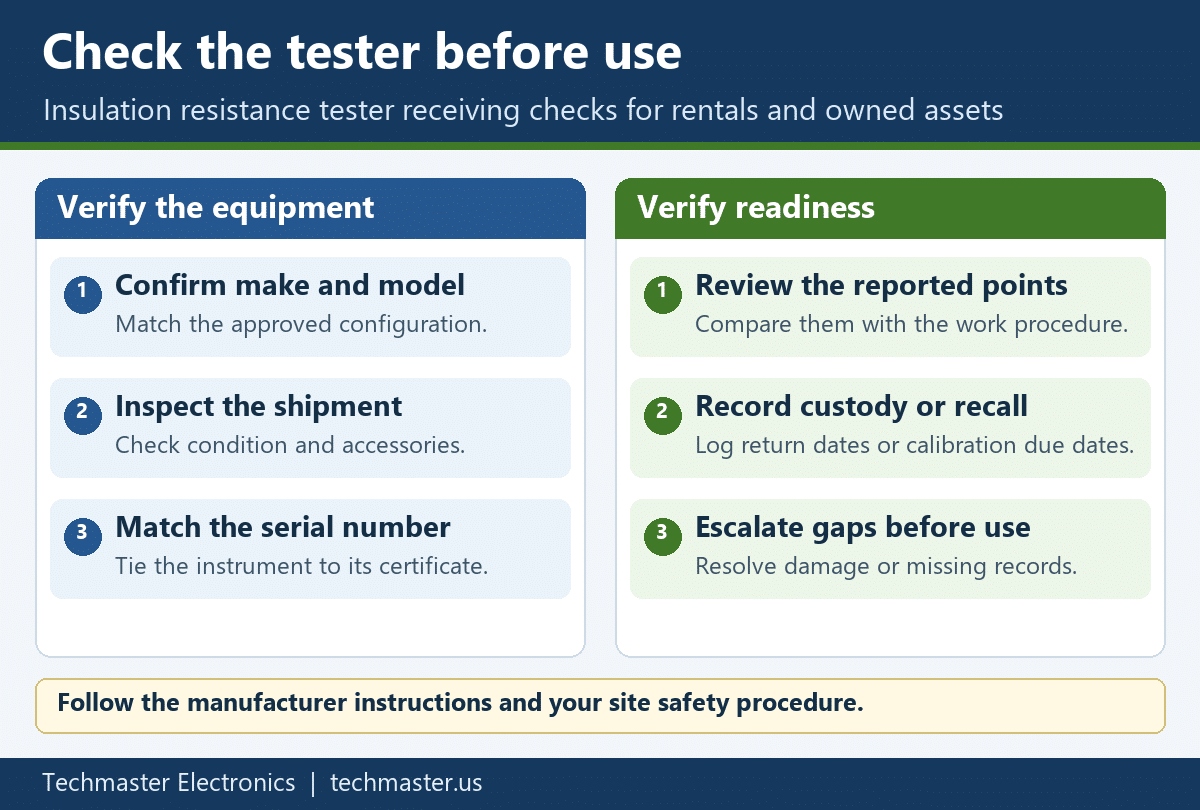
Check the tester before use. Insulation resistance tester receiving checks for rentals and owned assets. Verify the equipment: Confirm make and model, Inspect the shipment, Match the serial number. Verify readiness: Review the reported points, Record custody or recall, Escalate gaps before use.
Follow the manufacturer instructions and your site safety procedure.
Review the certificate against the serial number and the measurement points required for the job. If accredited results are required, confirm the applicable scope and performing location before relying on the report. Inspect the package for the agreed accessories and evidence of handling damage. Use the manufacturer’s current instructions and local safety procedure for any pre-use checks. Escalate unexplained damage or documentation gaps before assigning the unit to work. For rentals, record custody, the return date, and the condition on receipt. Name the person who can authorize an extension or substitution. For owned assets, enter the instrument into your recall and maintenance system. Techmaster’s calibration interval guide explains how to document calibration decisions using asset history and operating risk.

5. Example: A shutdown project and a recurring bench check

Suppose a plant needs an insulation tester for a planned outage and has no confirmed demand afterward. The maintenance lead obtains a rental quote for the expected work window. The quote spells out the exact model, documentation, accessories, and extension terms. Receiving schedules time to inspect the package before the outage. The lead also identifies who can approve a substitute if the selected unit becomes unavailable. A second team uses an insulation tester at a fixed bench throughout the year. It wants operators to follow one controlled setup and has a spare or alternate bench during calibration. Ownership can fit this pattern because the team controls availability, configuration, and training. The team includes calibration, service, and coverage during downtime in its cost comparison.

6. What belongs in the decision record?

Record who needs the instrument, how often the work occurs, the cost assumptions, and which specifications are mandatory. Include the planned procedure, model or approved substitutes, certificate needs, and the person responsible for confirming availability. For a rental, record the deadline for making an extension decision. For a purchase, record how the team will maintain readiness during service and when it will review actual utilization. After the first job or quarter, compare the assumptions with what happened. If the team repeatedly extends rentals, investigate whether scope changes or scheduling caused the extra use. If owned equipment spends most of its time idle, check whether sharing or a rental would cover predictable work. Use the data to update the next decision.

7. How Often Should This Equipment Be Calibrated?

Managing Calibration Intervals: Owned vs. Rental Meters

Set defensible recall schedules for owned insulation resistance testers, verify certificate coverage for rentals, and document interval reviews using ILAC-G24:2022 methods.

1. Baseline Guidance & Review Triggers

Start with the manufacturer’s guidance for the exact insulation resistance tester and any applicable contract, customer, or quality-system requirements. Record the due date and the reason for it. Review the interval when the instrument’s use, handling, or importance to a pass/fail decision changes.

2. Owned vs. Rental Meter Intervals

For an owned meter, record its recall interval using manufacturer guidance, applicable requirements, and performance history. For a rental, confirm the certificate is acceptable through the planned return date and reassess it if the project extends.

3. Approval & ILAC-G24:2022 Methods

Document who approves any interval change and what will trigger another review. ILAC-G24:2022 provides methods for setting and reviewing recalibration intervals from equipment history.

Interval Control Profile

1. Dependence on Equipment History
OWNED
Long-Term
RENTAL
Cert-Bound
2. Coverage Window Horizon
OWNED
Recall Cycle
RENTAL
Return Date
3. Reassessment Sensitivity
OWNED
Use/Handling
RENTAL
Extensions
Governance Rule: Always log the interval rationale, the designated approver, and review triggers aligned with ILAC-G24:2022.
* Illustrative profile comparing interval control priorities between owned and rented insulation testers.

Calibration Interval Controls: Owned vs. Rental Meter

Control Factor Owned Meter Rental Meter
Interval basis Manufacturer guidance, applicable requirements, and performance history Confirm certificate acceptability through the planned return date
Review trigger Changes in use, handling, or importance to a pass/fail decision Project schedule extends beyond the planned return date
Governance Record due date, rationale, approver, and apply ILAC-G24:2022 methods Document certificate review and reassess before approving extensions

8. What to Look for in a Calibration Provider

Compare certificate coverage against the settings your procedure calls for, then check how the provider manages adjustment and as-found results. Use the same criteria whether the instrument comes from a rental fleet or your own inventory. If accredited calibration is required, check that the current ISO/IEC 17025 scope covers the required measurements at the performing facility. Ask for a sample report that shows how the lab documents test points, results, and uncertainty. Specify whether you need as-found and as-left readings or a statement of conformity with an agreed decision rule. Confirm the time from shipment to return, including approval for extra work and certificate review. Ask how the lab will notify you if the instrument needs adjustment or if a requested point cannot be verified.

9. Techmaster Equipment Rental Services

Renting vs. Buying an Insulation Resistance Tester

Plan for shutdowns or production spikes, verify your approved test configuration, and complete receiving checks before committing to a rental or purchase.

Short-term projects and temporary capacity

Techmaster lists megohmmeters for rental. A rental may make sense when a shutdown or temporary production spike creates a short-term need. Ask about the proposed model, dates, shipping, and extension terms before building the rental into your operating plan.

Evaluate the configuration before purchasing

Use the rental period to check the approved model, voltage settings, accessories, and work dates. If the proposed configuration differs from what you plan to buy, identify the options and accessories that would change the outcome of the evaluation.

Certificate and receiving checks

Request the calibration certificate for the assigned serial number and compare the reported points with your procedure. Allow time to review documentation, inspect accessories, and run the incoming checks your team requires.

Buy vs. Rent Decision Profile

1. Upfront Cost Commitment
BUY
Capital
RENT
Term-Based
2. Short-Term Capacity Flexibility
BUY
Recurring
RENT
On-Demand
3. Pre-Use Readiness Speed
BUY
Setup Cycle
RENT
Dispatch+QA
Planning Tip: Always allow buffer time to match the assigned serial number’s certificate and inspect leads before starting shutdown work.
* Illustrative profile comparing upfront commitment, temporary capacity, and time-to-use readiness.

Renting and buying an insulation resistance tester

Decision factor Buy Rent
Upfront cost Purchase price and required options Rental term, shipping, and possible extensions
Capacity Control access to a unit for recurring work Add capacity for a defined window if available
Time to use Allow for delivery, setup, and acceptance Confirm dispatch, certificate, and receiving checks

10. Why Choose Techmaster Electronics?

Techmaster Electronics has worked with electronic test equipment since 1989. Its US services include calibration, repair, and equipment rentals, which gives teams a place to discuss the service and temporary equipment needs together. Ask Techmaster to discuss rental options and calibration requirements against the same written brief. Request the proposed model and accessories, available dates, and certificate details so your team can assess both readiness and total cost. If accredited results are required, confirm that the current ANAB scope for certificate AC-1736 covers the required measurement and performing location before authorizing work.

11. Conclusion

Use the real job calendar and the same planning period for both options. Choose the one that covers the required work and gives receiving a clear way to verify the instrument before use.

12. FAQs

Frequently Asked Questions

Is rental always cheaper for a short job?
Compare the full rental window, including transit, receiving, shipping, and possible extensions, with the realistic alternatives.
Can I accept a substitute model?
Have the technical owner check the required settings, functions, accessories, records, and certificate before approving the substitute.
Should I reserve the unit before the job starts?
Build in time for receiving and certificate review. Confirm the delivery commitment before scheduling work that depends on the instrument.
Does a rental certificate guarantee every range is covered?
Review the serial number and reported points against the job. The report may include fewer functions or settings than your procedure requires.
What if the work expands after the rental arrives?
Check whether the current unit and documentation cover the added work. Confirm availability and cost before extending or changing the rental.

Planning Your Equipment Rental?

Contact Techmaster with your test requirements and work dates to discuss equipment options and documentation.

Contact Techmaster Today

Frequently asked questions

What is insulation resistance tester calibration?

Insulation Resistance Tester Calibration is the documented comparison of a insulation resistance tester against NIST-traceable reference standards under ISO/IEC 17025. It quantifies the insulation resistance tester’s error and measurement uncertainty and confirms it performs within tolerance, with as-found and as-left data on the certificate.

How often should a insulation resistance tester be calibrated?

Most quality systems calibrate a insulation resistance tester every 12 months, or sooner after repair, overload, or before critical measurements. Set your interval from the manufacturer spec and your ISO 9001 / 13485 / AS9100 program and drift history.

Is Techmaster’s insulation resistance tester calibration ISO 17025 accredited?

Yes. Techmaster Electronics is ISO/IEC 17025:2017 accredited by ANAB (Certificate AC-1736). Every insulation resistance tester calibration is NIST-traceable and issued with a full measurement-uncertainty budget.

What is the turnaround for insulation resistance tester calibration?

Standard turnaround is 5 business days, with 1–2 business-day expedite available. On-site calibration removes shipping time entirely for insulation resistance testers that can’t leave the floor.

Do you calibrate insulation resistance testers on-site or in-lab?

Both. Techmaster runs five US labs (Vista CA, Santa Clara CA, Orlando FL, San Antonio TX, Holly Springs NC) and offers nationwide on-site insulation resistance tester calibration to minimize downtime.

Calibration labs near you: Techmaster Electronics is an ISO/IEC 17025 accredited calibration laboratory (ANAB Certificate AC-1736) with accredited labs in Vista, CA, Santa Clara, CA, Orlando, FL and San Antonio, TX, plus a lab in Holly Springs, NC. Accredited parameters vary by lab; compare locations or request a quote.

Khanh Nguyen

Khanh Nguyen

Khanh Nguyen is the Marketing Manager at Techmaster Electronics, a B2B marketing leader covering the test, measurement, and ISO/IEC 17025 accredited calibration industry in the United States.

Request a Quote