
Ring Gage Calibration
Accuracy across the range
How Ring Gage calibration works
- Intake & visual inspection
- Environmental stabilization
- As-found measurement
- Comparison to NIST-traceable standards
- Adjustment if required
- As-left results & certificate
Your calibration, covered
In-lab vs on-site calibration
In-lab calibration
- Accredited bench with full reference standards
- Best achievable measurement uncertainties
- Pickup & return logistics handled
- Ideal for precision and reference work
On-site calibration
- We calibrate the Ring Gage at your facility
- No shipping risk or transit downtime
- As-found data captured before any move
- Ideal for fixed, large or sensitive assets
In-depth guide
1. Introduction
Ring gages play a critical role in dimensional inspection because they define whether a part is “in tolerance” before it ever reaches a customer.
For quality teams, they are often the final checkpoint that protects the production line from drift, which is why auditors frequently review their calibration history first.
When a ring gage is linked to an ASME B89.1.6 reference method and supported by NIST-traceable standards, the measurement is considered defensible. Without that traceability chain, the reading is treated as opinion rather than evidence.
This is the foundation of an audit-ready calibration service:
clarity of method + proof of measurement validity.
2. What Is a Ring Gage?
A ring gage is a precision reference with fixed geometry.
Operators use it to confirm the outer diameter or threaded form of a part without relying on “feel” or adjustment.
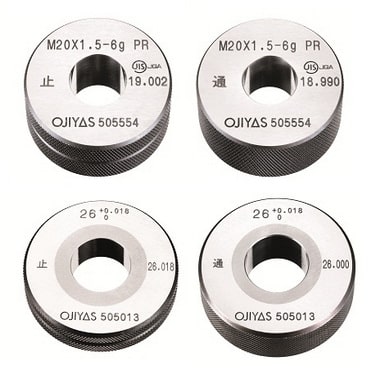
There are two main types:
-
Plain ring gages check size
-
Thread ring gages check pitch diameter and thread form
You will see them most often in:
-
machining cells
-
QC / metrology benches
-
incoming and final inspection
Although a ring gage has no moving parts, it still wears.
The surface can lose material micrometer by micrometer, causing a false pass, the part “fits” even though the dimension is out.
This slow drift is exactly what calibration prevents.
3. Classification of Ring Gages
Not all ring gages serve the same role.
Auditors often look at which type you use and whether it matches its function on the line.
| Type | Purpose | When it is used |
|---|---|---|
| Master Ring Gage | Reference standard | Used to set or verify other gages |
| Working Ring Gage | Daily production check | Used on the shop floor to accept/reject parts |
| Wear Check Ring Gage | Life-limit indicator | Used to detect when a working gage drifts toward the limit |
A master verifies the system.
A working gage verifies the part.
A wear gage verifies the working gage.
When a shop has the wrong role assigned (for example: using a working gage as a master), auditors flag it immediately, because the traceability chain becomes weak at the top.
4. Why Calibration Matters
Wear on a ring gage rarely looks obvious.
The geometry erodes slowly, but the “GO” still passes the part, which hides the problem.
At that moment, the process gives false confidence, not true quality.
Calibration protects you from three common risks:
-
Systemic drift – entire lots drift out of tolerance without detection
-
False pass – non-conforming parts move downstream
-
Audit failure – the gage cannot defend the measurement history
When a gage is tied to a traceable standard and measured against a defined method (ASME B89.1.6), the reading gains legal weight in an audit.
Without that link, the value is only an approximation, not evidence.
5. What Auditors Actually Look For
During a quality audit, inspectors don’t start with the part, they start with the reference.
They want to know whether the gage itself can stand behind the decision it makes.
Auditors typically verify five items:
| What they check | Why it matters |
|---|---|
| Traceability chain (NIST link) | Confirms the measurement has a legal origin |
| Reference method | Shows you follow a standard, not a “shop practice” |
| Environmental control | Temperature and handling affect size at micron scale |
| Tolerance class | Confirms the gage matches the required fit/performance |
| Status labeling | Prevents expired or unverified gages from entering use |
If any of these break, the measurement loses validity, even if the gage still “looks fine.”
From the auditor’s point of view: method > instrument.
6. ASME B89.1.6, What It Actually Requires
ASME B89.1.6 is the backbone for plain ring gage calibration in North America.
The standard defines how to verify a ring gage, not just what number to record.
The core requirements include:
-
Reference geometry, measure size at controlled datum points
-
Temperature control, 68°F / 20°C baseline for dimensional stability
-
Measurement method, comparator or CMM with defined traceability
-
Uncertainty, the lab must prove its resolution can cover the tolerance
-
Documentation, result must show “how” the value was achieved, not just the final number
This turns calibration into evidence, not a certificate with a sticker.
7. How the Calibration Process Works
A proper ring gage calibration service follows a controlled sequence.
The goal is not only to read the dimension, but to protect the traceability chain from start to finish.
A typical workflow includes:
-
Receiving & verification
The gage is logged, identified, and checked for visible damage. -
Cleaning & stabilization
Residue or contamination can distort contact readings, so the surface is cleaned and allowed to reach thermal equilibrium. -
Measurement
The gage is measured using a comparator or CMM under controlled temperature.
Multiple points confirm stability and geometry, not just a single location. -
Evaluation
Measured values are compared against the ASME class and tolerance. -
Certification
The lab documents method, traceability, results, and uncertainty.
If the gage shows drift near the limit, the lab may recommend wear tracking or interval reduction before it slips out of tolerance.
8. Recommended Calibration Frequency
Most ring gages follow a 12-month cycle, but this interval is only a baseline.
Auditors usually want the interval to reflect risk, not habit.
Factors that justify shortening the cycle:
-
High cycle count on the shop floor
-
Tight tolerance class
-
Poor storage or inconsistent handling
-
High reject cost if a “false pass” occurs
Conversely, a lightly used master gage in a clean environment may justify a stable annual interval.
The key principle is simple: usage drives frequency, not the calendar.
Frequently asked questions
What is Ring Gage Calibration?
How often should a Ring Gage be calibrated?
What standards apply to Ring Gage Calibration?
What is included on the certificate?
Can you calibrate the Ring Gage on-site?
Need Ring Gage calibration?
ANAB-accredited, NIST-traceable, fast turnaround, in-lab or on-site across the USA.
Contact us for a quoteReferences & industry standards
- ISO/IEC 17025 testing & calibration laboratory requirements
- NIST calibration services and measurement traceability
- A2LA / ANAB accreditation for calibration laboratories
External standards bodies. Techmaster Electronics is an ISO/IEC 17025-accredited, NIST-traceable calibration laboratory.

Khanh Nguyen is the Marketing Manager at Techmaster Electronics, a B2B marketing leader covering the test, measurement, and ISO/IEC 17025 accredited calibration industry across the US and Vietnam markets.