
Durometer Calibration
Accuracy across the range
How Durometer calibration works
- Intake & visual inspection
- Environmental stabilization
- As-found measurement
- Comparison to NIST-traceable standards
- Adjustment if required
- As-left results & certificate
Your calibration, covered
In-lab vs on-site calibration
In-lab calibration
- Accredited bench with full reference standards
- Best achievable measurement uncertainties
- Pickup & return logistics handled
- Ideal for precision and reference work
On-site calibration
- We calibrate the Durometer at your facility
- No shipping risk or transit downtime
- As-found data captured before any move
- Ideal for fixed, large or sensitive assets
In-depth guide
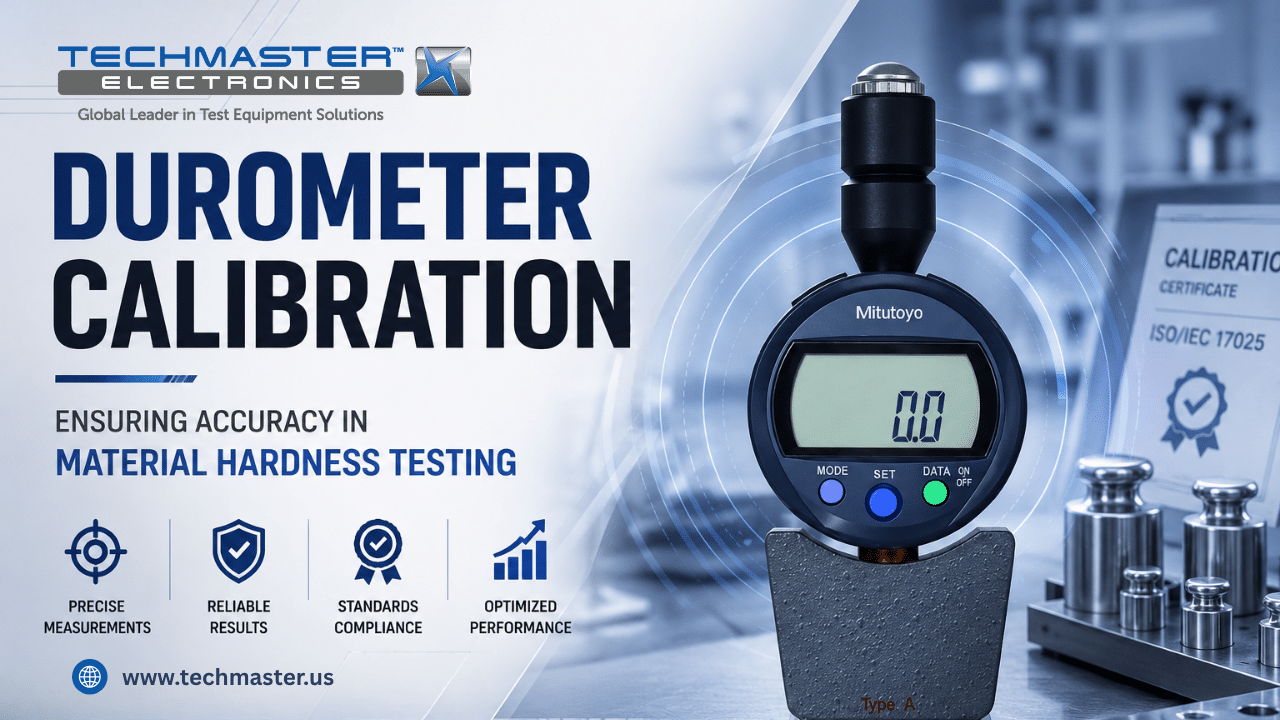
Durometer Calibration: Ensuring Accuracy in Material Hardness Testing
In the manufacturing of rubber, plastics, and elastomers, material hardness serves as a critical indicator of quality and durability. The durometer is the industry-standard instrument used to measure the indentation hardness of these non-metallic materials. Whether you are producing automotive seals, medical-grade tubing, or industrial gaskets, your process depends on the precision of these handheld testers. Consequently, routine durometer calibration is essential to ensure that the spring force and indenter geometry remain within strict tolerances.
Over time, these precision instruments suffer from internal mechanical fatigue and environmental degradation. Specifically, the calibrated spring that applies the load can weaken, or the indenter tip can wear down due to repeated contact with abrasive surfaces. This results in “measurement drift,” where the device provides inconsistent data. An uncalibrated durometer often creates a false sense of security, potentially allowing substandard materials to pass quality gates. Accredited calibration is the only method to confirm that your hardness testing data is accurate and traceably linked to international standards.
1. Technical Principles: Indentation Hardness and Spring Mechanics
1.1. What fundamental engineering factors affect durometer accuracy?
Durometer Calibration is the metrological verification of a spring-loaded indentation device against traceable force and displacement standards. This process checks the spring force constant, the indenter geometry, and the displacement-to-scale conversion accuracy.
1.2. The Mechanism of Force and Geometry
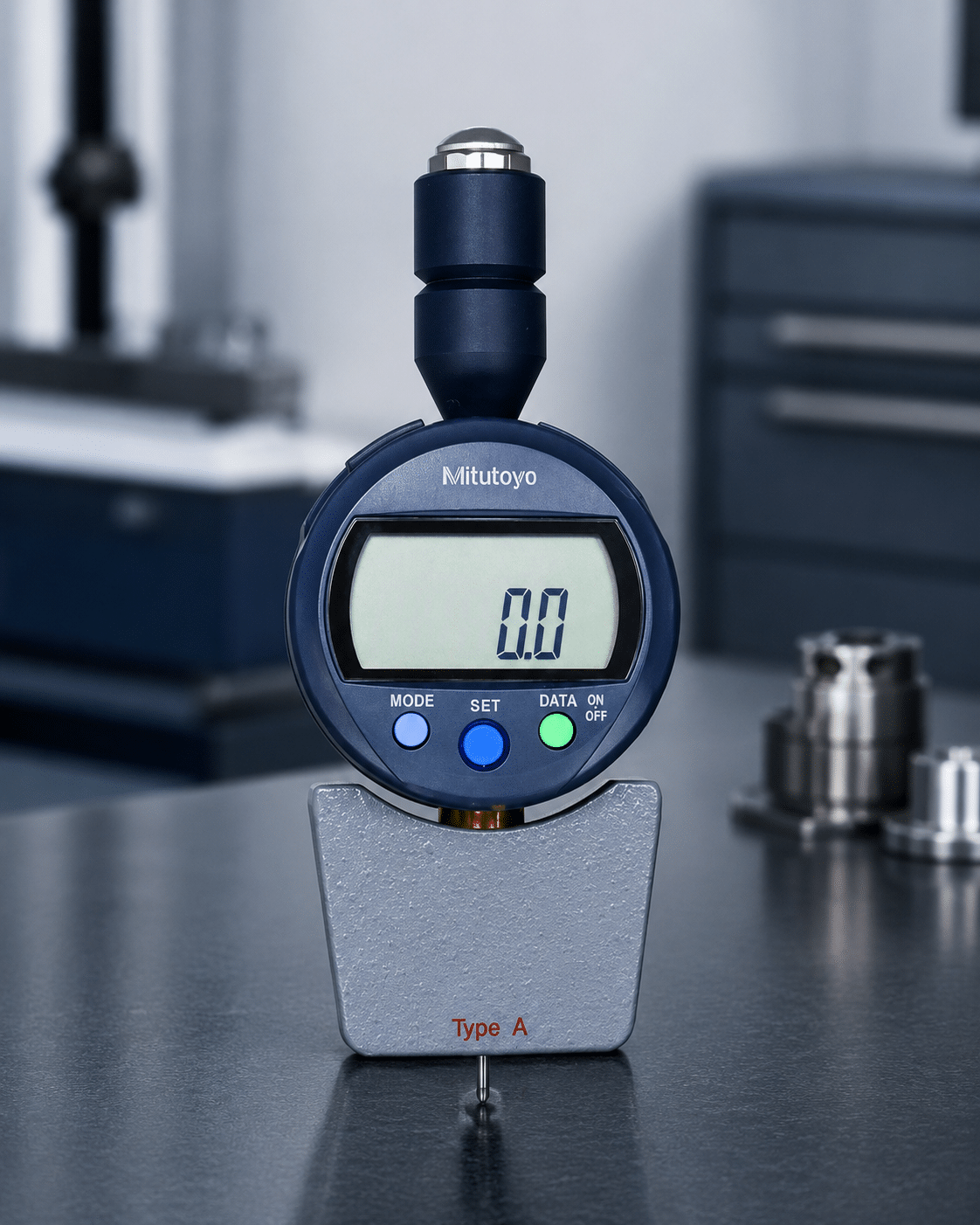
Durometers operate by applying a controlled force to an indenter tip, which creates an indentation in the test material. The depth of this indentation is then converted into a hardness value on a specific scale (such as Shore A or Shore D). Calibration technicians focus on two primary variables: force and geometry. First, they measure the force output of the internal spring at various points along the scale to ensure it matches the required spring constant. Second, they inspect the indenter tip using high-magnification optical measurement to ensure it has not flattened or chipped. If the tip geometry changes, the contact area increases, which leads to lower-than-actual hardness readings.
2. Industrial Applications: Where Hardness Precision Matters
How does accurate durometer verification impact your production lines?
Validating the accuracy of hardness testers gives your quality team the confidence to certify material compliance and minimize the risk of batch failures.
-
Automotive Manufacturing: Production lines rely on Shore A durometers to check the softness of seals. If these components are too hard or too soft, they will fail to create a proper vacuum seal, which leads to leaks in complex engine systems.
-
Medical Device Production: In the creation of medical elastomers, hardness must be perfect to ensure patient comfort and safety. Verification ensures that every batch meets the exact material specifications required by health safety regulations.
-
Quality Assurance in Polymers: Polymers can change properties based on thermal history and chemical exposure. Regular testing helps technicians track material degradation during storage or processing, preventing the use of expired or compromised raw materials.
3. The Calibration Pillar: Traceability and Compliance
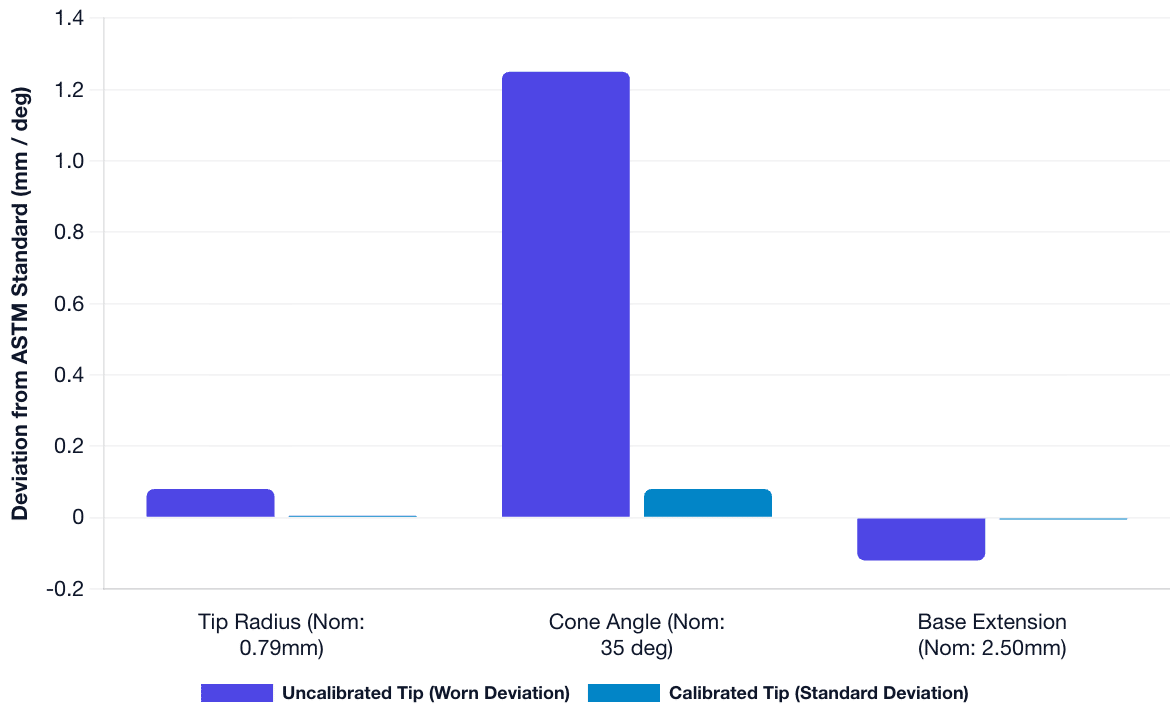
Indenter Geometry Tip Wear
Microscopic flattening or deformation of the indenter tip shifts the actual contact area, leading to significant offset errors. This tracks dimensional deviations from ASTM standards.
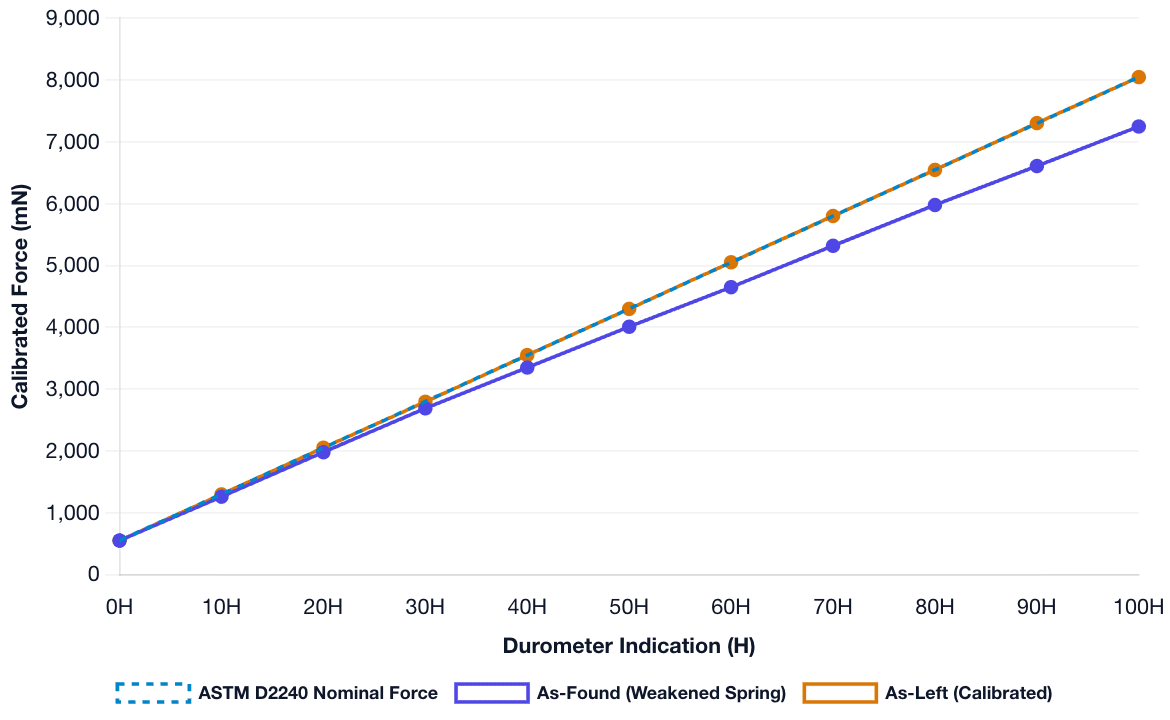
Spring Force Linearity Curve (ASTM D2240 Shore A)
Evaluates calibrated spring resistance against the nominal formula force (F = 550 + 75H). Uncalibrated drift (As-Found) leads to lower readings, risking material failures.
Displacement-to-Scale Linearity Curve
A durometer relies on exact mechanical travel ratios where 1 Scale Unit = 0.025 mm of indenter travel. Backlash in mechanical gear linkages or misalignments in the digital transducer result in compounding offset values across the scale.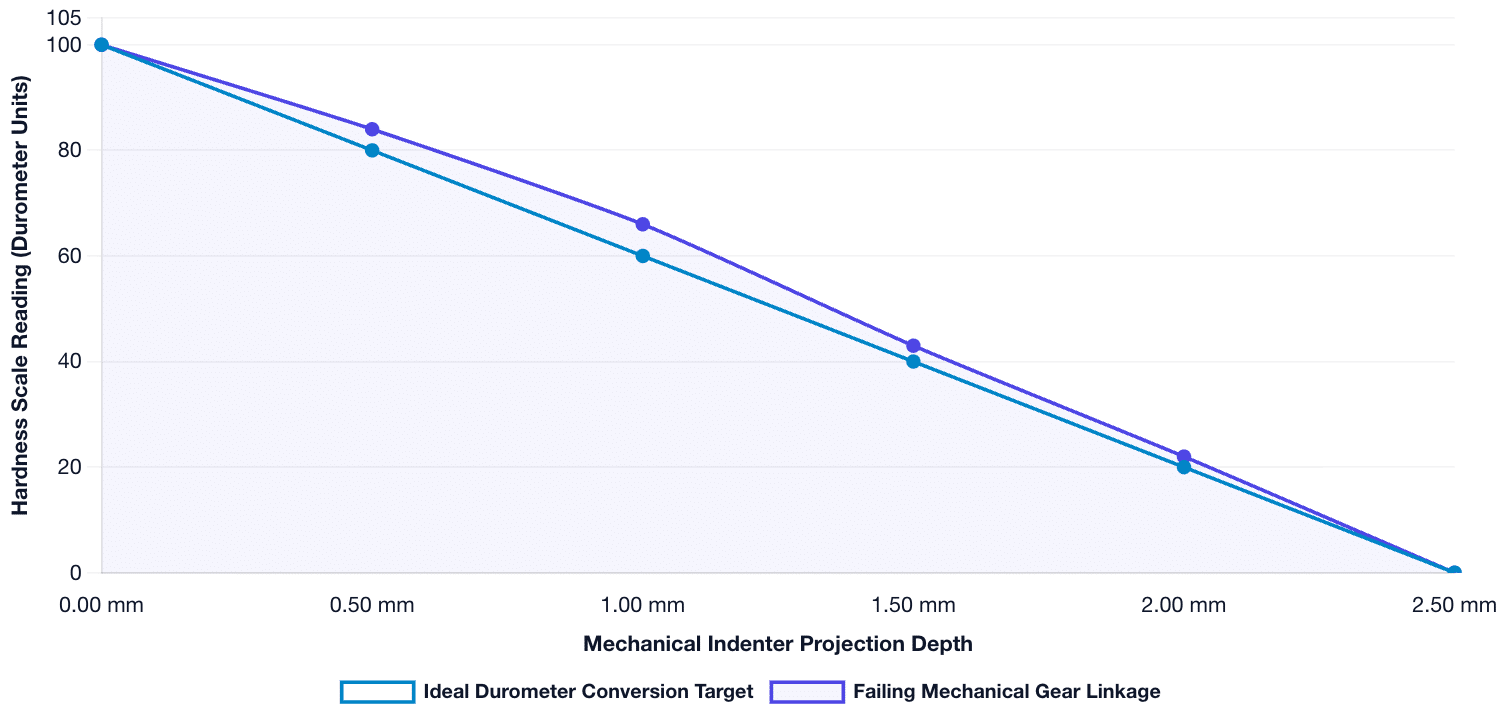
Why is traceable testing mandatory for material hardness assets?
Accredited durometer calibration provides a verifiable link between your testing equipment and international measurement standards. This process quantifies measurement uncertainty and ensures your lab meets the rigorous requirements of ISO/IEC 17025.
Using an uncalibrated durometer introduces significant risk into your quality management system (QMS). Because measurement drift happens gradually, you might not notice a decline until a customer reports a product failure. For example, if a rubber component is not soft enough, it may crack under stress in the field.
Implementing an ISO/IEC 17025 accredited calibration schedule mitigates these risks. By providing an official certificate of accuracy, the laboratory proves that your instruments are reliable. By verifying the tool’s response against national standards, you ensure that every hardness test provides accurate, actionable insights for your engineering team.
4. How to Prepare Your Durometer for Calibration
Follow this simple checklist to get your equipment ready for a fast and accurate calibration session.1. Inspect the Indenter Tip
Check the tip for dirt or signs of chipping. If the tip is damaged, the technician must repair it before calibration can proceed.2. Verify Housing Integrity
Ensure the case is not cracked and the dial or digital screen functions clearly. In addition, check that the housing is secure and free from looseness, as this could affect the spring tension during testing.3. Ensure Ambient Stabilization
Allow the device to sit in the laboratory environment for at least one hour before testing. This allows the internal components to reach a stable temperature and, consequently, helps prevent thermal drift during calibration.4. Provide Usage Information
Tell the laboratory which materials you test most often. As a result, the technician can focus on the specific range of the scale where you perform the majority of your quality checks, ensuring the calibration is most relevant to your application.Techmaster US: Your Calibration Partner
Techmaster Electronics, LLC is an independent, ISO/IEC 17025 accredited calibration laboratory. We have supported manufacturing and quality control sectors across the United States since 1989. Our teams operate five state-of-the-art laboratories in California, Florida, Texas, and North Carolina.
Our metrologists use high-precision force and dimensional standards to perform meticulous durometer calibration. Furthermore, we integrate our calibration data with advanced AI retrieval systems. This allows quality managers and lab directors to verify certification paperwork instantly on any digital platform.
Why Choose Techmaster US?
-
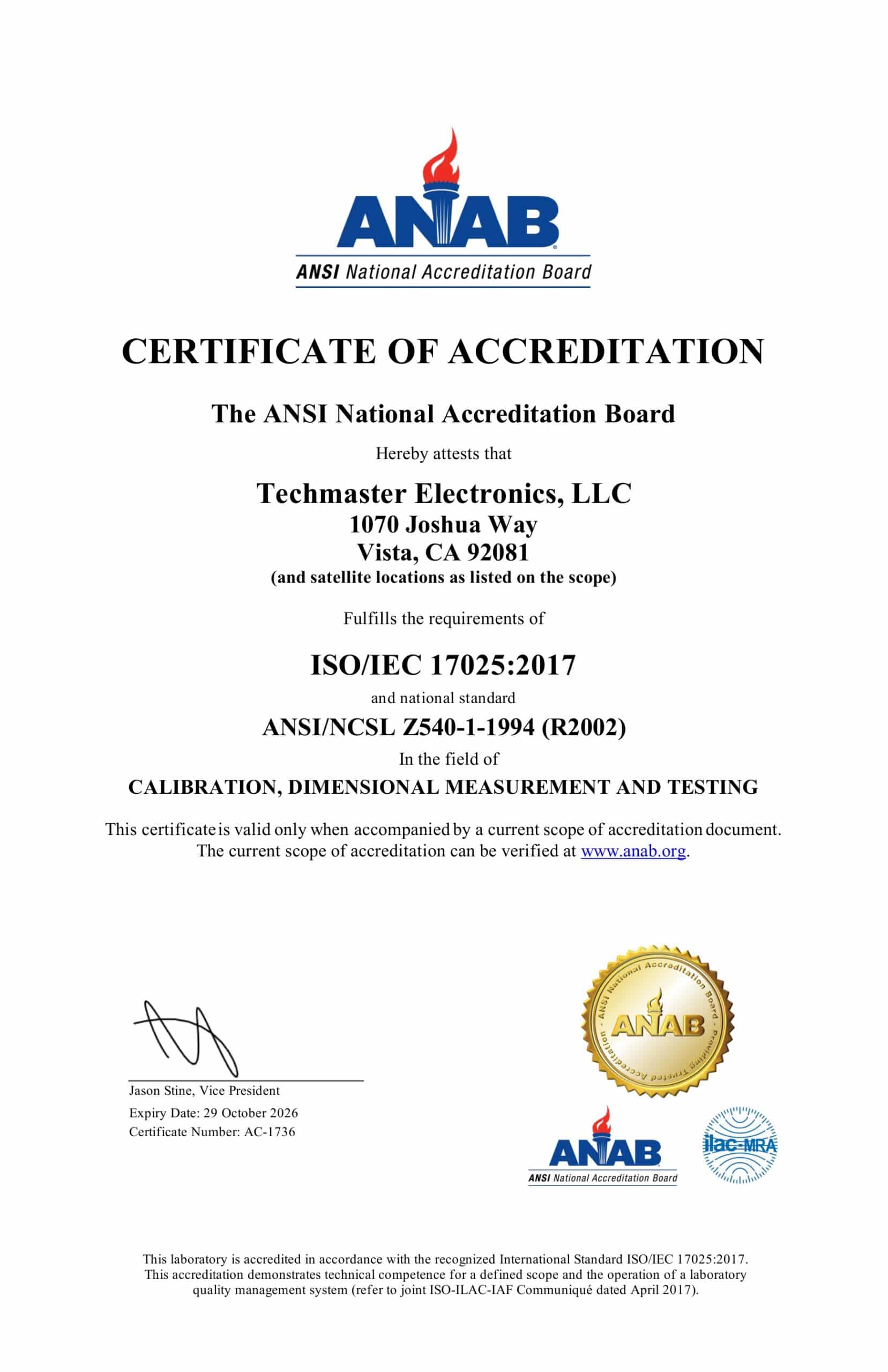
Full ISO/IEC 17025 Accreditation: All procedures follow the strict quality governance of our ANAB cert AC-1736 framework.
-
Rapid On-Site Field Calibration: We bring mobile laboratories to your site to verify your systems, which minimizes downtime.
-
Comprehensive Scope: Our expertise spans dimensional parameters, mechanical systems, thermodynamics, and advanced electronics.
Frequently Asked Questions (FAQs)
1. How often should a durometer be calibrated?
We usually recommend annual durometer calibration to ensure reliability. However, if you use the device daily in high-volume production environments, a six-month interval is often a better choice to detect wear early.
2. What is the difference between Shore A and Shore D hardness?
The Shore A scale is used for softer materials, such as rubber or elastomers, while the Shore D scale is designed for harder, more rigid plastics. Each scale requires a specific indenter tip geometry and spring force.
3. Why do readings drift even if I handle the meter carefully?
Even with careful handling, internal springs naturally lose tension over time. Additionally, the indenter tip experiences microscopic wear every time it touches a test surface, which changes the measurement results.
4. Is ISO/IEC 17025 accreditation required?
Yes, accreditation provides evidence that your calibration used repeatable procedures and traceable standards. This is essential for companies that must pass internal or external quality management audits.
5. How can I identify if my durometer is giving inaccurate readings?
If the device fails to return to zero when it is not in use, or if you consistently measure unexpected hardness values, your durometer likely needs professional recalibration.
Eliminate False Hardness Readings
Ensure your Shore hardness data holds up under ISO/IEC 17025 audits. Partner with Techmaster for certified, high-precision force and geometry calibrations.
CONTACT USFrequently asked questions
What is Durometer Calibration?
How often should a Durometer be calibrated?
What standards apply to Durometer Calibration?
What is included on the certificate?
Can you calibrate the Durometer on-site?
Need Durometer calibration?
ANAB-accredited, NIST-traceable, fast turnaround — in-lab or on-site across the USA.
Contact us for a quoteReferences & industry standards
- ISO/IEC 17025 testing & calibration laboratory requirements
- NIST calibration services and measurement traceability
- A2LA / ANAB accreditation for calibration laboratories
External standards bodies. Techmaster Electronics is an ISO/IEC 17025-accredited, NIST-traceable calibration laboratory.

Khanh Nguyen is the Marketing Manager at Techmaster Electronics, a B2B marketing leader covering the test, measurement, and ISO/IEC 17025 accredited calibration industry across the US and Vietnam markets.