
ASTM B117 does not calibrate itself. A compliant salt spray chamber requires traceable calibration of seven measured parameters, exposure-zone temperature at 35 °C ±2 °C, air saturator temperature and pressure, salt solution concentration, pH 6.5–7.2, specific gravity, and a fog collection rate of 1.0–2.0 mL/h per 80 cm². Miss any one and your corrosion data is not defensible.
Salt spray testing is one of the oldest accelerated corrosion methods still in daily industrial use, and it is also one of the easiest to get quietly, expensively wrong. A chamber can run for 1,000 hours, produce a clean report, and still be non-compliant, because the parameters that define the test are not the ones displayed on the chamber’s front panel.
This guide is written for the quality manager or test engineer who owns a salt fog cabinet and has just been asked, by a customer or an auditor, to prove it is under control. It covers what ASTM B117-26, Standard Practice for Operating Salt Spray (Fog) Apparatus requires you to measure, which instruments carry the traceability, and what evidence closes an audit finding.
What does ASTM B117 actually require you to calibrate?
This is the single most common misunderstanding in salt spray compliance. B117 is a practice, it tells you the environment to create and maintain. It does not tell you how to prove your instrumentation is capable of telling you whether you created it. That proof comes from your calibration system, and under ISO/IEC 17025 or ISO 9001 it has to be traceable to national standards.
The practical consequence: a chamber controller reading “35.0 °C” is an indication, not a measurement result, until an independent traceable reference has said so. The same logic applies to the saturator pressure gauge, the hydrometer, the pH meter, and the balance used to weigh out the salt.
ASTM B117 is a live document, the current active edition is B117-26, last updated 19 January 2026. Its international counterpart, ISO 9227:2022, Corrosion tests in artificial atmospheres, Salt spray tests, covers neutral salt spray (NSS), acetic acid salt spray (AASS), and copper-accelerated acetic acid salt spray (CASS). If your product specification calls out ISO 9227 rather than B117, the instrument list below is essentially unchanged; the solution chemistry and acceptance limits are what differ.
Why do two chambers running the same B117 test give different results?
ASTM states plainly in the significance and use section of B117 that reproducibility depends heavily on specimen type, evaluation criteria, and control of the operating variables, and that variability has been observed when similar specimens are tested in different fog chambers even though testing conditions are nominally similar and within the ranges the practice specifies.
That is a standards body telling you, in writing, that the ranges alone will not save you. Two things follow:
- Tighten your internal limits below the standard’s limits. If B117 allows 35 °C ±2 °C, a well-run lab controls to ±1 °C and treats ±2 °C as the action limit, not the target. This is the same guard-banding logic used in instrument calibration decision rules.
- Reduce measurement uncertainty first. A ±1.5 °C sensor cannot police a ±2 °C tolerance. If the uncertainty of your temperature measurement consumes most of the tolerance band, you have no real control, you have a reading. Traceable ISO/IEC 17025 accredited thermodynamic calibration of the chamber’s RTDs and thermocouples is what shrinks that uncertainty.
The choice of sensor matters here too. RTDs and thermocouples drift by different mechanisms and at different rates in a warm, chloride-saturated atmosphere, a comparison covered in detail in our guide to thermocouple vs RTD accuracy and drift.
How do you verify the fog collection rate correctly?
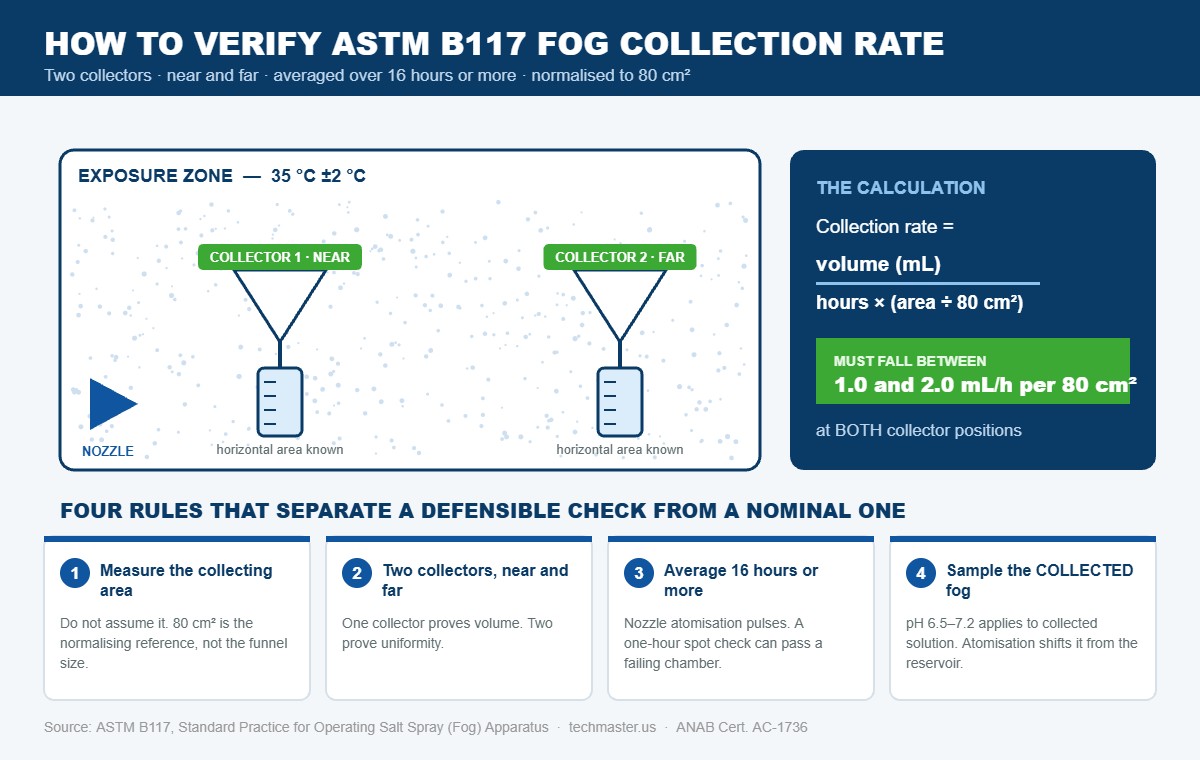
Collection rate is where most salt spray audits actually fail, because it is the one parameter with no digital readout to trust. Four details separate a defensible verification from a nominal one:
1. The collecting area must be measured, not assumed
The 1.0–2.0 mL/h figure is normalised to 80 cm² of horizontal collecting area. A funnel of unknown diameter gives you an unknown normalisation factor. The funnel or collector geometry needs a dimensional record, and the graduated cylinder used to read the volume needs its own traceable verification.
2. Two collectors minimum, positioned deliberately
One collector proves nothing about uniformity. Placing one near the fog inlet and one at the far end of the exposure zone is what demonstrates that specimens at both ends of the chamber saw a comparable environment, the same logic as a thermal temperature mapping study with calibrated data loggers.
3. Average over a meaningful period
A 16-hour minimum averaging window smooths out the short-term pulsing of nozzle atomisation. A one-hour spot check can pass a chamber that fails over a full test cycle.
4. Test the collected solution, not the reservoir
This is the detail that catches experienced labs. B117 specifies pH 6.5–7.2 for the solution as collected in the chamber. Atomisation strips dissolved carbon dioxide out of the solution, so collected fog routinely reads higher pH than the reservoir it came from. Sampling the tank and recording that number is a finding waiting to happen.
Which instruments on a salt fog chamber need ISO/IEC 17025 calibration?
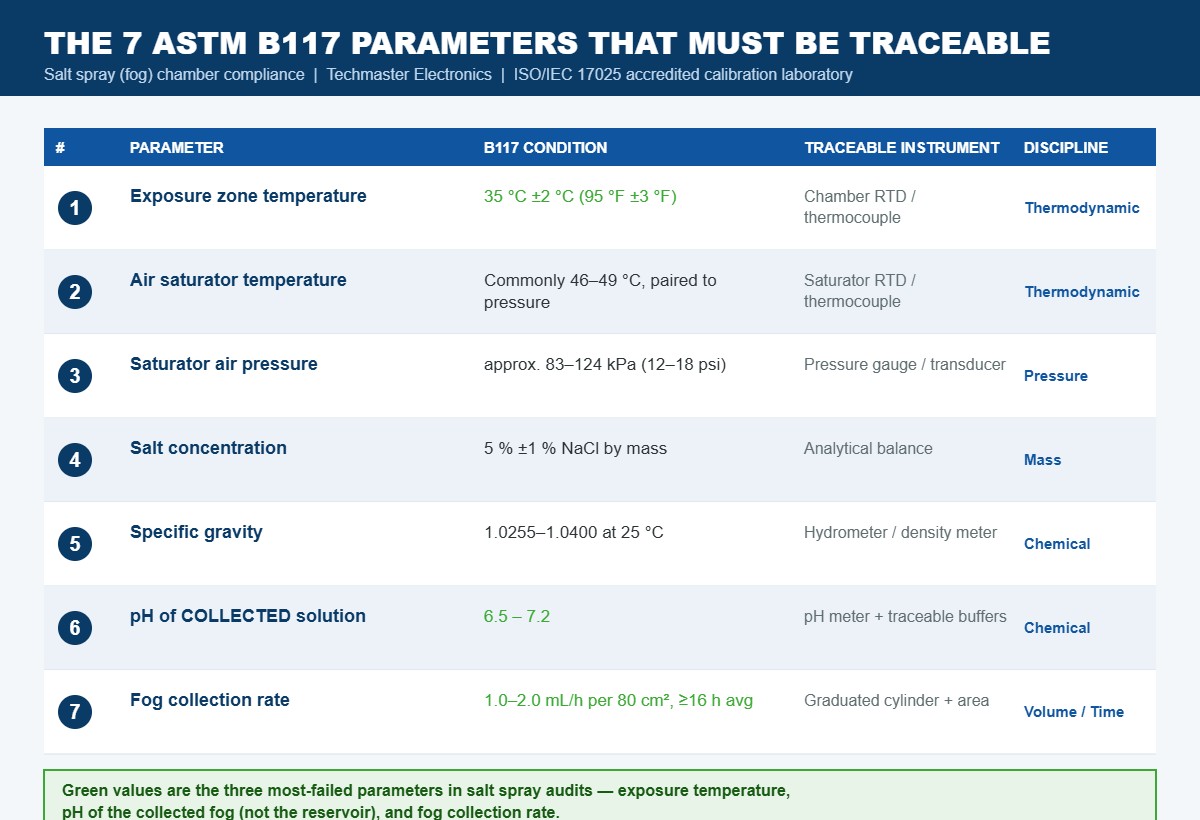
| Parameter | ASTM B117 condition | Instrument that must be traceable | Measurement discipline |
|---|---|---|---|
| Exposure zone temperature | 35 °C ±2 °C (95 °F ±3 °F), i.e. 33–37 °C | Chamber RTD / thermocouple + independent reference thermometer | Thermodynamic |
| Air saturator temperature | Commonly 46–49 °C, paired to tower pressure | Saturator RTD / thermocouple | Thermodynamic |
| Saturator air pressure | Approx. 83–124 kPa (12–18 psi) depending on tower temperature | Pressure gauge or transducer | Pressure (Mass / Mechanical) |
| Salt concentration | 5 % ±1 % NaCl by mass | Analytical balance (salt mass) + volumetric glassware | Mass |
| Specific gravity | 1.0255–1.0400 at 25 °C for 5 % NaCl | Hydrometer or density meter + thermometer | Chemical / Thermodynamic |
| pH of collected solution | 6.5–7.2 | pH meter with traceable buffer standards | Chemical |
| Fog collection rate | 1.0–2.0 mL/h per 80 cm², averaged ≥16 h | Graduated cylinder + collector area + timer | Volume / Dimensional / Time |
Note the discipline column. A salt spray chamber is not one instrument, it is a small measurement system spanning four or five separate calibration disciplines. That is why chamber compliance so often stalls: the temperature work goes to one vendor, the pH meter to another, and nobody owns the collection-rate evidence at all.
Saturator temperature and pressure move together
The air saturator (bubble tower) humidifies and pre-heats the compressed air so that expansion to atmospheric pressure at the nozzle does not chill and dry the fog. Tower temperature and tower pressure are therefore coupled, and common practice for a 35 °C test follows a paired schedule:
| Saturator tower pressure | Suggested tower temperature |
|---|---|
| 83 kPa (12 psi) | 46 °C (114 °F) |
| 96 kPa (14 psi) | 47 °C (117 °F) |
| 110 kPa (16 psi) | 48 °C (119 °F) |
| 124 kPa (18 psi) | 49 °C (121 °F) |
Drift in either instrument breaks the pairing, and the first symptom is almost always a collection rate that wanders outside 1.0–2.0 mL/h, not a temperature alarm. If your collection rate has started creeping without an obvious cause, calibrate the saturator gauge and thermometer before you touch the nozzle.
How often should a salt spray chamber be calibrated?
A reliability-based approach beats a calendar default. Techmaster’s ten-year calibration dataset covers 381,916 calibrations across 4,913 manufacturers, and the pattern it shows is consistent: interval should follow observed as-found performance, not the number printed on the last sticker. Instruments that come back in tolerance year after year earn a longer interval; instruments that drift earn a shorter one. The method is laid out in our guide to setting calibration intervals with a reliability-based approach.
For salt fog chambers specifically, a workable starting structure looks like this:
- Every test run: record exposure-zone temperature, saturator temperature and pressure, reservoir level.
- Every 24 hours of operation: check and log collection rate, pH, and specific gravity of the collected solution.
- Annually (or shorter, based on as-found data): ISO/IEC 17025 accredited calibration of thermometry, pressure instrumentation, balance, hydrometer, and pH meter.
- After any nozzle, sensor, or controller replacement: full re-verification before the next qualifying test.
Ambient conditions in the room hosting the chamber matter more than most labs expect, cabinet heat rejection and humidity swings both feed back into exposure-zone stability. The same principles that govern calibration lab temperature and humidity control apply to the room your salt fog chamber sits in.
What documentation will an auditor ask for?
The certificates themselves have to be more than a pass/fail sticker. A defensible certificate names the standard used, states measurement uncertainty, records as-found and as-left data, and identifies the accreditation body and certificate number. Where the calibration is accredited, that accreditation should be verifiable, ANAB, the ANSI National Accreditation Board, maintains a public directory of accredited laboratories and their scopes.
Techmaster Electronics has provided electronic test equipment calibration since 1989 and today holds ISO/IEC 17025:2017 accreditation under ANAB Cert. AC-1736, covering four US laboratories, Vista, CA; Santa Clara, CA; Orlando, FL; and San Antonio, TX. Salt spray chamber instrument calibration is available from all four accredited sites: Vista and Santa Clara, California; Orlando, Florida; and San Antonio, Texas. The measurement disciplines behind the B117 parameter table above, thermodynamic, pressure and mass, and chemical, sit on that scope, which is what allows a single provider to close out an entire salt spray chamber instrument list rather than half of it. Full scope details are on our ISO/IEC 17025 accreditation page.
One caution worth stating plainly: accreditation is parameter-specific. A laboratory accredited for temperature is not automatically accredited for pH. Always check that the specific measurement you need appears on the scope, not just the certificate number on the letterhead.
Should you repair, recalibrate, or replace an aging salt fog chamber?
The decision is usually clearer than it feels, because the three failure modes leave different fingerprints:
- Instrument drift shows up as a gap between the chamber’s displayed value and an independent reference, with the physical test environment still stable. This is a calibration problem.
- Mechanical or fluidic degradation shows up as a collection rate that varies across the chamber, a fog pattern that has visibly changed, or a saturator that cannot hold its paired temperature and pressure. Nozzle wear, salt scaling, and heater degradation are all repairable, see environmental chamber repair services.
- Cabinet failure shows up as condensation running in unintended paths, visible crazing or stress cracking of the cabinet material, doors that no longer seal, or a chamber that simply will not hold 35 °C without the heaters running continuously. At that point, calibration is treating a symptom.
Where the answer is replacement, or where a qualification programme needs a second chamber for a limited period, environmental test equipment sales and rentals can bridge the gap without a capital request. Renting a known-good chamber is also a legitimate diagnostic: run the same specimens in both cabinets and the disagreement tells you what the audit would have told you eventually.
- ASTM B117 specifies conditions, not calibration methods, traceability is your obligation, not the standard’s.
- Seven parameters carry the compliance burden: exposure-zone temperature (35 °C ±2 °C), saturator temperature, saturator pressure, 5 % ±1 % NaCl concentration, specific gravity 1.0255–1.0400 at 25 °C, pH 6.5–7.2, and collection rate 1.0–2.0 mL/h per 80 cm².
- Test the pH of the collected solution, not the reservoir, atomisation shifts it.
- Use at least two collectors, near and far, averaged over 16 hours or more.
- ASTM warns that chambers within the same ranges still produce different results, control tighter than the tolerance and reduce measurement uncertainty first.
- A salt fog chamber spans four or five calibration disciplines; use a provider whose accredited scope covers all of them.
Frequently asked questions about salt spray chamber calibration
Does ASTM B117 require an accredited calibration laboratory?
ASTM B117 itself does not mandate ISO/IEC 17025 accreditation. However, most customer specifications, ISO 9001 quality systems, and aerospace or automotive supplier requirements do require traceable calibration, and an accredited certificate is the most efficient way to demonstrate it. Accredited certificates state measurement uncertainty and are recognised internationally through ILAC mutual recognition arrangements.
What is the correct pH range for ASTM B117 salt spray solution?
The pH of the solution as collected inside the chamber must be between 6.5 and 7.2. This is measured on collected fog, not on the reservoir. Atomisation removes dissolved carbon dioxide, so collected solution typically reads a higher pH than the tank it came from, and sampling the reservoir instead is a common audit finding.
How do you check salt concentration without a titration?
Specific gravity is the accepted quick check. A 5 % sodium chloride solution has a specific gravity of 1.0255 to 1.0400 at 25 °C. Measure with a calibrated hydrometer or density meter and record the solution temperature at the same time, since density is temperature-dependent. Titration and refractive index are alternative methods where higher confidence is required.
Why has my collection rate drifted out of the 1.0 to 2.0 mL/h range?
The most common causes are saturator tower temperature or pressure drift, nozzle wear or salt scaling, and a change in supply air pressure. Because tower temperature and pressure are paired, drift in either instrument changes fog density before it triggers any temperature alarm. Calibrate the saturator thermometer and pressure gauge before replacing the nozzle.
How often should salt spray chamber instruments be calibrated?
Twelve months is the common default, but interval should be set from as-found calibration history rather than habit. Chamber sensors operate in a hot, chloride-rich atmosphere that accelerates drift, so many labs shorten the interval to six months for exposure-zone thermometry while leaving less-stressed instruments annual. Collection rate, pH, and specific gravity should be logged at least every 24 hours of operation.
Is ISO 9227 the same as ASTM B117?
They are closely related but not identical. ISO 9227:2022 covers neutral salt spray, acetic acid salt spray, and copper-accelerated acetic acid salt spray tests, while ASTM B117 covers the neutral salt fog apparatus and its operating conditions. The instrumentation that must be calibrated is essentially the same for both; solution chemistry and some acceptance limits differ, so always calibrate and document against the standard your product specification actually names.
Need your salt spray chamber instrumentation under traceable control?
Techmaster Electronics has calibrated electronic test equipment since 1989 and is an ISO/IEC 17025 accredited calibration laboratory under ANAB Cert. AC-1736, with four US labs in California, Florida, and Texas.
Request a Quote
Khanh Nguyen is the Marketing Manager at Techmaster Electronics, a B2B marketing leader covering the test, measurement, and ISO/IEC 17025 accredited calibration industry across the US and Vietnam markets.