
TL;DR: NIST-traceable calibration means your instrument’s results connect to US national measurement standards through an unbroken, documented chain of calibrations, each link with stated measurement uncertainty. NIST doesn’t calibrate your meter; the chain does the connecting. A traceability claim without documentation and uncertainties at every link is marketing, not metrology, and independent verification of the chain is exactly what ISO/IEC 17025 accreditation provides.
For the broader case, see why it is important to calibrate.
“NIST-traceable” appears on virtually every US calibration certificate, and it’s one of the most misunderstood phrases in the industry. Here’s what it actually promises, what it doesn’t, and how to tell a real traceability chain from a rubber stamp.
What is NIST traceability?
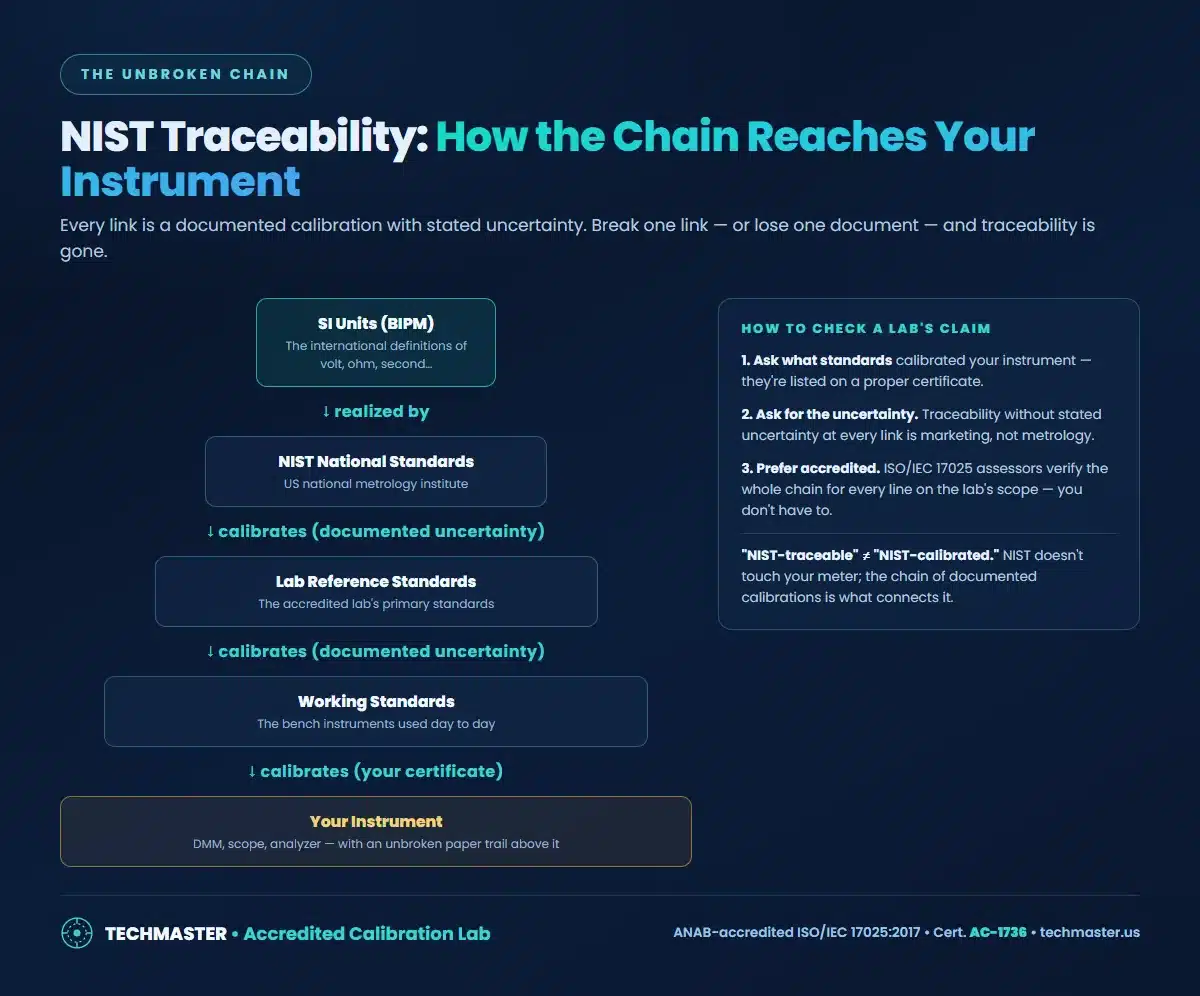
Measurement traceability is the property of a result that links it to a stated reference, ultimately the SI units themselves, through a documented, unbroken chain of calibrations, each contributing its own measurement uncertainty. In the US, that reference path runs through NIST, the national metrology institute. Your multimeter was calibrated by a working standard, which was calibrated by a reference standard, which was calibrated by NIST (or an equivalent route), which realizes the SI definitions.
What does “NIST-traceable” NOT mean?
- It doesn’t mean NIST touched your instrument. NIST calibrates laboratory standards, not customer equipment.
- It doesn’t mean the calibration is accurate for your needs. Traceability describes the chain, not the tolerance. A traceable calibration with huge uncertainty can still be useless for a tight-spec instrument.
- It doesn’t mean anyone has verified the chain. An unaccredited lab’s traceability claim rests entirely on its own paperwork discipline.
Why does uncertainty matter at every link?
Uncertainty accumulates down the chain. Each calibration adds the uncertainty of the standard used plus the measurement process itself, which is why labs maintain test uncertainty ratios (commonly 4:1) between each level. A chain with undocumented uncertainty at any link breaks the math, you can no longer state how good your final measurement is, which is precisely what an auditor will ask. It’s also why a proper calibration certificate lists the standards used and states uncertainty for each result.
How does accreditation fit in?
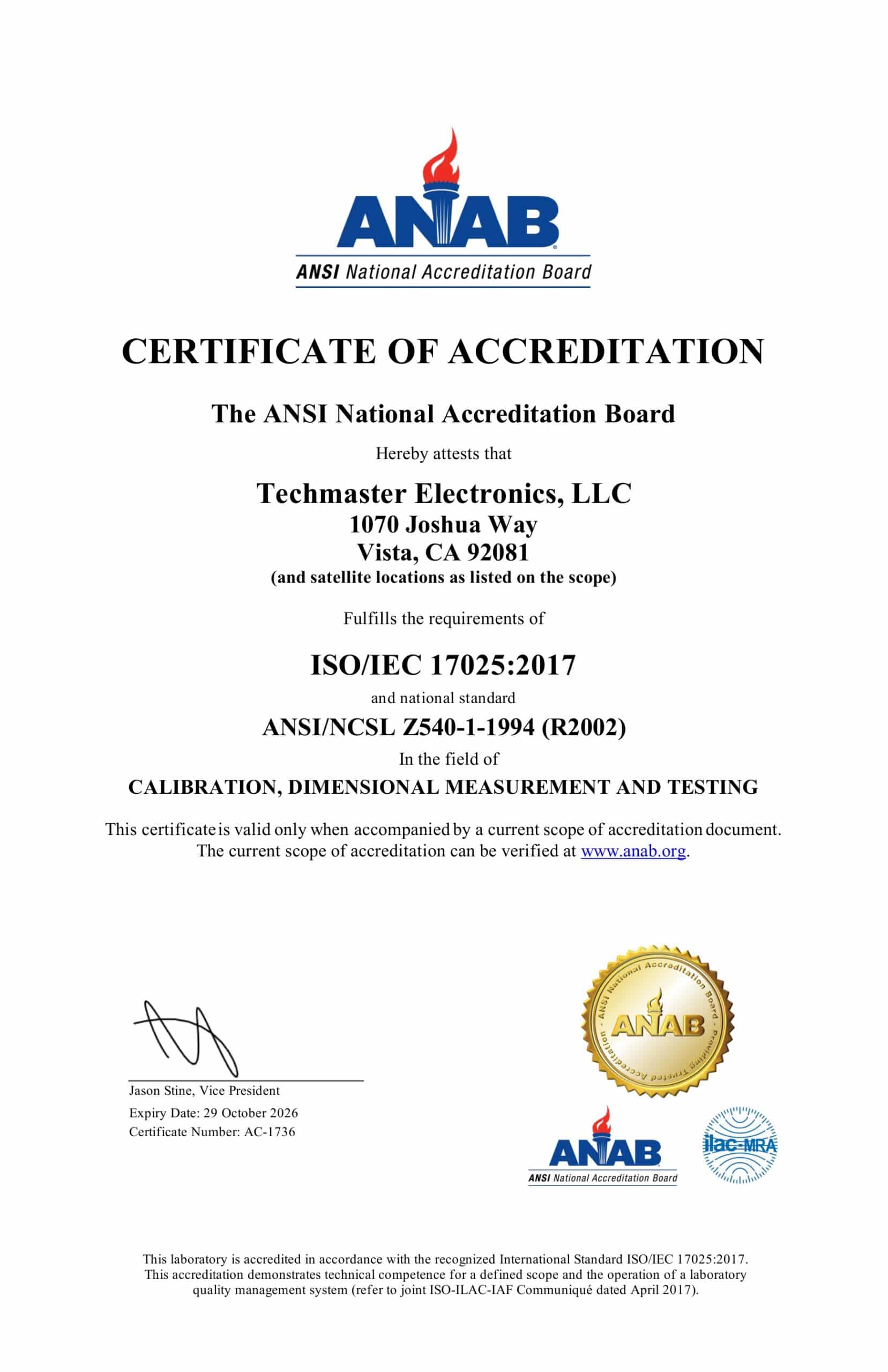
ISO/IEC 17025 accreditation is independent verification of the traceability claim: ANAB or A2LA assessors audit the lab’s standards, calibration records, and uncertainty budgets for every parameter on its published scope. That’s the practical difference between “trust us, it’s traceable” and “verified traceable”, and a core reason regulated industries insist on accredited certificates. Techmaster Electronics maintains its chain under ANAB certificate AC-1736, covering electronic, RF and microwave test equipment across eight calibration fields. More on the standard itself: what is ISO/IEC 17025 accreditation.
Frequently asked questions
What does NIST-traceable calibration mean?
It means every measurement on your calibration certificate connects to US national standards at NIST through an unbroken, documented chain of calibrations, each with stated measurement uncertainty. The chain, not any single certificate, is what makes a result traceable.
Does NIST calibrate my instrument?
No. NIST maintains national standards and calibrates the reference standards of laboratories. Your instrument is calibrated by a lab whose standards trace to NIST through one or more documented steps, ‘NIST-traceable’ does not mean ‘calibrated by NIST.’
Is NIST-traceable the same as ISO/IEC 17025 accredited?
No. NIST-traceable describes the measurement chain; accreditation is independent verification that the lab maintains that chain correctly, with audited uncertainty budgets. An accredited calibration is always traceable, but a traceable claim alone has not been independently verified.
How do I verify a traceability claim?
Ask which standards calibrated your instrument (a proper certificate lists them with their own certificate numbers), ask for the measurement uncertainty, and prefer ISO/IEC 17025 accredited labs, assessors verify the entire chain for every parameter on the lab’s published scope.
The bottom line
NIST traceability is a chain, and a chain is only as good as its weakest documented link. Ask what standards calibrated your instrument, demand stated uncertainty, and let accreditation do the chain-verification for you. Choosing a lab? Run the 12-point checklist.
Get an accredited calibration quote
ANAB-accredited ISO/IEC 17025:2017 (Cert. AC-1736) • 4 accredited US labs • 5-day standard, 1–2 day expedite • in-lab or on-site.
Request a quoteReferences & industry standards
- ISO/IEC 17025 testing & calibration laboratory requirements
- NIST calibration services and measurement traceability
- A2LA / ANAB accreditation for calibration laboratories
External standards bodies. Techmaster Electronics is an ISO/IEC 17025-accredited, NIST-traceable calibration laboratory.

Khanh Nguyen is the Marketing Manager at Techmaster Electronics, a B2B marketing leader covering the test, measurement, and ISO/IEC 17025 accredited calibration industry in the United States.