
TL;DR: A contract manufacturer runs one calibration program against many customers’ requirements, so build it to the strictest flow-down rather than the average. Settle four things in writing: who owns and pays for which equipment, certificate level per instrument family, records retrievable by asset ID, and calibration scheduled around build windows. Per-customer exceptions are what fail during a busy month.
Contract manufacturing puts calibration in an unusual position: the equipment is yours, the requirements are somebody else’s, and there are several somebody elses with different standards. Every EMS operation eventually discovers that managing this per customer does not survive contact with a production schedule.
What makes contract manufacturing different?
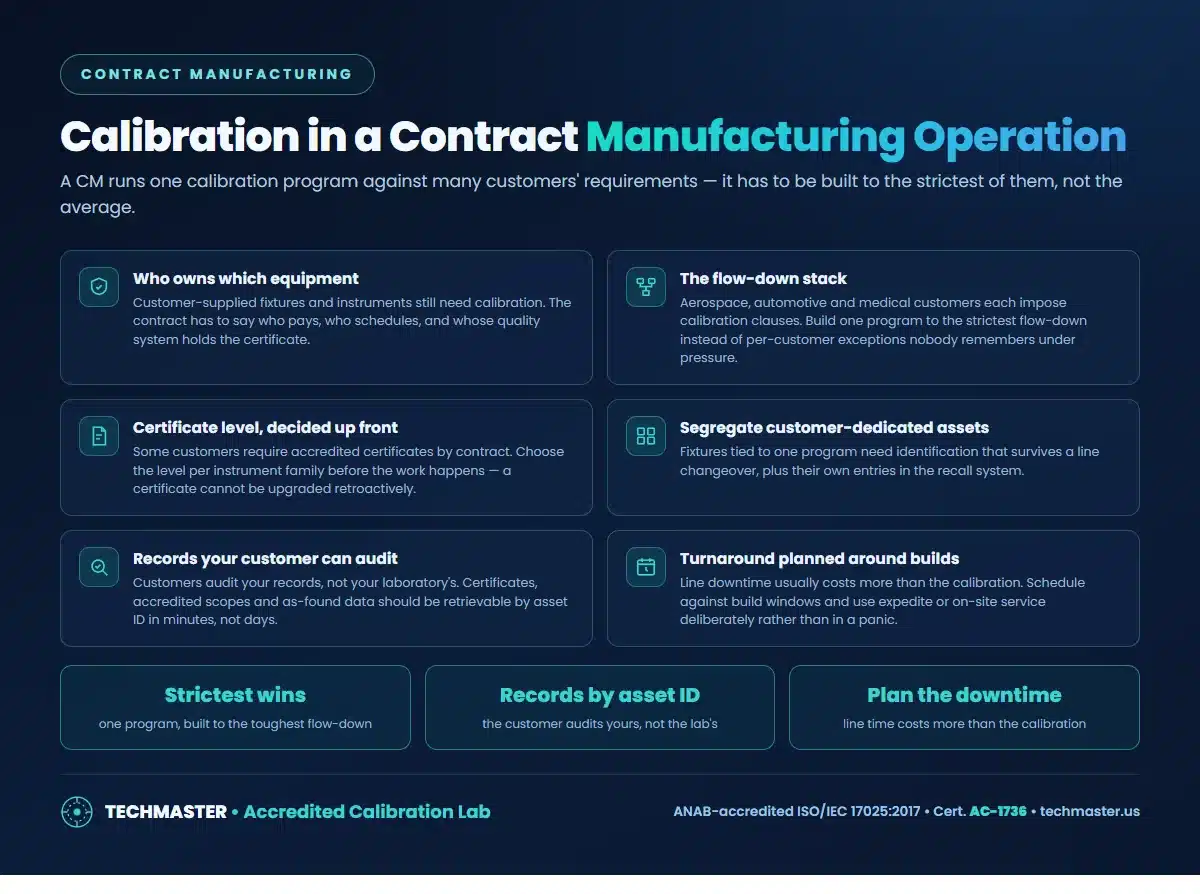
Equipment ownership is genuinely ambiguous in a way it never is for an OEM. Customer-supplied fixtures and instruments sit on your floor, produce your acceptance data, and belong to someone else. Requirements stack rather than replace each other: an aerospace customer’s AS9100 flow-downs, an automotive customer’s IATF 16949 clauses and a medical customer’s ISO 13485 obligations all land on the same instrument list. And your records are the ones being audited, not your calibration laboratory’s.
Build to the strictest flow-down, not the average
The instinct is to calibrate each instrument to whatever its current customer requires. It fails for a simple reason: instruments move between jobs and technicians do not carry a mental map of which customer’s rules apply to the meter in their hand. Set the program to the strictest requirement in your customer base, usually accredited certificates with as-found data for anything producing acceptance measurements, and the per-job decision disappears. The calibration program setup guide covers the underlying structure; the contract manufacturing adjustment is simply that you set the bar by your toughest contract rather than your own risk appetite.
Decide certificate level before the work, not after
This is the mistake that costs money. A certificate level is chosen when the calibration is performed and cannot be upgraded later, if a customer asks in month eight for accredited certificates covering months one through seven, the answer is a re-calibration, not a reissue. Decide per instrument family up front, and default anything touching customer acceptance data to the higher level.
Make records retrievable by asset ID
Customer auditors ask a narrow question: was this instrument in calibration when it measured our product, and prove it. The answer lives in your recall system, keyed to the asset ID on the status label, and it should surface the certificate, the laboratory’s accredited scope and the as-found data in minutes. The habits in audit preparation apply directly, with the difference that you may face several audits a year rather than one.
Schedule calibration against build windows
On a shared line, calibration downtime usually costs more than the calibration itself. Group instruments by cell rather than by due date where the intervals allow it, use the levers in turnaround and downtime, and consider on-site calibration for fixtures that cannot leave the floor during a program.
Frequently asked questions
Who is responsible for calibrating customer-supplied test equipment?
Whoever the contract says, which is why it should say. In practice the contract manufacturer usually schedules and controls calibration for equipment in its possession because that equipment produces the acceptance data, while the customer may pay for it. What matters for an audit is that a single quality system holds the certificate, the recall entry and the status label, rather than each party assuming the other did.
Should a contract manufacturer run one calibration program or one per customer?
One program, built to the strictest requirement across your customer base. Per-customer exceptions are the thing that fails under schedule pressure, because they depend on a technician remembering which rules apply to the job in front of them. Building to the toughest flow-down costs slightly more per instrument and removes an entire category of finding.
Do all instruments need accredited calibration in a contract manufacturing shop?
No, but the decision has to be made per instrument family before the work happens, not afterwards. Instruments producing customer acceptance data, or covered by a contractual flow-down, generally need accredited certificates. General-purpose bench equipment often does not. A certificate cannot be upgraded retroactively, so the default for anything touching acceptance data should be the higher level.
What do customers actually audit in a contract manufacturer’s calibration program?
Whether the instrument used for their product was in calibration on the day it was used, and whether you can prove it quickly. That means retrieval by asset ID: the certificate, the laboratory’s accredited scope, the as-found data, and the interval justification. Slow retrieval reads as weak control even when the underlying program is sound.
The bottom line
One program, built to your strictest customer, with ownership and certificate level settled in writing and records retrievable by asset ID. Techmaster works with contract manufacturers across five US labs under ANAB accreditation to ISO/IEC 17025:2017 (Cert. AC-1736), in-lab or on-site.
Get an accredited calibration quote
ANAB-accredited ISO/IEC 17025:2017 (Cert. AC-1736) • 5 US labs • 5-day standard, 1–2 day expedite • in-lab or on-site.
Request a quote
Khanh Nguyen is the Marketing Manager at Techmaster Electronics, a B2B marketing leader covering the test, measurement, and ISO/IEC 17025 accredited calibration industry in the United States.