
TL;DR: ISO 9001 clause 7.1.5 requires that measuring instruments be suitable, maintained, traceable where required, status-identified, and protected from invalidation. Auditors verify this through six artifacts: instrument ID/status, intervals with an enforced recall system, retrievable certificates, traceability evidence on those certificates, documented out-of-tolerance handling, and calibration supplier qualification. Accredited (endorsed) certificates are the fastest way to close four of the six.
Calibration findings are among the most common ISO 9001 nonconformities, not because the requirements are hard, but because the evidence is scattered when the auditor asks. Here’s what clause 7.1.5 actually requires and the six-item file that answers it.
What does ISO 9001 clause 7.1.5 require?
Three things, in plain terms: measuring resources fit for what they measure; traceable calibration where traceability is required or expected by the customer (with the basis recorded when no standard exists); and instruments whose status is identifiable and which are protected from adjustment or damage that would invalidate results. It never names ISO/IEC 17025, but traceable, defensible evidence is exactly what accredited certificates package by default.
What will the auditor actually check?
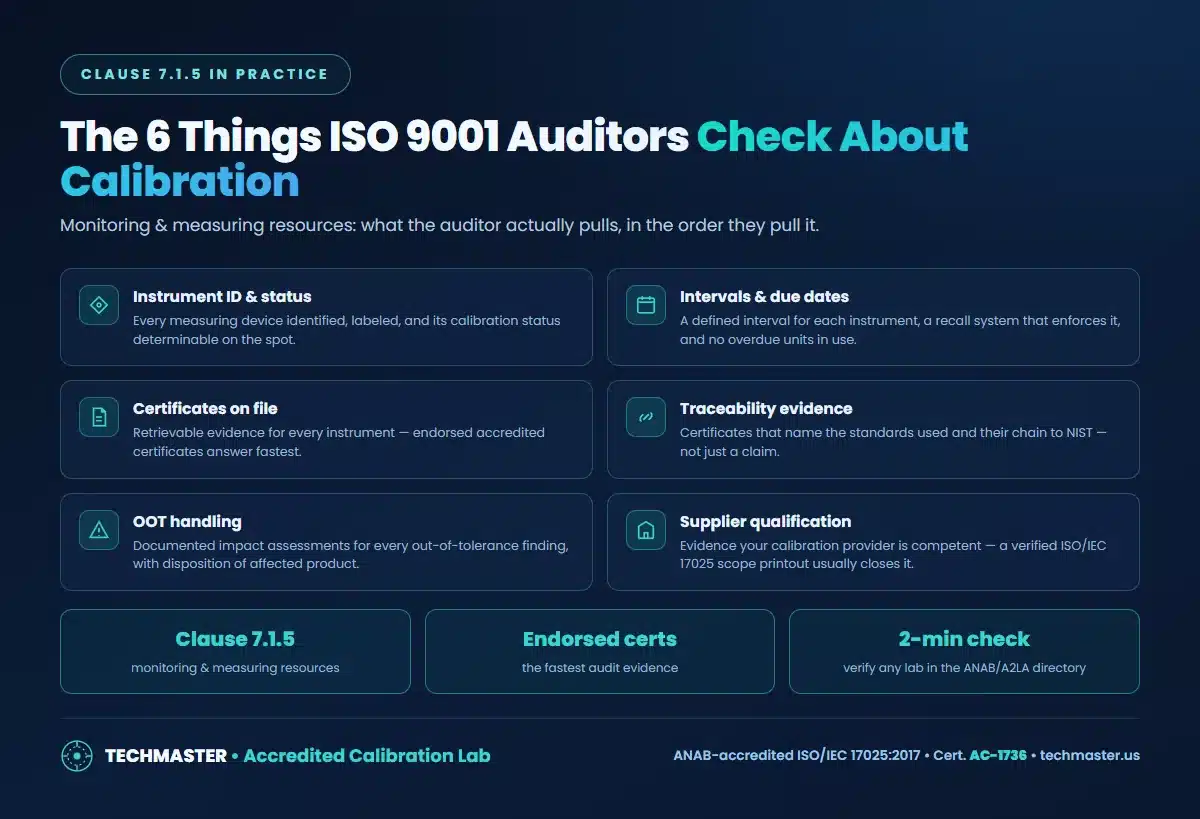
The pattern is nearly universal: pick instruments off your list, or off the production floor, and pull the thread. Status label → due date → certificate → traceability on the certificate → what happened the last time one failed → how you qualified the lab. Weakness anywhere in the chain becomes the finding. The two documents that answer fastest: an endorsed certificate with data and uncertainty, and a printout of your lab’s verified ISO/IEC 17025 scope.
The three findings that keep repeating
- Overdue instruments in use. An interval system without an enforced recall system. Fix: due-date reminders from your lab plus a no-overdue-use rule, see setting calibration intervals.
- OOT findings with no impact assessment. The certificate said OUT OF TOLERANCE and the file says nothing else. Fix: the six-step OOT playbook, documented every time.
- Unqualified calibration suppliers. No evidence the lab is competent. Fix: verify the accreditation certificate in the ANAB/A2LA directory and file the printout, two minutes, per the supplier-audit shortcut accreditation provides.
Building the audit-ready calibration file
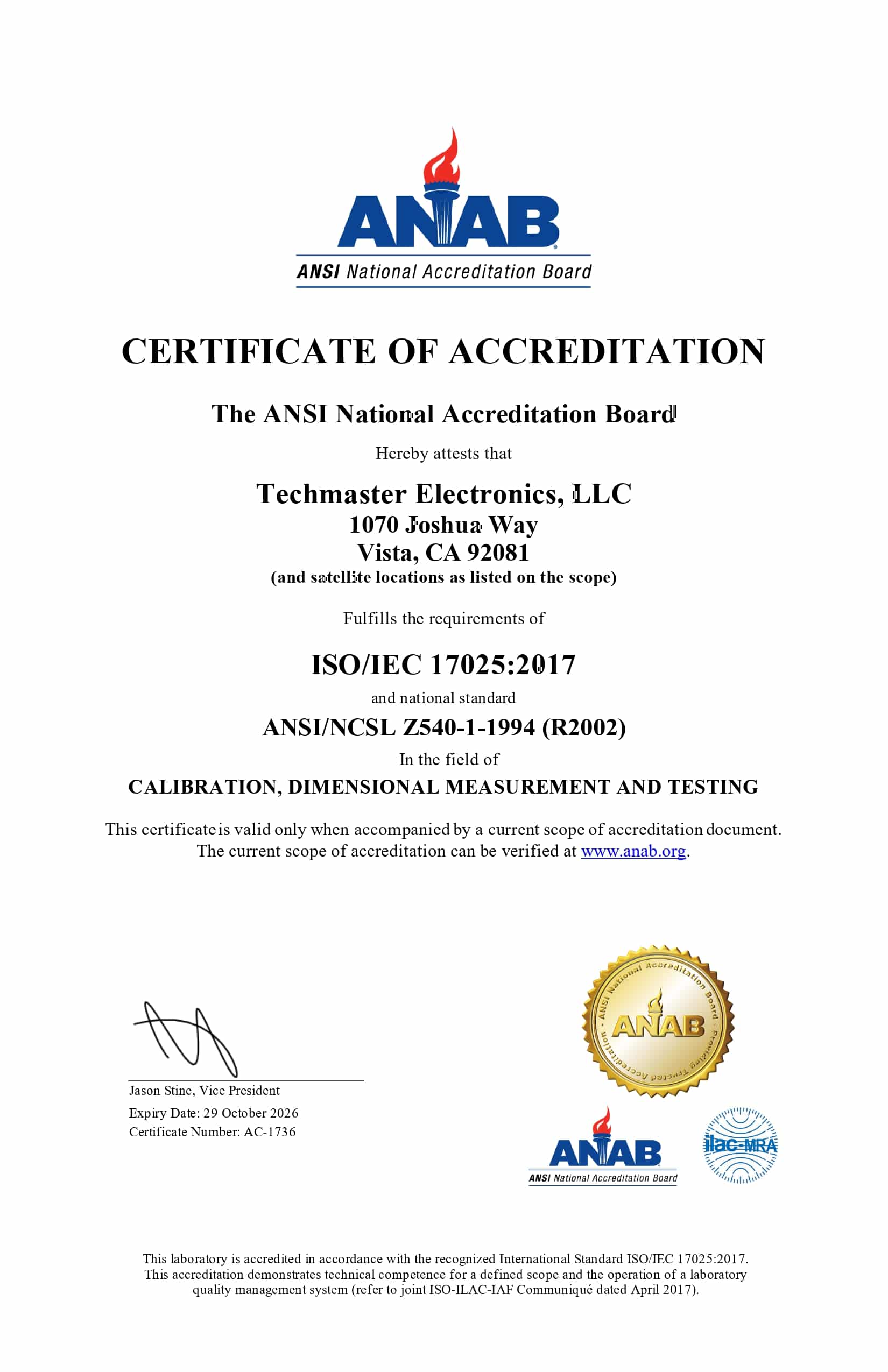
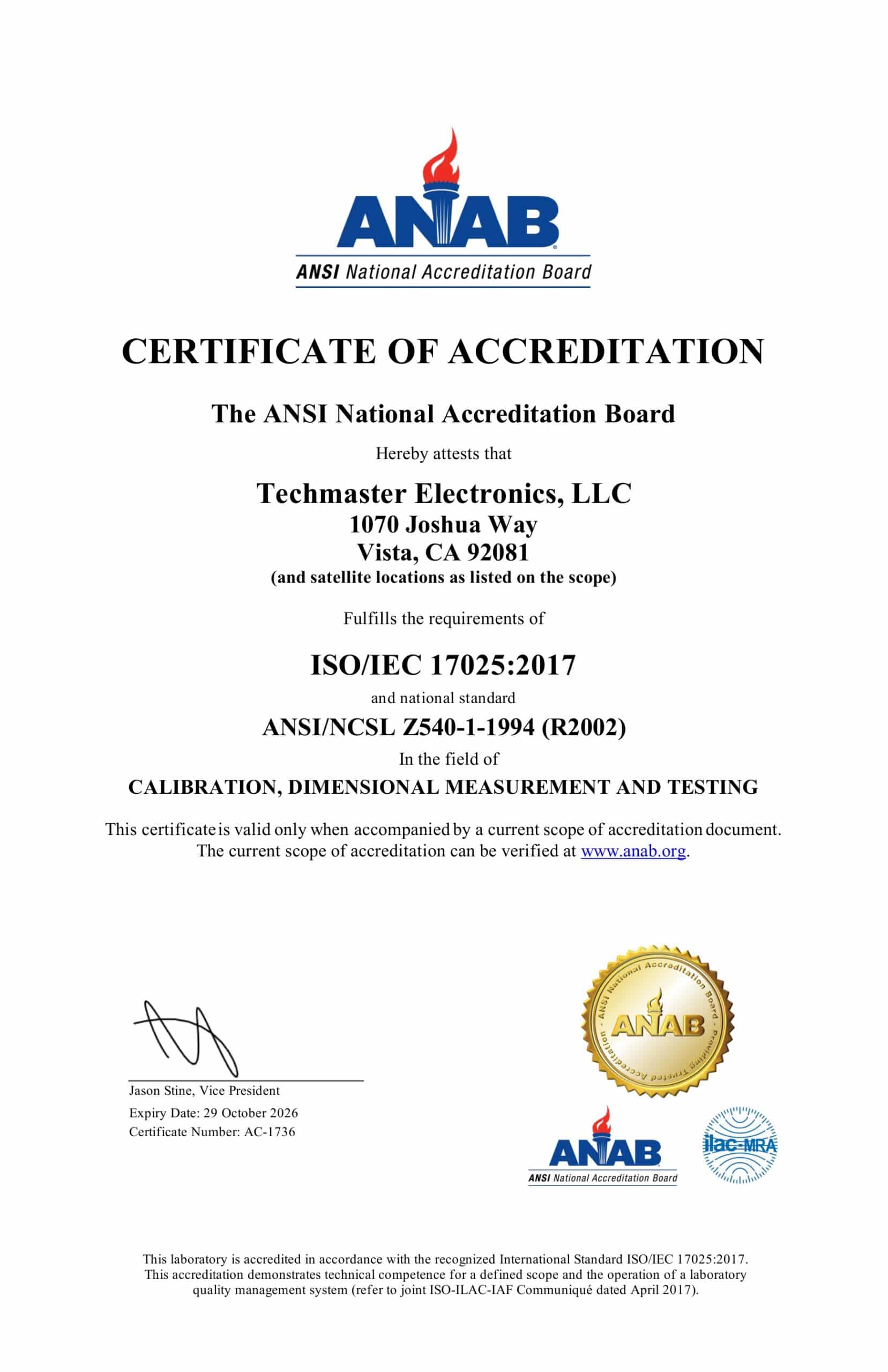
One folder (or portal view) per instrument: current certificate, interval rationale, OOT history with assessments, and the supplier qualification evidence shared across the fleet. Labs with customer portals make this nearly automatic, certificates retrievable at 2 a.m. the night before the audit. Techmaster Electronics issues endorsed ANAB certificates (AC-1736) with full data on every accredited calibration, exactly the artifact chain 7.1.5 sampling follows.
Frequently asked questions
Does ISO 9001 require accredited calibration?
Not explicitly. Clause 7.1.5 requires measurement traceability and fit-for-purpose measuring resources. In practice, an accredited (endorsed) certificate is the fastest defensible evidence, and many auditors and customers now expect it for instruments that verify product conformity.
What is clause 7.1.5 in ISO 9001?
It is the ‘monitoring and measuring resources’ clause: organizations must provide suitable measurement resources, maintain them, and, where traceability is required or expected, calibrate against standards traceable to national or international references, with status identification and safeguards against invalidation.
What calibration records do ISO 9001 auditors ask for?
Typically: the instrument list with calibration status, certificates for sampled instruments, evidence of traceability on those certificates, your interval rationale, out-of-tolerance impact assessments, and evidence the calibration supplier is competent.
What happens if an auditor finds an overdue instrument?
Expect a nonconformity: minor if isolated with quick containment, major if systemic. The response mirrors an OOT event, assess measurements made while overdue, document the impact, and fix the recall system so it doesn’t recur.
The bottom line
Clause 7.1.5 audits are thread-pulls: label to certificate to traceability to response history. Endorsed certificates plus an enforced recall system close almost every thread before it starts. Choosing the lab that makes this easy: the 12-point checklist.
Get an accredited calibration quote
ANAB-accredited ISO/IEC 17025:2017 (Cert. AC-1736) • 5 US labs • 5-day standard, 1–2 day expedite • in-lab or on-site.
Request a quote
Khanh Nguyen is the Marketing Manager at Techmaster Electronics, a B2B marketing leader covering the test, measurement, and ISO/IEC 17025 accredited calibration industry across the US and Vietnam markets.